• About
  • Masthead
  • License Content
  • Advertise
  • Submit Press Release
  • RSS/Email List
  • 2MM Podcast
  • Write for us
  • Contact Us
2 Minute Medicine
No Result
View All Result

No products in the cart.

SUBSCRIBE
  • Specialties
    • All Specialties, All Recent Reports
    • Cardiology
    • Chronic Disease
    • Dermatology
    • Emergency
    • Endocrinology
    • Gastroenterology
    • Imaging and Intervention
    • Infectious Disease
    • Nephrology
    • Neurology
    • Obstetrics
    • Oncology
    • Ophthalmology
    • Pediatrics
    • Pharma
    • Preclinical
    • Psychiatry
    • Public Health
    • Pulmonology
    • Rheumatology
    • Surgery
  • Tools
    • EvidencePulse™
    • HypeCheck™
    • NPI Registry Lookup
    • RVU Search
  • Pharma
  • AI News
  • The Scan+
  • Classics™+
    • 2MM+ Online Access
    • Paperback and Ebook
  • Rewinds
  • Partners
    • License Content
    • Submit Press Release
    • Advertise with Us
  • Account
    • Subscribe
    • Cart
    • Sign-in
    • My account
2 Minute Medicine
  • Specialties
    • All Specialties, All Recent Reports
    • Cardiology
    • Chronic Disease
    • Dermatology
    • Emergency
    • Endocrinology
    • Gastroenterology
    • Imaging and Intervention
    • Infectious Disease
    • Nephrology
    • Neurology
    • Obstetrics
    • Oncology
    • Ophthalmology
    • Pediatrics
    • Pharma
    • Preclinical
    • Psychiatry
    • Public Health
    • Pulmonology
    • Rheumatology
    • Surgery
  • Tools
    • EvidencePulse™
    • HypeCheck™
    • NPI Registry Lookup
    • RVU Search
  • Pharma
  • AI News
  • The Scan+
  • Classics™+
    • 2MM+ Online Access
    • Paperback and Ebook
  • Rewinds
  • Partners
    • License Content
    • Submit Press Release
    • Advertise with Us
  • Account
    • Subscribe
    • Cart
    • Sign-in
    • My account
SUBSCRIBE
2 Minute Medicine
Subscribe
Home All Specialties Chronic Disease

Folate supplementation associated with reduced risk of spontaneous abortion

byMaren ShapiroandLeah Hawkins Bressler, MD, MPH
June 10, 2014
in Chronic Disease, Obstetrics
Reading Time: 3 mins read
0
Share on FacebookShare on Twitter

1. Compared to women who did not take folate supplements, women with the highest level of folate supplementation prepregnancy had a 20% reduced risk of spontaneous abortion. 

2. The inverse association was dose dependent, with higher levels of folate supplementation associated with lower risk of spontaneous abortion. 

Evidence Rating Level: 2 (Good) 

Study Rundown: The American College of Obstetricians and Gynecologists, the USPSTF and the CDC all currently recommend that all women of childbearing age take 400 ug/day of folic acid to prevent fetal neural tube defects. Despite this recommendation, the vast majority of women do not achieve this daily intake. Preliminary studies in animal models suggest that folate supplementation, in addition to reducing the risk of neural tube defects, may also improve embryo and fetal survival rates. However, research in humans remains inconclusive and some early studies even raising concern for an increase in miscarriage with folic acid supplementation.

In this study, researchers used data from the Nurses’ Health Study to show that women with the highest intake of supplemental folate (730 ug/day, nearly double the current recommended dose) experienced a lower risk of spontaneous abortion than women who did not take folate supplements. Strengths of this study include prospective design, large sample size and high follow-up rates. Results may be limited by recall bias due to self-reported data. Additionally, dietary intake data was only collected every four years such that participants’ folate intake may have varied over this time period. Future studies might employ a randomized design to compare rates of miscarriage among women randomized to higher doses of folate supplementation (ie 800 ug/day) to the currently recommended 400ug/day and compare birth outcomes.

Click to read the study in Obstetrics & Gynecology

RELATED REPORTS

Medical or procedural abortion may not increase risk of psychotropic medication use after five years

2 Minute Medicine Rewind July 27th, 2026 

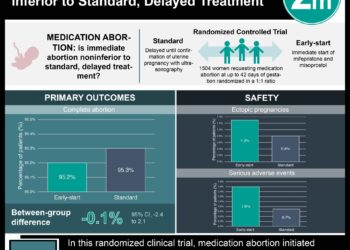
#VisualAbstract: Very Early Medication Abortion was Noninferior to Standard, Delayed Treatment

Relevant Reading: Folic Acid and Miscarriage: An Unjustified Link

Study Author, Audrey J. Gaskins, ScD, talks to 2 Minute Medicine: Harvard School of Public Health 

“Despite the fact that the US food supply is fortified with folic acid, the majority of US reproductive aged women consume far below the recommendation of 400 µg/day. Our study showed that prepregnancy supplemental folate intake at levels well beyond those currently recommended for the prevention of neural tube defects was not associated with increased risk of pregnancy loss; rather it may be an effective strategy to prevent spontaneous abortion.”

In-Depth [prospective cohort]: Using data from the Nurses’ Health Study II, an ongoing prospective cohort study of female nurses ages 22-44, researchers identified all women who reported at least one pregnancy from 1992-2009. Dietary and supplemental folate intake was assessed every 4 years via survey. The primary outcome was self-reported spontaneous abortion (loss at <20 weeks gestation) or stillbirth (loss at ≥20 weeks).

Of the 15,950 pregnancies reported, 2,750 (17.3%) ended in spontaneous abortion and 120 (0.8%) in stillbirth. Compared with women who consumed the least amount of folate prepregnancy (<258 ug/day), those who consumed, both via supplementation and dietary sources, the most (>851 ug/day) had a lower risk of spontaneous abortion (RR=0.91, p-trend=0.04). Women with the highest intake of supplemental folate (>730 ug/day) also had a lower risk of spontaneous abortion than those who took no folate supplementation (RR=0.80, p-trend<0.001).

More from this author: SSRI use during pregnancy not associated with fetal, neonatal or infant mortality, IUD contraception equally effective in teenagers as in older women, More US women using emergency contraception, Updated USPSTF guidelines favor treatment of mild gestational diabetes 

Image: PD 

©2012-2014 2minutemedicine.com. All rights reserved. No works may be reproduced without expressed written consent from 2minutemedicine.com. Disclaimer: We present factual information directly from peer reviewed medical journals. No post should be construed as medical advice and is not intended as such by the authors, editors, staff or by 2minutemedicine.com. PLEASE SEE A HEALTHCARE PROVIDER IN YOUR AREA IF YOU SEEK MEDICAL ADVICE OF ANY SORT.  

Tags: abortionfolate
Previous Post

HPV catch-up vaccine completion low among pregnant and black women

Next Post

Statin use linked with slightly lower physical activity in men

RelatedReports

Quick Take: Effect of Pregabalin on Radiotherapy-Related Neuropathic Pain in Patients With Head and Neck Cancer: A Randomized Controlled Trial
Chronic Disease

Medical or procedural abortion may not increase risk of psychotropic medication use after five years

July 27, 2026
Variability in interpretation of breast biopsy slides associated with low verification of atypia and ductal carcinoma in situ
Weekly Rewinds

2 Minute Medicine Rewind July 27th, 2026 

July 27, 2026
#VisualAbstract: Very Early Medication Abortion was Noninferior to Standard, Delayed Treatment
StudyGraphics

#VisualAbstract: Very Early Medication Abortion was Noninferior to Standard, Delayed Treatment

November 27, 2024
Increased risk of stillbirth recurrence after a previous stillbirth
Emergency

At-home misoprostol increases rate of day-care procedures and patient satisfaction in late medical abortion

September 10, 2024
Next Post
Low circulating cholesterol in neonates linked with pyloric stenosis

Statin use linked with slightly lower physical activity in men

Gastric bypass surgery reduces cardio-metabolic risk factors

Bariatric weight loss surgery linked with remission in diabetics

Preterm birth associated with elevated plasma insulin levels

Addition of insulin to metformin in Type 2 Diabetes may increase risk of mortality

2 Minute Medicine® is an award winning, physician-run, expert medical media company. Our content is curated, written and edited by practicing health professionals who have clinical and scientific expertise in their field of reporting. Our editorial management team is comprised of highly-trained MD physicians. Join numerous brands, companies, and hospitals who trust our licensed content.

Recent Reports

  • Single-dose CRISPR therapy reduces hereditary angioedema attacks
  • Once-weekly oral islatravir-lenacapavir is noninferior to daily HIV therapy
  • Weight loss is associated with improved vascular function in patients with metabolic dysfunction-associated steatotic liver disease
License Content
Terms of Use | Disclaimer
Cookie Policy
Privacy Statement (EU)
Disclaimer
  • Specialties
    • All Specialties, All Recent Reports
    • Cardiology
    • Chronic Disease
    • Dermatology
    • Emergency
    • Endocrinology
    • Gastroenterology
    • Imaging and Intervention
    • Infectious Disease
    • Nephrology
    • Neurology
    • Obstetrics
    • Oncology
    • Ophthalmology
    • Pediatrics
    • Pharma
    • Preclinical
    • Psychiatry
    • Public Health
    • Pulmonology
    • Rheumatology
    • Surgery
  • Tools
    • EvidencePulse™
    • HypeCheck™
    • NPI Registry Lookup
    • RVU Search
  • Pharma
  • AI News
  • The Scan
  • Classics™
    • 2MM+ Online Access
    • Paperback and Ebook
  • Rewinds
  • Partners
    • License Content
    • Submit Press Release
    • Advertise with Us
  • Account
    • Subscribe
    • Cart
    • Sign-in
    • My account
No Result
View All Result

© 2026 2 Minute Medicine, Inc. - Physician-written medical news.