

Patient Basics: Arthritis Associated With Inflammatory Bowel Disease
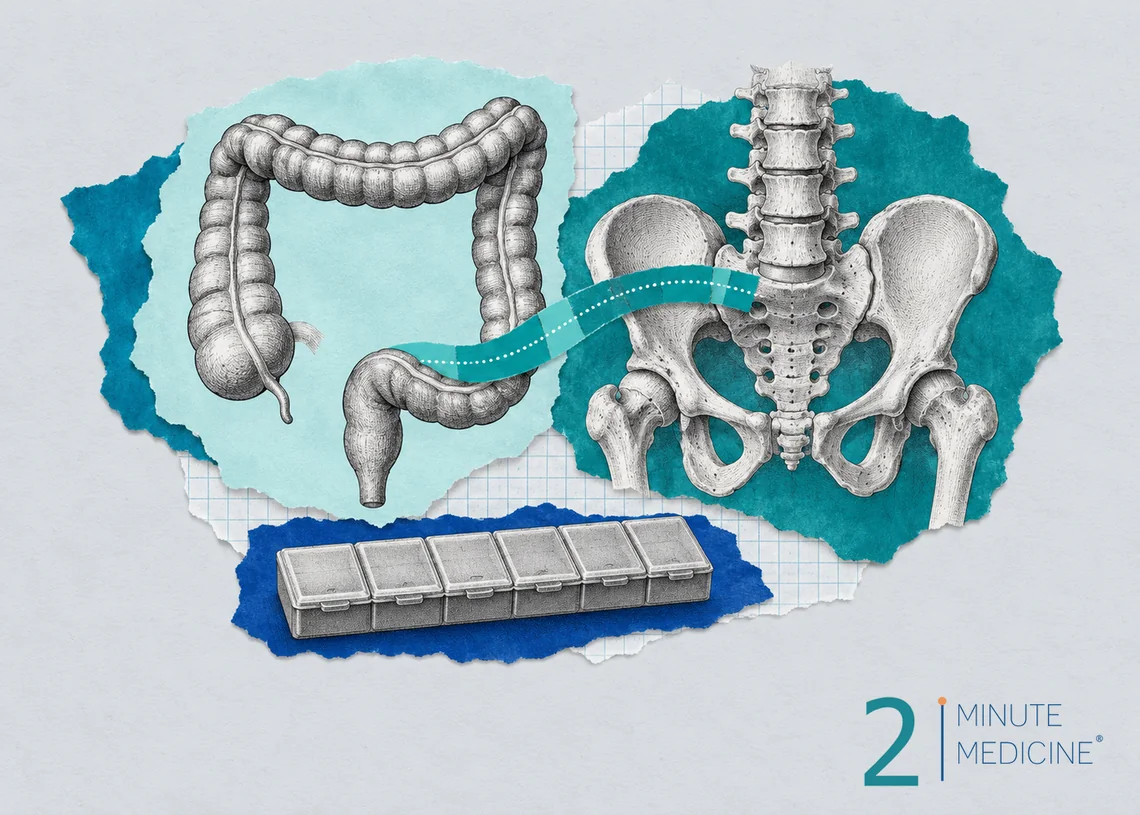
IBD arthritis is joint inflammation that happens in people with inflammatory bowel disease (IBD), meaning Crohn’s disease or ulcerative colitis. Doctors also call it enteropathic arthritis. It can cause painful, swollen joints in the arms and legs, or stiffness and pain in the lower back. Joint problems are the most common symptom of IBD outside the gut, and treating the bowel disease often helps the joints too.
Key points
- Up to about 1 in 3 people with IBD have joint pain or arthritis at some point.
- One type flares in a few large joints, such as the knees and ankles, often when the bowel flares.
- Another type affects the spine and pelvis, causing back pain and morning stiffness that can continue even when the gut is calm.
- IBD arthritis is a different disease from rheumatoid arthritis and usually doesn’t damage the joints.
- NSAID pain relievers such as ibuprofen can trigger IBD flares, so ask before using them.
What causes IBD arthritis
In IBD, the immune system attacks the lining of the gut. The same overactive immune response can spill over to the joints, tendons and spine. Inflamed bowel tissue may let gut bacteria and their products reach the bloodstream more easily, which may stir up inflammation elsewhere. Genes play a part too. People who carry a gene marker called HLA-B27 are more likely to develop the spine form.
IBD arthritis belongs to a family of conditions called spondyloarthritis, along with ankylosing spondylitis and psoriatic arthritis. People with IBD often have other symptoms outside the gut at the same time, such as red, tender lumps on the shins (erythema nodosum), mouth sores and eye inflammation.
IBD arthritis symptoms
Arthritis in the arms and legs
- Few-joint type. Pain and swelling in fewer than 5 joints, most often the knees, ankles, hips, wrists or elbows, and usually on one side. It tends to flare along with bowel symptoms and settles within a few weeks to a couple of months.
- Many-joint type. Pain and swelling in 5 or more joints, often the small knuckles of both hands. It can last months or years and doesn’t follow the bowel’s ups and downs.
Arthritis in the spine and pelvis
Inflammation of the sacroiliac joints, where the spine meets the pelvis, and of the spine itself causes:
- Low back or buttock pain that started slowly, often before age 45
- Stiffness in the morning that lasts more than 30 minutes
- Pain that eases with movement and exercise and gets worse with rest
- Back pain that wakes you in the second half of the night
In some people, this becomes ankylosing spondylitis, in which parts of the spine slowly fuse and lose flexibility. Spine symptoms can start years before IBD is diagnosed.
Other signs
- Pain where tendons attach to bone, especially the back of the heel or the sole of the foot
- A whole finger or toe swelling up like a sausage
- Joint aches without swelling, which are very common in IBD
How it’s diagnosed
There is no single test. A doctor, often a rheumatologist working with your gastroenterologist, looks at your joints and spine and asks how your symptoms relate to your bowel disease. Tests may include:
- Blood tests for inflammation (CRP and sedimentation rate). Tests for rheumatoid arthritis are usually negative.
- Joint fluid drawn with a needle to rule out infection or gout in a swollen joint
- X-rays or MRI of the sacroiliac joints and spine
- Ultrasound of sore tendons and joints
- HLA-B27 testing in some cases
Doctors also look for other causes of joint pain in people with IBD. These include aches as steroid doses are lowered, low vitamin D, thin bones from steroid use, bone damage from lost blood supply (avascular necrosis), and, rarely, a reaction to a medicine.
How IBD arthritis is treated
Treat the bowel disease
Getting Crohn’s disease or ulcerative colitis under control is the first step. The few-joint type often improves as the gut heals. In ulcerative colitis, surgery to remove the colon often eases this type of arthritis, but it doesn’t help the spine form.
Medicines for the joints
- Pain relief. Acetaminophen is a first choice for mild pain. NSAIDs such as ibuprofen and naproxen relieve joint pain but can trigger IBD flares. Your doctors may allow a short course while your bowel disease is quiet.
- Steroids. A steroid shot into a swollen joint can calm it quickly. A short course of steroid pills may treat a flare of both gut and joints.
- Sulfasalazine and methotrexate can help arthritis in the arms and legs. They don’t help the spine form.
- Biologic and targeted drugs. TNF blockers such as infliximab and adalimumab treat both IBD and IBD arthritis, including the spine form. Upadacitinib, a daily pill, is also approved for both IBD and spondyloarthritis. Some other IBD drugs act mainly on the gut and may not help the joints, so tell your gastroenterologist about joint symptoms when choosing treatment.
Movement and therapy
For spine and pelvis pain, daily stretching, back exercises, swimming and good posture keep the spine flexible. A physical therapist can set up a program. Rest a swollen joint during a flare, then return to gentle movement. Heat eases stiffness, and ice eases a hot, swollen joint.
Living with IBD arthritis
- Track joint and bowel symptoms together so your doctors can see patterns.
- Don’t smoke. Smoking worsens Crohn’s disease and spine arthritis.
- Ask about vitamin D, calcium and a bone density test if you’ve taken steroids.
- Have yearly eye exams, and keep vaccines up to date if you take medicines that weaken the immune system.
When to see a doctor
- A swollen, painful joint, or back pain and stiffness that lasts more than a few weeks
- Joint pain that starts with a new IBD medicine or when steroids are lowered
- Heel pain or a swollen finger or toe
Get care the same day for a hot, red, very painful joint, especially with fever, which can be an infection, or for a painful red eye with blurred vision or light sensitivity.
Common questions about IBD arthritis
Can Crohn’s disease cause joint pain?
Yes. Joint pain is the most common symptom of Crohn’s disease outside the gut. It may come from IBD arthritis, aches that appear as steroid doses come down, or low vitamin D. Ulcerative colitis can cause the same joint problems. Tell your doctor about any joint swelling or long morning stiffness.
Is IBD arthritis the same as rheumatoid arthritis?
No. Rheumatoid arthritis usually affects small joints on both sides evenly, shows up on specific blood tests and can wear away bone. IBD arthritis is usually negative on those tests, and the arm and leg form rarely damages joints. Rarely, a person has both.
Does irritable bowel syndrome cause arthritis?
No. Irritable bowel syndrome (IBS) causes belly pain and changes in bowel habits but no inflammation in the gut, so it doesn’t cause this type of arthritis. People with IBS do have more widespread aches, as seen in fibromyalgia. IBS and IBD are different conditions with similar names.
Questions to ask your doctor
- Which type of IBD arthritis do I have?
- Is my joint pain linked to my bowel disease activity?
- Can I take NSAIDs, and if so, for how long?
- Will my IBD medicine treat my joints too?
- Should I see a rheumatologist or a physical therapist?
Learn more
- Crohn’s disease (National Institute of Diabetes and Digestive and Kidney Diseases)
- Ankylosing spondylitis (National Institute of Arthritis and Musculoskeletal and Skin Diseases)
This guide is general information and doesn’t replace advice from your own doctor. Last updated October 2026.






 Get the app