
• About
  • Masthead
  • License Content
  • Advertise
  • Press Releases
  • Newsroom
  • RSS/Email List
  • 2MM Podcast
  • Write for us
  • Contact Us
2 Minute Medicine
No Result
View All Result

No products in the cart.

Sign in
SUBSCRIBE
  • About
  • Specialties
    • All Specialties, All Recent Reports
    • Cardiology
    • Chronic Disease
    • Dermatology
    • Emergency
    • Endocrinology
    • Gastroenterology
    • Imaging and Intervention
    • Infectious Disease
    • Nephrology
    • Neurology
    • Obstetrics
    • Oncology
    • Ophthalmology
    • Pediatrics
    • Pharma
    • Preclinical
    • Psychiatry
    • Public Health
    • Pulmonology
    • Rheumatology
    • Surgery
    • Rewinds
    • The Scan
  • EvidencePulse™
  • HypeCheck™
  • AI News
  • Classics™
    • 2MM+ Online Access
    • Paperback and Ebook
  • Tools
    • NPI Registry Lookup
    • RVU Search
    • Physician Pay by Specialty
    • ICD-10 Code Lookup
    • FDA Drug Approvals
    • Drug Safety for Breastfeeding/Pregnancy
    • Clinical Guidelines
    • Medical Calculators
    • ECG Reference
      • QTc Calculator
      • Sgarbossa Criteria
      • ECG Axis Calculator
      • AV Block Helper
  • Rankings
    • Medical School Rankings
    • Residency Rankings
  • Partners
    • License Content
    • Advertise with Us
2 Minute Medicine
  • About
  • Specialties
    • All Specialties, All Recent Reports
    • Cardiology
    • Chronic Disease
    • Dermatology
    • Emergency
    • Endocrinology
    • Gastroenterology
    • Imaging and Intervention
    • Infectious Disease
    • Nephrology
    • Neurology
    • Obstetrics
    • Oncology
    • Ophthalmology
    • Pediatrics
    • Pharma
    • Preclinical
    • Psychiatry
    • Public Health
    • Pulmonology
    • Rheumatology
    • Surgery
    • Rewinds
    • The Scan
  • EvidencePulse™
  • HypeCheck™
  • AI News
  • Classics™
    • 2MM+ Online Access
    • Paperback and Ebook
  • Tools
    • NPI Registry Lookup
    • RVU Search
    • Physician Pay by Specialty
    • ICD-10 Code Lookup
    • FDA Drug Approvals
    • Drug Safety for Breastfeeding/Pregnancy
    • Clinical Guidelines
    • Medical Calculators
    • ECG Reference
      • QTc Calculator
      • Sgarbossa Criteria
      • ECG Axis Calculator
      • AV Block Helper
  • Rankings
    • Medical School Rankings
    • Residency Rankings
  • Partners
    • License Content
    • Advertise with Us
Sign in
SUBSCRIBE
2 Minute Medicine
Sign in
Subscribe
2 Minute MedicineFree on Google PlayGet
✦EvidencePulse™by 2 Minute Medicine3 reportsYou askedtop stroke trials 2026Synthesizing medical evidence...Top 2026 stroke trial results:OCEANIC — ischemic stroke: 6.2% vs 8.4%OPTION* — mRS 0–1: 43.6% vs 34.2%ORIENTAL* — mRS 0–2: 58.6% vs 46.6%*Higher sICH in intervention armsParticipants randomizedNOCEANIC12,327OPTION570ORIENTAL564Ask about guidelines or landmark trials...↑Try EvidencePulse™Ask the evidence. Get the signal.Try it now →
Home Health A to Z

Patient Basics: Bedsores (Pressure Injuries, Decubitus Ulcers)
by2 Minute Medicine
October 30, 2026
in Health A to Z
Reading Time: 5 mins read
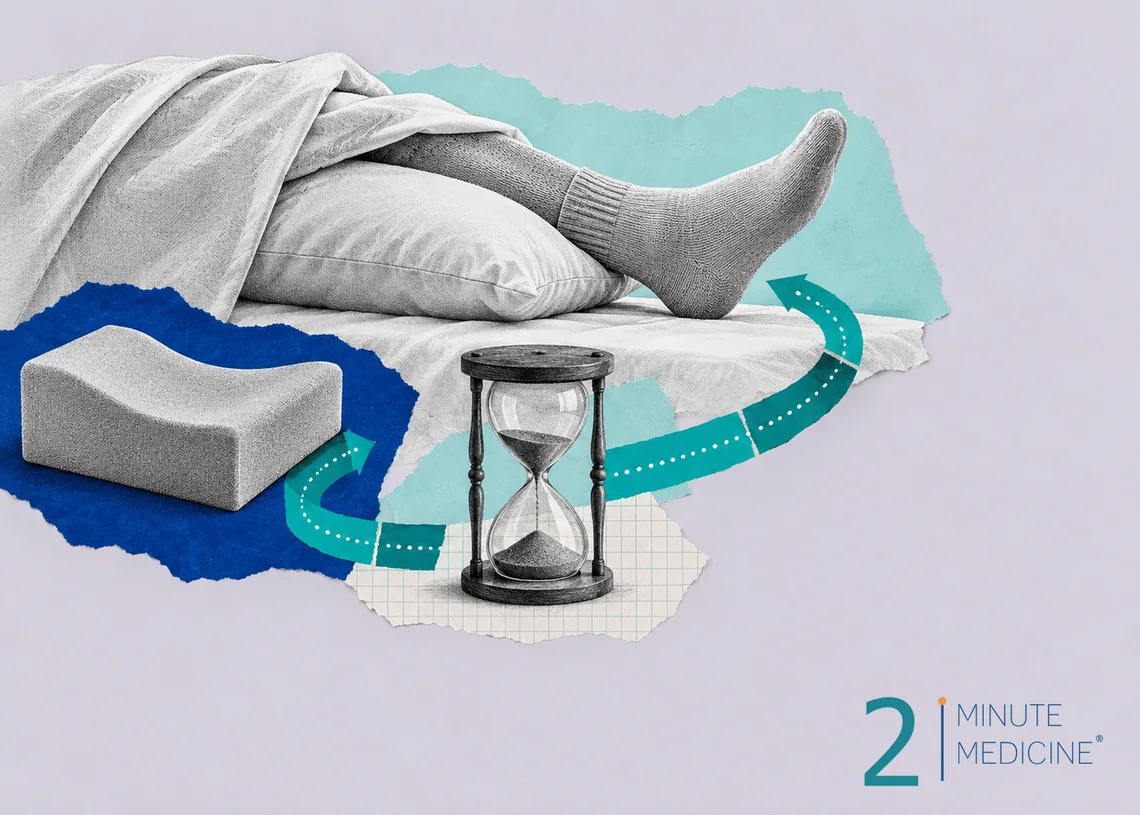
Collage on preventing bedsores: a socked foot resting on a pillow with the heel lifted, an hourglass and a soft foam cushion
Share on FacebookShare on TwitterShare on LinkedIn

Bedsores are areas of damaged skin and tissue caused by pressure that lasts too long, usually over a bony spot such as the tailbone, hips or heels. Doctors and nurses now call them pressure injuries. Older names include pressure ulcers and decubitus ulcers. They mostly affect people who spend long hours in a bed or wheelchair, and most can be prevented with regular changes of position and daily skin checks.

Key points

  • Pressure squeezes the tiny blood vessels that feed the skin. Damage can begin within a few hours.
  • An early sore looks like a red or darker patch of skin that doesn’t fade when you press on it.
  • Changing position often is the most important way to prevent them.
  • Deep sores can take months to heal and can lead to serious infection.
  • Tell a nurse or doctor about any new sore, however small.

What causes bedsores

  • Pressure. Body weight presses the skin against a mattress or chair. Casts, braces, tubes and oxygen masks can press on the skin too.
  • Shear. When the body slides, such as down a raised hospital bed, the skin stays put while deeper tissue moves. This stretches and tears small blood vessels.
  • Friction. Skin rubs against sheets when someone is pulled across a bed.
  • Moisture. Sweat, urine or stool softens the skin and makes it easier to damage.

Who is at risk

  • People who can’t move easily because of paralysis, a coma, recovery from surgery, serious illness or frailty
  • People with less feeling in their skin, such as after a spinal cord injury or from diabetes nerve damage
  • Older adults with thin, fragile skin
  • People who are underweight, eat poorly or don’t drink enough
  • People with poor blood flow
  • People who leak urine or stool
  • People with dementia or confusion, who may not shift position on their own

Where they form

In bed, sores most often form on the tailbone, hips, heels, ankles, shoulder blades, elbows, ears and the back of the head. In a chair or wheelchair, they form on the tailbone, the buttocks, the spine and the backs of the arms and legs.

Stages of a pressure injury

  • Stage 1. The skin is unbroken but stays red after pressure is removed, and it doesn’t turn pale when pressed. On darker skin, the area may look purple, bluish or darker than the skin nearby, without obvious redness. It may feel warm, firm, soft, painful or itchy.
  • Stage 2. The top layer of skin breaks, leaving a shallow pink sore or a blister.
  • Stage 3. The sore goes through the skin into the fat below and looks like a crater.
  • Stage 4. The sore reaches muscle, tendon or bone.

Some sores are covered by dead tissue, so their depth can’t be seen. A purple or maroon patch, or a dark blister, can be a deep tissue injury, where the damage starts underneath and shows on the surface later. Damage below the skin is often larger than it looks from the outside.

Possible complications

  • Infection of the skin and nearby tissue (cellulitis)
  • Infection of the bone under the sore (osteomyelitis)
  • Infection that spreads to the blood (sepsis), which can be life-threatening
  • Ongoing pain and a longer stay in the hospital

How bedsores are treated

The first step is to take pressure off the sore. A care team, often including a wound care nurse, will:

  • Reposition the person on a regular schedule and keep weight off the sore
  • Use a special mattress or cushion made of foam, air or gel that spreads out pressure
  • Clean the sore, usually with saline (salt water), and cover it with a dressing that keeps it moist but not soggy
  • Remove dead tissue, a step called debridement, using special dressings, gels or small instruments
  • Treat infection with antibiotics
  • Boost nutrition with more protein, calories and fluids
  • Control pain, especially before dressing changes

Slow-healing sores may be treated with a vacuum dressing (negative pressure wound therapy). Deep sores may need surgery to clean the wound and close it with a flap of healthy tissue. Early sores can heal in days to weeks once pressure is removed. Deep ones may take months.

Prevention

Move and shift

  • In bed, change position at least every 2 hours. Use pillows or foam wedges to lie tilted a little to one side, not flat on a hip bone.
  • Float the heels off the bed with a pillow under the calves.
  • Keep the head of the bed as low as is safe, ideally no higher than 30 degrees, to reduce sliding.
  • In a chair, shift your weight about every 15 minutes if you can. People who can’t shift on their own need help changing position about every hour.
  • Lift instead of dragging when moving someone in bed. A draw sheet helps.
  • Use a pressure-relieving mattress or cushion. Avoid ring-shaped or donut cushions, which can cut off blood flow.

Care for the skin

  • Check the skin every day, paying close attention to bony areas. Use a mirror or ask someone to help.
  • Keep skin clean and dry. Clean up promptly after leaks, and use a barrier cream to protect the skin.
  • Use mild soap and moisturize dry skin.
  • Don’t rub or massage skin over bony areas or red patches.
  • Check the skin under braces, tubes and oxygen masks.

Eat and drink well

Enough protein, calories and fluids help skin stay healthy and heal. A dietitian can help plan meals. Quitting smoking also improves blood flow to the skin.

RELATED REPORTS

No Content Available

When to call a doctor or nurse

  • A red or dark patch that doesn’t fade after pressure is taken off it
  • Any broken skin or blister over a bony area
  • A sore that gets bigger, deeper or more painful
  • Pus, a bad smell, or spreading redness, warmth or swelling

Get emergency care for fever, chills, confusion, a fast heartbeat or sudden weakness in someone with a pressure sore. These can be signs of sepsis.

Common questions about bedsores

How long does it take for bedsores to form?

A bedsore can start after 2 to 3 hours of steady pressure, and sometimes sooner in someone very ill or frail. Damage deep under the skin can take 2 to 3 days to show on the surface. That’s why people who can’t move need a change of position at least every 2 hours.

How do you treat bedsores on the buttocks?

Take the pressure off first. Cut down sitting time, use a pressure-relieving cushion, and lie tilted on your side instead of flat on your back. Keep the area clean and dry, protect it with a barrier cream, and cover broken skin with the dressing a nurse recommends.

What does decubitus mean?

Decubitus comes from the Latin word for lying down, so a decubitus ulcer is a sore from lying in one position. Doctors now prefer the term pressure injury, because these sores also form from sitting and from medical devices. Hospital staff sometimes shorten it to “decub.”

Questions to ask your doctor

  • How often should we change position, and what’s the safest way to do it?
  • Would a special mattress or cushion help?
  • What stage is this sore?
  • How should I clean and dress it at home?
  • Should we see a wound care specialist or a dietitian?

Learn more

  • Pressure sores (MedlinePlus, U.S. National Library of Medicine)
  • Pressure ulcers (pressure sores) (NHS)

This guide is general information and doesn’t replace advice from your own doctor. Last updated October 2026.

Tags: Bedsores
Previous Post

Patient Basics: Basal Cell Carcinoma

Next Post

Patient Basics: Bacterial Vaginosis (BV)

RelatedReports

No Content Available
Next Post
Collage on bacterial vaginosis: a microscope, a glass slide with rod-shaped bacteria, a petri dish and a single orchid

Patient Basics: Bacterial Vaginosis (BV)

Balanitis collage: a basin of clear water, a folded soft towel, a blank cream tube and a single sugar cube on teal paper

Patient Basics: Balanitis

Collage of a colon glowing white as on a barium enema X-ray, a blank film sheet and a gown on a hook

Patient Basics: Barium Enema (Lower GI Series)

✦ EvidencePulse™ by 2 Minute Medicine 3 reports You asked top stroke trials 2026 Synthesizing medical evidence... Top 2026 stroke trial results: OCEANIC — ischemic stroke: 6.2% vs 8.4% OPTION* — mRS 0–1: 43.6% vs 34.2% ORIENTAL* — mRS 0–2: 58.6% vs 46.6% *Higher sICH in intervention arms Participants randomizedN OCEANIC 12,327 OPTION 570 ORIENTAL 564 Ask about guidelines or landmark trials... Try EvidencePulse™ Get the signal. Try it now → Physician-trained medical AI by 2 Minute Medicine

2MM+ All Access

Full details →
$4.99 /month

3-day free trial · cancel anytime

  • ✓100+ physician-written reports
  • ✓EvidencePulse™ + HypeCheck™
  • ✓Ad-free reading + newsletters
Start 3-day free trial

Then $4.99/month. Manage renewal in your account.

2 Minute Medicine® is an award winning, physician-run, expert medical media company. Our content is curated, written and edited by practicing health professionals who have clinical and scientific expertise in their field of reporting. Our editorial management team is comprised of highly-trained MD physicians. Join numerous brands, companies, and hospitals who trust our licensed content.

Recent Reports

  • Nipocalimab patient interviews identify mouth dryness as the most important symptom to improve in phase 2 Sjögren’s disease data
  • CDC reports 5,182 confirmed measles cases in the United States in 2026
  • In selected patients with anterior-circulation large-vessel stroke 24-72 hours after onset, thrombectomy improved 90-day function but increased hemorrhage and death
License Content
Terms of Use | Disclaimer
Cookie Policy

Get the app

Read 2 Minute Medicine on iPhone, iPad and Android.

Download on the App StoreGet it on Google Play
QR code for www.2minutemedicine.com/app
On a computer? Scan this with your phone’s camera.
2MM+ All Access Full details →

The medical literature, distilled daily.

Monthly plan selected: $4.99 /month.

$4.99/month

3-day free trial · cancel anytime

Start 3-day free trial

Then $4.99/month. Manage renewal in your account.

Yearly plan selected: $49.90 /year.

$49.90/year

2 months free

Start 3-day free trial

Then $49.90/year.

Membership benefits

  • ✓100+ physician-written reports
  • ✓AI EvidencePulse™ + HypeCheck™
  • ✓Ad-free reading + newsletters
  • ✓FDA drug approvals + clinical calculators

Already a member? Sign in

  • Get the app
  • About
  • Specialties
    • All Specialties, All Recent Reports
    • Cardiology
    • Chronic Disease
    • Dermatology
    • Emergency
    • Endocrinology
    • Gastroenterology
    • Imaging and Intervention
    • Infectious Disease
    • Nephrology
    • Neurology
    • Obstetrics
    • Oncology
    • Ophthalmology
    • Pediatrics
    • Pharma
    • Preclinical
    • Psychiatry
    • Public Health
    • Pulmonology
    • Rheumatology
    • Surgery
    • Rewinds
    • The Scan
  • EvidencePulse™
  • HypeCheck™
  • AI News
  • Classics™
    • 2MM+ Online Access
    • Paperback and Ebook
  • Tools
    • NPI Registry Lookup
    • RVU Search
    • Physician Pay by Specialty
    • ICD-10 Code Lookup
    • FDA Drug Approvals
    • Drug Safety for Breastfeeding/Pregnancy
    • Clinical Guidelines
    • Medical Calculators
    • ECG Reference
      • QTc Calculator
      • Sgarbossa Criteria
      • ECG Axis Calculator
      • AV Block Helper
  • Rankings
    • Medical School Rankings
    • Residency Rankings
  • Partners
    • License Content
    • Advertise with Us
No Result
View All Result

© 2026 2 Minute Medicine, Inc. - Physician-written medical news.


