
• About
  • Masthead
  • License Content
  • Advertise
  • Press Releases
  • Newsroom
  • RSS/Email List
  • 2MM Podcast
  • Write for us
  • Contact Us
2 Minute Medicine
No Result
View All Result

No products in the cart.

Sign in
SUBSCRIBE
  • About
  • Specialties
    • All Specialties, All Recent Reports
    • Cardiology
    • Chronic Disease
    • Dermatology
    • Emergency
    • Endocrinology
    • Gastroenterology
    • Imaging and Intervention
    • Infectious Disease
    • Nephrology
    • Neurology
    • Obstetrics
    • Oncology
    • Ophthalmology
    • Pediatrics
    • Pharma
    • Preclinical
    • Psychiatry
    • Public Health
    • Pulmonology
    • Rheumatology
    • Surgery
    • Rewinds
    • The Scan
  • EvidencePulse™
  • HypeCheck™
  • AI News
  • Classics™
    • 2MM+ Online Access
    • Paperback and Ebook
  • Tools
    • Medical Calculators
    • Clinical Guidelines
    • Physician Pay by Specialty
    • FDA Drug Approvals
    • RVU Search
    • ICD-10 Code Lookup
    • Drug Safety for Breastfeeding/Pregnancy
    • ECG Reference
      • QTc Calculator
      • Sgarbossa Criteria
      • ECG Axis Calculator
      • AV Block Helper
    • NPI Registry Lookup
  • Rankings
    • Medical School Rankings
    • Residency Rankings
  • Partners
    • License Content
    • Advertise with Us
2 Minute Medicine
  • About
  • Specialties
    • All Specialties, All Recent Reports
    • Cardiology
    • Chronic Disease
    • Dermatology
    • Emergency
    • Endocrinology
    • Gastroenterology
    • Imaging and Intervention
    • Infectious Disease
    • Nephrology
    • Neurology
    • Obstetrics
    • Oncology
    • Ophthalmology
    • Pediatrics
    • Pharma
    • Preclinical
    • Psychiatry
    • Public Health
    • Pulmonology
    • Rheumatology
    • Surgery
    • Rewinds
    • The Scan
  • EvidencePulse™
  • HypeCheck™
  • AI News
  • Classics™
    • 2MM+ Online Access
    • Paperback and Ebook
  • Tools
    • Medical Calculators
    • Clinical Guidelines
    • Physician Pay by Specialty
    • FDA Drug Approvals
    • RVU Search
    • ICD-10 Code Lookup
    • Drug Safety for Breastfeeding/Pregnancy
    • ECG Reference
      • QTc Calculator
      • Sgarbossa Criteria
      • ECG Axis Calculator
      • AV Block Helper
    • NPI Registry Lookup
  • Rankings
    • Medical School Rankings
    • Residency Rankings
  • Partners
    • License Content
    • Advertise with Us
Sign in
SUBSCRIBE
2 Minute Medicine
Sign in
Subscribe
2 Minute MedicineFree on Google PlayGet
✦EvidencePulse™by 2 Minute Medicine3 reportsYou askedtop stroke trials 2026Synthesizing medical evidence...Top 2026 stroke trial results:OCEANIC — ischemic stroke: 6.2% vs 8.4%OPTION* — mRS 0–1: 43.6% vs 34.2%ORIENTAL* — mRS 0–2: 58.6% vs 46.6%*Higher sICH in intervention armsParticipants randomizedNOCEANIC12,327OPTION570ORIENTAL564Ask about guidelines or landmark trials...↑Try EvidencePulse™Ask the evidence. Get the signal.Try it now →
Home Health A to Z

Patient Basics: Cholecystitis
by2 Minute Medicine
October 30, 2026
in Health A to Z
Reading Time: 6 mins read
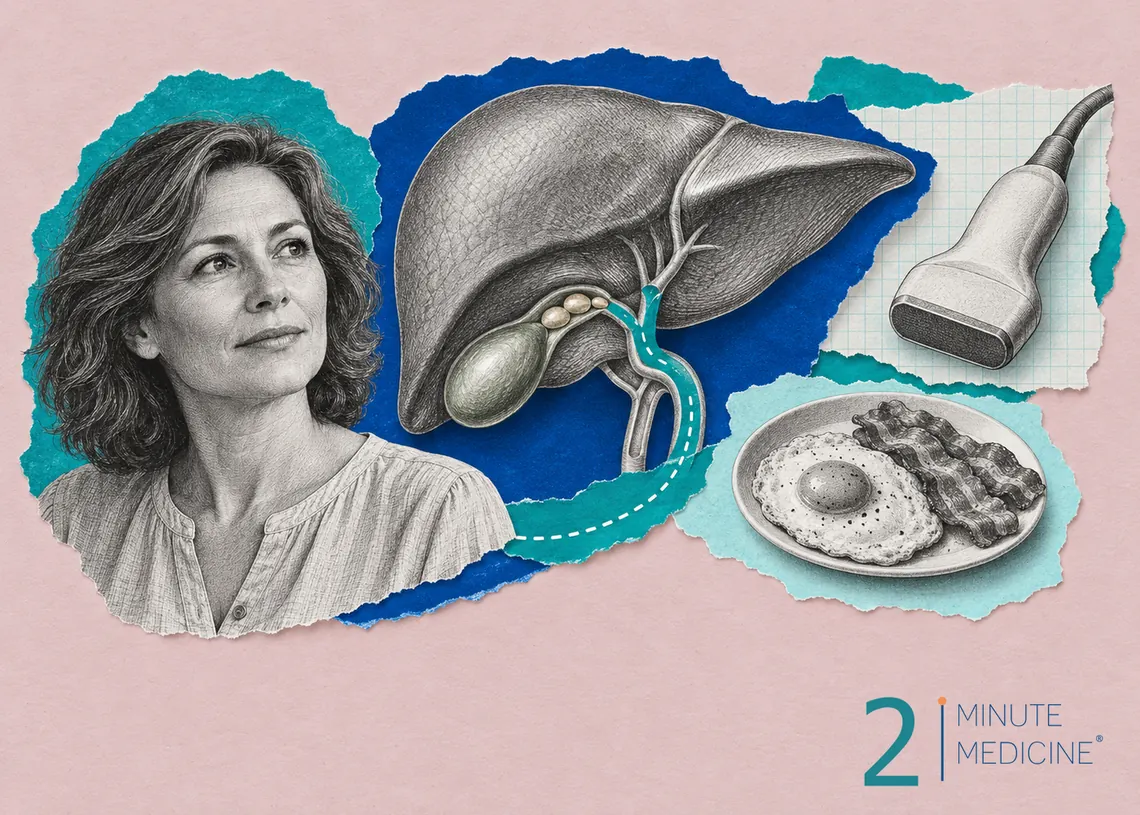
Collage for cholecystitis: a woman in profile, a liver with gallbladder and small stones, an ultrasound probe and fried food
Share on FacebookShare on TwitterShare on LinkedIn

Cholecystitis (koh-luh-sis-TIE-tis) is inflammation of the gallbladder, a small pouch under the liver that stores bile. In most cases a gallstone blocks the gallbladder’s outlet, and the trapped bile irritates its wall. It causes steady pain in the upper right belly that lasts for hours. Most people need hospital care, and many have their gallbladder removed.

Key points

  • Gallstones cause about 9 in 10 cases.
  • The main symptom is pain under the right ribs that lasts more than a few hours, often with fever, nausea or vomiting.
  • An ultrasound is usually the first test.
  • Treatment starts with fluids, pain medicine and often antibiotics, followed by surgery to take out the gallbladder.
  • You can live a normal life without a gallbladder.

What causes cholecystitis

The liver makes bile, a greenish fluid that helps digest fat. Between meals, bile is stored in the gallbladder. When you eat, especially a fatty meal, the gallbladder squeezes bile through a small tube (the cystic duct) into the intestine.

Gallstones are hard lumps that form when bile has too much cholesterol or other substances. A stone can get stuck in the cystic duct. Bile backs up, the gallbladder swells, and its wall becomes inflamed. Bacteria can then cause an infection.

Gallstones are more likely if you:

  • Are a woman, especially if you have been pregnant or take estrogen
  • Are over 40
  • Are carrying extra weight, or lose weight very quickly, for example after weight-loss surgery or on some weight-loss medicines
  • Have diabetes
  • Have a family history of gallstones
  • Are of Native American or Mexican American heritage

Less often, cholecystitis happens without stones. This mostly affects people who are already very ill, for example after major surgery, severe burns or a long stay in intensive care.

Acute and chronic cholecystitis

Acute cholecystitis comes on suddenly and is what this guide mainly covers. Chronic cholecystitis follows repeated milder attacks over months or years. The gallbladder becomes scarred and thick, and it doesn’t work well. People with chronic cholecystitis often have bouts of pain after meals, along with bloating, nausea or burping. An ultrasound usually shows stones and a thick gallbladder wall, and the usual treatment is planned surgery to remove the gallbladder.

RELATED REPORTS

Cholecystectomy may be feasible in patients with silent common duct stones

2 Minute Medicine Rewind July 8 – July 15, 2014

Cholecystitis symptoms

  • Steady, severe pain in the upper right or upper middle belly, which some people describe as pain in the upper stomach under the breasts
  • Pain that spreads to the right shoulder blade or back
  • Pain that often starts after a large or fatty meal and lasts longer than 4 to 6 hours
  • Tenderness when the area is pressed, or when you take a deep breath
  • Fever or chills, which are more likely if the inflamed gallbladder has become infected
  • Nausea and vomiting
  • Yellow skin or eyes (jaundice), dark urine or pale stools, if a stone has moved into the main bile duct

Pain from gallstones that fades within a few hours is called biliary colic. It is a warning that cholecystitis could happen later. Older adults and people with diabetes may have milder pain and no fever even when the gallbladder is badly inflamed.

How it’s diagnosed

  • Exam. The doctor presses under your right ribs while you breathe in. A sharp catch of pain is a typical sign.
  • Blood tests look for infection and check the liver and pancreas.
  • Ultrasound. This painless scan is usually the first imaging test. It shows stones, a thickened gallbladder wall and fluid around it.
  • HIDA scan. A small amount of a tracer is injected into a vein. A camera follows it from the liver into the gallbladder. If the tracer never fills the gallbladder, the duct is blocked.
  • CT or MRI. These help when the diagnosis is unclear or to look for problems such as a stone in the main bile duct.

Treatment

In the hospital

  • Fluids through a vein (IV)
  • Little or nothing to eat at first, to rest the gallbladder
  • Medicine for pain and nausea
  • Antibiotics, if infection is likely

Surgery

Removing the gallbladder (cholecystectomy) is the main treatment. Most surgeons do it within a few days of the attack, during the same hospital stay. Waiting longer raises the chance of another attack.

Most operations use small cuts and a camera (laparoscopy). Many people go home within a day or two and return to normal activity in 1 to 2 weeks. A larger open cut is sometimes needed if the gallbladder is badly inflamed or scarred. Recovery from open surgery takes longer.

If a stone has moved into the main bile duct, a doctor can remove it with a scope passed through the mouth, a procedure called ERCP. This is the usual way to unblock a bile duct.

If surgery isn’t safe

For people who are too ill for surgery, a radiologist can place a thin drainage tube through the skin into the gallbladder. Bile drains into a bag outside the body. This relieves the infection, and surgery can be done later if your health improves.

Possible complications

Without treatment, the gallbladder wall can lose its blood supply, form a pocket of pus, or tear. Stones can also cause inflammation of the pancreas (pancreatitis) or infection in the bile ducts (cholangitis). These are serious and need urgent care.

Life after gallbladder removal

Bile flows straight from the liver into the intestine, so you can still digest food. Most people eat normally. Some have looser stools or gas for a few weeks, especially after fatty meals. Smaller meals and less greasy food help while your body adjusts.

Lowering your risk

  • Aim for a healthy weight, and lose weight gradually rather than through crash diets.
  • Stay physically active.
  • Eat regular meals with plenty of fiber.
  • If you have had episodes of gallstone pain, ask whether removing your gallbladder now makes sense.

Get emergency care if you have

  • Belly pain that is severe or lasts more than a few hours
  • Belly pain with fever or chills
  • Yellow skin or eyes
  • Vomiting that keeps you from holding down fluids

Common questions about cholecystitis

What can cholecystitis pain be confused with?

Cholecystitis pain is often mistaken for heartburn, a stomach ulcer, pancreatitis, a kidney stone or pneumonia. Pain high in the belly can also come from a heart attack, especially in women, older adults and people with diabetes. That is why doctors often check an ECG and blood tests along with an ultrasound.

What is the difference between cholecystitis and cholangitis?

Cholecystitis is inflammation of the gallbladder itself. Cholangitis is an infection of the bile ducts, the tubes that carry bile from the liver and gallbladder to the intestine. Cholangitis usually causes fever, jaundice and belly pain together, and it needs urgent antibiotics and a procedure to clear the blocked duct.

Can mild cholecystitis go away without surgery?

A mild attack may settle with rest, fluids and antibiotics. But cholecystitis from gallstones often comes back, sometimes worse, so most doctors advise removing the gallbladder soon after the first attack. People who are too ill for surgery may be watched closely or have a drainage tube instead.

What should I eat if I have gallbladder problems?

During an attack, you may be told not to eat at all for a short time. While you wait for surgery, smaller meals that are low in fat can make attacks less likely. Fried food, fatty meat, cream and rich desserts are common triggers.

Questions to ask your doctor

  • Do I have gallstones, and are they causing this?
  • When should my gallbladder come out?
  • Can it be done with small cuts?
  • What should I eat after surgery?
  • Which symptoms after I go home mean I should call you?

Learn more

  • Acute cholecystitis (MedlinePlus, U.S. National Library of Medicine)
  • Gallstones (National Institute of Diabetes and Digestive and Kidney Diseases)

This guide is general information and doesn’t replace advice from your own doctor. Last updated October 2026.
Tags: cholecystitis
Previous Post

Patient Basics: Chlamydia

Next Post

Patient Basics: Cervical Polyps

RelatedReports

Surgical care collage: an operating light over a draped table, a tray with a surgical cap and mask, and a closed case
Gastroenterology

Cholecystectomy may be feasible in patients with silent common duct stones

March 21, 2025
Increased infections noted with longer duration neonatal PICC placement
Chronic Disease

2 Minute Medicine Rewind July 8 – July 15, 2014

July 14, 2014
Gastroenterology

Health care reform linked with reduced racial disparities in surgical care

February 14, 2014
Next Post
Cervical polyp collage: an anatomical drawing of the uterus and cervix, a slender flower stem and a blank calendar page

Patient Basics: Cervical Polyps

Cervicitis collage: a young woman in calm profile, a sealed lab swab tube in a small rack and a closed door

Patient Basics: Cervicitis

Chemical eye injury collage: an open eye behind clear safety goggles, water from a faucet and a capped cleaner bottle

Patient Basics: Chemical Injury to the Eye

✦ EvidencePulse™ by 2 Minute Medicine 3 reports You asked top stroke trials 2026 Synthesizing medical evidence... Top 2026 stroke trial results: OCEANIC — ischemic stroke: 6.2% vs 8.4% OPTION* — mRS 0–1: 43.6% vs 34.2% ORIENTAL* — mRS 0–2: 58.6% vs 46.6% *Higher sICH in intervention arms Participants randomizedN OCEANIC 12,327 OPTION 570 ORIENTAL 564 Ask about guidelines or landmark trials... Try EvidencePulse™ Get the signal. Try it now → Physician-trained medical AI by 2 Minute Medicine

2MM+ All Access

Full details →
$4.99 /month

3-day free trial · cancel anytime

  • ✓100+ physician-written reports
  • ✓EvidencePulse™ + HypeCheck™
  • ✓Ad-free reading + newsletters
Start 3-day free trial

Then $4.99/month. Manage renewal in your account.

2 Minute Medicine® is an award winning, physician-run, expert medical media company. Our content is curated, written and edited by practicing health professionals who have clinical and scientific expertise in their field of reporting. Our editorial management team is comprised of highly-trained MD physicians. Join numerous brands, companies, and hospitals who trust our licensed content.

Recent Reports

  • AI cardiac MRI analysis marginally outperforms clinicians in predicting all-cause mortality
  • In a phase 3 trial, tirzepatide reduced BMI versus placebo in adolescents with obesity and obesity-related complications
  • Continuation of immunotherapy after immune checkpoint inhibitor-induced myocarditis in patients with lung cancer may be safe and effective
License Content
Terms of Use | Disclaimer
Cookie Policy

Get the app

Read 2 Minute Medicine on iPhone, iPad and Android.

Download on the App StoreGet it on Google Play
QR code for www.2minutemedicine.com/app
On a computer? Scan this with your phone’s camera.
2MM+ All Access Full details →

The medical literature, distilled daily.

Monthly plan selected: $4.99 /month.

$4.99/month

3-day free trial · cancel anytime

Start 3-day free trial

Then $4.99/month. Manage renewal in your account.

Yearly plan selected: $49.90 /year.

$49.90/year

2 months free

Start 3-day free trial

Then $49.90/year.

Membership benefits

  • ✓100+ new physician-written study summaries monthly, 12,000+ searchable
  • ✓AI EvidencePulse™ + HypeCheck™
  • ✓Ad-free reading + newsletters
  • ✓FDA drug approvals + clinical calculators

Already a member? Sign in

  • Get the app
  • About
  • Specialties
    • All Specialties, All Recent Reports
    • Cardiology
    • Chronic Disease
    • Dermatology
    • Emergency
    • Endocrinology
    • Gastroenterology
    • Imaging and Intervention
    • Infectious Disease
    • Nephrology
    • Neurology
    • Obstetrics
    • Oncology
    • Ophthalmology
    • Pediatrics
    • Pharma
    • Preclinical
    • Psychiatry
    • Public Health
    • Pulmonology
    • Rheumatology
    • Surgery
    • Rewinds
    • The Scan
  • EvidencePulse™
  • HypeCheck™
  • AI News
  • Classics™
    • 2MM+ Online Access
    • Paperback and Ebook
  • Tools
    • Medical Calculators
    • Clinical Guidelines
    • Physician Pay by Specialty
    • FDA Drug Approvals
    • RVU Search
    • ICD-10 Code Lookup
    • Drug Safety for Breastfeeding/Pregnancy
    • ECG Reference
      • QTc Calculator
      • Sgarbossa Criteria
      • ECG Axis Calculator
      • AV Block Helper
    • NPI Registry Lookup
  • Rankings
    • Medical School Rankings
    • Residency Rankings
  • Partners
    • License Content
    • Advertise with Us
No Result
View All Result

© 2026 2 Minute Medicine, Inc. - Physician-written medical news.


