

Patient Basics: Esophageal Rings and Webs
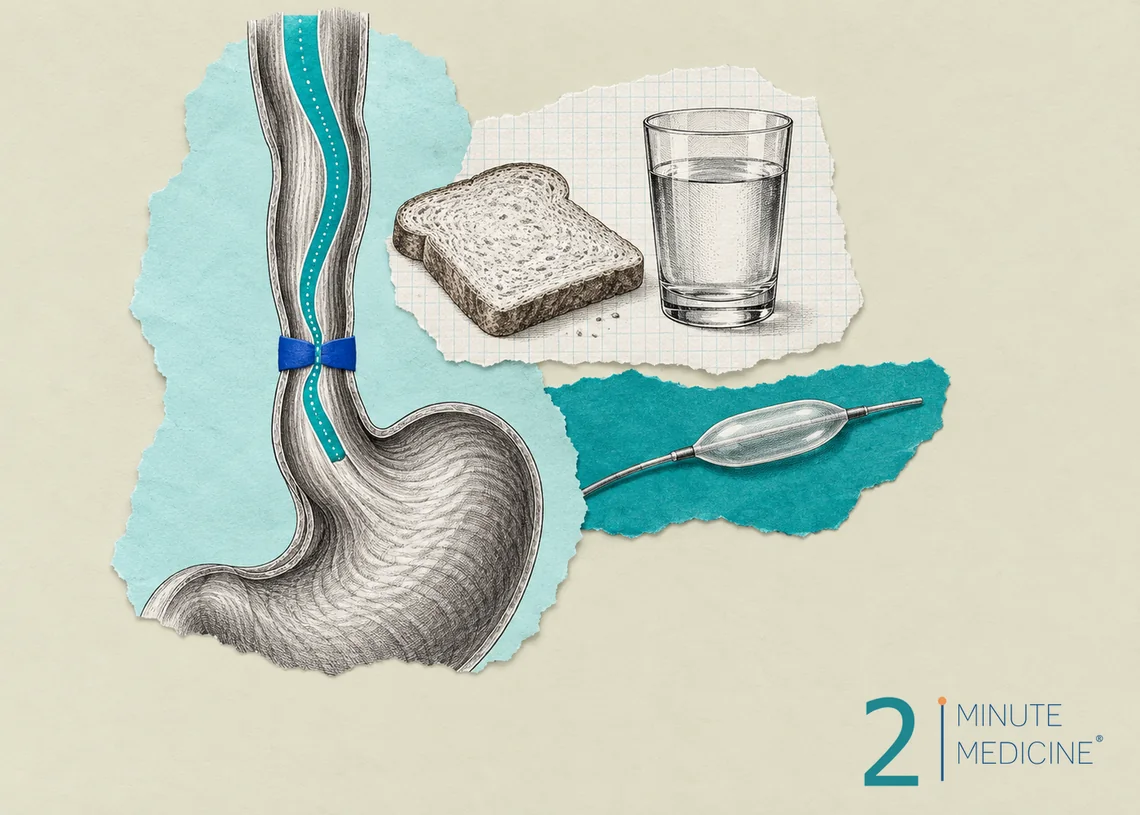
Esophageal rings and webs are thin folds of tissue that partly narrow the esophagus, the tube that carries food from your throat to your stomach. Many people have one and never know it. When a ring or web is tight enough, solid food can stick on the way down. A short procedure to stretch the narrow spot usually fixes the problem.
Key points
- Rings form near the bottom of the esophagus. Webs usually form near the top, just below the throat.
- The main symptom is solid food, often meat or bread, that sticks in the chest or throat now and then.
- Doctors find them with a barium swallow X-ray or an upper endoscopy.
- Stretching (dilation) during an endoscopy usually brings fast relief, though rings can come back.
- Food that is stuck and won’t go down, especially if you can’t swallow your own saliva, is an emergency.
What causes esophageal rings and webs
Rings
The most common type is a Schatzki ring, a thin band of tissue where the esophagus joins the stomach. It is often found along with a hiatal hernia, where the top of the stomach pushes up through the diaphragm. Long-term acid reflux may play a part. Rings are more common in older adults.
Doctors sometimes call a Schatzki ring a B ring. A less common A ring is a band of muscle a little higher up that tightens and relaxes. It rarely causes symptoms.
Several rings stacked along the esophagus can be a sign of eosinophilic esophagitis (EoE). This is an allergy-related condition where a type of white blood cell builds up in the esophagus and makes it stiff and narrow. It is more common in younger adults and children, and often in people with asthma, eczema or food allergies.
Webs
Webs (sometimes called esophageal webbing) are thin membranes that stretch across part of the upper esophagus. A web right where the throat meets the esophagus may be called a pharyngeal or postcricoid web. Their cause is often unknown. They can be linked to:
- Long-term iron deficiency. A web together with iron-deficiency anemia and trouble swallowing is called Plummer-Vinson syndrome. It is rare and mostly affects middle-aged women.
- Some skin and immune conditions, such as blistering skin diseases or graft-versus-host disease after a stem cell transplant.
Symptoms
Most rings and webs cause no trouble at all. When they do, symptoms include:
- Food that seems to stick behind the breastbone or at the base of the throat, mainly with solid foods
- Symptoms that come and go, sometimes with weeks or months between episodes
- Needing to drink water to push food down, or bringing food back up
- Coughing or choking while eating, more often with webs
- Heartburn, if acid reflux is also present
A sudden blockage after a bite of steak or bread, often during a rushed meal, is a common way a Schatzki ring first shows up. Liquids usually pass easily unless the food is fully stuck.
Trouble swallowing that steadily gets worse, or comes with weight loss, needs prompt testing to rule out other causes, including cancer.
How they’re diagnosed
- Barium swallow (esophagram). You drink a chalky liquid that shows up on X-ray, and sometimes swallow a barium tablet or a piece of food coated in barium. This shows the outline of the esophagus and can reveal thin rings or webs that are easy to miss in other ways.
- Upper endoscopy. While you are sedated, a doctor passes a thin, flexible tube with a camera through your mouth into the esophagus and stomach. Small tissue samples (biopsies) can check for EoE and reflux damage. The narrow spot can be stretched during the same procedure.
- Blood tests check for iron-deficiency anemia, especially if a web is found.
How esophageal rings and webs are treated
Stretching the narrow spot
During an endoscopy, the doctor widens the ring or web with a small balloon that is inflated inside it, or with a series of gently tapered tubes (dilators). Some webs break just from the scope passing through. Most people can swallow better right away. You will likely go home the same day and start with soft foods.
The main risk is a tear in the wall of the esophagus. It is uncommon, and the doctor will tell you which warning signs to watch for afterward, such as severe chest pain or fever. Rings can narrow again over months or years, and the stretching can be repeated.
Treating the cause
- Acid-reducing medicine. A proton pump inhibitor (PPI), such as omeprazole, may lower the chance of a Schatzki ring coming back, especially if you have reflux.
- Iron. Treating iron deficiency sometimes makes a web go away without stretching. Your doctor will also look for the reason you are low in iron.
- EoE treatment. Options include PPIs, steroid medicine that you swallow so it coats the esophagus, removing trigger foods from your diet, or an injected medicine called dupilumab.
Living with it
- Cut food into small pieces and chew it well.
- Eat slowly, and take sips of water between bites.
- Take extra care with steak, chicken, bread, rice and raw vegetables.
- Sit upright while you eat and for a little while after.
- Avoid eating quickly while drinking alcohol, which can dull the sense that food is sticking.
People with Plummer-Vinson syndrome have a higher risk of cancer in the throat and upper esophagus, so they need regular follow-up.
When to see a doctor
- Food sticks when you swallow, even now and then
- You’ve changed what you eat to avoid this feeling
- Swallowing problems get worse over time
- You lose weight without trying, or feel very tired (a possible sign of anemia)
Go to an emergency department if food is stuck and won’t pass, you can’t swallow your saliva, you are drooling, or you have chest pain or trouble breathing. Don’t try to force the food down with more food. A doctor can remove it with an endoscope.
Common questions about esophageal rings and webs
What is the difference between an esophageal ring and a web?
A ring circles the whole inside of the esophagus, usually at the bottom near the stomach, and is fairly common. A web is a thin flap that stretches across only part of the tube, usually at the top near the throat, and is rarer. Both can make solid food stick, and both are treated by stretching.
Can an esophageal web go away on its own?
Sometimes. A web linked to iron deficiency may shrink once iron levels are back to normal. Other webs usually stay, but a web that causes no symptoms doesn’t need treatment. If food sticks, stretching during an endoscopy usually fixes it in one session.
Do esophageal rings come back after stretching?
They can. A Schatzki ring narrows again in many people over months or years. Taking a PPI may lower the chance, and the ring can be stretched again whenever symptoms return. Webs come back less often, especially once any iron deficiency is treated.
Are esophageal rings and webs a sign of cancer?
No. Rings and webs are harmless (benign) tissue, not cancer. The exception to watch is Plummer-Vinson syndrome, which raises the risk of cancer in the throat and upper esophagus. Swallowing trouble that keeps getting worse, or comes with weight loss, needs prompt testing.
Questions to ask your doctor
- Do I have a ring, a web or something else?
- Do I need my esophagus stretched?
- How likely is it to come back?
- Should I take medicine for acid reflux?
- Do I need tests for EoE or iron deficiency?
Learn more
- Swallowing disorders (MedlinePlus, U.S. National Library of Medicine)
This guide is general information and doesn’t replace advice from your own doctor. Last updated October 2026.






 Get the app