

Patient Basics: Shoulder Dislocation
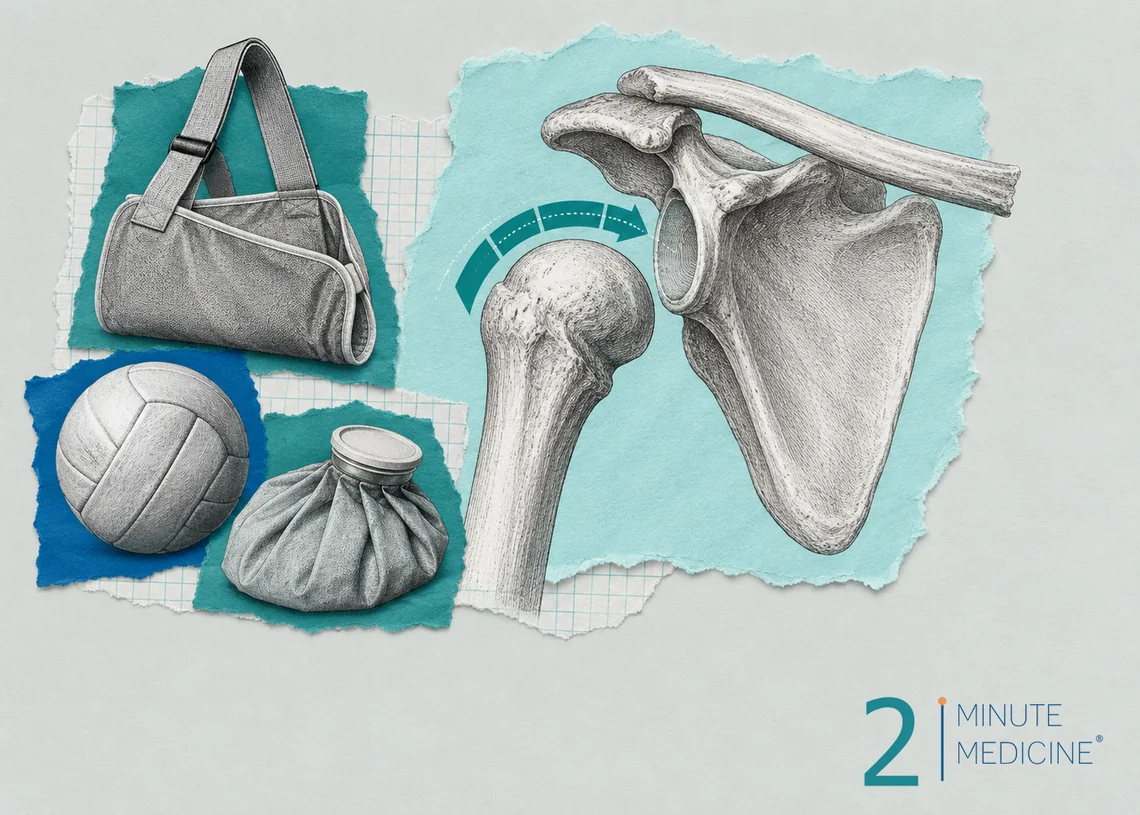
A shoulder dislocation happens when the ball at the top of the upper arm bone pops out of the shallow socket in the shoulder blade. It hurts a lot, and you usually can’t move your arm. A dislocated shoulder needs care in an emergency department or urgent care, where a doctor can check for broken bones and nerve damage and then ease the joint back into place.
Key points
- The shoulder is the joint people dislocate most often, usually in a fall or during sports.
- Don’t try to push it back in yourself. You could damage nerves, blood vessels or bone.
- Once the joint is back in place, the pain eases quickly. A sling, ice and then exercises help it heal.
- Teens and young adults have a high chance of it happening again. Surgery may help prevent that.
- Numbness, or a hand that is cold, pale or blue, needs care right away.
How the shoulder comes out of joint
The shoulder moves more freely than any other joint in the body. Its socket is shallow, a bit like a golf ball resting on a tee. A rim of cartilage (the labrum), the joint capsule, ligaments and the rotator cuff muscles hold the ball in place. A strong force can push the ball out and tear some of these tissues.
- Forward (anterior) dislocation is by far the most common type. The ball slips out the front, often when the arm is raised and pulled back, as in a tackle or a block.
- Backward (posterior) dislocation is less common. It can happen during a seizure or an electric shock.
- Partial dislocation (subluxation) means the ball slips partway out and then slides back in by itself.
What causes a shoulder dislocation
- Contact sports such as football, hockey, rugby and wrestling
- Falls during skiing, snowboarding, biking, climbing or gymnastics
- Throwing and overhead sports, such as volleyball and baseball
- Falling onto an outstretched arm, a common cause in older adults
- Car and motorcycle crashes
- Seizures
Some people are born with loose joints, and their shoulders can slip out with little force.
Shoulder dislocation symptoms
- Sudden, severe pain
- Being unable to move the arm, or holding it slightly away from the body
- A shoulder that looks squared off, with a bump at the front
- Swelling and, later, bruising
- Numbness, tingling or weakness down the arm
What to do right away
- Keep the arm still in the position that hurts least. Support it against your body with a towel or pillow.
- Put ice wrapped in a cloth on the shoulder.
- Go to an emergency department or urgent care. Don’t drive yourself.
- Don’t eat or drink until a doctor has seen you, in case you need medicine to make you sleepy.
How it’s diagnosed
The doctor looks at the shoulder, checks the pulse in your wrist and tests feeling and strength in your arm and hand. A nerve near the shoulder (the axillary nerve) can get stretched, which leaves a numb patch on the outside of the upper arm. X-rays show which way the joint has moved and whether a bone is broken. Later, an MRI scan may look for torn cartilage, a torn rotator cuff or a dent in the ball of the arm bone.
How a shoulder dislocation is treated
Putting the joint back
Doctors call this a reduction. You get pain medicine, a numbing shot into the joint or medicine that makes you sleepy. The doctor then moves your arm in slow, steady steps until the ball slides back into the socket. Many people feel a clunk and then a lot less pain. A second X-ray checks that it is in place.
The first weeks
- Sling. You wear it for comfort, often for one to three weeks. Take it off a few times a day to move your elbow, wrist and fingers so they don’t get stiff.
- Ice and pain relief. Use ice for 15 to 20 minutes at a time. Acetaminophen or an anti-inflammatory such as ibuprofen can help.
- Physical therapy. Gentle range-of-motion exercises come first, then exercises to strengthen the rotator cuff and the muscles around the shoulder blade.
Surgery
Surgery repairs the torn tissues that hold the joint in place. It may be offered:
- After a first dislocation in a young athlete, because the chance of it happening again is high
- When the shoulder keeps dislocating or feels unstable
- When there is a broken bone, a large piece of bone missing from the socket rim, or a torn rotator cuff
Most repairs are done through small cuts with a camera (arthroscopy). Shoulders with bone loss may need an open operation that moves a small piece of bone to the front of the socket.
Recovery
Most people go back to daily activities within a few weeks. Returning to contact or overhead sports usually takes around three months, once full motion and strength are back. Going back too soon raises the chance of another dislocation. People over 40 recover more slowly and are more likely to have a rotator cuff tear that needs attention.
Lowering your risk
- Keep up the strengthening exercises from physical therapy, even after the shoulder feels fine.
- Use proper technique and protective gear in sports.
- Older adults can lower their fall risk with balance exercises, good lighting and safe footwear.
When to see a doctor
Any shoulder you think is dislocated needs to be seen the same day. Get emergency care if your hand or arm is numb, cold, pale or blue, if a bone is poking through the skin, or if the dislocation came from a high-speed crash. After treatment, call your doctor if the shoulder slips out again or keeps feeling loose.
Common questions about shoulder dislocation
Can you pop a dislocated shoulder back in yourself?
It’s best not to try. Pulling on the arm can break a bone or damage nerves and blood vessels, and an X-ray is needed first to check for a fracture. People who have dislocated many times sometimes learn a safe method from their doctor, but a first dislocation always needs medical care.
How long does a dislocated shoulder take to heal?
The pain usually eases a lot once the joint is back in place. Daily activities return within a few weeks, and full healing with strength and sports often takes about three months. After surgery, the return to full activity usually takes four to six months.
What’s the difference between a dislocated shoulder and a separated shoulder?
A dislocated shoulder means the ball of the arm bone has come out of its socket. A separated shoulder is a different injury, a sprain or tear of the ligaments where the collarbone meets the top of the shoulder blade. Separations usually heal with a sling and exercises.
Will my shoulder dislocate again?
It depends mostly on your age and activities. Teens and young adults who play sports have a high chance, often about half or more, of another dislocation without surgery. The chance is much lower in people over 40. Physical therapy helps, and surgery lowers the risk further.
Questions to ask your doctor
- Did the dislocation tear anything or break a bone?
- How long should I wear the sling?
- Which exercises should I do, and when can I start physical therapy?
- When can I go back to my sport or work?
- Would surgery lower my chance of another dislocation?
Learn more
- Dislocated shoulder (NHS)
- Dislocations (MedlinePlus, U.S. National Library of Medicine)
This guide is general information and doesn’t replace advice from your own doctor. Last updated October 2026.






 Get the app