
• About
  • Masthead
  • License Content
  • Advertise
  • Press Releases
  • Newsroom
  • RSS/Email List
  • 2MM Podcast
  • Write for us
  • Contact Us
2 Minute Medicine
No Result
View All Result

No products in the cart.

Sign in
SUBSCRIBE
  • About
  • Specialties
    • All Specialties, All Recent Reports
    • Cardiology
    • Chronic Disease
    • Dermatology
    • Emergency
    • Endocrinology
    • Gastroenterology
    • Imaging and Intervention
    • Infectious Disease
    • Nephrology
    • Neurology
    • Obstetrics
    • Oncology
    • Ophthalmology
    • Pediatrics
    • Pharma
    • Preclinical
    • Psychiatry
    • Public Health
    • Pulmonology
    • Rheumatology
    • Surgery
    • Rewinds
    • The Scan
  • EvidencePulse™
  • HypeCheck™
  • AI News
  • Classics™
    • 2MM+ Online Access
    • Paperback and Ebook
  • Tools
    • NPI Registry Lookup
    • RVU Search
    • Physician Pay by Specialty
    • ICD-10 Code Lookup
    • FDA Drug Approvals
    • Drug Safety for Breastfeeding/Pregnancy
    • Clinical Guidelines
    • Medical Calculators
    • ECG Reference
      • QTc Calculator
      • Sgarbossa Criteria
      • ECG Axis Calculator
      • AV Block Helper
  • Rankings
    • Medical School Rankings
    • Residency Rankings
  • Partners
    • License Content
    • Advertise with Us
2 Minute Medicine
  • About
  • Specialties
    • All Specialties, All Recent Reports
    • Cardiology
    • Chronic Disease
    • Dermatology
    • Emergency
    • Endocrinology
    • Gastroenterology
    • Imaging and Intervention
    • Infectious Disease
    • Nephrology
    • Neurology
    • Obstetrics
    • Oncology
    • Ophthalmology
    • Pediatrics
    • Pharma
    • Preclinical
    • Psychiatry
    • Public Health
    • Pulmonology
    • Rheumatology
    • Surgery
    • Rewinds
    • The Scan
  • EvidencePulse™
  • HypeCheck™
  • AI News
  • Classics™
    • 2MM+ Online Access
    • Paperback and Ebook
  • Tools
    • NPI Registry Lookup
    • RVU Search
    • Physician Pay by Specialty
    • ICD-10 Code Lookup
    • FDA Drug Approvals
    • Drug Safety for Breastfeeding/Pregnancy
    • Clinical Guidelines
    • Medical Calculators
    • ECG Reference
      • QTc Calculator
      • Sgarbossa Criteria
      • ECG Axis Calculator
      • AV Block Helper
  • Rankings
    • Medical School Rankings
    • Residency Rankings
  • Partners
    • License Content
    • Advertise with Us
Sign in
SUBSCRIBE
2 Minute Medicine
Sign in
Subscribe
2 Minute MedicineFree on Google PlayGet
✦EvidencePulse™by 2 Minute Medicine3 reportsYou askedtop stroke trials 2026Synthesizing medical evidence...Top 2026 stroke trial results:OCEANIC — ischemic stroke: 6.2% vs 8.4%OPTION* — mRS 0–1: 43.6% vs 34.2%ORIENTAL* — mRS 0–2: 58.6% vs 46.6%*Higher sICH in intervention armsParticipants randomizedNOCEANIC12,327OPTION570ORIENTAL564Ask about guidelines or landmark trials...↑Try EvidencePulse™Ask the evidence. Get the signal.Try it now →
Home Health A to Z

Patient Basics: Tay-Sachs Disease
by2 Minute Medicine
October 30, 2026
in Health A to Z
Reading Time: 5 mins read
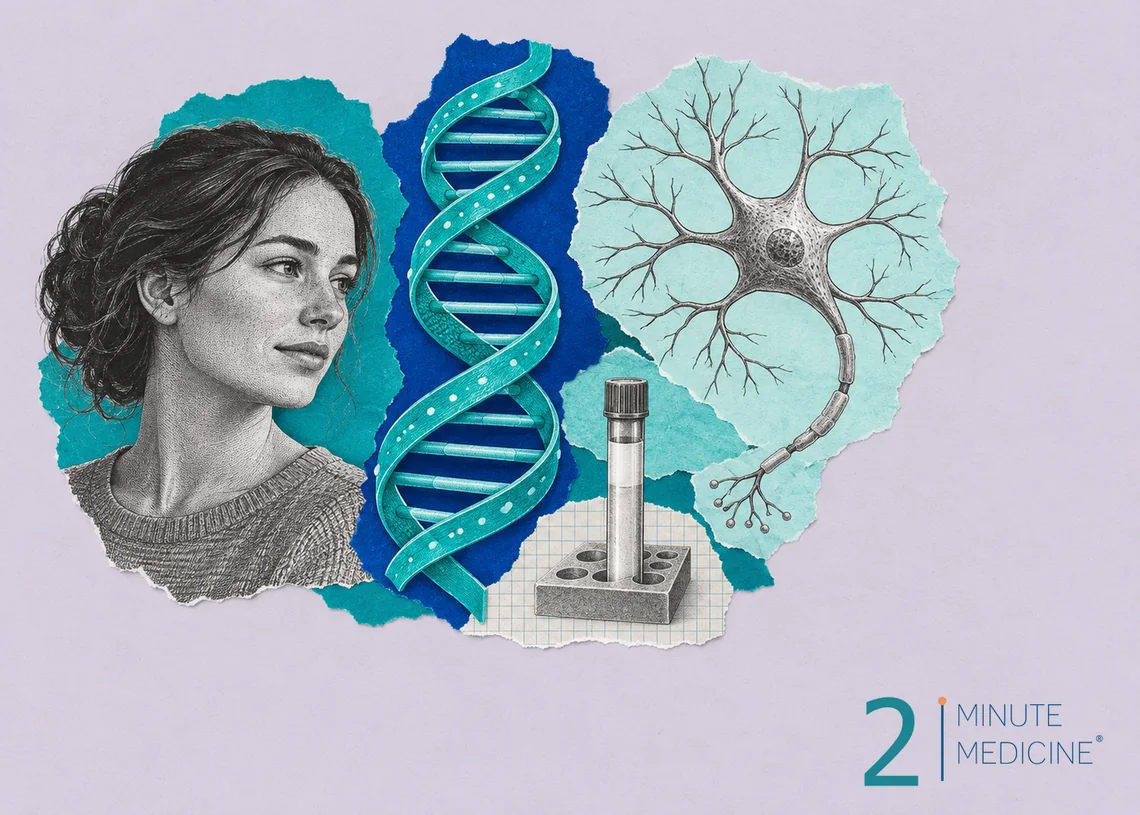
Collage on Tay-Sachs disease: a young woman in profile, a DNA helix ribbon, an engraved nerve cell and a capped sample tube
Share on FacebookShare on TwitterShare on LinkedIn

Tay-Sachs disease is a rare genetic disorder that slowly destroys nerve cells in the brain and spinal cord. A child gets it only when both parents pass on a changed copy of the same gene. There is no cure, so carrier testing before or during pregnancy is the main way families learn their risk and plan ahead.

Key points

  • Tay-Sachs is caused by changes in the HEXA gene, which leaves the body without an enzyme needed to break down a fatty substance in nerve cells.
  • The most common form starts in babies at about 3 to 6 months of age. Children with this form usually live only into early childhood.
  • Milder forms can start later in childhood or in adulthood.
  • Carriers have no symptoms. If both parents are carriers, each pregnancy has a 1 in 4 chance of Tay-Sachs.
  • Treatment focuses on comfort, nutrition, seizure control and support for the family.

What causes Tay-Sachs disease and how it’s inherited

Inside nerve cells, an enzyme called hexosaminidase A (Hex A) breaks down a fatty substance called GM2 ganglioside. In Tay-Sachs, the HEXA gene that makes this enzyme doesn’t work. The fatty substance builds up and damages nerve cells over time.

Everyone has two copies of the HEXA gene, one from each parent. A person with one working copy and one changed copy is a carrier. Carriers are healthy. When two carriers have a child together:

  • There is a 1 in 4 chance the child will have Tay-Sachs.
  • There is a 1 in 2 chance the child will be a carrier.
  • There is a 1 in 4 chance the child will have two working copies.

These odds are the same for every pregnancy.

Who is at higher risk

Anyone can be a carrier. Carriers are more common in some groups:

  • People of Ashkenazi (Central or Eastern European) Jewish descent, where about 1 in 30 is a carrier
  • French Canadians from parts of Quebec
  • Cajun communities in Louisiana
  • Old Order Amish communities in Pennsylvania

In the general population, carriers are much rarer, roughly 1 in 300. Thanks to decades of carrier screening, Tay-Sachs is now rare among Ashkenazi Jewish families.

RELATED REPORTS

No Content Available

Symptoms of Tay-Sachs disease

Infantile Tay-Sachs

Babies seem healthy at birth and for the first few months. Then they start to lose skills and stop making progress:

  • Weak muscles, and trouble rolling over, sitting or crawling
  • A strong startle reaction to noise
  • Less interest in people and surroundings
  • Loss of vision and hearing
  • Seizures
  • Trouble swallowing and, later, breathing

An eye doctor may see a “cherry-red spot” at the back of the eye, which is a classic sign.

Juvenile and late-onset forms

When the body still makes a small amount of the enzyme, symptoms appear later and progress more slowly. In the juvenile form, children develop problems with walking, speech and thinking, often between ages 2 and 10. Late-onset Tay-Sachs usually starts in the teens or adult years with leg weakness, clumsiness, unsteady walking, slurred speech, and sometimes mood problems or psychosis. Many adults with this form live a normal or near-normal lifespan.

How it’s diagnosed

  • Enzyme test. A blood test measures Hex A activity. Very low levels point to Tay-Sachs.
  • Genetic test. A DNA test looks for changes in both copies of the HEXA gene and confirms the diagnosis.
  • Eye exam to look for the cherry-red spot
  • Prenatal tests. If both parents are carriers, cells from the placenta (chorionic villus sampling) or the fluid around the baby (amniocentesis) can be tested during pregnancy.

Carrier screening and family planning

Carrier screening is a blood or saliva test. It is offered to people who are planning a pregnancy or are pregnant, especially if either partner has Jewish, French Canadian or Cajun ancestry, or there is a family history. Many clinics now offer a broad screening panel to everyone. An enzyme test finds carriers of any background, and DNA testing adds detail. If you’re pregnant or take birth control pills, the lab may need to test white blood cells for an accurate enzyme result.

If both partners are carriers, a genetic counselor can explain the options. These include testing during pregnancy, IVF with testing of embryos before they are placed in the uterus, using donor eggs or sperm, or adoption.

Treatment and care

There is no cure yet. Care aims to keep a child or adult as comfortable and active as possible:

  • Anti-seizure medicines
  • Feeding support, including a feeding tube when swallowing becomes unsafe
  • Physical therapy and careful positioning to prevent stiff joints and pressure sores
  • Treatment of chest infections and help clearing mucus
  • Palliative care and hospice teams, who support the whole family at home or in the hospital

Researchers are testing gene therapy and other treatments in clinical trials. Ask your care team whether a trial might be right for your family.

Caring for a child with a serious illness is exhausting. Social workers, counselors and support groups for families affected by Tay-Sachs can help.

When to see a doctor

  • You are planning a pregnancy and haven’t had carrier screening
  • You have a family history of Tay-Sachs or another genetic disease
  • Your baby stops gaining skills, loses skills, startles strongly at sounds or has seizures
  • A teen or adult develops unexplained weakness, clumsiness or slurred speech

Common questions about Tay-Sachs disease

What are other names for Tay-Sachs disease?

Doctors also call it hexosaminidase A deficiency or GM2 gangliosidosis, names that come from the missing enzyme and the fatty substance that builds up. The disease is named after Warren Tay, a British eye doctor, and Bernard Sachs, an American neurologist, who described it in the 1880s.

Is Tay-Sachs disease always fatal?

The infant form is, and most children with it die before age 5. The juvenile form also shortens life, often to the teen years. Late-onset Tay-Sachs is milder, and many adults with it live a normal or near-normal lifespan, though they may need help with walking over time.

How rare is Tay-Sachs disease?

It is very rare. In most of the population only about 1 in 300 people carries a changed gene, so two carriers having a child together is unusual. Carrier screening, which began in the 1970s, has cut the number of Ashkenazi Jewish babies born with Tay-Sachs by more than 90%.

Questions to ask your doctor

  • Should my partner and I have carrier screening?
  • Which test is best for our backgrounds?
  • If we are both carriers, what are our options?
  • What care and support can our family get at home?
  • Are there clinical trials we could join?

Learn more

  • Tay-Sachs disease (MedlinePlus Genetics, U.S. National Library of Medicine)

This guide is general information and doesn’t replace advice from your own doctor. Last updated October 2026.

Tags: Tay-Sachs Disease
Previous Post

Patient Basics: Takayasu’s Arteritis

Next Post

Patient Basics: Spinal Cord Tumors

RelatedReports

No Content Available
Next Post
Spinal cord tumor collage: engraved vertebrae with the spinal cord inside, a reflex hammer and a tuning fork

Patient Basics: Spinal Cord Tumors

Stuttering collage: a calm teenage boy, a paper speech bubble in separated pieces and two cups joined by a string

Patient Basics: Stuttering

Collage on sun allergy: a middle-aged man in a wide-brimmed hat, a large sun, a blank sunscreen tube and a beach umbrella

Patient Basics: Sun Allergy (Photosensitivity)

✦ EvidencePulse™ by 2 Minute Medicine 3 reports You asked top stroke trials 2026 Synthesizing medical evidence... Top 2026 stroke trial results: OCEANIC — ischemic stroke: 6.2% vs 8.4% OPTION* — mRS 0–1: 43.6% vs 34.2% ORIENTAL* — mRS 0–2: 58.6% vs 46.6% *Higher sICH in intervention arms Participants randomizedN OCEANIC 12,327 OPTION 570 ORIENTAL 564 Ask about guidelines or landmark trials... Try EvidencePulse™ Get the signal. Try it now → Physician-trained medical AI by 2 Minute Medicine

2MM+ All Access

Full details →
$4.99 /month

3-day free trial · cancel anytime

  • ✓100+ physician-written reports
  • ✓EvidencePulse™ + HypeCheck™
  • ✓Ad-free reading + newsletters
Start 3-day free trial

Then $4.99/month. Manage renewal in your account.

2 Minute Medicine® is an award winning, physician-run, expert medical media company. Our content is curated, written and edited by practicing health professionals who have clinical and scientific expertise in their field of reporting. Our editorial management team is comprised of highly-trained MD physicians. Join numerous brands, companies, and hospitals who trust our licensed content.

Recent Reports

  • Use of colchicine is not associated with reduced cardiovascular events among Chinese adults starting urate-lowering therapy
  • ARO-DIMER-PA can Significantly Lower LDL-C and Triglycerides in Patients with Mixed Hyperlipidemia
  • CCTA-guided PCI noninferior to IVUS-guided PCI for target-vessel failure
License Content
Terms of Use | Disclaimer
Cookie Policy

Get the app

Read 2 Minute Medicine on iPhone, iPad and Android.

Download on the App StoreGet it on Google Play
QR code for www.2minutemedicine.com/app
On a computer? Scan this with your phone’s camera.
2MM+ All Access Full details →

The medical literature, distilled daily.

Monthly plan selected: $4.99 /month.

$4.99/month

3-day free trial · cancel anytime

Start 3-day free trial

Then $4.99/month. Manage renewal in your account.

Yearly plan selected: $49.90 /year.

$49.90/year

2 months free

Start 3-day free trial

Then $49.90/year.

Membership benefits

  • ✓100+ new physician-written study summaries monthly, 12,000+ searchable
  • ✓AI EvidencePulse™ + HypeCheck™
  • ✓Ad-free reading + newsletters
  • ✓FDA drug approvals + clinical calculators

Already a member? Sign in

  • Get the app
  • About
  • Specialties
    • All Specialties, All Recent Reports
    • Cardiology
    • Chronic Disease
    • Dermatology
    • Emergency
    • Endocrinology
    • Gastroenterology
    • Imaging and Intervention
    • Infectious Disease
    • Nephrology
    • Neurology
    • Obstetrics
    • Oncology
    • Ophthalmology
    • Pediatrics
    • Pharma
    • Preclinical
    • Psychiatry
    • Public Health
    • Pulmonology
    • Rheumatology
    • Surgery
    • Rewinds
    • The Scan
  • EvidencePulse™
  • HypeCheck™
  • AI News
  • Classics™
    • 2MM+ Online Access
    • Paperback and Ebook
  • Tools
    • NPI Registry Lookup
    • RVU Search
    • Physician Pay by Specialty
    • ICD-10 Code Lookup
    • FDA Drug Approvals
    • Drug Safety for Breastfeeding/Pregnancy
    • Clinical Guidelines
    • Medical Calculators
    • ECG Reference
      • QTc Calculator
      • Sgarbossa Criteria
      • ECG Axis Calculator
      • AV Block Helper
  • Rankings
    • Medical School Rankings
    • Residency Rankings
  • Partners
    • License Content
    • Advertise with Us
No Result
View All Result

© 2026 2 Minute Medicine, Inc. - Physician-written medical news.


