• About
  • Masthead
  • License Content
  • Advertise
  • Submit Press Release
  • RSS/Email List
  • 2MM Podcast
  • Write for us
  • Contact Us
2 Minute Medicine
No Result
View All Result

No products in the cart.

SUBSCRIBE
  • Specialties
    • All Specialties, All Recent Reports
    • Cardiology
    • Chronic Disease
    • Dermatology
    • Emergency
    • Endocrinology
    • Gastroenterology
    • Imaging and Intervention
    • Infectious Disease
    • Nephrology
    • Neurology
    • Obstetrics
    • Oncology
    • Ophthalmology
    • Pediatrics
    • Pharma
    • Preclinical
    • Psychiatry
    • Public Health
    • Pulmonology
    • Rheumatology
    • Surgery
  • Tools
    • EvidencePulse™
    • RVU Search
    • NPI Registry Lookup
  • Pharma
  • AI News
  • The Scan+
  • Classics™+
    • 2MM+ Online Access
    • Paperback and Ebook
  • Rewinds
  • Partners
    • License Content
    • Submit Press Release
    • Advertise with Us
  • Account
    • Subscribe
    • Sign-in
    • My account
2 Minute Medicine
  • Specialties
    • All Specialties, All Recent Reports
    • Cardiology
    • Chronic Disease
    • Dermatology
    • Emergency
    • Endocrinology
    • Gastroenterology
    • Imaging and Intervention
    • Infectious Disease
    • Nephrology
    • Neurology
    • Obstetrics
    • Oncology
    • Ophthalmology
    • Pediatrics
    • Pharma
    • Preclinical
    • Psychiatry
    • Public Health
    • Pulmonology
    • Rheumatology
    • Surgery
  • Tools
    • EvidencePulse™
    • RVU Search
    • NPI Registry Lookup
  • Pharma
  • AI News
  • The Scan+
  • Classics™+
    • 2MM+ Online Access
    • Paperback and Ebook
  • Rewinds
  • Partners
    • License Content
    • Submit Press Release
    • Advertise with Us
  • Account
    • Subscribe
    • Sign-in
    • My account
SUBSCRIBE
2 Minute Medicine
Subscribe
Home All Specialties Oncology

Subcutaneous amivantamab with lazertinib is non-inferior to intravenous administration, with fewer adverse reactions

byVanessa GiulianoandSze Wah Samuel Chan
July 1, 2024
in Chronic Disease, Oncology
Reading Time: 2 mins read
0
Share on FacebookShare on Twitter

1. Subcutaneous amivantamab combined with lazertinib was non-inferior to intravenous amivantamab with lazertinib in terms of efficacy in treating refractory EGFR-mutated NSCLC.

2. Subcutaneous amivantamab resulted in fewer infusion-related reactions, allowed for shorter administration times, and increased patient convenience compared to the intravenous formulation

Evidence Rating Level: 1 (Excellent)

Study Rundown: The present study is a randomized controlled trial that assessed the efficacy of subcutaneous amivantamab with lazertinib compared to intravenous amivantamab with lazertinib. It included patients with EGFR-mutated advanced non-small cell lung cancer (NSCLC) who had progressed following treatment with osimertinib and platinum-based chemotherapy. Patients were randomized to receive either subcutaneous or intravenous amivantamab. The study demonstrated that subcutaneous amivantamab, combined with lazertinib, was non-inferior to its intravenous counterpart in terms of pharmacokinetics and efficacy. Additionally, the subcutaneous formulation resulted in fewer infusion-related reactions and venous thromboembolic events. Strengths of this study include its randomized controlled design, large sample size, and comprehensive assessment of pharmacokinetics, efficacy, and safety. Limitations include a short follow-up period of seven months, which may limit the assessment of long-term safety and efficacy. Overall, the study supports the use of subcutaneous amivantamab over the intravenous formulation for patients with EGFR-mutated advanced NSCLC.

Click to read the study in The Journal of Clinical Oncology

Relevant Reading: LBA14 Amivantamab plus lazertinib vs osimertinib as first-line treatment in patients with EGFR-mutated, advanced non-small cell lung cancer (NSCLC): Primary results from MARIPOSA, a phase III, global, randomized, controlled trial

RELATED REPORTS

Amivantumab plus lazertinib improves survival in EGFR-mutated advanced NSCLC

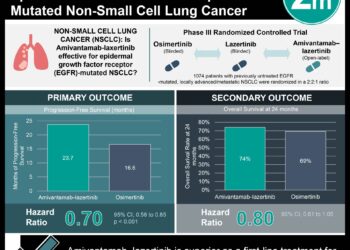
#VisualAbstract Amivantamab-lazertinib is Effective for Epidermal Growth Factor Receptor Mutated Non-Small Cell Lung Cancer

Amivantamab and Lazertinib in Untreated EGFR-Mutated Advanced NSCLC

In-Depth [randomized controlled trial]: This study assessed the efficacy and safety of subcutaneous versus intravenous amivantamab, both combined with lazertinib, in patients with EGFR-mutated advanced NSCLC who progressed after osimertinib and platinum-based chemotherapy. Patients were randomized 1:1 to receive either subcutaneous or intravenous amivantamab. The primary endpoints were pharmacokinetic noninferiority, measured by trough concentrations (Ctrough) and area under the curve (AUCD1-D15). Secondary endpoints included objective response rate (ORR), progression-free survival (PFS), and overall survival (OS). 418 patients were included in the trial. Subcutaneous amivantamab showed comparable pharmacokinetics to the intravenous form, with geometric mean ratios of Ctrough at cycle-2-day-1 of 1.15 (90% CI, 1.04-1.26) and at cycle-4-day-1 of 1.42 (90% CI, 1.27-1.61), and cycle-2 AUCD1-D15 of 1.03 (90% CI, 0.98-1.09). Median PFS was 6.1 months for subcutaneous and 4.3 months for intravenous (HR for disease progression or death, 0.84; 95% CI, 0.64-1.10; P=0.20). Furthermore, OS was significantly longer for subcutaneous (HR for death, 0.62; 95% CI, 0.42-0.92; nominal P=0.02). Importantly, fewer infusion-related reactions were observed in the subcutaneous group (13% vs. 66%). Overall, this study supports the use of subcutaneous amivantamab over the intravenous formulation in terms of efficacy and safety for the treatment of NSCLC.

Image: PD

©2024 2 Minute Medicine, Inc. All rights reserved. No works may be reproduced without expressed written consent from 2 Minute Medicine, Inc. Inquire about licensing here. No article should be construed as medical advice and is not intended as such by the authors or by 2 Minute Medicine, Inc.
Tags: amivantEGFR lung cancerlazertinib
Previous Post

#VisualAbstract: Vimseltinib Produces Objective Radiological Responses in Tenosynovial Giant Cell Tumour Patients

Next Post

Amivantamab and Lazertinib in Untreated EGFR-Mutated Advanced NSCLC

RelatedReports

Lessons from real-world implementation of lung cancer screening
Chronic Disease

Amivantumab plus lazertinib improves survival in EGFR-mutated advanced NSCLC

November 27, 2024
#VisualAbstract Amivantamab-lazertinib is Effective for Epidermal Growth Factor Receptor Mutated Non-Small Cell Lung Cancer
StudyGraphics

#VisualAbstract Amivantamab-lazertinib is Effective for Epidermal Growth Factor Receptor Mutated Non-Small Cell Lung Cancer

July 22, 2024
Patient Basics: Large Cell Cancer of the Lung
Oncology

Amivantamab and Lazertinib in Untreated EGFR-Mutated Advanced NSCLC

July 1, 2024
#VisualAbstract Osimertinib significantly improved progression-free survival in patients with unresectable stage III non-small cell lung cancer
StudyGraphics

#VisualAbstract Osimertinib significantly improved progression-free survival in patients with unresectable stage III non-small cell lung cancer

June 28, 2024
Next Post
Patient Basics: Large Cell Cancer of the Lung

Amivantamab and Lazertinib in Untreated EGFR-Mutated Advanced NSCLC

#VisualAbstract: Ridinilazole reduces recurrent Clostridioides difficile infection and preserves gut microbi-ome diversity versus vancomycin

#VisualAbstract: Ridinilazole reduces recurrent Clostridioides difficile infection and preserves gut microbi-ome diversity versus vancomycin

#VisualAbstract: Adjuvant Dabrafenib plus Trametinib Improves Outcomes in Stage III Melanoma

#VisualAbstract: Adjuvant Dabrafenib plus Trametinib Improves Outcomes in Stage III Melanoma

2 Minute Medicine® is an award winning, physician-run, expert medical media company. Our content is curated, written and edited by practicing health professionals who have clinical and scientific expertise in their field of reporting. Our editorial management team is comprised of highly-trained MD physicians. Join numerous brands, companies, and hospitals who trust our licensed content.

Recent Reports

  • Functional recovery after maternal ischemic stroke may be commonly favourable
  • Faster correction of severe hyponatremia reduces death and neurologic events
  • Sustained participation in hospital-based intervention programs reduces future community violence
License Content
Terms of Use | Disclaimer
Cookie Policy
Privacy Statement (EU)
Disclaimer

© 2025 2 Minute Medicine, Inc. - Physician-written medical news.

  • Specialties
    • All Specialties, All Recent Reports
    • Cardiology
    • Chronic Disease
    • Dermatology
    • Emergency
    • Endocrinology
    • Gastroenterology
    • Imaging and Intervention
    • Infectious Disease
    • Nephrology
    • Neurology
    • Obstetrics
    • Oncology
    • Ophthalmology
    • Pediatrics
    • Pharma
    • Preclinical
    • Psychiatry
    • Public Health
    • Pulmonology
    • Rheumatology
    • Surgery
  • Tools
    • EvidencePulse™
    • RVU Search
    • NPI Registry Lookup
  • Pharma
  • AI News
  • The Scan
  • Classics™
    • 2MM+ Online Access
    • Paperback and Ebook
  • Rewinds
  • Partners
    • License Content
    • Submit Press Release
    • Advertise with Us
  • Account
    • Subscribe
    • Sign-in
    • My account
No Result
View All Result

© 2025 2 Minute Medicine, Inc. - Physician-written medical news.