• About
  • Masthead
  • License Content
  • Advertise
  • Submit Press Release
  • RSS/Email List
  • 2MM Podcast
  • Write for us
  • Contact Us
2 Minute Medicine
No Result
View All Result

No products in the cart.

SUBSCRIBE
  • About
  • Specialties
    • All Specialties, All Recent Reports
    • Cardiology
    • Chronic Disease
    • Dermatology
    • Emergency
    • Endocrinology
    • Gastroenterology
    • Imaging and Intervention
    • Infectious Disease
    • Nephrology
    • Neurology
    • Obstetrics
    • Oncology
    • Ophthalmology
    • Pediatrics
    • Pharma
    • Preclinical
    • Psychiatry
    • Public Health
    • Pulmonology
    • Rheumatology
    • Surgery
  • Tools+
    • EvidencePulse™
    • HypeCheck™
    • NPI Registry Lookup
    • RVU Search
  • Pharma
  • AI Roundup
  • The Scan+
  • Classics™+
    • 2MM+ Online Access
    • Paperback and Ebook
  • Rewinds
  • Partners
    • License Content
    • Submit Press Release
    • Advertise with Us
  • Account
    • Subscribe
    • My account
    • Cart
    • Sign-in
2 Minute Medicine
  • About
  • Specialties
    • All Specialties, All Recent Reports
    • Cardiology
    • Chronic Disease
    • Dermatology
    • Emergency
    • Endocrinology
    • Gastroenterology
    • Imaging and Intervention
    • Infectious Disease
    • Nephrology
    • Neurology
    • Obstetrics
    • Oncology
    • Ophthalmology
    • Pediatrics
    • Pharma
    • Preclinical
    • Psychiatry
    • Public Health
    • Pulmonology
    • Rheumatology
    • Surgery
  • Tools+
    • EvidencePulse™
    • HypeCheck™
    • NPI Registry Lookup
    • RVU Search
  • Pharma
  • AI Roundup
  • The Scan+
  • Classics™+
    • 2MM+ Online Access
    • Paperback and Ebook
  • Rewinds
  • Partners
    • License Content
    • Submit Press Release
    • Advertise with Us
  • Account
    • Subscribe
    • My account
    • Cart
    • Sign-in
SUBSCRIBE
2 Minute Medicine
Subscribe
Home All Specialties Chronic Disease

Addition of immunosuppression does not improve outcome of supportive therapy for IgA nephropathy
byDavid ArsaniousandShaidah Deghan, MSc. MD
December 4, 2015
in Chronic Disease, Nephrology
Reading Time: 3 mins read
Multidrug induction therapy increases remission from lupus nephritis
Share on FacebookShare on Twitter


1. Addition of immunosuppression to supportive therapy did not lead to significantly improve outcomes described as full remission and a decrease in the eGFR of at least 15 ml/min/1.73 m2of BSA after 3 years of follow-up.

2. There was no significant difference between the rate of decreases in eGFR between patients who received supportive care alone and patients who received immunosuppression in addition to supportive care.

Evidence Rating Level: 2 (Good)         

Study Rundown: IgA nephropathy is the most common form of glomerulonephritis. The current Kidney Disease: Improving Global Outcomes (KDIGO) guidelines recommend blockade of the renin-angiotensin system using an angiotensin-converting-enzyme inhibitor (ACEI) or an angiotensin II-receptor blocker (ARB) for patients with IgA nephropathy who have > 1 gram of urinary protein excretion per day. The KDIGO guidelines also recommend using systemic glucocorticoid immunosuppressive therapy in patients who have >1 gram of urinary protein excretion per day and a GFR > 50 mL per minute despite supportive treatment. To date, there have been conflicting controlled trials that have attempted to assess the utility of immunosuppressive glucocorticoid therapy in addition to standard supportive therapy (ACEI/ARB) over supportive therapy alone.

This study began with a six-month run-in phase, wherein all the patients received an ACEI/ARB. If after the six-month run-in phase, proteinuria remained elevated, patients entered the 3-year study phase. Patients either receive supportive care alone (supportive care group) or supportive care and immunosuppression (immunosuppression group). Patients whose proteinuria of eGFR did not respond sufficiently were found to be eligible for randomization in the 3-year study phase in either the supportive therapy group or immunosuppression group. The first primary endpoint of the study was full clinical remission at the end of the 3-year trial phase (as measured by protein to creatinine ratio <0.2), in which a statistically significant difference was found. The second primary endpoint of the study was a decrease in eGFR ≥ 15 mL/min/1.73m2, in which no significant difference was found.

RELATED REPORTS

2MM: AI Roundup: FDA clears autonomous blood draw robot, UHS acquires Talkspace, Databricks reaches $190 billion valuation, and AI-designed glioblastoma vaccine advances

Aletta brings autonomous robotics into routine blood collection

Higher coffee intake is associated with lower visceral fat despite similar body mass index

This study draws strength from its randomized, controlled, two-group, parallel, group-sequential design. It also avoided the confounders that emerged in prior investigations of immunosuppression in IgA nephropathy through maintaining strict, consistent adherence to renin-angiotensin blockade. This study lacks in its ability to be extrapolated to cases of more advanced disease, such as patients with proteinuria >3.5 g per day or eGFR < 30 mL/min/1.73m2.

Click to read the study, published today in NEJM

Relevant Reading: IgA Nephropathy

In-Depth [randomized controlled trial]: In this study, 337 patients at 32 nephrology centers in Germany were enrolled in the initial 6-month run-in phase. During this phase, all the patients received comprehensive supportive therapy that included ACEI/ARB therapy to lower BP below 125/75 mmHg. If after the six-month run-in phase, proteinuria remained between 0.75 – 3.5 g per day, patients entered the 3-year study phase. These patients were randomized to receive either supportive care alone (supportive care group) or supportive care and immunosuppression (immunosuppression group). Patients with eGFR ≥ 60 mL/min/1.73m2 were randomly assigned to the immunosuppression group received glucocorticoid for 36 months while patients with eGFR 30 – 59 mL/min/1.73m2 were assigned to receive cyclophosphamide followed by azathioprine plus prednisolone for 36 months.

At the end of the run-in phase 177 patients were found to be eligible for randomization in the 3-year study phase. The primary endpoint showed a statistically significant higher percentage of full clinical remission at 36 months (5% of patients in the supportive-care group vs. 17% of patients in the immunosuppression group; p=0.01). In the analysis of available cases, it was found that 4/72 supportive care patients’ vs 17/71 immunosuppression patients exhibited full clinical remission (95% [CI], 1.55 – 18.66; p = 0.008).

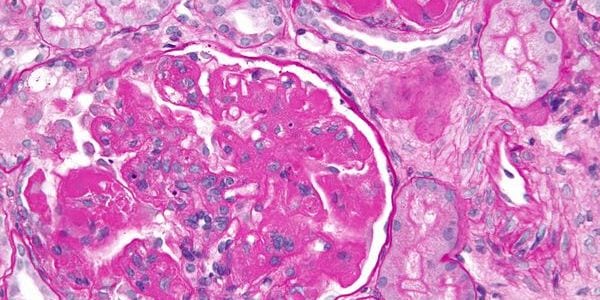
Image: PD

©2015 2 Minute Medicine, Inc. All rights reserved. No works may be reproduced without expressed written consent from 2 Minute Medicine, Inc. Inquire about licensing here. No article should be construed as medical advice and is not intended as such by the authors or by 2 Minute Medicine, Inc.


Previous Post

Prevalence of neural tube defects unchanged over 20 years in Europe

Next Post

Radiation dose associated with increased heart disease in Hodgkin lymphoma survivors

RelatedReports

Collage of medical tech icons circling a central chip with 'AI Roundup' title and 2 Minute Medicine logo in teal background.
AI Roundup

2MM: AI Roundup: FDA clears autonomous blood draw robot, UHS acquires Talkspace, Databricks reaches $190 billion valuation, and AI-designed glioblastoma vaccine advances

September 8, 2026
Artificial Intelligence

Aletta brings autonomous robotics into routine blood collection

September 8, 2026
Chronic Disease

Higher coffee intake is associated with lower visceral fat despite similar body mass index

September 8, 2026
Quick Take: Diagnostic Yield of One-Time Colonoscopy vs One-Time Flexible Sigmoidoscopy vs Multiple Rounds of Mailed Fecal Immunohistochemical Tests in Colorectal Cancer Screening
Chronic Disease

Molecularly guided therapy may improve outcomes in patients with unfavourable cancer of unknown primary compared with standard chemotherapy

September 7, 2026
Next Post
No benefit of erlotinib in combined hepatocellular carcinoma treatment

Radiation dose associated with increased heart disease in Hodgkin lymphoma survivors

Tramadol and Celecoxib effective pain control for hysteroscopy

Tramadol and Celecoxib effective pain control for hysteroscopy

Recurrence of endometrial hyperplasia following medical therapy is common

Recurrence of endometrial hyperplasia following medical therapy is common

EvidencePulse™ by 2 Minute Medicine 2026 evidence scan 3 reports You asked top stroke trials 2026 Synthesizing medical evidence... Top 2026 stroke trial results: OCEANIC — ischemic stroke: 6.2% vs 8.4% OPTION* — mRS 0–1: 43.6% vs 34.2% ORIENTAL* — mRS 0–2: 58.6% vs 46.6% *Higher sICH in intervention arms Participants randomizedN OCEANIC 12,327 OPTION 570 ORIENTAL 564 Ask about guidelines or landmark trials... ↑ Try EvidencePulse™ Ask the evidence.
Get the signal.
Try it now → Physician-trained medical AI by 2 Minute Medicine

2MM+ All Access

Full details →
$4.99 /month

5-day free trial · cancel anytime

  • ✓100+ physician-written reports
  • ✓EvidencePulse™ + HypeCheck™
  • ✓Ad-free reading + newsletters
Start 5-day free trial

Then $4.99/month. Manage renewal in your account.

2 Minute Medicine® is an award winning, physician-run, expert medical media company. Our content is curated, written and edited by practicing health professionals who have clinical and scientific expertise in their field of reporting. Our editorial management team is comprised of highly-trained MD physicians. Join numerous brands, companies, and hospitals who trust our licensed content.

Recent Reports

  • 2MM: AI Roundup: FDA clears autonomous blood draw robot, UHS acquires Talkspace, Databricks reaches $190 billion valuation, and AI-designed glioblastoma vaccine advances
  • Aletta brings autonomous robotics into routine blood collection
  • Higher coffee intake is associated with lower visceral fat despite similar body mass index
License Content
Terms of Use | Disclaimer
Cookie Policy
Cleantalk Pixel
  • About
  • Specialties
    • All Specialties, All Recent Reports
    • Cardiology
    • Chronic Disease
    • Dermatology
    • Emergency
    • Endocrinology
    • Gastroenterology
    • Imaging and Intervention
    • Infectious Disease
    • Nephrology
    • Neurology
    • Obstetrics
    • Oncology
    • Ophthalmology
    • Pediatrics
    • Pharma
    • Preclinical
    • Psychiatry
    • Public Health
    • Pulmonology
    • Rheumatology
    • Surgery
  • Tools
    • EvidencePulse™
    • HypeCheck™
    • NPI Registry Lookup
    • RVU Search
  • Pharma
  • AI Roundup
  • The Scan
  • Classics™
    • 2MM+ Online Access
    • Paperback and Ebook
  • Rewinds
  • Partners
    • License Content
    • Submit Press Release
    • Advertise with Us
  • Account
    • Subscribe
    • My account
    • Cart
    • Sign-in
No Result
View All Result

© 2026 2 Minute Medicine, Inc. - Physician-written medical news.

2MM+ All Access Full details →

The medical literature, distilled daily.

Monthly plan selected: $4.99 /month.

$4.99/month

5-day free trial · cancel anytime

Start 5-day free trial

Then $4.99/month. Manage renewal in your account.

Yearly plan selected: $49.90 /year.

$49.90/year

2 months free · only $4.16/month

Start 5-day free trial

Then $49.90/year. Manage renewal in your account.

Membership benefits

  • ✓100+ physician-written reports
  • ✓AI EvidencePulse™ + HypeCheck™
  • ✓Ad-free reading + newsletters

Already a member? Sign in