• About
  • Masthead
  • License Content
  • Advertise
  • Submit Press Release
  • RSS/Email List
  • 2MM Podcast
  • Write for us
  • Contact Us
2 Minute Medicine
No Result
View All Result

No products in the cart.

SUBSCRIBE
  • Specialties
    • All Specialties, All Recent Reports
    • Cardiology
    • Chronic Disease
    • Dermatology
    • Emergency
    • Endocrinology
    • Gastroenterology
    • Imaging and Intervention
    • Infectious Disease
    • Nephrology
    • Neurology
    • Obstetrics
    • Oncology
    • Ophthalmology
    • Pediatrics
    • Pharma
    • Preclinical
    • Psychiatry
    • Public Health
    • Pulmonology
    • Rheumatology
    • Surgery
  • Tools
    • EvidencePulse™
    • RVU Search
    • NPI Registry Lookup
  • Pharma
  • AI News
  • The Scan+
  • Classics™+
    • 2MM+ Online Access
    • Paperback and Ebook
  • Rewinds
  • Partners
    • License Content
    • Submit Press Release
    • Advertise with Us
  • Account
    • Subscribe
    • Sign-in
    • My account
2 Minute Medicine
  • Specialties
    • All Specialties, All Recent Reports
    • Cardiology
    • Chronic Disease
    • Dermatology
    • Emergency
    • Endocrinology
    • Gastroenterology
    • Imaging and Intervention
    • Infectious Disease
    • Nephrology
    • Neurology
    • Obstetrics
    • Oncology
    • Ophthalmology
    • Pediatrics
    • Pharma
    • Preclinical
    • Psychiatry
    • Public Health
    • Pulmonology
    • Rheumatology
    • Surgery
  • Tools
    • EvidencePulse™
    • RVU Search
    • NPI Registry Lookup
  • Pharma
  • AI News
  • The Scan+
  • Classics™+
    • 2MM+ Online Access
    • Paperback and Ebook
  • Rewinds
  • Partners
    • License Content
    • Submit Press Release
    • Advertise with Us
  • Account
    • Subscribe
    • Sign-in
    • My account
SUBSCRIBE
2 Minute Medicine
Subscribe
Home All Specialties Cardiology

The Evolut Low Risk Trial: Self-expanding TAVR noninferior to surgery in low-risk patients
byJames Roebker
March 20, 2019
in Cardiology, Chronic Disease, Surgery
Reading Time: 3 mins read
0
Share on FacebookShare on Twitter

1. Among patients with severe aortic stenosis at low-risk for surgery, transcatheter aortic valve replacement (TAVR) with a self-expanding valve was noninferior to surgical aortic valve replacement (SAVR) with respect to a composite of all-cause mortality or disabling stroke at 24 months.

2. While all-cause mortality was similar between TAVR and SAVR at 24 months, the incidence of disabling stroke, atrial fibrillation, and acute kidney injury was significantly less with TAVR while rates of pacemaker implantation was less in the SAVR group. 

Evidence Rating Level: 1 (Excellent)      

Study Rundown: Though transcatheter aortic valve replacement (TAVR) was originally developed as a treatment option for high-risk patients with severe aortic stenosis, its indications have expanded to intermediate-risk patients on an individualized basis; however, limited evidence exists in the low-risk patient population. The Evolut Low Risk trial was designed to assess the safety and efficacy of TAVR using a self-expandable valve in this low-risk surgical cohort. This reports the results from the prespecified interim analysis of the Evolut trial, which randomized patients with severe aortic stenosis and a three percent or less predicted 30-day surgical mortality risk to either TAVR with a self-expanding valve or surgical aortic valve replacement (SAVR). TAVR was found to be noninferior with respect to the primary endpoint – a composite of death or disabling stroke at 24 months – but did not meet the prespecified criterion for superiority. Among key secondary endpoints, TAVR was found to have a significantly lower incidence of disabling stroke at 24 months, new-onset atrial fibrillation, acute kidney injury (AKI), and severe bleeding. Higher rates of permanent pacemaker implantation and moderate to severe aortic regurgitation were found in the TAVR group. This landmark trial, published alongside results from the PARTNER 3 trial on TAVR with balloon-expandable valves versus surgery, suggests that low-risk surgical patients do as well and perhaps better with TAVR compared to SAVR over two years.

This was the preliminary analysis from a multicenter, randomized trial that used an adaptive Bayesian design. The study provides data for the largest patient cohort currently being treated with SAVR. It is further strengthened by its publication alongside similar results from the PARTNER 3 trial. The main limitation is that only a minority of patients had reached the complete 24-month follow-up. Additional long-term data is needed before making definitive conclusions.

Click to read the study in NEJM

RELATED REPORTS

#VisualAbstract: Transcatheter Aortic-Valve Replacement Reduced the Incidence of Death, Stroke, or Hospitalization in Asymptomatic Severe Aortic Stenosis

Novel transcatheter heart valve may be effective for management of high-risk aortic regurgitation

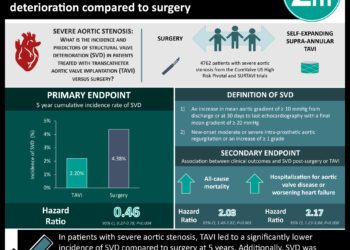
#VisualAbstract: Transcatheter aortic valve implantation is associated with reduced rate of structural valve deterioration compared to surgery

Relevant Reading: Transcatheter aortic-valve replacement with a balloon-expandable valve in low-risk patients

In-Depth [randomized controlled trial]: This was a multinational, noninferiority trial that randomized patients with severe aortic-valve stenosis and 3% predicted 30-day risk of death with surgery in a 1:1 ratio to TAVR with one of three self-expanding, supraannular bioprostheses (n=725) or SAVR (n=678). The primary endpoint was noninferiority of TAVR compared to SAVR with respect to a composite of death from any cause or disabling stroke at 24 months. Secondary endpoints included a 30-day composite safety endpoint (death, disabling stroke, life-threatening bleeding, major vascular complications, and stage 2/3 kidney injury), the primary endpoint and individual components at 30 days, life-threatening bleeding at 30 days, permanent pacemaker implantation at 30 days, and new-onset atrial fibrillation at 30 days, among others. Hemodynamic assessment included mean valve gradients, effective orifice area, and aortic regurgitation at 30 days.

For this prespecified interim analysis, 12-month follow-up data was available for 432 patients in the TAVR group (n=72 for 24-month follow-up) and 352 in the SAVR group (n=65 for 24-month follow-up). The incidence of the primary endpoint was 5.3% (95% Bayesian credible interval [BCI], 3.3 to 8.0) in the TAVR group vs. 6.7% (95% BCI, 4.4 to 9.6) in the SAVR group, which met the prespecified noninferiority threshold (posterior probability of noninferiority, >0.999) but not superiority (posterior probability of superiority, >0.779). TAVR demonstrated a significantly reduced incidence of the 30-day secondary safety endpoint (5.3% vs. 10.7% with SAVR), new-onset atrial fibrillation (7.7% vs. 35.4%), life-threatening bleeding (2.4 vs. 7.5%), and AKI (0.9% vs. 2.8%). A higher incidence of permanent pacemaker implantation (17.4% vs. 6.1% at 30 days) at one year and moderate to severe aortic regurgitation was found in the TAVR group. TAVR was also reported to have a smaller mean aortic gradient (8.6 mmHg vs. 11.2 mmHg with SAVR) and greater mean effective orifice area (2.3 vs. 2.0) at one year.

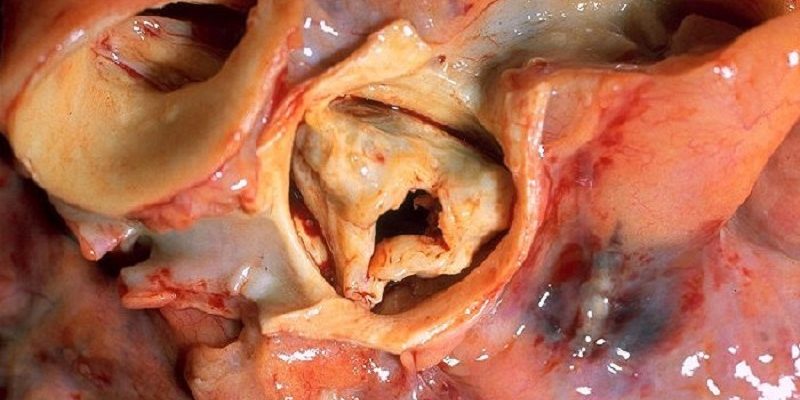
Image: PD

©2019 2 Minute Medicine, Inc. All rights reserved. No works may be reproduced without expressed written consent from 2 Minute Medicine, Inc. Inquire about licensing here. No article should be construed as medical advice and is not intended as such by the authors or by 2 Minute Medicine, Inc

Tags: surgical aortic valve replacement (SAVR)Transcatheter aortic valve replacement (TAVR)
Previous Post

The PARTNER 3 Trial: TAVR with balloon-expandable valves has favorable post-surgical outcomes among low-risk patients with severe aortic stenosis

Next Post

Students infected by Schistosoma shed light on cause of Katayama syndrome

RelatedReports

#VisualAbstract: Transcatheter Aortic-Valve Replacement Reduced the Incidence of Death, Stroke, or Hospitalization in Asymptomatic Severe Aortic Stenosis
StudyGraphics

#VisualAbstract: Transcatheter Aortic-Valve Replacement Reduced the Incidence of Death, Stroke, or Hospitalization in Asymptomatic Severe Aortic Stenosis

November 8, 2024
Imaging biomarkers may improve prediction of aortic valve stenosis
Cardiology

Novel transcatheter heart valve may be effective for management of high-risk aortic regurgitation

May 2, 2024
#VisualAbstract: Transcatheter aortic valve implantation is associated with reduced rate of structural valve deterioration compared to surgery
StudyGraphics

#VisualAbstract: Transcatheter aortic valve implantation is associated with reduced rate of structural valve deterioration compared to surgery

May 2, 2023
Patient Basics: Heart Murmur
Cardiology

Early left ventricular ejection fraction improvement post transcatheter aortic valve replacement associated with improved 5-year clinical outcomes

December 21, 2022
Next Post
Students infected by Schistosoma shed light on cause of Katayama syndrome

Students infected by Schistosoma shed light on cause of Katayama syndrome

Adjunctive TMP-SMX (Bactrim) associated with higher clinical cure rates for cutaneous abscesses

Adjunctive ultrasonography for breast cancer screening likely not associated with better outcomes

Patisiran therapy reduces ventricular myocardial strain in hereditary transthyretin amyloidosis

Patisiran therapy reduces ventricular myocardial strain in hereditary transthyretin amyloidosis

2 Minute Medicine® is an award winning, physician-run, expert medical media company. Our content is curated, written and edited by practicing health professionals who have clinical and scientific expertise in their field of reporting. Our editorial management team is comprised of highly-trained MD physicians. Join numerous brands, companies, and hospitals who trust our licensed content.

Recent Reports

  • Management of Dyspnea With High-Flow Nasal Air or Fan-A Randomized Controlled Crossover Trial
  • The efficacy of preoperative evolocumab-rosuvastatin combination therapy in patients with ST-elevation myocardial infarction
  • Infrapatellar Fat Pad Glucocorticoid Injection in Knee Osteoarthritis
License Content
Terms of Use | Disclaimer
Cookie Policy
Privacy Statement (EU)
Disclaimer

© 2025 2 Minute Medicine, Inc. - Physician-written medical news.

  • Specialties
    • All Specialties, All Recent Reports
    • Cardiology
    • Chronic Disease
    • Dermatology
    • Emergency
    • Endocrinology
    • Gastroenterology
    • Imaging and Intervention
    • Infectious Disease
    • Nephrology
    • Neurology
    • Obstetrics
    • Oncology
    • Ophthalmology
    • Pediatrics
    • Pharma
    • Preclinical
    • Psychiatry
    • Public Health
    • Pulmonology
    • Rheumatology
    • Surgery
  • Tools
    • EvidencePulse™
    • RVU Search
    • NPI Registry Lookup
  • Pharma
  • AI News
  • The Scan
  • Classics™
    • 2MM+ Online Access
    • Paperback and Ebook
  • Rewinds
  • Partners
    • License Content
    • Submit Press Release
    • Advertise with Us
  • Account
    • Subscribe
    • Sign-in
    • My account
No Result
View All Result

© 2025 2 Minute Medicine, Inc. - Physician-written medical news.