
• About
  • Masthead
  • License Content
  • Advertise
  • RSS/Email List
  • 2MM Podcast
  • Write for us
  • Contact Us
2 Minute Medicine
No Result
View All Result

No products in the cart.

Sign in
SUBSCRIBE
  • About
  • Specialties
    • All Specialties, All Recent Reports
    • Cardiology
    • Chronic Disease
    • Dermatology
    • Emergency
    • Endocrinology
    • Gastroenterology
    • Imaging and Intervention
    • Infectious Disease
    • Nephrology
    • Neurology
    • Obstetrics
    • Oncology
    • Ophthalmology
    • Pediatrics
    • Pharma
    • Preclinical
    • Psychiatry
    • Public Health
    • Pulmonology
    • Rheumatology
    • Surgery
    • Rewinds
    • The Scan
  • EvidencePulse™
  • HypeCheck™
  • AI News
  • Classics™
    • 2MM+ Online Access
    • Paperback and Ebook
  • Tools
    • NPI Registry Lookup
    • RVU Search
  • Partners
    • License Content
    • Advertise with Us
2 Minute Medicine
  • About
  • Specialties
    • All Specialties, All Recent Reports
    • Cardiology
    • Chronic Disease
    • Dermatology
    • Emergency
    • Endocrinology
    • Gastroenterology
    • Imaging and Intervention
    • Infectious Disease
    • Nephrology
    • Neurology
    • Obstetrics
    • Oncology
    • Ophthalmology
    • Pediatrics
    • Pharma
    • Preclinical
    • Psychiatry
    • Public Health
    • Pulmonology
    • Rheumatology
    • Surgery
    • Rewinds
    • The Scan
  • EvidencePulse™
  • HypeCheck™
  • AI News
  • Classics™
    • 2MM+ Online Access
    • Paperback and Ebook
  • Tools
    • NPI Registry Lookup
    • RVU Search
  • Partners
    • License Content
    • Advertise with Us
Sign in
SUBSCRIBE
2 Minute Medicine
Sign in
Subscribe
✦ EvidencePulse™ by 2 Minute Medicine 2026 evidence scan 3 reports You asked top stroke trials 2026 Synthesizing medical evidence... Top 2026 stroke trial results: OCEANIC — ischemic stroke: 6.2% vs 8.4% OPTION* — mRS 0–1: 43.6% vs 34.2% ORIENTAL* — mRS 0–2: 58.6% vs 46.6% *Higher sICH in intervention arms Participants randomizedN OCEANIC 12,327 OPTION 570 ORIENTAL 564 Ask about guidelines or landmark trials... ↑ Try EvidencePulse™ Ask the evidence.
Get the signal.
Try it now → Physician-trained medical AI by 2 Minute Medicine
Home All Specialties Artificial Intelligence

An artificial intelligence model demonstrates the potential for improving the efficiency of structural heart disease screening using electrocardiograms
byCheng En Xi
October 21, 2026
in Artificial Intelligence, Cardiology
Reading Time: 2 mins read
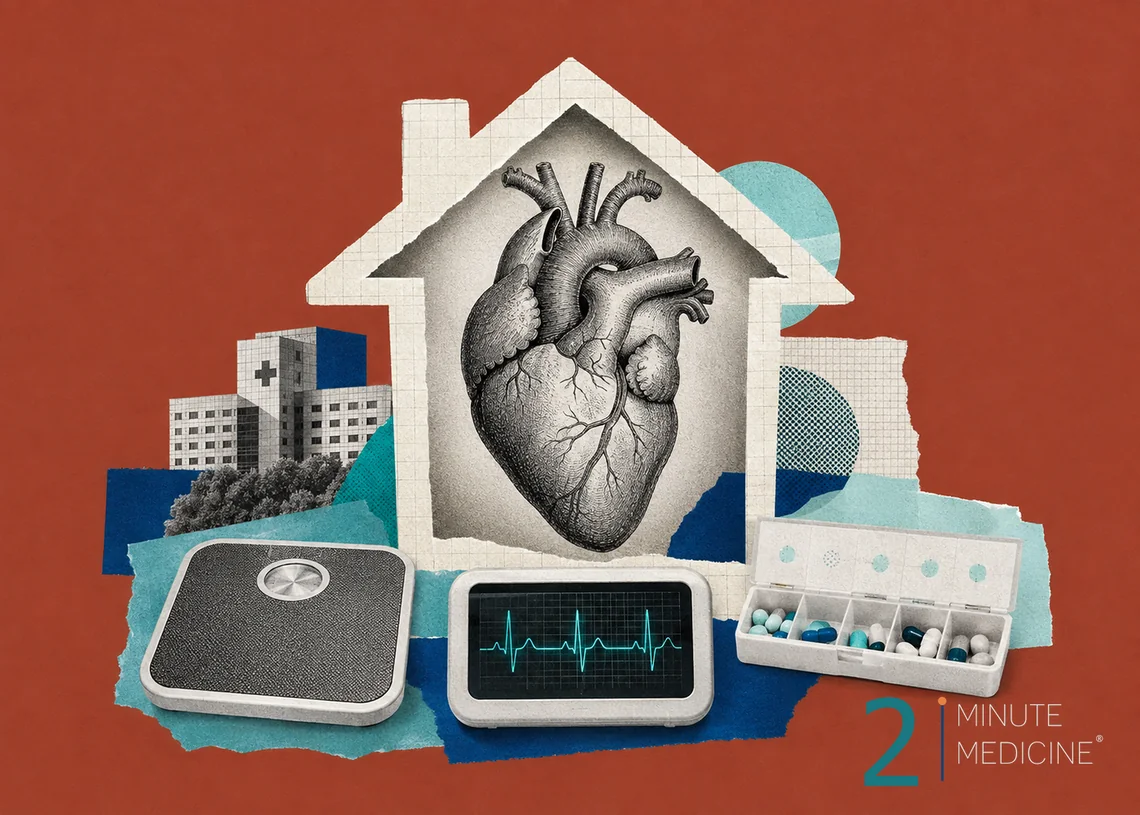
An illustration featuring a heart within a house, with a stethoscope, a scale, and medication, symbolizing heart failure home hospital care.
Share on FacebookShare on TwitterShare on LinkedIn

1. An artificial intelligence model combined electronic health records and electrocardiograms to select and screen suitable patients for structural heart diseases.

2. In a retrospective evaluation, the AI model reduced false positives and improved precision and sensitivity across multiple patient cohorts.

Evidence Rating Level: 2 (Good)

Study Rundown: Artificial intelligence (AI) has the potential to scale up the detection of structural heart disease (SHD) using routine electrocardiograms (ECGs), a technique known as AI-ECG. However, evidence remains limited on how best to integrate these tools into clinical care and minimize unnecessary testing. Oikonomou and colleagues developed TARGET-AI to determine whether electronic health records (EHRs) could guide more selective deployment of AI-ECG screening. TARGET-AI combines a model that analyzes patient histories and an ECG model trained using paired echocardiography reports. Researchers then compared targeted screening with TARGET-AI identifying suitable screening candidates against screening all patients with available ECGs. The study found that TARGET-AI improved the balance between precision and sensitivity across 26 structural heart disease labels while reducing false positive results. Similar improvements were observed in community participants and hospitalized patients. While the study demonstrated that pre-selecting screening candidates with an AI model may improve the efficiency of AI-based cardiac screening, prospective evaluation remains necessary to examine whether this approach improves patient outcomes.

Click here to read the study in NEJM AI

Relevant Reading: Application of artificial intelligence to the electrocardiogram

RELATED REPORTS

Deep learning model demonstrates potential to generate an interpretable brain health biomarker from sleep electroencephalography

Artificial intelligence (AI)-powered mental health app demonstrated improved social well-being among users

In-Depth [retrospective cohort study]: TARGET-AI was developed using 754,533 ECG-echocardiogram pairs from 159,322 adults. It combined an AI model trained to analyze EHRs and summarize clinical events before each ECG, and another model that was trained on relationships between ECG tracings and echocardiography reports. Temporal screening validation included 5,198 patients whose first known echocardiogram occurred within 90 days after an ECG, and external evaluation included 33,518 UK Biobank participants with cardiac magnetic resonance imaging and 3,628 MIMIC-IV patients. The outcomes included discrimination, sensitivity, F1 scores, and false-positive counts. Within the temporal screening cohort, discrimination of SHD achieved an area under the receiver operating characteristic curve (AUROC) of 0.90 for left ventricular systolic dysfunction, and an AUROC of 0.85 for severe aortic stenosis. Across the 26 SHD labels in screening validation, targeted deployment increased F1 scores by a median of 0.25 (range: 0.09-0.75) and reduced false positives by a median of 303 per label (range: -715 to -77). Median F1 improvements were 0.20 (range: 0.05-0.33) in the UK Biobank database and 0.13 (range: 0.08-0.06) in the MIMIC-IV database. While demonstrating potential, this study was limited by its retrospective evaluation and omission of unstructured clinical notes during patient history review. Nonetheless, this study provides evidence that an AI model like TARGET-AI may improve the efficiency of AI-ECG screening for SHD and reduce unnecessary testing.

Citation: Oikonomou EK, Batinica B, Dhingra LS, Aminorroaya A, Coppi A, Khera R. TARGET-AI: A Foundational Approach for the Targeted Deployment of Artificial Intelligence Electrocardiography in the Electronic Health Record. NEJM AI. 2026 Jan 22;3(2). doi: 10.1056/aioa2500588.

© 2026 2 Minute Medicine, Inc. All rights reserved. No part of this article may be reproduced, distributed or transmitted in any form or by any means without the prior written permission of 2 Minute Medicine, Inc. To license this content, contact 2 Minute Medicine, Inc. This article is for informational and educational purposes only; it is not medical advice and does not replace the judgment of a qualified healthcare professional.
Image: © 2 Minute Medicine


Tags: #ECGartificial intelligenceelectrocardiogramheartheart diseasescreening
Previous Post

A community health initiative in low-income areas may reduce hospital admission rates

RelatedReports

A sleeping child with electrodes on the scalp, surrounded by a moon and night sky, illustrating sleep monitoring and brain health assessment.
Artificial Intelligence

Deep learning model demonstrates potential to generate an interpretable brain health biomarker from sleep electroencephalography

October 19, 2026
A woman engages with a mental health app on her phone, while another woman provides support. The image symbolizes the connection between technology and mental well-being.
Artificial Intelligence

Artificial intelligence (AI)-powered mental health app demonstrated improved social well-being among users

October 15, 2026
A depiction of a heart, a vaccine vial, and a COVID-19 virus, with an ECG waveform in the background.
Artificial Intelligence

Pairing cardiac magnetic resonance with electrocardiograms (ECGs) improved artificial intelligence (AI) assessments of cardiovascular diseases

October 9, 2026
An illustration featuring silhouettes of healthcare workers and a hospital corridor, symbolizing the physician strike context in South Korea.
Artificial Intelligence

Physician edits to artificial intelligence (AI)-generated messages to patients were associated with different response time burdens

October 8, 2026
✦ EvidencePulse™ by 2 Minute Medicine 2026 evidence scan 3 reports You asked top stroke trials 2026 Synthesizing medical evidence... Top 2026 stroke trial results: OCEANIC — ischemic stroke: 6.2% vs 8.4% OPTION* — mRS 0–1: 43.6% vs 34.2% ORIENTAL* — mRS 0–2: 58.6% vs 46.6% *Higher sICH in intervention arms Participants randomizedN OCEANIC 12,327 OPTION 570 ORIENTAL 564 Ask about guidelines or landmark trials... Try EvidencePulse™ Get the signal. Try it now → Physician-trained medical AI by 2 Minute Medicine

2MM+ All Access

Full details →
$4.99 /month

3-day free trial · cancel anytime

  • ✓100+ physician-written reports
  • ✓EvidencePulse™ + HypeCheck™
  • ✓Ad-free reading + newsletters
Start 3-day free trial

Then $4.99/month. Manage renewal in your account.

NPI Lookup · Free

Look up any US clinician

Search by name or NPI number, live from the CMS NPI Registry.

  • OIG exclusion check
  • Licenses and specialties
  • No account needed
Open NPI Lookup →

2 Minute Medicine® is an award winning, physician-run, expert medical media company. Our content is curated, written and edited by practicing health professionals who have clinical and scientific expertise in their field of reporting. Our editorial management team is comprised of highly-trained MD physicians. Join numerous brands, companies, and hospitals who trust our licensed content.

Recent Reports

  • An artificial intelligence model demonstrates the potential for improving the efficiency of structural heart disease screening using electrocardiograms
  • A community health initiative in low-income areas may reduce hospital admission rates
  • Induction with remimazolam (Byfavo) for patients undergoing laparoscopic gastrointestinal surgery may reduce post-operative delirium compared with propofol
License Content
Terms of Use | Disclaimer
Cookie Policy
2MM+ All Access Full details →

The medical literature, distilled daily.

Monthly plan selected: $4.99 /month.

$4.99/month

3-day free trial · cancel anytime

Start 3-day free trial

Then $4.99/month. Manage renewal in your account.

Yearly plan selected: $49.90 /year.

$49.90/year

2 months free

Start 3-day free trial

Then $49.90/year.

Membership benefits

  • ✓100+ physician-written reports
  • ✓AI EvidencePulse™ + HypeCheck™
  • ✓Ad-free reading + newsletters
  • ✓NPI watchlist + bulk NPI verification

Already a member? Sign in

  • About
  • Specialties
    • All Specialties, All Recent Reports
    • Cardiology
    • Chronic Disease
    • Dermatology
    • Emergency
    • Endocrinology
    • Gastroenterology
    • Imaging and Intervention
    • Infectious Disease
    • Nephrology
    • Neurology
    • Obstetrics
    • Oncology
    • Ophthalmology
    • Pediatrics
    • Pharma
    • Preclinical
    • Psychiatry
    • Public Health
    • Pulmonology
    • Rheumatology
    • Surgery
    • Rewinds
    • The Scan
  • EvidencePulse™
  • HypeCheck™
  • AI News
  • Classics™
    • 2MM+ Online Access
    • Paperback and Ebook
  • Tools
    • NPI Registry Lookup
    • RVU Search
  • Partners
    • License Content
    • Advertise with Us
No Result
View All Result

© 2026 2 Minute Medicine, Inc. - Physician-written medical news.