• About
  • Masthead
  • License Content
  • Advertise
  • Submit Press Release
  • RSS/Email List
  • 2MM Podcast
  • Write for us
  • Contact Us
2 Minute Medicine
No Result
View All Result

No products in the cart.

SUBSCRIBE
  • About
  • Specialties
    • All Specialties, All Recent Reports
    • Cardiology
    • Chronic Disease
    • Dermatology
    • Emergency
    • Endocrinology
    • Gastroenterology
    • Imaging and Intervention
    • Infectious Disease
    • Nephrology
    • Neurology
    • Obstetrics
    • Oncology
    • Ophthalmology
    • Pediatrics
    • Pharma
    • Preclinical
    • Psychiatry
    • Public Health
    • Pulmonology
    • Rheumatology
    • Surgery
  • Tools+
    • EvidencePulse™
    • HypeCheck™
    • NPI Registry Lookup
    • RVU Search
  • Pharma
  • AI Roundup
  • The Scan+
  • Classics™+
    • 2MM+ Online Access
    • Paperback and Ebook
  • Rewinds
  • Partners
    • License Content
    • Submit Press Release
    • Advertise with Us
  • Account
    • Subscribe
    • My account
    • Cart
    • Sign-in
2 Minute Medicine
  • About
  • Specialties
    • All Specialties, All Recent Reports
    • Cardiology
    • Chronic Disease
    • Dermatology
    • Emergency
    • Endocrinology
    • Gastroenterology
    • Imaging and Intervention
    • Infectious Disease
    • Nephrology
    • Neurology
    • Obstetrics
    • Oncology
    • Ophthalmology
    • Pediatrics
    • Pharma
    • Preclinical
    • Psychiatry
    • Public Health
    • Pulmonology
    • Rheumatology
    • Surgery
  • Tools+
    • EvidencePulse™
    • HypeCheck™
    • NPI Registry Lookup
    • RVU Search
  • Pharma
  • AI Roundup
  • The Scan+
  • Classics™+
    • 2MM+ Online Access
    • Paperback and Ebook
  • Rewinds
  • Partners
    • License Content
    • Submit Press Release
    • Advertise with Us
  • Account
    • Subscribe
    • My account
    • Cart
    • Sign-in
SUBSCRIBE
2 Minute Medicine
Subscribe
Home All Specialties Chronic Disease

Fluorophores enhance visualization for image-guided surgery [PreClinical]

byJudith KandelandSarah Stapleton
January 9, 2015
in Chronic Disease, Endocrinology, Imaging and Intervention, Preclinical
Reading Time: 3 mins read
Fluorophores enhance visualization for image-guided surgery [PreClinical]
Share on FacebookShare on Twitter

1. Two near-infrared fluorophores (NIRfs), fluorescing at different wavelengths, were identified for their inherent chemical affinity for thyroid tissue.

2. The injection of both fluorophores allowed for the simultaneous resolution of the thyroid and parathyroid glands in rats and pigs.

Evidence Rating Level: 3 (Average)

Study Rundown: Precise identification of specific tissue types is crucial in many intricate surgeries. For example, human parathyroid glands (PG), approximately 3-5 mm in diameter, must be distinguished from the neighboring larger thyroid gland (TG) and left intact during thyroid resection surgery. Damage to PGs can result in a lifetime of complications.

This study used NIRfs to distinguish the two glands for image-guided surgery. Rather than covalently attaching a targeting domain to an existing NIRf, which can be a lengthy process, the authors screened a novel library of NIRfs for their inherent chemical affinity to thyroid tissue. Two particular compounds exhibited excellent affinity: T700 and T800, which emit light at ~700nm and ~800 nm, respectively. Particular molecular compositions of the fluorophores (T700-F and T800-F) demonstrated the best thyroid signal-to-background ratio (SBR) in mice. When injected into pigs, whose PGs are particularly difficult to identify, T800-F exhibited sustained preferential binding to parathyroid tissue, while T700-F had weaker, decreasing PG fluorescence. Therefore, to maximize identification of the individual glands, the authors injected rats with T800-F and T700-F 24 and 6 hours before surgery, respectively. Simultaneous in vivo illumination of both channels demonstrated that T800-F provided excellent PG labeling, while T700-F labeled both PG and TG. Similar results were obtained with pigs.

While use of inherently targeting NIRfs bypasses the need for covalent conjugation of fluorophore and targeting molecule, identification of such NIRfs is itself a laborious task. Further studies on fluorophore safety and clearance may be needed before this work can be applied to human medicine. Overall, the specific labeling shown in this work suggests that increased precision in organ identification during image-guided surgery may be attainable with inherently targeting NIRfs.

RELATED REPORTS

Perioperative vitamin C supplementation may not reduce bleeding in percutaneous renal biopsy patients

Artificial intelligence matches dermatologists in melanoma diagnosis

2MM: AI Roundup –Dermatology accuracy, faster drug discovery, heart disease detection, and global medical training [September 11th,  2025]

Click to read the study in Nature Medicine

Relevant Reading: Image-guided cancer surgery using near-infrared fluorescence

In-Depth [animal study]: The T700 and T800 compounds were identified from a library of 280 NIRfs, each of which was intravenously injected into CD-1 mice and evaluated for thyroid targeting. Before performing in vivo organ visualization experiments, the researchers confirmed that the TG and PG exhibited minimal autofluorescence when illuminated at 700 and 800 nm wavelengths.

Several variations on T700 and T800, including T700-F and T800-F, were synthesized by the addition of side chains to the compounds. When injected into mice at a concentration of 0.2 mg/kg, the T700-F and T800-F showed the highest SBR of all of the compounds (n=5 mice per group), and only decreased in signal intensity by 17% between 1 and 4 hours. In the initial pig studies, female Yorkshire pigs were injected with a 0.06 mg/kg concentration of T700-F or T800-F (n=3 per group). The signal intensity of T800-F-labeled PG decreased minimally after 5 hours, while that of the T700-F labeled PG decreased greatly in this time period. Parathyroid-to-thyroid signal ratio (PTR) curves were produced for each NIRf from their fluorescence data.

Two in vivo simultaneous imaging studies were completed, one with male Sprague-Dawley rats, the other with their pig model. In the rat study, 0.35 mg/kg of T800-F was injected 24 hours before surgery, and the same dose of T800-F was injected 6 hours before surgery. The pig studies used doses of 0.06 mg/kg. In both sets of experiments, hematoxylin and eosin staining coupled with NIR fluorescence imaging of excised samples confirmed the specific NIRf targeting of the thyroid and parathyroid tissues. Consistent with in vivo observations, PG fluorescence was observed at 800 nm, while 700 nm illuminated both the TG and PG.

More from this author: Engineered stem cells mitigate liver damage caused by radiation, Injectable loaded microparticle scaffolds improve vaccine responses in mice, Nanoparticles may reduce impact of neurological injury, Cholesterol-containing lipid particles protect mice from lethal bacterial toxins, Noninvasive imaging method detects and evaluates size of metastases

Image: Wiki/PD

©2014 2 Minute Medicine, Inc. All rights reserved. No works may be reproduced without expressed written consent from 2 Minute Medicine, Inc. No article should be construed as medical advice and is not intended as such by the authors, editors, staff or by 2 Minute Medicine, Inc.
Tags: biopsy
Previous Post

Use of injectable contraceptive, Depo-Provera, linked to increased risk of HIV

Next Post

MRI superior to CT for liver cancer diagnosis

RelatedReports

Blood type correlates with egg reserve in infertile women
Nephrology

Perioperative vitamin C supplementation may not reduce bleeding in percutaneous renal biopsy patients

July 10, 2026
Patient Basics: Melanoma
AI Roundup

Artificial intelligence matches dermatologists in melanoma diagnosis

September 15, 2025
2 Minute Medicine AI Roundup editorial illustration
AI Roundup

2MM: AI Roundup –Dermatology accuracy, faster drug discovery, heart disease detection, and global medical training [September 11th,  2025]

September 25, 2025
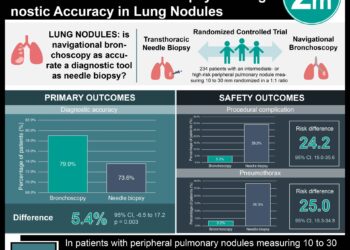
#VisualAbstract: Navigational Bronchoscopy is Noninferior to Transthoracic Needle Biopsy for Diagnostic Accuracy in Lung Nodules
StudyGraphics

#VisualAbstract: Navigational Bronchoscopy is Noninferior to Transthoracic Needle Biopsy for Diagnostic Accuracy in Lung Nodules

June 2, 2025
Next Post
Tumor size, chemoembolization response may predict hepatocellular carcinoma recurrence

MRI superior to CT for liver cancer diagnosis

Radiation plus hormone therapy may improve prostate cancer survival

Radiation plus hormone therapy may improve prostate cancer survival

Maternal vitamin D deficiency associated with preterm birth

Maternal vitamin D deficiency associated with preterm birth

EvidencePulse™ by 2 Minute Medicine 2026 evidence scan 3 reports You asked top stroke trials 2026 Synthesizing medical evidence... Top 2026 stroke trial results: OCEANIC — ischemic stroke: 6.2% vs 8.4% OPTION* — mRS 0–1: 43.6% vs 34.2% ORIENTAL* — mRS 0–2: 58.6% vs 46.6% *Higher sICH in intervention arms Participants randomizedN OCEANIC 12,327 OPTION 570 ORIENTAL 564 Ask about guidelines or landmark trials... ↑ Try EvidencePulse™ Ask the evidence.
Get the signal.
Try it now → Physician-trained medical AI by 2 Minute Medicine

2MM+ All Access

Full details →
$4.99 /month

5-day free trial · cancel anytime

  • ✓100+ physician-written reports
  • ✓EvidencePulse™ + HypeCheck™
  • ✓Ad-free reading + newsletters
Start 5-day free trial

Then $4.99/month. Manage renewal in your account.

2 Minute Medicine® is an award winning, physician-run, expert medical media company. Our content is curated, written and edited by practicing health professionals who have clinical and scientific expertise in their field of reporting. Our editorial management team is comprised of highly-trained MD physicians. Join numerous brands, companies, and hospitals who trust our licensed content.

Recent Reports

  • Earlier Genetic Testing Predicts Bilateral Mastectomy in Young BRCA Carriers
  • Uterine-Sparing Mesh Repair Outperforms Hysterectomy for Prolapse
  • Daraxonrasib showed antitumor activity in previously treated RAS-mutant non–small-cell lung cancer
License Content
Terms of Use | Disclaimer
Cookie Policy
Cleantalk Pixel
  • About
  • Specialties
    • All Specialties, All Recent Reports
    • Cardiology
    • Chronic Disease
    • Dermatology
    • Emergency
    • Endocrinology
    • Gastroenterology
    • Imaging and Intervention
    • Infectious Disease
    • Nephrology
    • Neurology
    • Obstetrics
    • Oncology
    • Ophthalmology
    • Pediatrics
    • Pharma
    • Preclinical
    • Psychiatry
    • Public Health
    • Pulmonology
    • Rheumatology
    • Surgery
  • Tools
    • EvidencePulse™
    • HypeCheck™
    • NPI Registry Lookup
    • RVU Search
  • Pharma
  • AI Roundup
  • The Scan
  • Classics™
    • 2MM+ Online Access
    • Paperback and Ebook
  • Rewinds
  • Partners
    • License Content
    • Submit Press Release
    • Advertise with Us
  • Account
    • Subscribe
    • My account
    • Cart
    • Sign-in
No Result
View All Result

© 2026 2 Minute Medicine, Inc. - Physician-written medical news.

2MM+ All Access Full details →

The medical literature, distilled daily.

Monthly plan selected: $4.99 /month.

$4.99/month

5-day free trial · cancel anytime

Start 5-day free trial

Then $4.99/month. Manage renewal in your account.

Yearly plan selected: $49.90 /year.

$49.90/year

2 months free · only $4.16/month

Start 5-day free trial

Then $49.90/year. Manage renewal in your account.

Membership benefits

  • ✓100+ physician-written reports
  • ✓AI EvidencePulse™ + HypeCheck™
  • ✓Ad-free reading + newsletters

Already a member? Sign in