• About
  • Masthead
  • License Content
  • Advertise
  • Press Releases
  • Newsroom
  • RSS/Email List
  • 2MM Podcast
  • Write for us
  • Contact Us
2 Minute Medicine
No Result
View All Result

No products in the cart.

Sign in
SUBSCRIBE
  • About
  • Specialties
    • All Specialties, All Recent Reports
    • Cardiology
    • Chronic Disease
    • Dermatology
    • Emergency
    • Endocrinology
    • Gastroenterology
    • Imaging and Intervention
    • Infectious Disease
    • Nephrology
    • Neurology
    • Obstetrics
    • Oncology
    • Ophthalmology
    • Pediatrics
    • Pharma
    • Preclinical
    • Psychiatry
    • Public Health
    • Pulmonology
    • Rheumatology
    • Surgery
    • Rewinds
    • The Scan
  • EvidencePulse™
  • HypeCheck™
  • AI News
  • Classics™
    • 2MM+ Online Access
    • Paperback and Ebook
  • Tools
    • NPI Registry Lookup
    • RVU Search
    • ICD-10 Code Lookup
    • Medical School Rankings
    • FDA Drug Approvals
    • Drug Safety for Breastfeeding/Pregnancy
    • Clinical Guidelines
    • Medical Calculators
    • ECG Reference
      • QTc Calculator
      • Sgarbossa Criteria
      • ECG Axis Calculator
      • AV Block Helper
  • Partners
    • License Content
    • Advertise with Us
2 Minute Medicine
  • About
  • Specialties
    • All Specialties, All Recent Reports
    • Cardiology
    • Chronic Disease
    • Dermatology
    • Emergency
    • Endocrinology
    • Gastroenterology
    • Imaging and Intervention
    • Infectious Disease
    • Nephrology
    • Neurology
    • Obstetrics
    • Oncology
    • Ophthalmology
    • Pediatrics
    • Pharma
    • Preclinical
    • Psychiatry
    • Public Health
    • Pulmonology
    • Rheumatology
    • Surgery
    • Rewinds
    • The Scan
  • EvidencePulse™
  • HypeCheck™
  • AI News
  • Classics™
    • 2MM+ Online Access
    • Paperback and Ebook
  • Tools
    • NPI Registry Lookup
    • RVU Search
    • ICD-10 Code Lookup
    • Medical School Rankings
    • FDA Drug Approvals
    • Drug Safety for Breastfeeding/Pregnancy
    • Clinical Guidelines
    • Medical Calculators
    • ECG Reference
      • QTc Calculator
      • Sgarbossa Criteria
      • ECG Axis Calculator
      • AV Block Helper
  • Partners
    • License Content
    • Advertise with Us
Sign in
SUBSCRIBE
2 Minute Medicine
Sign in
Subscribe
2 Minute MedicineFree on Google PlayGet
✦EvidencePulse™by 2 Minute Medicine3 reportsYou askedtop stroke trials 2026Synthesizing medical evidence...Top 2026 stroke trial results:OCEANIC — ischemic stroke: 6.2% vs 8.4%OPTION* — mRS 0–1: 43.6% vs 34.2%ORIENTAL* — mRS 0–2: 58.6% vs 46.6%*Higher sICH in intervention armsParticipants randomizedNOCEANIC12,327OPTION570ORIENTAL564Ask about guidelines or landmark trials...↑Try EvidencePulse™Ask the evidence. Get the signal.Try it now →
Home All Specialties Oncology

Overall survival is similar for patients receiving CT-based or minimal follow-up after surgical resection of non-small-cell lung cancer
byKassandra McFarlaneandSze Wah Samuel Chan
August 29, 2022
in Chronic Disease, Oncology, Pulmonology
Reading Time: 3 mins read
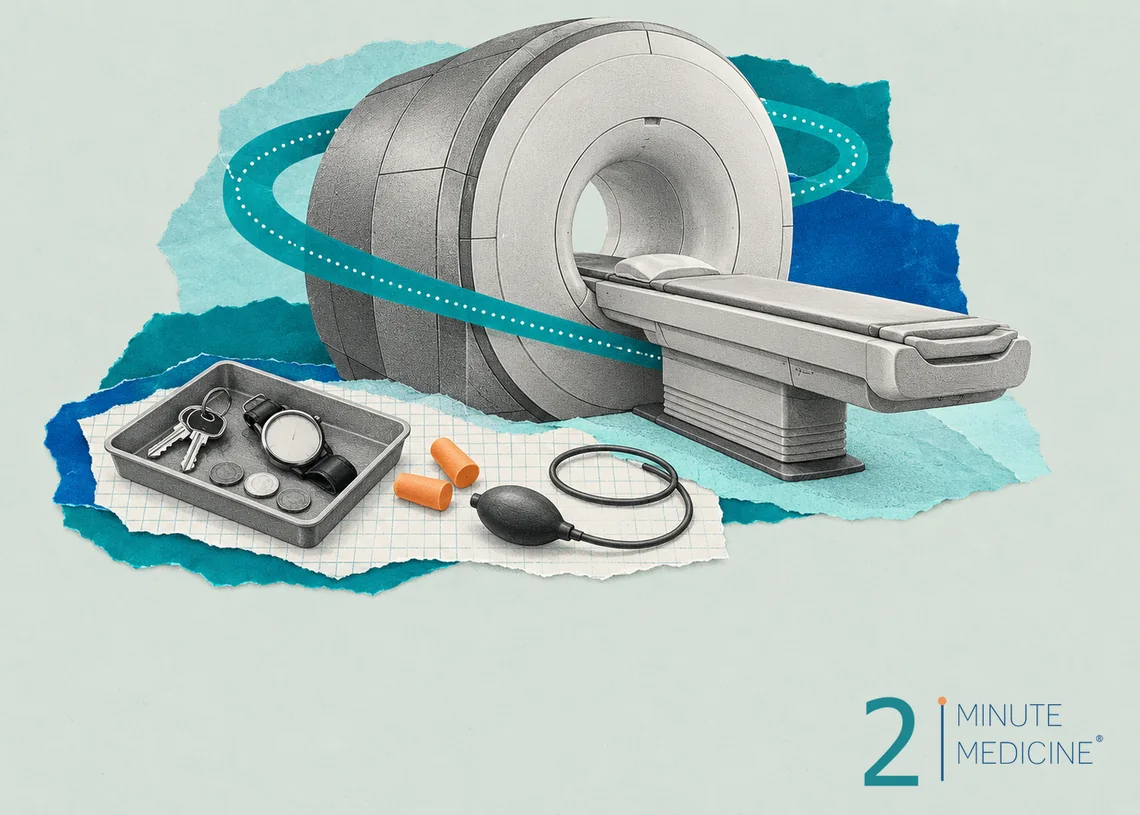
Collage for an MRI: an engraved scanner with an empty table, foam earplugs, a call button and a tray of keys and a watch
Share on FacebookShare on TwitterShare on LinkedIn

1. There was no difference in median overall survival between minimal follow-up and CT-based follow-up groups.

2. Disease-free survival was not significantly different between minimal follow-up and CT-based follow-up groups.

Evidence Rating Level: 1 (Excellent)

Study Rundown: For patients with non-small-cell lung cancer (NSCLC) who meet the guidelines, the standard of care is to receive surgical resection of their tumour(s). Regardless, there is a high risk of recurrent disease and lung cancer is the primary cause of death in this population. This randomized controlled study aimed to compare the outcomes between CT-based surveillance and minimal follow-up measures post-surgical resection of NSCLC tumours. The primary outcome of interest was overall survival (OS) and secondary outcomes included disease-free survival. In the minimal follow-up group, 44.9% of patients died, compared to 42.0% of those in the CT-based group. There was no significant difference between the groups for median OS; 8.5 years for the minimal follow-up group and 10.3 years for the CT-based group. There was similarly no difference statistically between the groups for disease-free survival. There were 404 recurrences, second primary cancers, or deaths in the minimal follow-up group, compared to 440 in the CT-based group. Limitations to this study include the high proportion of patients who had stage I and I NSCLC that contributed to less OS events and reduced power of the study. Additionally, the study excluded patients who had received wedge resections, so applications of the results from this study should be considered cautiously in those patient groups. Overall, the results from this study provide evidence that the inclusion of CT scan for follow-up post surgical intervention for non-small-cell lung cancer does not improve overall survival as compared to minimal follow-up strategies that include chest x-ray.

Click to read the study in The Lancet Oncology

Relevant Reading: Let us not underestimate the long-term risk of SPLC after surgical resection of NSCLC

RELATED REPORTS

Daraxonrasib showed antitumor activity in previously treated RAS-mutant non–small-cell lung cancer

Perioperative toripalimab improves event-free survival in non-small cell lung cancer

FDA approvedFor non-small cell lung cancer: Jideytro (zidesamtinib), Jul 22, 2026→

In-Depth [ randomized controlled trial]: This open-label, phase 3, randomized controlled trial was conducted out of 122 healthcare centres in France. The study enrolled 1,775 adult patients to receive one of two follow-up options; 888 were allocated to the minimal follow-up group, consisting of chest x-ray, and 887 were allocated to receive CT-based follow-up, which included chest x-rays, thoraco-abdominal contrast-enhanced CT scan, and fibre-optic bronchoscopy. Patients had received their surgical resections within the previous 8 weeks of enrollment. The median OS for patients in the minimal follow-up group was 8.5 years (95% confidence interval (CI), 7.4-9.6 years) compared to 10.3 years (95% CI, 8.1 – not reached) for patients in the CT-based group (hazard ratio (HR) 0.95, 95% CI, 0.83-1.10). There were also no differences between 3- and 5-year OS rates between the groups. Three year OS for the minimal follow-up group was 77.2% (95% CI, 74.5-80) vs 76.1% (95% CI, 73.3-78.9) for the CT-based group. The median OS after 5 years for the minimal follow-up group was 66.8% (95% CI, 63.7-69.0) vs 65.8% (95% CI, 62.6-68.9) for the CT-based group. There was no significant difference between groups for disease-free survival; 4.9 years (95% CI, 4.3-not reached) in the CT-based group compared to median not reached (95% CI not reached-not reached) in the minimal follow-up group (adjusted HR 1.14; 95% CI, 0.99-1.30).

Image: PD

©2022 2 Minute Medicine, Inc. All rights reserved. No works may be reproduced without expressed written consent from 2 Minute Medicine, Inc. Inquire about licensing here. No article should be construed as medical advice and is not intended as such by the authors or by 2 Minute Medicine, Inc.

Tags: lung cancer surveillancenon-small cell lung cancer (NSCLC)resected lung cancer
Previous Post

Talimogene laherparepvec addition to pembrolizumab showed no significant clinical improvement in advanced melanoma

Next Post

Characteristics of mpox virus infections across 16 countries

RelatedReports

Dacomitinib may be effective in EGFR-associated lung cancer
Oncology

Daraxonrasib showed antitumor activity in previously treated RAS-mutant non–small-cell lung cancer

September 4, 2026
Lung cancer immunotherapy collage: engraved lungs and trachea, a cluster of round immune cells and a folded surgical towel
Surgery

Perioperative toripalimab improves event-free survival in non-small cell lung cancer

August 9, 2026
Lung cancer collage: engraved lungs with the trachea and branching bronchi above a knitted wool scarf and a pine sprig
Chronic Disease

Ivonescimab improves survival in advanced non-small cell lung cancer

April 30, 2025
Chronic Disease

Perioperative pembrolizumab improves survival in resectable early-stage non-small cell lung cancer

October 17, 2024
Next Post

Characteristics of mpox virus infections across 16 countries

Aflibercept monotherapy equivalent to bevacizumab first for diabetic macular edema

Tailored care approaches may improve glaucoma medication adherence

✦ EvidencePulse™ by 2 Minute Medicine 3 reports You asked top stroke trials 2026 Synthesizing medical evidence... Top 2026 stroke trial results: OCEANIC — ischemic stroke: 6.2% vs 8.4% OPTION* — mRS 0–1: 43.6% vs 34.2% ORIENTAL* — mRS 0–2: 58.6% vs 46.6% *Higher sICH in intervention arms Participants randomizedN OCEANIC 12,327 OPTION 570 ORIENTAL 564 Ask about guidelines or landmark trials... Try EvidencePulse™ Get the signal. Try it now → Physician-trained medical AI by 2 Minute Medicine

2MM+ All Access

Full details →
$4.99 /month

3-day free trial · cancel anytime

  • ✓100+ physician-written reports
  • ✓EvidencePulse™ + HypeCheck™
  • ✓Ad-free reading + newsletters
Start 3-day free trial

Then $4.99/month. Manage renewal in your account.

NPI Lookup · Free

Look up any US clinician

Search by name or NPI number, live from the CMS NPI Registry.

  • OIG exclusion check
  • Licenses and specialties
  • No account needed
Open NPI Lookup →

2 Minute Medicine® is an award winning, physician-run, expert medical media company. Our content is curated, written and edited by practicing health professionals who have clinical and scientific expertise in their field of reporting. Our editorial management team is comprised of highly-trained MD physicians. Join numerous brands, companies, and hospitals who trust our licensed content.

Recent Reports

  • Early mitral valve surgery may improve long-term survival in asymptomatic severe mitral regurgitation
  • CDC reports increasing early-season influenza activity and at least 900 deaths nationwide
  • A concentrated exposure therapy intervention may be more effective than digital cognitive behavioural therapy in obsessive-compulsive disorder
License Content
Terms of Use | Disclaimer
Cookie Policy

Get the app

Read 2 Minute Medicine on iPhone, iPad and Android.

Download on the App StoreGet it on Google Play
QR code for www.2minutemedicine.com/app
On a computer? Scan this with your phone’s camera.
2MM+ All Access Full details →

The medical literature, distilled daily.

Monthly plan selected: $4.99 /month.

$4.99/month

3-day free trial · cancel anytime

Start 3-day free trial

Then $4.99/month. Manage renewal in your account.

Yearly plan selected: $49.90 /year.

$49.90/year

2 months free

Start 3-day free trial

Then $49.90/year.

Membership benefits

  • ✓100+ physician-written reports
  • ✓AI EvidencePulse™ + HypeCheck™
  • ✓Ad-free reading + newsletters
  • ✓NPI watchlist + bulk NPI verification

Already a member? Sign in

  • Get the app
  • About
  • Specialties
    • All Specialties, All Recent Reports
    • Cardiology
    • Chronic Disease
    • Dermatology
    • Emergency
    • Endocrinology
    • Gastroenterology
    • Imaging and Intervention
    • Infectious Disease
    • Nephrology
    • Neurology
    • Obstetrics
    • Oncology
    • Ophthalmology
    • Pediatrics
    • Pharma
    • Preclinical
    • Psychiatry
    • Public Health
    • Pulmonology
    • Rheumatology
    • Surgery
    • Rewinds
    • The Scan
  • EvidencePulse™
  • HypeCheck™
  • AI News
  • Classics™
    • 2MM+ Online Access
    • Paperback and Ebook
  • Tools
    • NPI Registry Lookup
    • RVU Search
    • ICD-10 Code Lookup
    • Medical School Rankings
    • FDA Drug Approvals
    • Drug Safety for Breastfeeding/Pregnancy
    • Clinical Guidelines
    • Medical Calculators
    • ECG Reference
      • QTc Calculator
      • Sgarbossa Criteria
      • ECG Axis Calculator
      • AV Block Helper
  • Partners
    • License Content
    • Advertise with Us
No Result
View All Result

© 2026 2 Minute Medicine, Inc. - Physician-written medical news.