

Patient Basics: Anal Disorders
Anal disorders are problems that affect the anus, the opening at the end of the digestive tract where stool leaves the body. They are very common and often cause pain, itching, bleeding or a lump. Many people feel embarrassed and put off getting help, but most of these problems are easy to treat. Bleeding from the bottom should always be checked by a doctor, because it can have more than one cause.
Key points
- Hemorrhoids, small tears (fissures) and itching are the most common anal problems.
- Hard stools and straining cause or worsen many of them. More fiber and water often help.
- Warm-water soaks ease pain and swelling from many conditions.
- A painful, swollen lump with fever may be an abscess and needs prompt drainage.
- Don’t assume rectal bleeding is from hemorrhoids, especially if you are 45 or older or your bowel habits have changed.
Common anal disorders
Hemorrhoids
Everyone has cushions of blood vessels in and around the anus. When they swell, they are called hemorrhoids. Internal hemorrhoids are inside and usually painless, but they can bleed bright red blood on the toilet paper or in the bowl, or bulge out during a bowel movement. External hemorrhoids lie under the skin around the anus and can itch or ache. If a clot forms in one (a thrombosed hemorrhoid, also called a perianal hematoma), it becomes a hard, very painful purple lump. Straining, constipation, pregnancy, long sitting on the toilet and heavy lifting all play a part.
Anal fissure
A fissure is a small tear in the lining of the anus, usually from passing a hard or large stool. It causes sharp, cutting pain during bowel movements and a burning ache that can last an hour or more afterward, often with a streak of bright blood. The anal muscle can go into spasm, which slows healing. Most fissures heal within a few weeks with softer stools.
Itching (pruritus ani)
Itching around the anus is common. Causes include moisture, leftover stool, too much wiping or scrubbing, scented soaps and wipes, some foods and drinks such as coffee and spicy food, skin conditions such as eczema or psoriasis, yeast infections and pinworms in children. Scratching makes it worse.
Abscess and fistula
A perianal abscess is a pocket of pus near the anus, caused by an infected gland. It causes a red, swollen, throbbing lump that hurts more when you sit, often with fever. A deeper ischiorectal abscess may show less swelling but cause deep pain and fever. After an abscess drains, about 1 in 3 people develop a fistula, a small tube-like tunnel between the inside of the anus and the skin nearby that leaks pus or fluid. Fistulas are more common in people with Crohn’s disease.
Other conditions
- Skin tags are small, soft flaps of skin, often left after a hemorrhoid or fissure heals. They are harmless.
- Anal warts are caused by human papillomavirus (HPV).
- Rectal prolapse is when the lower part of the bowel slides out through the anus. It is most common in older women.
- Fecal incontinence means trouble controlling gas or stool. It can follow childbirth injuries, surgery or nerve damage.
- Proctitis is inflammation of the rectum lining, from inflammatory bowel disease, infections including some sexually transmitted ones, or radiation.
- Anal cancer is uncommon. It is mostly linked to HPV, and the risk is higher in people with HIV, those who smoke, and people with weak immune systems.
What your symptoms may mean
- Bright red blood without pain: often internal hemorrhoids, but other causes need to be ruled out
- Sharp pain with bowel movements: often a fissure
- A sudden painful lump at the edge of the anus: often a clotted hemorrhoid
- Throbbing pain, swelling and fever: possibly an abscess
- Itching: often moisture, irritation or a skin problem
- Dark or mixed-in blood, or a change in bowel habits: needs a doctor’s visit soon
How doctors find the cause
A doctor will ask about your symptoms and bowel habits and look at the area. A gloved, lubricated finger can feel inside the anus (a digital rectal exam). A short, lighted tube (anoscope) shows the lining. If a fissure is too painful, the exam may be gentle or done later. A colonoscopy may be recommended for bleeding if you are 45 or older, if you have a family history of colon cancer, or if you have other warning signs such as weight loss or anemia.
Home care that helps many conditions
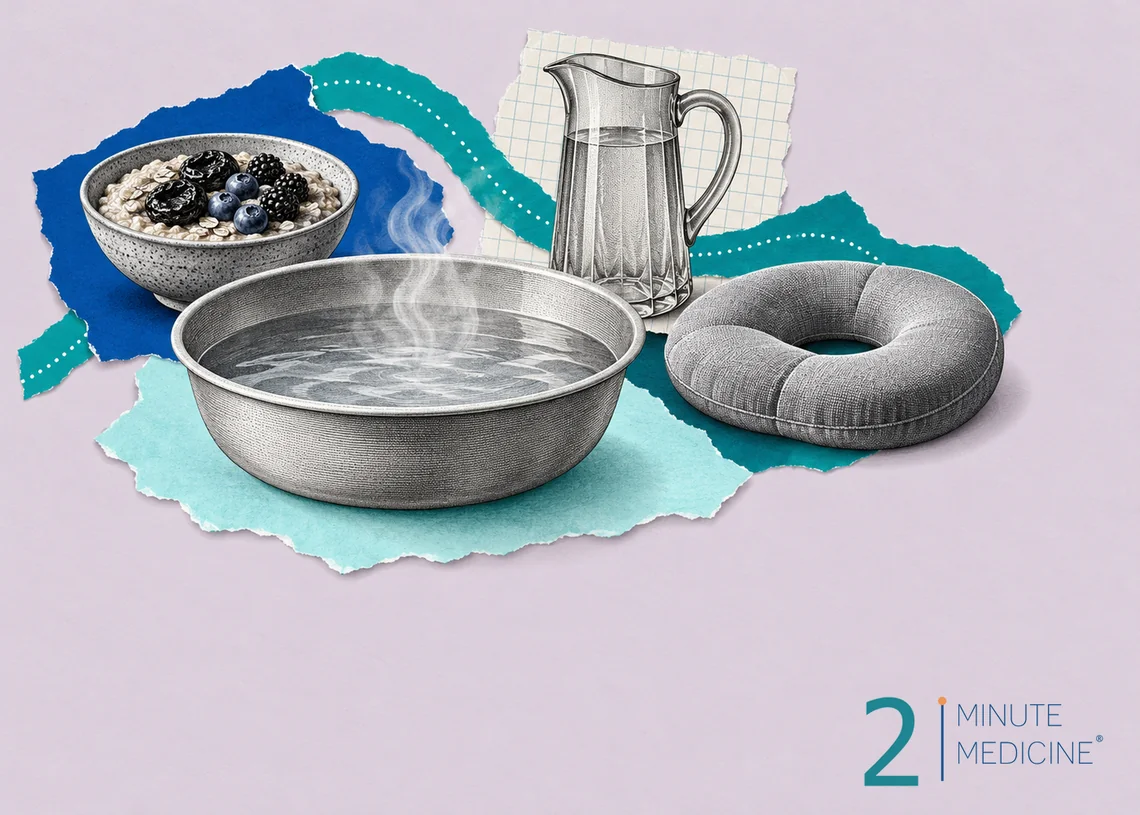
- Keep stools soft. Eat more fruits, vegetables, beans and whole grains. A fiber supplement such as psyllium helps too. Drink plenty of water.
- Don’t strain or sit on the toilet for long periods. Leave your phone outside.
- Sitz baths. Sit in a few inches of warm water for 10 to 15 minutes, a few times a day and after bowel movements.
- Clean gently. Rinse with water or use soft, unscented wipes, then pat dry. Avoid scented soaps and scrubbing.
- Short-term creams. Over-the-counter hemorrhoid creams and hydrocortisone can ease itching and swelling. Use hydrocortisone for no more than a week unless a doctor says otherwise.
- Pain relief. Acetaminophen or ibuprofen can help. Opioid pain medicines cause constipation.
Medical treatments for anal disorders
- Hemorrhoids: in the office, a doctor can place a tiny rubber band around an internal hemorrhoid so it shrinks and falls off. Other options include injections or heat treatment. Large or troublesome hemorrhoids may need surgery. A clotted external hemorrhoid can be removed in the first few days to ease pain.
- Fissures: prescription ointments such as nitroglycerin or diltiazem relax the anal muscle so the tear can heal. Botulinum toxin (Botox) injections or a small operation to loosen the muscle help fissures that don’t heal.
- Abscesses: must be drained. Antibiotics alone don’t cure them.
- Fistulas: usually need surgery. The surgeon chooses a method that protects the muscles that control bowel movements.
- Warts: can be frozen, removed or treated with creams.
- Prolapse: usually needs surgery.
- Incontinence: often improves with more fiber, pelvic floor exercises and biofeedback.
When to see a doctor
- Any bleeding from the bottom, or blood in your stool
- Pain or itching that lasts more than a week despite home care
- A lump that is new, growing or won’t go away
- A change in bowel habits that lasts more than a few weeks
- Pus or fluid leaking near the anus
- Trouble controlling stool or gas
Get emergency care for heavy bleeding, bleeding with dizziness or fainting, or severe pain and swelling near the anus with fever, especially if you have diabetes or a weak immune system.
Common questions about anal disorders
How is a perianal abscess treated?
A doctor drains it through a small cut, often in the office or emergency department with numbing medicine. Deep or large abscesses are drained in an operating room. Pain usually eases quickly once the pus is out. Antibiotics are added for some people, such as those with diabetes or spreading redness.
What causes a thrombosed hemorrhoid?
Blood pools and clots inside an external hemorrhoid. Straining, constipation or diarrhea, heavy lifting, long sitting and pregnancy are common triggers. The pain is worst in the first 2 or 3 days and usually settles within 1 to 2 weeks, though the lump can take longer to shrink.
Why is clear liquid coming out of my anus?
Small amounts of clear or yellowish mucus can come from internal hemorrhoids that bulge out, a fistula, rectal prolapse, proctitis or irritable bowel syndrome. The moisture often makes the skin itch. See a doctor if it keeps happening, contains blood or pus, or comes with pain or fever.
Questions to ask your doctor
- What is causing my symptoms?
- Do I need a colonoscopy?
- Which creams or products are safe for me to use, and for how long?
- What can I do to keep this from coming back?
- Would an office procedure or surgery help?
Learn more
- Anal disorders (MedlinePlus, U.S. National Library of Medicine)
- Hemorrhoids (National Institute of Diabetes and Digestive and Kidney Diseases)
This guide is general information and doesn’t replace advice from your own doctor. Last updated October 2026.






 Get the app