• About
  • Masthead
  • License Content
  • Advertise
  • Press Releases
  • Newsroom
  • RSS/Email List
  • 2MM Podcast
  • Write for us
  • Contact Us
2 Minute Medicine
No Result
View All Result

No products in the cart.

Sign in
SUBSCRIBE
  • About
  • Specialties
    • All Specialties, All Recent Reports
    • Cardiology
    • Chronic Disease
    • Dermatology
    • Emergency
    • Endocrinology
    • Gastroenterology
    • Imaging and Intervention
    • Infectious Disease
    • Nephrology
    • Neurology
    • Obstetrics
    • Oncology
    • Ophthalmology
    • Pediatrics
    • Pharma
    • Preclinical
    • Psychiatry
    • Public Health
    • Pulmonology
    • Rheumatology
    • Surgery
    • Rewinds
    • The Scan
  • EvidencePulse™
  • HypeCheck™
  • AI News
  • Classics™
    • 2MM+ Online Access
    • Paperback and Ebook
  • Tools
    • NPI Registry Lookup
    • RVU Search
    • Physician Pay by Specialty
    • ICD-10 Code Lookup
    • FDA Drug Approvals
    • Drug Safety for Breastfeeding/Pregnancy
    • Clinical Guidelines
    • Medical Calculators
    • ECG Reference
      • QTc Calculator
      • Sgarbossa Criteria
      • ECG Axis Calculator
      • AV Block Helper
  • Rankings
    • Medical School Rankings
    • Residency Rankings
  • Partners
    • License Content
    • Advertise with Us
2 Minute Medicine
  • About
  • Specialties
    • All Specialties, All Recent Reports
    • Cardiology
    • Chronic Disease
    • Dermatology
    • Emergency
    • Endocrinology
    • Gastroenterology
    • Imaging and Intervention
    • Infectious Disease
    • Nephrology
    • Neurology
    • Obstetrics
    • Oncology
    • Ophthalmology
    • Pediatrics
    • Pharma
    • Preclinical
    • Psychiatry
    • Public Health
    • Pulmonology
    • Rheumatology
    • Surgery
    • Rewinds
    • The Scan
  • EvidencePulse™
  • HypeCheck™
  • AI News
  • Classics™
    • 2MM+ Online Access
    • Paperback and Ebook
  • Tools
    • NPI Registry Lookup
    • RVU Search
    • Physician Pay by Specialty
    • ICD-10 Code Lookup
    • FDA Drug Approvals
    • Drug Safety for Breastfeeding/Pregnancy
    • Clinical Guidelines
    • Medical Calculators
    • ECG Reference
      • QTc Calculator
      • Sgarbossa Criteria
      • ECG Axis Calculator
      • AV Block Helper
  • Rankings
    • Medical School Rankings
    • Residency Rankings
  • Partners
    • License Content
    • Advertise with Us
Sign in
SUBSCRIBE
2 Minute Medicine
Sign in
Subscribe
2 Minute MedicineFree on Google PlayGet
✦EvidencePulse™by 2 Minute Medicine3 reportsYou askedtop stroke trials 2026Synthesizing medical evidence...Top 2026 stroke trial results:OCEANIC — ischemic stroke: 6.2% vs 8.4%OPTION* — mRS 0–1: 43.6% vs 34.2%ORIENTAL* — mRS 0–2: 58.6% vs 46.6%*Higher sICH in intervention armsParticipants randomizedNOCEANIC12,327OPTION570ORIENTAL564Ask about guidelines or landmark trials...↑Try EvidencePulse™Ask the evidence. Get the signal.Try it now →
Home Health A to Z

Patient Basics: Head and Neck Cancer

by2 Minute Medicine
October 30, 2026
in Health A to Z
Reading Time: 6 mins read
Head and neck cancer collage: a calm man in his 60s with a gray beard beside a voice box drawing, a dental mirror and a mug
Share on FacebookShare on TwitterShare on LinkedIn

Head and neck cancer is a group of cancers that start in the mouth, throat, voice box (larynx), nose and sinuses, or salivary glands. Tobacco, alcohol and the human papillomavirus (HPV) cause most of them. A mouth sore that won’t heal, a lump in the neck or hoarseness that lasts more than a few weeks should be checked. Found early, many of these cancers can be cured.

Key points

  • Most head and neck cancers grow from the thin, flat cells lining the mouth, nose and throat (squamous cell carcinoma).
  • HPV now causes most cancers of the tonsils and back of the tongue in the US, often in people who have never smoked.
  • Treatment may include surgery, radiation, chemotherapy, targeted medicines and immunotherapy, often in combination.
  • Treatment can affect eating, swallowing, speaking and appearance, so a team that includes speech and dental specialists is part of care.
  • Not using tobacco, limiting alcohol and getting the HPV vaccine lower the risk.

Where head and neck cancers start

  • Mouth (oral cavity): lips, gums, the front of the tongue, the floor and roof of the mouth, and the inside of the cheeks
  • Throat (pharynx): the upper part behind the nose (nasopharynx), the middle part with the tonsils and base of the tongue (oropharynx), and the lower part (hypopharynx)
  • Voice box (larynx), which holds the vocal cords
  • Nose and sinuses
  • Salivary glands, mostly the large gland in front of the ear

Cancers of the thyroid, brain, eye and skin are usually treated as separate types.

What causes head and neck cancer

  • Tobacco in any form, including cigarettes, cigars, pipes, chewing tobacco and snuff
  • Alcohol. Heavy drinking raises the risk, and drinking plus smoking raises it far more than either alone.
  • HPV infection, mainly type 16, which spreads through sexual contact, including oral sex
  • Betel quid or areca nut, chewed in parts of Asia and in some US communities
  • Epstein-Barr virus, linked to cancer of the nasopharynx, which is more common in people of Southeast Asian or North African descent
  • Sun exposure, for cancer of the lip
  • Work exposures such as wood dust, nickel or formaldehyde, for nose and sinus cancers
  • A weak immune system, for example after an organ transplant

Head and neck cancer is more common in men and in people over 50.

Signs of head and neck cancer

See a doctor or dentist if any of these lasts more than 2 to 3 weeks:

  • A sore, ulcer or lump in the mouth that doesn’t heal
  • A white or red patch on the gums, tongue or lining of the mouth
  • A painless lump in the neck
  • A sore throat that won’t go away, or the sense of a lump when you swallow
  • Pain or trouble swallowing
  • Hoarseness or a change in your voice
  • Ear pain on one side, with a normal ear exam
  • A blocked nose on one side, nosebleeds or swelling around the eye or cheek
  • Loose teeth or dentures that suddenly don’t fit
  • Numbness in the face or lip, or weight loss without trying

How it’s diagnosed

  • Exam. An ear, nose and throat doctor (otolaryngologist) looks in your mouth, feels your neck and passes a thin, flexible scope through the nose to see the throat and voice box.
  • Biopsy. The doctor takes a tiny sample from the area, or draws cells from a neck lump with a fine needle, and a lab checks it for cancer. Throat cancers are tested for HPV, which affects treatment and outlook.
  • Imaging. CT, MRI or PET-CT scans show how big the cancer is and whether it has reached the lymph nodes in the neck or spread farther.
  • Dental exam, to treat tooth problems before radiation

How head and neck cancer is treated

A team of surgeons, radiation oncologists, medical oncologists, dentists, speech therapists and dietitians plans care. The choice depends on where the cancer is, its stage, its HPV status and your overall health.

  • Surgery removes the tumor and often nearby lymph nodes in the neck. Some throat cancers can be removed through the mouth with robotic or laser tools. Larger operations may need reconstruction using tissue from another part of the body.
  • Radiation is used alone for small cancers, after surgery, or with chemotherapy instead of surgery to help keep the voice box and swallowing.
  • Chemotherapy, often cisplatin, is given with radiation to make it work better.
  • Targeted therapy with cetuximab blocks a growth signal on cancer cells.
  • Immunotherapy such as pembrolizumab or nivolumab helps the immune system fight cancer that has come back or spread, and for some people it is given around the time of surgery.

Side effects and recovery

Radiation to the head and neck often causes mouth sores, a dry mouth, taste changes, painful swallowing and red skin. Some people need a feeding tube for a while. A speech-language pathologist teaches swallowing exercises that are best started before treatment. Long-term effects can include dry mouth, stiffness, tooth decay, an underactive thyroid and, rarely, damage to the jawbone, so regular dental care is important for life. If the voice box is removed, people can learn to speak again with a voice prosthesis or other devices.

RELATED REPORTS

Subcutaneous amivantamab received accelerated approval for recurrent or metastatic head and neck cancer after platinum chemotherapy and immunotherapy

#VisualAbstract: Neoadjuvant and Adjuvant Pembrolizumab in Locally Advanced Head and Neck Cancer

After treatment

Follow-up visits are frequent for the first few years, with exams and scans to check for return of the cancer. If you smoke, quitting improves treatment results and lowers the risk of a second cancer. Ask about support groups. Changes to eating, speech and appearance can affect mood, and help is available.

Lowering your risk

  • Don’t use tobacco in any form. Free help is available at 1-800-QUIT-NOW.
  • Limit alcohol.
  • Get the HPV vaccine. It is recommended at ages 11 to 12, with catch-up through age 26, and some adults up to 45 may benefit.
  • Use a lip balm with sunscreen.
  • See a dentist regularly. Dentists check for early signs of mouth cancer.

Common questions about head and neck cancer

Is head and neck cancer curable?

Often, yes, especially when found early. Many small cancers of the mouth and voice box are cured with surgery or radiation alone. Throat cancers caused by HPV respond especially well to treatment. Cancer that has spread widely is harder to cure, but treatment can control it for a long time.

Is a lump in my neck cancer?

Usually not. Most neck lumps are lymph nodes swollen from a cold, sore throat or dental infection, and they shrink within a few weeks. A lump that is painless, firm and lasts more than 2 to 3 weeks, especially in an adult, should be checked by a doctor.

Is HPV-related throat cancer contagious?

No, cancer itself can’t be passed to others. The HPV virus spreads through sexual contact, but it is very common, and most infections clear on their own. Long-term partners of people with HPV-related throat cancer don’t appear to face a much higher risk of the cancer.

Questions to ask your doctor

  • Where exactly is my cancer, what stage is it, and is it HPV-related?
  • What are my treatment options, and what are the goals of each?
  • How will treatment affect my eating, speech and appearance?
  • Should I see a dentist and a speech therapist before treatment starts?
  • How often will I need checkups afterward?

Learn more

  • Head and neck cancers (National Cancer Institute)
  • Head and neck cancer (MedlinePlus, U.S. National Library of Medicine)

This guide is general information and doesn’t replace advice from your own doctor. Last updated October 2026.

Tags: head and neck cancer
Previous Post

Patient Basics: Hemorrhagic Stroke

Next Post

Patient Basics: Head Injury in Children

RelatedReports

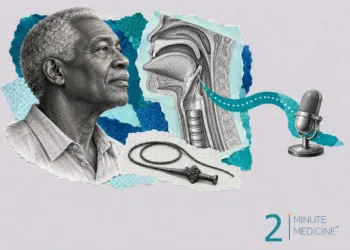
Collage on throat cancer: an older man in profile beside an engraved larynx and pharynx, a coiled scope and a microphone
2MM Trial Briefs

Subcutaneous amivantamab received accelerated approval for recurrent or metastatic head and neck cancer after platinum chemotherapy and immunotherapy

November 6, 2026
#VisualAbstract: Neoadjuvant and Adjuvant Pembrolizumab in Locally Advanced Head and Neck Cancer
StudyGraphics

#VisualAbstract: Neoadjuvant and Adjuvant Pembrolizumab in Locally Advanced Head and Neck Cancer

July 9, 2025
#VisualAbstract: Atezolizumab Does Not Improve Outcomes in High-Risk Locally Advanced Head and Neck Squamous Cell Carcinoma
StudyGraphics

#VisualAbstract: Atezolizumab Does Not Improve Outcomes in High-Risk Locally Advanced Head and Neck Squamous Cell Carcinoma

March 24, 2025
The Scan by 2 Minute Medicine®:  Ultra-Trail du Mont-Blanc, Taylor Swift, NBA rookie Chet Holmgren and Magic Mushrooms!
The Scan by 2 Minute Medicine®

The Scan by 2 Minute Medicine®: Jamie Foxx Back in Action, Paracetamol for Pain, FDA Against Addictive Vape Flavours, and Coffee and Tea, Beyond Caffeine:

January 7, 2025
Next Post
Glomerulonephritis collage: an engraved kidney with a magnified filter under a lens, a urine sample cup and a salt shaker

Patient Basics: Glomerulonephritis

Gonorrhea collage: a microscope beside a dish of paired round bacteria, a capped sample cup and a sealed pill packet

Patient Basics: Gonorrhea

Guillain-Barre syndrome collage: a calm man, a nerve fiber in a segmented teal sheath, a reflex hammer and a walker

Patient Basics: Guillain-Barre Syndrome

✦ EvidencePulse™ by 2 Minute Medicine 3 reports You asked top stroke trials 2026 Synthesizing medical evidence... Top 2026 stroke trial results: OCEANIC — ischemic stroke: 6.2% vs 8.4% OPTION* — mRS 0–1: 43.6% vs 34.2% ORIENTAL* — mRS 0–2: 58.6% vs 46.6% *Higher sICH in intervention arms Participants randomizedN OCEANIC 12,327 OPTION 570 ORIENTAL 564 Ask about guidelines or landmark trials... Try EvidencePulse™ Get the signal. Try it now → Physician-trained medical AI by 2 Minute Medicine

2MM+ All Access

Full details →
$4.99 /month

3-day free trial · cancel anytime

  • ✓100+ physician-written reports
  • ✓EvidencePulse™ + HypeCheck™
  • ✓Ad-free reading + newsletters
Start 3-day free trial

Then $4.99/month. Manage renewal in your account.

2 Minute Medicine® is an award winning, physician-run, expert medical media company. Our content is curated, written and edited by practicing health professionals who have clinical and scientific expertise in their field of reporting. Our editorial management team is comprised of highly-trained MD physicians. Join numerous brands, companies, and hospitals who trust our licensed content.

Recent Reports

  • Nipocalimab patient interviews identify mouth dryness as the most important symptom to improve in phase 2 Sjögren’s disease data
  • CDC reports 5,182 confirmed measles cases in the United States in 2026
  • In selected patients with anterior-circulation large-vessel stroke 24-72 hours after onset, thrombectomy improved 90-day function but increased hemorrhage and death
License Content
Terms of Use | Disclaimer
Cookie Policy

Get the app

Read 2 Minute Medicine on iPhone, iPad and Android.

Download on the App StoreGet it on Google Play
QR code for www.2minutemedicine.com/app
On a computer? Scan this with your phone’s camera.
2MM+ All Access Full details →

The medical literature, distilled daily.

Monthly plan selected: $4.99 /month.

$4.99/month

3-day free trial · cancel anytime

Start 3-day free trial

Then $4.99/month. Manage renewal in your account.

Yearly plan selected: $49.90 /year.

$49.90/year

2 months free

Start 3-day free trial

Then $49.90/year.

Membership benefits

  • ✓100+ physician-written reports
  • ✓AI EvidencePulse™ + HypeCheck™
  • ✓Ad-free reading + newsletters
  • ✓FDA drug approvals + clinical calculators

Already a member? Sign in

  • Get the app
  • About
  • Specialties
    • All Specialties, All Recent Reports
    • Cardiology
    • Chronic Disease
    • Dermatology
    • Emergency
    • Endocrinology
    • Gastroenterology
    • Imaging and Intervention
    • Infectious Disease
    • Nephrology
    • Neurology
    • Obstetrics
    • Oncology
    • Ophthalmology
    • Pediatrics
    • Pharma
    • Preclinical
    • Psychiatry
    • Public Health
    • Pulmonology
    • Rheumatology
    • Surgery
    • Rewinds
    • The Scan
  • EvidencePulse™
  • HypeCheck™
  • AI News
  • Classics™
    • 2MM+ Online Access
    • Paperback and Ebook
  • Tools
    • NPI Registry Lookup
    • RVU Search
    • Physician Pay by Specialty
    • ICD-10 Code Lookup
    • FDA Drug Approvals
    • Drug Safety for Breastfeeding/Pregnancy
    • Clinical Guidelines
    • Medical Calculators
    • ECG Reference
      • QTc Calculator
      • Sgarbossa Criteria
      • ECG Axis Calculator
      • AV Block Helper
  • Rankings
    • Medical School Rankings
    • Residency Rankings
  • Partners
    • License Content
    • Advertise with Us
No Result
View All Result

© 2026 2 Minute Medicine, Inc. - Physician-written medical news.