
• About
  • Masthead
  • License Content
  • Advertise
  • Press Releases
  • Newsroom
  • RSS/Email List
  • 2MM Podcast
  • Write for us
  • Contact Us
2 Minute Medicine
No Result
View All Result

No products in the cart.

Sign in
SUBSCRIBE
  • About
  • Specialties
    • All Specialties, All Recent Reports
    • Cardiology
    • Chronic Disease
    • Dermatology
    • Emergency
    • Endocrinology
    • Gastroenterology
    • Imaging and Intervention
    • Infectious Disease
    • Nephrology
    • Neurology
    • Obstetrics
    • Oncology
    • Ophthalmology
    • Pediatrics
    • Pharma
    • Preclinical
    • Psychiatry
    • Public Health
    • Pulmonology
    • Rheumatology
    • Surgery
    • Rewinds
    • The Scan
  • EvidencePulse™
  • HypeCheck™
  • AI News
  • Classics™
    • 2MM+ Online Access
    • Paperback and Ebook
  • Tools
    • NPI Registry Lookup
    • RVU Search
    • Physician Pay by Specialty
    • ICD-10 Code Lookup
    • FDA Drug Approvals
    • Drug Safety for Breastfeeding/Pregnancy
    • Clinical Guidelines
    • Medical Calculators
    • ECG Reference
      • QTc Calculator
      • Sgarbossa Criteria
      • ECG Axis Calculator
      • AV Block Helper
  • Rankings
    • Medical School Rankings
    • Residency Rankings
  • Partners
    • License Content
    • Advertise with Us
2 Minute Medicine
  • About
  • Specialties
    • All Specialties, All Recent Reports
    • Cardiology
    • Chronic Disease
    • Dermatology
    • Emergency
    • Endocrinology
    • Gastroenterology
    • Imaging and Intervention
    • Infectious Disease
    • Nephrology
    • Neurology
    • Obstetrics
    • Oncology
    • Ophthalmology
    • Pediatrics
    • Pharma
    • Preclinical
    • Psychiatry
    • Public Health
    • Pulmonology
    • Rheumatology
    • Surgery
    • Rewinds
    • The Scan
  • EvidencePulse™
  • HypeCheck™
  • AI News
  • Classics™
    • 2MM+ Online Access
    • Paperback and Ebook
  • Tools
    • NPI Registry Lookup
    • RVU Search
    • Physician Pay by Specialty
    • ICD-10 Code Lookup
    • FDA Drug Approvals
    • Drug Safety for Breastfeeding/Pregnancy
    • Clinical Guidelines
    • Medical Calculators
    • ECG Reference
      • QTc Calculator
      • Sgarbossa Criteria
      • ECG Axis Calculator
      • AV Block Helper
  • Rankings
    • Medical School Rankings
    • Residency Rankings
  • Partners
    • License Content
    • Advertise with Us
Sign in
SUBSCRIBE
2 Minute Medicine
Sign in
Subscribe
2 Minute MedicineFree on Google PlayGet
✦EvidencePulse™by 2 Minute Medicine3 reportsYou askedtop stroke trials 2026Synthesizing medical evidence...Top 2026 stroke trial results:OCEANIC — ischemic stroke: 6.2% vs 8.4%OPTION* — mRS 0–1: 43.6% vs 34.2%ORIENTAL* — mRS 0–2: 58.6% vs 46.6%*Higher sICH in intervention armsParticipants randomizedNOCEANIC12,327OPTION570ORIENTAL564Ask about guidelines or landmark trials...↑Try EvidencePulse™Ask the evidence. Get the signal.Try it now →
Home Health A to Z

Patient Basics: Leukemia (Overview)
by2 Minute Medicine
October 30, 2026
in Health A to Z
Reading Time: 5 mins read
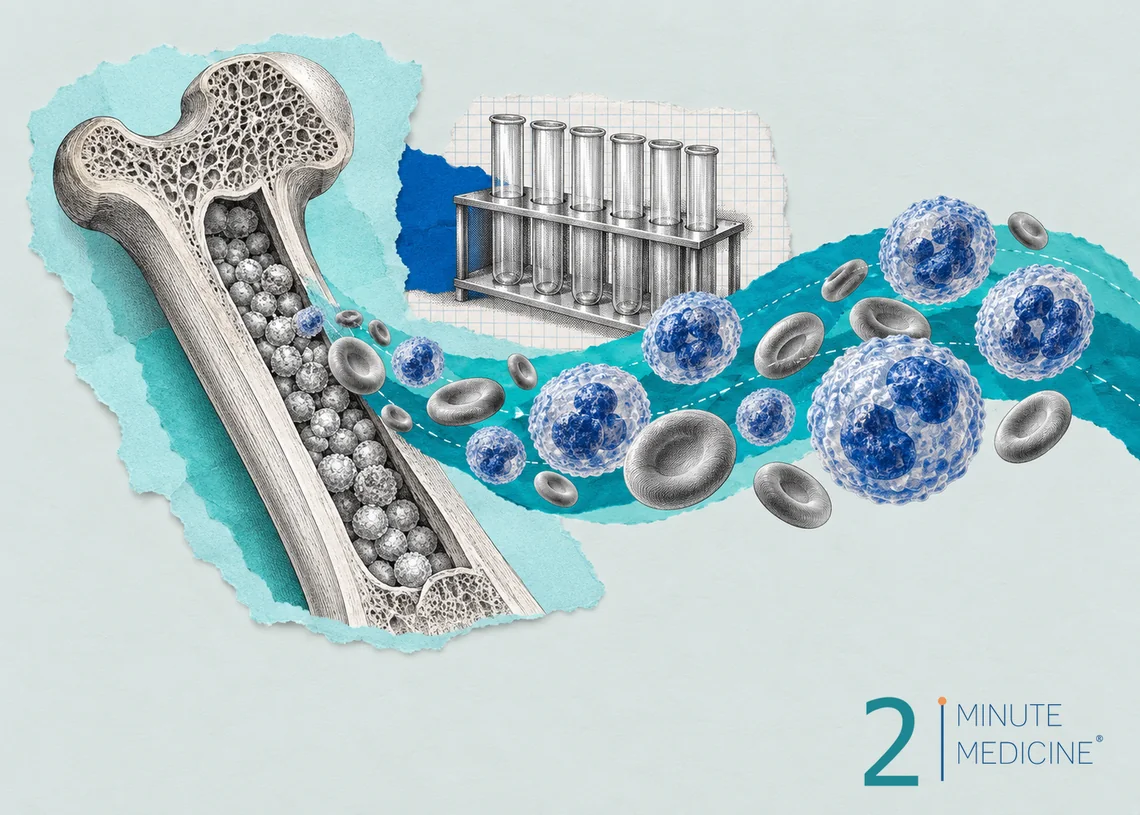
Leukemia collage: engraved red and white blood cells drifting from a bone cross-section, with a rack of blank test tubes
Share on FacebookShare on TwitterShare on LinkedIn

Leukemia is a cancer of the blood-forming cells in the bone marrow, the soft tissue inside bones. The marrow makes large numbers of abnormal white blood cells that don’t work properly and crowd out healthy blood cells. There are several types, and treatment and outlook differ a great deal between them, so knowing the exact type is the first step.

Key points

  • The four main types are acute lymphocytic (ALL), acute myeloid (AML), chronic lymphocytic (CLL) and chronic myeloid (CML) leukemia.
  • Acute leukemias come on fast and need treatment right away. Chronic leukemias often grow slowly over years.
  • Tiredness, infections that keep coming back, easy bruising or bleeding, and fevers are common signs.
  • Blood tests and a bone marrow test confirm the diagnosis and the type.
  • Treatment may include chemotherapy, targeted pills, immunotherapy or a stem cell transplant. Some slow types need only regular checkups at first.

How leukemia develops

Your bone marrow makes three kinds of blood cells: red cells carry oxygen, white cells fight infection, and platelets help blood clot. Leukemia starts when a young blood cell picks up changes in its genes and begins copying itself out of control. These leukemia cells fill the marrow and spill into the blood. With fewer healthy cells, people become anemic (short of red cells), catch infections easily and bleed or bruise more.

Types of leukemia

Doctors sort leukemia in two ways. Acute or chronic describes how fast it grows. Lymphocytic or myeloid describes which family of blood cells it comes from.

  • Acute lymphocytic leukemia (ALL). The most common cancer in children. It also affects adults.
  • Acute myeloid leukemia (AML). The most common acute leukemia in adults, mostly in people over 60.
  • Chronic lymphocytic leukemia (CLL). The most common leukemia in adults in the US. It often grows slowly and is mostly found in people over 60, often by a routine blood test.
  • Chronic myeloid leukemia (CML). Caused by a swap between two chromosomes that makes an abnormal gene called BCR-ABL. Daily pills now control it well for most people.

Rarer types include hairy cell leukemia, acute promyelocytic leukemia (a form of AML), chronic myelomonocytic leukemia and large granular lymphocytic leukemia. Some of these have their own specific treatments.

Leukemia causes and risk factors

Most people with leukemia have no clear cause. Things that raise the risk include:

  • Older age, for most types
  • Past chemotherapy or radiation for another cancer
  • High levels of radiation, or long contact with the chemical benzene
  • Smoking, which raises the risk of AML
  • Some genetic conditions, such as Down syndrome
  • Other bone marrow diseases, such as myelodysplastic syndrome
  • A parent, brother or sister with CLL

Leukemia is not contagious, and most cases are not passed down in families.

RELATED REPORTS

No Content Available

Leukemia symptoms

  • Feeling very tired or weak, looking pale, or getting short of breath
  • Fevers, or infections that keep coming back or won’t clear
  • Bruising easily, nosebleeds or bleeding gums
  • Tiny red or purple dots on the skin (petechiae)
  • Bone or joint pain
  • Swollen lymph nodes in the neck, armpits or groin
  • A full or uncomfortable feeling under the left ribs from a swollen spleen
  • Night sweats and weight loss without trying

Acute leukemia often causes these signs over a few weeks. Chronic leukemia may cause no symptoms at all for years.

How leukemia is diagnosed

  • Complete blood count (CBC). Counts red cells, white cells and platelets. Abnormal counts are often the first clue.
  • Blood smear. A specialist looks at your blood under a microscope for leukemia cells.
  • Bone marrow test. A needle takes a small sample of liquid marrow and a tiny core of bone, usually from the back of the hip bone. You get numbing medicine first.
  • Cell and gene tests. Lab tests on the leukemia cells, such as flow cytometry and chromosome and gene studies, pin down the exact type. They also show which targeted drugs may work.
  • Spinal tap (lumbar puncture). Checks the fluid around the brain and spinal cord in types that can spread there, such as ALL.

How leukemia is treated

A blood cancer doctor (hematologist-oncologist) plans treatment based on the type, the gene changes in the leukemia cells, your age and your overall health.

Acute leukemia

Treatment starts soon after diagnosis. It usually begins with strong chemotherapy, given in the hospital, to clear leukemia from the marrow (induction). More rounds follow to kill leftover cells. Many people also get targeted drugs, such as FLT3 inhibitors for some kinds of AML. Older adults with AML often take venetoclax with a gentler chemotherapy. For ALL, immunotherapy drugs such as blinatumomab and CAR T-cell therapy, which retrains a person’s own immune cells, are now part of treatment.

Chronic leukemia

  • CML is treated with daily pills called tyrosine kinase inhibitors, such as imatinib, dasatinib or nilotinib. Many people live a near-normal lifespan, and some can stop the pills under close monitoring.
  • CLL that causes no problems is often watched with regular blood tests (active monitoring). When treatment is needed, options include BTK inhibitor pills such as acalabrutinib or zanubrutinib, or venetoclax with an antibody drug for a set length of time.

Stem cell transplant

A stem cell (bone marrow) transplant replaces diseased marrow with healthy blood-forming cells, usually from a donor. It is used mainly for acute leukemia that has a high chance of coming back.

Supportive care

Blood and platelet transfusions, antibiotics, antifungal medicines and growth factor shots help people get through treatment safely.

When to see a doctor

  • Tiredness, paleness or bruising that you can’t explain
  • Infections or fevers that keep coming back
  • Swollen lymph nodes that last more than 2 weeks

Get care the same day for a fever during leukemia treatment, bleeding that won’t stop, or sudden trouble breathing. Call 911 for severe bleeding or confusion.

Common questions about leukemia

Is leukemia a blood cancer?

Yes. Leukemia is one of the three main blood cancers, along with lymphoma and myeloma. It starts in the bone marrow, where blood is made, and leukemia cells travel in the blood. Lymphoma mainly grows in lymph nodes, and myeloma comes from plasma cells in the marrow.

Can leukemia be cured?

Many types can. About 9 in 10 children with ALL are cured, and acute promyelocytic leukemia is cured in most people. Cure rates for AML and adult ALL are lower but improving. CLL and CML usually aren’t cured, but treatment can control them for many years.

What is the difference between acute and chronic leukemia?

Acute leukemia grows quickly from very immature cells and makes people sick within weeks, so treatment starts right away. Chronic leukemia grows from more mature cells, often slowly, and may cause no symptoms for years. Some chronic leukemias are watched for a long time before treatment.

Questions to ask your doctor

  • What type of leukemia do I have, and what gene changes were found?
  • Is the goal of my treatment cure or long-term control?
  • Will I need to stay in the hospital, and for how long?
  • Would a stem cell transplant or a clinical trial help me?
  • How can I lower my risk of infection during treatment?

Learn more

  • Leukemia (National Cancer Institute)
  • Leukemia (MedlinePlus, U.S. National Library of Medicine)

This guide is general information and doesn’t replace advice from your own doctor. Last updated October 2026.

Tags: Leukemia (Overview)
Previous Post

Patient Basics: Malaria

Next Post

Patient Basics: Lung Transplant

RelatedReports

No Content Available
Next Post
Lactose intolerance collage: a glass of milk, an engraved small intestine, a wedge of hard cheese and a bowl of yogurt

Patient Basics: Lactose Intolerance

Langerhans cell histiocytosis collage: a calm young girl, a branching immune cell, a thigh bone and a toy rabbit

Patient Basics: Langerhans Cell Histiocytosis (Histiocytosis X)

Lead poisoning collage: an old window frame with peeling paint, an old tap with a water drop and wooden toy blocks

Patient Basics: Lead Poisoning

✦ EvidencePulse™ by 2 Minute Medicine 3 reports You asked top stroke trials 2026 Synthesizing medical evidence... Top 2026 stroke trial results: OCEANIC — ischemic stroke: 6.2% vs 8.4% OPTION* — mRS 0–1: 43.6% vs 34.2% ORIENTAL* — mRS 0–2: 58.6% vs 46.6% *Higher sICH in intervention arms Participants randomizedN OCEANIC 12,327 OPTION 570 ORIENTAL 564 Ask about guidelines or landmark trials... Try EvidencePulse™ Get the signal. Try it now → Physician-trained medical AI by 2 Minute Medicine

2MM+ All Access

Full details →
$4.99 /month

3-day free trial · cancel anytime

  • ✓100+ physician-written reports
  • ✓EvidencePulse™ + HypeCheck™
  • ✓Ad-free reading + newsletters
Start 3-day free trial

Then $4.99/month. Manage renewal in your account.

2 Minute Medicine® is an award winning, physician-run, expert medical media company. Our content is curated, written and edited by practicing health professionals who have clinical and scientific expertise in their field of reporting. Our editorial management team is comprised of highly-trained MD physicians. Join numerous brands, companies, and hospitals who trust our licensed content.

Recent Reports

  • AI Model Shows Promise in Predicting PTSD Risk Following Trauma
  • 2 Minute Medicine Rewind November 16, 2026
  • ERX1000 plus semaglutide increased weight loss and metabolic measures in diet-induced obese mice
License Content
Terms of Use | Disclaimer
Cookie Policy

Get the app

Read 2 Minute Medicine on iPhone, iPad and Android.

Download on the App StoreGet it on Google Play
QR code for www.2minutemedicine.com/app
On a computer? Scan this with your phone’s camera.
2MM+ All Access Full details →

The medical literature, distilled daily.

Monthly plan selected: $4.99 /month.

$4.99/month

3-day free trial · cancel anytime

Start 3-day free trial

Then $4.99/month. Manage renewal in your account.

Yearly plan selected: $49.90 /year.

$49.90/year

2 months free

Start 3-day free trial

Then $49.90/year.

Membership benefits

  • ✓100+ new physician-written study summaries monthly, 12,000+ searchable
  • ✓AI EvidencePulse™ + HypeCheck™
  • ✓Ad-free reading + newsletters
  • ✓FDA drug approvals + clinical calculators

Already a member? Sign in

  • Get the app
  • About
  • Specialties
    • All Specialties, All Recent Reports
    • Cardiology
    • Chronic Disease
    • Dermatology
    • Emergency
    • Endocrinology
    • Gastroenterology
    • Imaging and Intervention
    • Infectious Disease
    • Nephrology
    • Neurology
    • Obstetrics
    • Oncology
    • Ophthalmology
    • Pediatrics
    • Pharma
    • Preclinical
    • Psychiatry
    • Public Health
    • Pulmonology
    • Rheumatology
    • Surgery
    • Rewinds
    • The Scan
  • EvidencePulse™
  • HypeCheck™
  • AI News
  • Classics™
    • 2MM+ Online Access
    • Paperback and Ebook
  • Tools
    • NPI Registry Lookup
    • RVU Search
    • Physician Pay by Specialty
    • ICD-10 Code Lookup
    • FDA Drug Approvals
    • Drug Safety for Breastfeeding/Pregnancy
    • Clinical Guidelines
    • Medical Calculators
    • ECG Reference
      • QTc Calculator
      • Sgarbossa Criteria
      • ECG Axis Calculator
      • AV Block Helper
  • Rankings
    • Medical School Rankings
    • Residency Rankings
  • Partners
    • License Content
    • Advertise with Us
No Result
View All Result

© 2026 2 Minute Medicine, Inc. - Physician-written medical news.


