
• About
  • Masthead
  • License Content
  • Advertise
  • Press Releases
  • Newsroom
  • RSS/Email List
  • 2MM Podcast
  • Write for us
  • Contact Us
2 Minute Medicine
No Result
View All Result

No products in the cart.

Sign in
SUBSCRIBE
  • About
  • Specialties
    • All Specialties, All Recent Reports
    • Cardiology
    • Chronic Disease
    • Dermatology
    • Emergency
    • Endocrinology
    • Gastroenterology
    • Imaging and Intervention
    • Infectious Disease
    • Nephrology
    • Neurology
    • Obstetrics
    • Oncology
    • Ophthalmology
    • Pediatrics
    • Pharma
    • Preclinical
    • Psychiatry
    • Public Health
    • Pulmonology
    • Rheumatology
    • Surgery
    • Rewinds
    • The Scan
  • EvidencePulse™
  • HypeCheck™
  • AI News
  • Classics™
    • 2MM+ Online Access
    • Paperback and Ebook
  • Tools
    • NPI Registry Lookup
    • RVU Search
    • Physician Pay by Specialty
    • ICD-10 Code Lookup
    • FDA Drug Approvals
    • Drug Safety for Breastfeeding/Pregnancy
    • Clinical Guidelines
    • Medical Calculators
    • ECG Reference
      • QTc Calculator
      • Sgarbossa Criteria
      • ECG Axis Calculator
      • AV Block Helper
  • Rankings
    • Medical School Rankings
    • Residency Rankings
  • Partners
    • License Content
    • Advertise with Us
2 Minute Medicine
  • About
  • Specialties
    • All Specialties, All Recent Reports
    • Cardiology
    • Chronic Disease
    • Dermatology
    • Emergency
    • Endocrinology
    • Gastroenterology
    • Imaging and Intervention
    • Infectious Disease
    • Nephrology
    • Neurology
    • Obstetrics
    • Oncology
    • Ophthalmology
    • Pediatrics
    • Pharma
    • Preclinical
    • Psychiatry
    • Public Health
    • Pulmonology
    • Rheumatology
    • Surgery
    • Rewinds
    • The Scan
  • EvidencePulse™
  • HypeCheck™
  • AI News
  • Classics™
    • 2MM+ Online Access
    • Paperback and Ebook
  • Tools
    • NPI Registry Lookup
    • RVU Search
    • Physician Pay by Specialty
    • ICD-10 Code Lookup
    • FDA Drug Approvals
    • Drug Safety for Breastfeeding/Pregnancy
    • Clinical Guidelines
    • Medical Calculators
    • ECG Reference
      • QTc Calculator
      • Sgarbossa Criteria
      • ECG Axis Calculator
      • AV Block Helper
  • Rankings
    • Medical School Rankings
    • Residency Rankings
  • Partners
    • License Content
    • Advertise with Us
Sign in
SUBSCRIBE
2 Minute Medicine
Sign in
Subscribe
2 Minute MedicineFree on Google PlayGet
✦EvidencePulse™by 2 Minute Medicine3 reportsYou askedtop stroke trials 2026Synthesizing medical evidence...Top 2026 stroke trial results:OCEANIC — ischemic stroke: 6.2% vs 8.4%OPTION* — mRS 0–1: 43.6% vs 34.2%ORIENTAL* — mRS 0–2: 58.6% vs 46.6%*Higher sICH in intervention armsParticipants randomizedNOCEANIC12,327OPTION570ORIENTAL564Ask about guidelines or landmark trials...↑Try EvidencePulse™Ask the evidence. Get the signal.Try it now →
Home Health A to Z

Patient Basics: Pelvic Ultrasound and Transvaginal Ultrasound
by2 Minute Medicine
October 30, 2026
in Health A to Z
Reading Time: 5 mins read
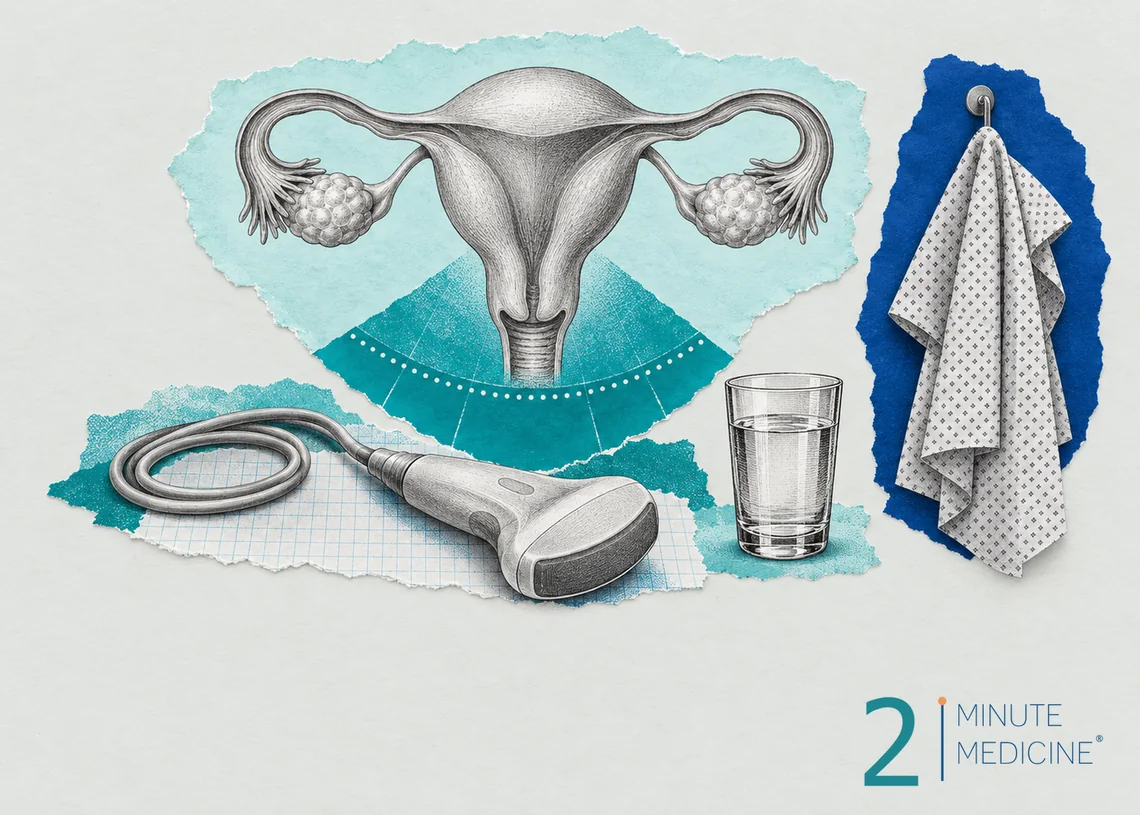
Transvaginal ultrasound collage: a drawing of the uterus and ovaries, an ultrasound transducer, a glass of water and a gown
Share on FacebookShare on TwitterShare on LinkedIn

A transvaginal ultrasound uses a thin, wand-shaped probe placed a few inches into the vagina to make close-up pictures of the uterus, ovaries and cervix. A standard pelvic ultrasound looks at the same organs through the skin of the lower belly instead. Both use sound waves, not radiation. They are often done one after the other, and neither takes long.

Key points

  • The abdominal (transabdominal) scan gives a wide view and works best with a full bladder.
  • The transvaginal (internal) scan gives sharper detail and is done with an empty bladder.
  • Doctors use these scans to look into pelvic pain, unusual bleeding, fibroids, ovarian cysts and early pregnancy.
  • A transvaginal scan may feel like pressure but is rarely painful. You can ask for a chaperone or to place the probe yourself.
  • Ultrasound has no known harmful effects and can be used in pregnancy.

Pelvic ultrasound vs transvaginal ultrasound

  • Transabdominal pelvic ultrasound. A handheld device (transducer) moves over gel on your lower belly. A full bladder lifts the bowel out of the way and acts as a window. It shows large structures well, such as a big fibroid or a pregnancy past the first few months.
  • Transvaginal ultrasound. Also called endovaginal ultrasound. The probe is about as wide as two fingers and sits close to the uterus and ovaries, so the pictures are much clearer. It is the better test for small cysts, the lining of the uterus, and pregnancy in the first weeks.
  • Translabial ultrasound. The probe rests against the outside of the vaginal opening, without going inside. It is sometimes used to look at the pelvic floor and bladder, or when an internal scan isn’t possible.

In men, a pelvic ultrasound mostly checks the bladder and prostate, often through the lower belly.

Why the test is done

  • Pelvic pain or pressure
  • Heavy, irregular or painful periods, or any bleeding after menopause
  • Checking for fibroids, polyps, ovarian cysts or signs of endometriosis
  • A lump or tenderness found during a pelvic exam
  • Making sure an IUD is in the right place
  • Early pregnancy: confirming where the pregnancy is, checking the heartbeat, dating it, or looking for the cause of pain or bleeding
  • Fertility care, such as tracking eggs as they grow

Sometimes a small amount of salt water is placed into the uterus during the scan to outline its lining (saline sonohysterography). This is a separate test with its own instructions.

Getting ready

  • For an abdominal scan, you’ll usually be asked to drink several glasses of water about an hour before and not empty your bladder.
  • For a transvaginal scan, you’ll empty your bladder just before it starts.
  • You can have either scan during your period. Remove a tampon before a transvaginal scan.
  • Tell the staff if you have a latex allergy, because some probe covers contain latex.
  • A top and pants or skirt are easier than a dress, since you’ll undress from the waist down for an internal scan.

How a transvaginal ultrasound is done

A sonographer (a technologist trained in ultrasound) or a doctor does the scan in a dim room.

The abdominal part: You lie on your back. Warm gel goes on your lower belly, and the transducer is pressed and moved over the skin. A full bladder can make this uncomfortable, but it only lasts a few minutes.

The internal part: After you empty your bladder, you lie on your back with your knees bent, either with your feet in stirrups or a cushion under your hips. The probe is covered with a disposable sheath and gel, then gently placed a few inches into the vagina. The sonographer angles it to see each organ. You’ll feel pressure, a bit like a pelvic exam with a speculum but often less. Tell them if anything hurts.

RELATED REPORTS

No Content Available

The whole visit usually takes 15 to 45 minutes. If you haven’t had vaginal sex, or an internal scan would be hard for you, say so. An abdominal or translabial scan can often be used instead.

Afterward

You can wipe off the gel, get dressed and go back to your normal day. A little spotting after a transvaginal scan is uncommon and usually harmless.

Possible risks

Ultrasound uses sound waves, and no harmful effects are known at the levels used for medical scans. The main downside is brief discomfort from a full bladder or from pressure during the internal scan.

Your results

The sonographer saves pictures but usually isn’t allowed to explain them. A radiologist or gynecologist reads the scan, and your own doctor typically gets the report within a day or a few days. Many findings, such as small fibroids or simple ovarian cysts, are common and harmless. Your doctor may suggest a repeat scan in a few weeks or months, often timed to your menstrual cycle, or other tests.

When to call your doctor

  • You haven’t heard about your results within the time you were told
  • Bleeding or pain after the scan that is more than mild

Get emergency care for severe one-sided pelvic pain, heavy bleeding, fainting, or shoulder-tip pain in early pregnancy. These can be signs of an ectopic pregnancy or a twisted ovary.

Common questions about transvaginal ultrasound

Does a transvaginal ultrasound hurt?

For most people it doesn’t. It feels like pressure, and the probe is thinner than a speculum used for a Pap test. It can be sore if you have endometriosis, an infection or vaginal dryness after menopause. Ask the sonographer to slow down or stop at any time.

Do you have to remove your tampon for an ultrasound?

Yes, for a transvaginal scan, so the probe can be placed. For an abdominal scan, a tampon can usually stay in, though it may show up on the images as a bright line with a shadow behind it. Let the sonographer know so they don’t mistake it for something else.

Can a transvaginal ultrasound harm an early pregnancy?

No. A transvaginal scan does not cause miscarriage and is the standard way to check a pregnancy in the first weeks. The probe stays in the vagina and doesn’t enter the uterus. It often shows a heartbeat earlier than an abdominal scan can.

Can a pelvic ultrasound detect ovarian cancer?

It can show a growth on an ovary and features that make cancer more or less likely, but it can’t confirm cancer on its own. Most ovarian masses are harmless cysts. A blood test, follow-up scans, or surgery may be needed to know for sure.

Questions to ask your doctor

  • Will I have an abdominal scan, an internal scan, or both?
  • Should I come with a full bladder or an empty one?
  • Does it matter where I am in my menstrual cycle?
  • When and how will I get the results?
  • Do any findings need a repeat scan or other tests?

Learn more

  • Transvaginal ultrasound (MedlinePlus, U.S. National Library of Medicine)

This guide is general information and doesn’t replace advice from your own doctor. Last updated October 2026.

Tags: Pelvic Ultrasound and Transvaginal Ultrasound
Previous Post

Patient Basics: Skin Biopsy

Next Post

Patient Basics: Percutaneous Transhepatic Cholangiography (PTC)

RelatedReports

No Content Available
Next Post
Mediastinoscopy collage: a windpipe between two lungs with nearby lymph nodes, a slender lighted scope and a blank wristband

Patient Basics: Mediastinoscopy

Myelogram collage: a side view of the spine with the spinal canal traced in teal, a CT scanner ring and a blank X-ray film

Patient Basics: Myelography (Myelogram)

Oxygen saturation test collage: a fingertip in a pulse oximeter clip, a pair of lungs and coiled oxygen tubing

Patient Basics: Oxygen Saturation Test (Pulse Oximetry and Arterial Blood Gas)

✦ EvidencePulse™ by 2 Minute Medicine 3 reports You asked top stroke trials 2026 Synthesizing medical evidence... Top 2026 stroke trial results: OCEANIC — ischemic stroke: 6.2% vs 8.4% OPTION* — mRS 0–1: 43.6% vs 34.2% ORIENTAL* — mRS 0–2: 58.6% vs 46.6% *Higher sICH in intervention arms Participants randomizedN OCEANIC 12,327 OPTION 570 ORIENTAL 564 Ask about guidelines or landmark trials... Try EvidencePulse™ Get the signal. Try it now → Physician-trained medical AI by 2 Minute Medicine

2MM+ All Access

Full details →
$4.99 /month

3-day free trial · cancel anytime

  • ✓100+ physician-written reports
  • ✓EvidencePulse™ + HypeCheck™
  • ✓Ad-free reading + newsletters
Start 3-day free trial

Then $4.99/month. Manage renewal in your account.

2 Minute Medicine® is an award winning, physician-run, expert medical media company. Our content is curated, written and edited by practicing health professionals who have clinical and scientific expertise in their field of reporting. Our editorial management team is comprised of highly-trained MD physicians. Join numerous brands, companies, and hospitals who trust our licensed content.

Recent Reports

  • Pelacarsen lowers lipoprotein(a) but does not reduce major cardiovascular events in patients with established cardiovascular disease
  • Durvalumab plus enfortumab vedotin was approved for perioperative treatment of muscle-invasive bladder cancer
  • CDC reports 5,412 confirmed measles cases in the United States in 2026
License Content
Terms of Use | Disclaimer
Cookie Policy

Get the app

Read 2 Minute Medicine on iPhone, iPad and Android.

Download on the App StoreGet it on Google Play
QR code for www.2minutemedicine.com/app
On a computer? Scan this with your phone’s camera.
2MM+ All Access Full details →

The medical literature, distilled daily.

Monthly plan selected: $4.99 /month.

$4.99/month

3-day free trial · cancel anytime

Start 3-day free trial

Then $4.99/month. Manage renewal in your account.

Yearly plan selected: $49.90 /year.

$49.90/year

2 months free

Start 3-day free trial

Then $49.90/year.

Membership benefits

  • ✓100+ new physician-written study summaries monthly, 12,000+ searchable
  • ✓AI EvidencePulse™ + HypeCheck™
  • ✓Ad-free reading + newsletters
  • ✓FDA drug approvals + clinical calculators

Already a member? Sign in

  • Get the app
  • About
  • Specialties
    • All Specialties, All Recent Reports
    • Cardiology
    • Chronic Disease
    • Dermatology
    • Emergency
    • Endocrinology
    • Gastroenterology
    • Imaging and Intervention
    • Infectious Disease
    • Nephrology
    • Neurology
    • Obstetrics
    • Oncology
    • Ophthalmology
    • Pediatrics
    • Pharma
    • Preclinical
    • Psychiatry
    • Public Health
    • Pulmonology
    • Rheumatology
    • Surgery
    • Rewinds
    • The Scan
  • EvidencePulse™
  • HypeCheck™
  • AI News
  • Classics™
    • 2MM+ Online Access
    • Paperback and Ebook
  • Tools
    • NPI Registry Lookup
    • RVU Search
    • Physician Pay by Specialty
    • ICD-10 Code Lookup
    • FDA Drug Approvals
    • Drug Safety for Breastfeeding/Pregnancy
    • Clinical Guidelines
    • Medical Calculators
    • ECG Reference
      • QTc Calculator
      • Sgarbossa Criteria
      • ECG Axis Calculator
      • AV Block Helper
  • Rankings
    • Medical School Rankings
    • Residency Rankings
  • Partners
    • License Content
    • Advertise with Us
No Result
View All Result

© 2026 2 Minute Medicine, Inc. - Physician-written medical news.


