
• About
  • Masthead
  • License Content
  • Advertise
  • Press Releases
  • Newsroom
  • RSS/Email List
  • 2MM Podcast
  • Write for us
  • Contact Us
2 Minute Medicine
No Result
View All Result

No products in the cart.

Sign in
SUBSCRIBE
  • About
  • Specialties
    • All Specialties, All Recent Reports
    • Cardiology
    • Chronic Disease
    • Dermatology
    • Emergency
    • Endocrinology
    • Gastroenterology
    • Imaging and Intervention
    • Infectious Disease
    • Nephrology
    • Neurology
    • Obstetrics
    • Oncology
    • Ophthalmology
    • Pediatrics
    • Pharma
    • Preclinical
    • Psychiatry
    • Public Health
    • Pulmonology
    • Rheumatology
    • Surgery
    • Rewinds
    • The Scan
  • EvidencePulse™
  • HypeCheck™
  • AI News
  • Classics™
    • 2MM+ Online Access
    • Paperback and Ebook
  • Tools
    • NPI Registry Lookup
    • RVU Search
    • Physician Pay by Specialty
    • ICD-10 Code Lookup
    • FDA Drug Approvals
    • Drug Safety for Breastfeeding/Pregnancy
    • Clinical Guidelines
    • Medical Calculators
    • ECG Reference
      • QTc Calculator
      • Sgarbossa Criteria
      • ECG Axis Calculator
      • AV Block Helper
  • Rankings
    • Medical School Rankings
    • Residency Rankings
  • Partners
    • License Content
    • Advertise with Us
2 Minute Medicine
  • About
  • Specialties
    • All Specialties, All Recent Reports
    • Cardiology
    • Chronic Disease
    • Dermatology
    • Emergency
    • Endocrinology
    • Gastroenterology
    • Imaging and Intervention
    • Infectious Disease
    • Nephrology
    • Neurology
    • Obstetrics
    • Oncology
    • Ophthalmology
    • Pediatrics
    • Pharma
    • Preclinical
    • Psychiatry
    • Public Health
    • Pulmonology
    • Rheumatology
    • Surgery
    • Rewinds
    • The Scan
  • EvidencePulse™
  • HypeCheck™
  • AI News
  • Classics™
    • 2MM+ Online Access
    • Paperback and Ebook
  • Tools
    • NPI Registry Lookup
    • RVU Search
    • Physician Pay by Specialty
    • ICD-10 Code Lookup
    • FDA Drug Approvals
    • Drug Safety for Breastfeeding/Pregnancy
    • Clinical Guidelines
    • Medical Calculators
    • ECG Reference
      • QTc Calculator
      • Sgarbossa Criteria
      • ECG Axis Calculator
      • AV Block Helper
  • Rankings
    • Medical School Rankings
    • Residency Rankings
  • Partners
    • License Content
    • Advertise with Us
Sign in
SUBSCRIBE
2 Minute Medicine
Sign in
Subscribe
2 Minute MedicineFree on Google PlayGet
✦EvidencePulse™by 2 Minute Medicine3 reportsYou askedtop stroke trials 2026Synthesizing medical evidence...Top 2026 stroke trial results:OCEANIC — ischemic stroke: 6.2% vs 8.4%OPTION* — mRS 0–1: 43.6% vs 34.2%ORIENTAL* — mRS 0–2: 58.6% vs 46.6%*Higher sICH in intervention armsParticipants randomizedNOCEANIC12,327OPTION570ORIENTAL564Ask about guidelines or landmark trials...↑Try EvidencePulse™Ask the evidence. Get the signal.Try it now →
Home Health A to Z

Patient Basics: Percutaneous Transhepatic Cholangiography (PTC)
by2 Minute Medicine
October 30, 2026
in Health A to Z
Reading Time: 5 mins read
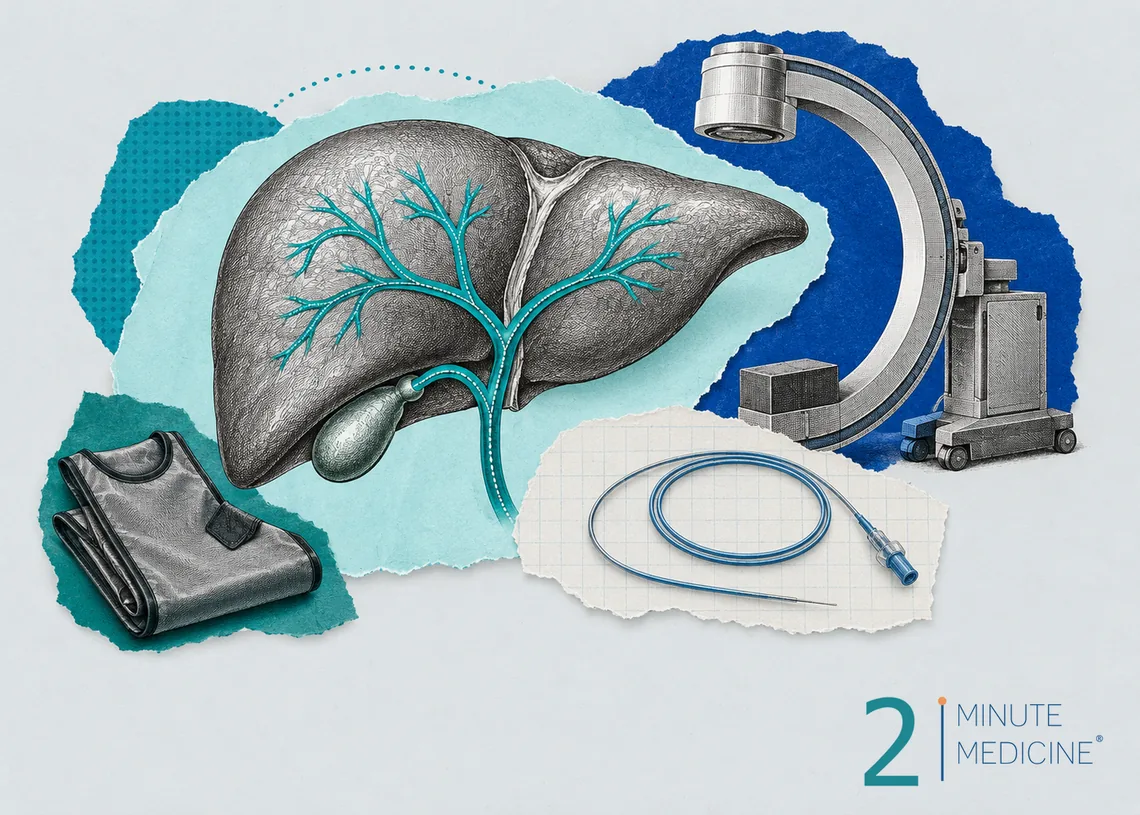
Percutaneous transhepatic cholangiography collage: a liver with branching bile ducts, a coiled catheter and a lead apron
Share on FacebookShare on TwitterShare on LinkedIn

Percutaneous transhepatic cholangiography (PTC) is an X-ray test of the bile ducts, the small tubes that carry bile out of the liver. A doctor passes a thin needle through the skin and into a bile duct inside the liver, then injects dye that shows up on X-rays. It is most often done when a duct is blocked, and the same visit is often used to drain the bile or open the blockage.

Key points

  • “Percutaneous” means through the skin, “transhepatic” means through the liver, and “cholangiography” means X-ray pictures of the bile ducts.
  • It shows where a bile duct is blocked or narrowed, and often why.
  • An interventional radiologist does it, usually with sedation and numbing medicine.
  • Many people leave with a small drainage tube in their side for a while.
  • Fever, chills, bleeding or a drain that stops working after the test need a call to your doctor right away.

Why percutaneous transhepatic cholangiography is done

Bile is a fluid made in the liver that helps digest fat. When a bile duct is blocked, bile backs up into the blood and causes yellow skin and eyes (jaundice), itching, dark urine and pale stools. A blocked duct can also get infected (cholangitis).

Today, an MRI scan of the bile ducts (MRCP) or a scope passed through the mouth (ERCP) is usually tried first. PTC is used when:

  • ERCP can’t reach the blockage or didn’t work
  • The stomach or intestine has been changed by surgery, such as gastric bypass
  • The blockage is high up, where the ducts from the right and left sides of the liver join
  • Bile is leaking after surgery

Common causes of blocked ducts include gallstones, scar tissue after surgery, primary sclerosing cholangitis, and cancers of the bile duct, pancreas or liver.

During the same procedure, the doctor can also:

  • Place a drainage tube (a biliary drain) to let bile flow out
  • Stretch a narrow duct with a balloon
  • Place a stent, a small tube that holds the duct open
  • Take a sample of tissue (a brush biopsy) or remove stones

Before the test

  • You’ll have blood tests to check clotting and kidney function.
  • Tell your team about all your medicines. You may need to stop blood thinners such as warfarin, apixaban or clopidogrel for a few days. Only stop them if your doctor tells you to.
  • Tell them about any allergy to X-ray dye (contrast), iodine or latex, and whether you could be pregnant.
  • Don’t eat for about 6 to 8 hours before. Follow your team’s exact instructions about drinks and morning medicines.
  • Plan for someone to drive you home. Some people stay overnight, especially if a drain is placed.

During the test

You’ll lie on your back on an X-ray table. A nurse starts an IV and gives you antibiotics to prevent infection, along with medicine to help you relax. Some people have general anesthesia.

RELATED REPORTS

No Content Available

The doctor cleans the skin on your right side, between the lower ribs, and numbs it. Using ultrasound and live X-ray (fluoroscopy) to guide them, they pass a very thin needle through the skin and into the liver until it reaches a bile duct. You may be asked to hold your breath for a few seconds at a time. Dye is then injected, and X-ray pictures show the ducts and any blockage.

You may feel pressure, and some people feel a brief ache in the right shoulder. The test itself takes about 30 minutes to an hour. Placing a drain or stent adds more time.

Afterward

You’ll rest in bed for several hours while nurses check your blood pressure, pulse and the puncture site. Expect some soreness where the needle or tube went in for a few days.

If you go home with a drain:

  • Keep the dressing clean and dry, and change it as you were shown.
  • Empty the bag when it is half full, and keep track of how much drains.
  • Flush the tube only if you were told to.
  • Keep the tube from kinking or being pulled.
  • Shower with the site covered. Avoid baths and swimming.

Drains are usually changed every 2 to 3 months, and many are later swapped for an internal stent.

Possible risks

Serious problems are uncommon, but they are more likely when a drain is placed. They include:

  • Bleeding inside the liver or belly
  • Infection of the bile ducts or blood, which can cause fever and chills within hours
  • Bile leaking into the belly
  • An allergic reaction to the dye
  • A drain that slips out of place
  • Rarely, air leaking around a lung

Your results

The radiologist can often tell you what the pictures showed before you go home. The report describes the size of the ducts, where any blockage is and what it looks like. Biopsy results take several days. Your doctor will explain what comes next, such as surgery, more stent work or cancer treatment.

When to call your doctor

  • Fever of 100.4°F (38°C) or higher, or shaking chills
  • Pain that gets worse instead of better
  • Bleeding from the site, or blood in the drain bag
  • The drain falls out, leaks around the tube, or stops draining
  • Yellow skin or eyes that get worse

Call 911 for fainting, a racing heart, trouble breathing or severe belly pain.

Common questions about percutaneous transhepatic cholangiography

Is a percutaneous transhepatic cholangiogram painful?

Most people feel some pressure and a sting from the numbing shot, but sedation keeps the test bearable. A brief ache in the right shoulder or side is common. The site is often sore for a few days, especially with a drain, and pain medicine helps.

What is the difference between PTC and ERCP?

Both show and treat the bile ducts. In ERCP, a flexible scope goes through the mouth and stomach to reach the ducts from below, with no cut in the skin. In PTC, a needle goes through the skin and liver to reach the ducts from above. PTC is often used when ERCP can’t be done.

What does PTC mean in medical terms?

PTC stands for percutaneous transhepatic cholangiography, an X-ray test of the bile ducts done by putting dye in through the skin and liver. When a drain is left in place, the procedure is often called PTBD, short for percutaneous transhepatic biliary drainage.

Questions to ask your doctor

  • Why do I need PTC instead of ERCP or an MRI?
  • Will I go home with a drain, and for how long?
  • Which of my medicines should I stop, and when?
  • Will I stay overnight?
  • Who do I call if the drain has a problem at night?

Learn more

  • Percutaneous transhepatic cholangiogram (MedlinePlus, U.S. National Library of Medicine)

This guide is general information and doesn’t replace advice from your own doctor. Last updated October 2026.

Tags: PTCA
Previous Post

Patient Basics: Pelvic Ultrasound and Transvaginal Ultrasound

Next Post

Patient Basics: Pulmonary Function Testing (Lung Function Tests)

RelatedReports

No Content Available
Next Post
Mediastinoscopy collage: a windpipe between two lungs with nearby lymph nodes, a slender lighted scope and a blank wristband

Patient Basics: Mediastinoscopy

Myelogram collage: a side view of the spine with the spinal canal traced in teal, a CT scanner ring and a blank X-ray film

Patient Basics: Myelography (Myelogram)

Oxygen saturation test collage: a fingertip in a pulse oximeter clip, a pair of lungs and coiled oxygen tubing

Patient Basics: Oxygen Saturation Test (Pulse Oximetry and Arterial Blood Gas)

✦ EvidencePulse™ by 2 Minute Medicine 3 reports You asked top stroke trials 2026 Synthesizing medical evidence... Top 2026 stroke trial results: OCEANIC — ischemic stroke: 6.2% vs 8.4% OPTION* — mRS 0–1: 43.6% vs 34.2% ORIENTAL* — mRS 0–2: 58.6% vs 46.6% *Higher sICH in intervention arms Participants randomizedN OCEANIC 12,327 OPTION 570 ORIENTAL 564 Ask about guidelines or landmark trials... Try EvidencePulse™ Get the signal. Try it now → Physician-trained medical AI by 2 Minute Medicine

2MM+ All Access

Full details →
$4.99 /month

3-day free trial · cancel anytime

  • ✓100+ physician-written reports
  • ✓EvidencePulse™ + HypeCheck™
  • ✓Ad-free reading + newsletters
Start 3-day free trial

Then $4.99/month. Manage renewal in your account.

2 Minute Medicine® is an award winning, physician-run, expert medical media company. Our content is curated, written and edited by practicing health professionals who have clinical and scientific expertise in their field of reporting. Our editorial management team is comprised of highly-trained MD physicians. Join numerous brands, companies, and hospitals who trust our licensed content.

Recent Reports

  • Pelacarsen lowers lipoprotein(a) but does not reduce major cardiovascular events in patients with established cardiovascular disease
  • Durvalumab plus enfortumab vedotin was approved for perioperative treatment of muscle-invasive bladder cancer
  • CDC reports 5,412 confirmed measles cases in the United States in 2026
License Content
Terms of Use | Disclaimer
Cookie Policy

Get the app

Read 2 Minute Medicine on iPhone, iPad and Android.

Download on the App StoreGet it on Google Play
QR code for www.2minutemedicine.com/app
On a computer? Scan this with your phone’s camera.
2MM+ All Access Full details →

The medical literature, distilled daily.

Monthly plan selected: $4.99 /month.

$4.99/month

3-day free trial · cancel anytime

Start 3-day free trial

Then $4.99/month. Manage renewal in your account.

Yearly plan selected: $49.90 /year.

$49.90/year

2 months free

Start 3-day free trial

Then $49.90/year.

Membership benefits

  • ✓100+ new physician-written study summaries monthly, 12,000+ searchable
  • ✓AI EvidencePulse™ + HypeCheck™
  • ✓Ad-free reading + newsletters
  • ✓FDA drug approvals + clinical calculators

Already a member? Sign in

  • Get the app
  • About
  • Specialties
    • All Specialties, All Recent Reports
    • Cardiology
    • Chronic Disease
    • Dermatology
    • Emergency
    • Endocrinology
    • Gastroenterology
    • Imaging and Intervention
    • Infectious Disease
    • Nephrology
    • Neurology
    • Obstetrics
    • Oncology
    • Ophthalmology
    • Pediatrics
    • Pharma
    • Preclinical
    • Psychiatry
    • Public Health
    • Pulmonology
    • Rheumatology
    • Surgery
    • Rewinds
    • The Scan
  • EvidencePulse™
  • HypeCheck™
  • AI News
  • Classics™
    • 2MM+ Online Access
    • Paperback and Ebook
  • Tools
    • NPI Registry Lookup
    • RVU Search
    • Physician Pay by Specialty
    • ICD-10 Code Lookup
    • FDA Drug Approvals
    • Drug Safety for Breastfeeding/Pregnancy
    • Clinical Guidelines
    • Medical Calculators
    • ECG Reference
      • QTc Calculator
      • Sgarbossa Criteria
      • ECG Axis Calculator
      • AV Block Helper
  • Rankings
    • Medical School Rankings
    • Residency Rankings
  • Partners
    • License Content
    • Advertise with Us
No Result
View All Result

© 2026 2 Minute Medicine, Inc. - Physician-written medical news.


