

• About
  • Masthead
  • License Content
  • Advertise
  • Submit Press Release
  • RSS/Email List
  • 2MM Podcast
  • Write for us
  • Contact Us
2 Minute Medicine
No Result
View All Result

No products in the cart.

SUBSCRIBE
  • About
  • Specialties
    • All Specialties, All Recent Reports
    • Cardiology
    • Chronic Disease
    • Dermatology
    • Emergency
    • Endocrinology
    • Gastroenterology
    • Imaging and Intervention
    • Infectious Disease
    • Nephrology
    • Neurology
    • Obstetrics
    • Oncology
    • Ophthalmology
    • Pediatrics
    • Pharma
    • Preclinical
    • Psychiatry
    • Public Health
    • Pulmonology
    • Rheumatology
    • Surgery
  • Tools+
    • EvidencePulse™
    • HypeCheck™
    • NPI Registry Lookup
    • RVU Search
  • Pharma
  • AI Roundup
  • The Scan+
  • Classics™+
    • 2MM+ Online Access
    • Paperback and Ebook
  • Rewinds
  • Partners
    • License Content
    • Submit Press Release
    • Advertise with Us
  • Account
    • Subscribe
    • My account
    • Cart
    • Sign-in
2 Minute Medicine
  • About
  • Specialties
    • All Specialties, All Recent Reports
    • Cardiology
    • Chronic Disease
    • Dermatology
    • Emergency
    • Endocrinology
    • Gastroenterology
    • Imaging and Intervention
    • Infectious Disease
    • Nephrology
    • Neurology
    • Obstetrics
    • Oncology
    • Ophthalmology
    • Pediatrics
    • Pharma
    • Preclinical
    • Psychiatry
    • Public Health
    • Pulmonology
    • Rheumatology
    • Surgery
  • Tools+
    • EvidencePulse™
    • HypeCheck™
    • NPI Registry Lookup
    • RVU Search
  • Pharma
  • AI Roundup
  • The Scan+
  • Classics™+
    • 2MM+ Online Access
    • Paperback and Ebook
  • Rewinds
  • Partners
    • License Content
    • Submit Press Release
    • Advertise with Us
  • Account
    • Subscribe
    • My account
    • Cart
    • Sign-in
SUBSCRIBE
2 Minute Medicine
Subscribe
EvidencePulse™ by 2 Minute Medicine 2026 evidence scan 3 reports You asked top stroke trials 2026 Synthesizing medical evidence... Top 2026 stroke trial results: OCEANIC — ischemic stroke: 6.2% vs 8.4% OPTION* — mRS 0–1: 43.6% vs 34.2% ORIENTAL* — mRS 0–2: 58.6% vs 46.6% *Higher sICH in intervention arms Participants randomizedN OCEANIC 12,327 OPTION 570 ORIENTAL 564 Ask about guidelines or landmark trials... ↑ Try EvidencePulse™ Ask the evidence.
Get the signal.
Try it now → Physician-trained medical AI by 2 Minute Medicine
Home All Specialties Imaging and Intervention

Radiographic surrogates may predict tumor-specific survival in renal carcinoma
byBenjamin Laguna, MDandDylan Wolman
August 30, 2015
in Imaging and Intervention, Oncology
Reading Time: 3 mins read
Radiographic surrogates may predict tumor-specific survival in renal carcinoma
Share on FacebookShare on Twitter

1. Computed tomography derived imaging characteristics were correlated with disease specific gene expression to create a radiogenomic based surrogate of molecular assays (SOMA) in patients with clear-cell renal cell carcinoma (CCRCC) which was predictive of disease-specific and stage-independent survival in a validated cohort.

2. Radiogenomic based SOMAs can theoretically be created for different disease entities without the need for invasive tissue acquisition, providing new clinical tools for disease stratification and individual prognostication in clinical trials.

Evidence Rating: 2 (Good)

Study Rundown: Genomic tumor information has increasingly been used to help in the prognostication, stratification, and delineation of treatment strategies for patients, but has been limited by invasive tissue acquisition and by the lack of macrophenotypic data often revealed by imaging. To circumvent these difficulties and integrate the value of non-invasive imaging, SOMAs can be developed based on correlation of specific imaging characteristics to individual genomic indicators within a cohort. This allows for a non-invasive, quantitative tool to integrate the patient-specific information offered by both genomic and radiologic data to help in the prognostication and stratification of specific tumors. In this study, a SOMA was designed for patients with CCRCC based on a known cohort of 70 patients with surgically resected CCRCC who underwent pre-operative CT imaging and molecular characterization of surgical pathology samples. A radiogenomic risk score (RRS) model that predicted CCRCC-specific survival in a stage-, grade- and performance status independent fashion was developed from the known CCRCC cohort, and then validated in a prospective CCRCC cohort. This study, while suggesting immediately relevant prognostication tools for CCRCC, also suggests that similar radiogenomic surrogates can be created for other tumors across modalities, helping create prognostication tools that do not necessarily rely on tissue acquisition for each patient. This study was limited by its overall size, and by its population selection, which may limit the generalizability of this RRS for patients with CCRCC from other populations. Future studies should validate the approach with a more heterogeneous multi-center population and determine if the RRS can be extrapolated to larger populations, or should be reserved for geographically limited populations.

Click to read the study in Radiology

Relevant reading: Molecular stratification of clear cell renal cell carcinoma by consensus clustering reveals distinct subtypes and survival patterns

RELATED REPORTS

Two plasma-based biomarkers may accurately predict positive CT head scans in traumatic brain injury

Pre-conception computed tomography ionizing radiation may be associated with worse reproductive outcomes

Bristol Myers Squibb: Opdivo-Qvantig is the first FDA approved subcutaneous version of cancer immunotherapy targeting PD-1

In-Depth [retrospective cohort]: Based on analysis and regression of gene expression analysis and CT imaging trait analysis, an RRS model was developed, with four key imaging features that were independent of stage, grade, and patient performance status, specifically: quartile percentage of tumor necrosis, tumor transition zone, tumor-parenchyma interaction, and tumor-parenchyma interface. Briefly, each of these features were chosen to represent physiologic and morphologic characteristics of the local tumor microenvironment and the tumor itself, and were correlated by multivariate linear regression to the top eigenvector of each patient’s individual gene expression matrix. The gene expression matrix was independently correlated to patient outcomes in a separate publication. In short, this mathematically linked the expression of specific risk-associated genes with specific radiophenotypic features identified by CT imaging to generate the RRS. This risk score was then validated in a prospective cohort of patients with CCRCC, showing that there was a relationship between RRS and a previously and validated genomic-based risk score (R = 0.45, p < 0.001, classification accuracy of 68.6%, p < 0.001), and that the RRS could predict disease-specific survival (log-rank p < 0.001), and was independent of stage, grade, and performance status (multivariate Cox model p < 0.05, log-rank p < 0.001).

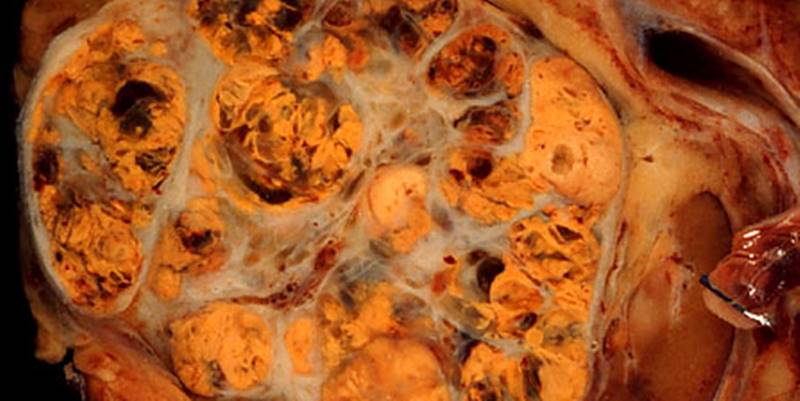
Image: PD

©2015 2 Minute Medicine, Inc. All rights reserved. No works may be reproduced without expressed written consent from 2 Minute Medicine, Inc. Inquire about licensing here. No article should be construed as medical advice and is not intended as such by the authors or by 2 Minute Medicine, Inc.
Tags: Computed Tomography (CT)renal-cell carcinoma
Previous Post

No significant improvement in older adult cognitive function with moderate physical activity

Next Post

More live births after natural cycle IVF

RelatedReports

Brain lesions on MRI linked with subsequent increased stroke risk
Emergency

Two plasma-based biomarkers may accurately predict positive CT head scans in traumatic brain injury

March 22, 2026
Half of parents aware of CT radiation cancer risk
Obstetrics

Pre-conception computed tomography ionizing radiation may be associated with worse reproductive outcomes

September 8, 2025
Radiographic surrogates may predict tumor-specific survival in renal carcinoma
Pharma

Bristol Myers Squibb: Opdivo-Qvantig is the first FDA approved subcutaneous version of cancer immunotherapy targeting PD-1

February 17, 2025
Radiographic surrogates may predict tumor-specific survival in renal carcinoma
Chronic Disease

Nivolumab does not improve survival in patients with advanced renal cell carcinoma with progression after immune checkpoint inhibitors

October 30, 2024
Next Post
Infertility treatments not associated with increased short-term cancer risk

More live births after natural cycle IVF

Food environment associated with gestational diabetes

Food environment associated with gestational diabetes

Substance abuse prevalent among adolescents with chronic medical conditions

Substance abuse prevalent among adolescents with chronic medical conditions

EvidencePulse™ by 2 Minute Medicine 2026 evidence scan 3 reports You asked top stroke trials 2026 Synthesizing medical evidence... Top 2026 stroke trial results: OCEANIC — ischemic stroke: 6.2% vs 8.4% OPTION* — mRS 0–1: 43.6% vs 34.2% ORIENTAL* — mRS 0–2: 58.6% vs 46.6% *Higher sICH in intervention arms Participants randomizedN OCEANIC 12,327 OPTION 570 ORIENTAL 564 Ask about guidelines or landmark trials... ↑ Try EvidencePulse™ Ask the evidence.
Get the signal.
Try it now → Physician-trained medical AI by 2 Minute Medicine

2MM+ All Access

Full details →
$4.99 /month

5-day free trial · cancel anytime

  • ✓100+ physician-written reports
  • ✓EvidencePulse™ + HypeCheck™
  • ✓Ad-free reading + newsletters
Start 5-day free trial

Then $4.99/month. Manage renewal in your account.

2 Minute Medicine® is an award winning, physician-run, expert medical media company. Our content is curated, written and edited by practicing health professionals who have clinical and scientific expertise in their field of reporting. Our editorial management team is comprised of highly-trained MD physicians. Join numerous brands, companies, and hospitals who trust our licensed content.

Recent Reports

  • Video mental health care may have clinical advantages versus phone or in-person visits
  • Higher maternal body mass index is associated with increased risk of cardiovascular disease in offspring
  • Transanastomotic tubes not linked to anastomotic stricture after esophageal atresia repair
License Content
Terms of Use | Disclaimer
Cookie Policy
Cleantalk Pixel
2MM+ All Access Full details →

The medical literature, distilled daily.

Monthly plan selected: $4.99 /month.

$4.99/month

5-day free trial · cancel anytime

Start 5-day free trial

Then $4.99/month. Manage renewal in your account.

Yearly plan selected: $49.90 /year.

$49.90/year

2 months free · only $4.16/month

Start 5-day free trial

Then $49.90/year. Manage renewal in your account.

Membership benefits

  • ✓100+ physician-written reports
  • ✓AI EvidencePulse™ + HypeCheck™
  • ✓Ad-free reading + newsletters

Already a member? Sign in

  • About
  • Specialties
    • All Specialties, All Recent Reports
    • Cardiology
    • Chronic Disease
    • Dermatology
    • Emergency
    • Endocrinology
    • Gastroenterology
    • Imaging and Intervention
    • Infectious Disease
    • Nephrology
    • Neurology
    • Obstetrics
    • Oncology
    • Ophthalmology
    • Pediatrics
    • Pharma
    • Preclinical
    • Psychiatry
    • Public Health
    • Pulmonology
    • Rheumatology
    • Surgery
  • Tools
    • EvidencePulse™
    • HypeCheck™
    • NPI Registry Lookup
    • RVU Search
  • Pharma
  • AI Roundup
  • The Scan
  • Classics™
    • 2MM+ Online Access
    • Paperback and Ebook
  • Rewinds
  • Partners
    • License Content
    • Submit Press Release
    • Advertise with Us
  • Account
    • Subscribe
    • My account
    • Cart
    • Sign-in
No Result
View All Result

© 2026 2 Minute Medicine, Inc. - Physician-written medical news.