

• About
  • Masthead
  • License Content
  • Advertise
  • Submit Press Release
  • RSS/Email List
  • 2MM Podcast
  • Write for us
  • Contact Us
2 Minute Medicine
No Result
View All Result

No products in the cart.

SUBSCRIBE
  • About
  • Specialties
    • All Specialties, All Recent Reports
    • Cardiology
    • Chronic Disease
    • Dermatology
    • Emergency
    • Endocrinology
    • Gastroenterology
    • Imaging and Intervention
    • Infectious Disease
    • Nephrology
    • Neurology
    • Obstetrics
    • Oncology
    • Ophthalmology
    • Pediatrics
    • Pharma
    • Preclinical
    • Psychiatry
    • Public Health
    • Pulmonology
    • Rheumatology
    • Surgery
  • Tools+
    • EvidencePulse™
    • HypeCheck™
    • NPI Registry Lookup
    • RVU Search
  • Pharma
  • AI Roundup
  • The Scan+
  • Classics™+
    • 2MM+ Online Access
    • Paperback and Ebook
  • Rewinds
  • Partners
    • License Content
    • Submit Press Release
    • Advertise with Us
  • Account
    • Subscribe
    • My account
    • Cart
    • Sign-in
2 Minute Medicine
  • About
  • Specialties
    • All Specialties, All Recent Reports
    • Cardiology
    • Chronic Disease
    • Dermatology
    • Emergency
    • Endocrinology
    • Gastroenterology
    • Imaging and Intervention
    • Infectious Disease
    • Nephrology
    • Neurology
    • Obstetrics
    • Oncology
    • Ophthalmology
    • Pediatrics
    • Pharma
    • Preclinical
    • Psychiatry
    • Public Health
    • Pulmonology
    • Rheumatology
    • Surgery
  • Tools+
    • EvidencePulse™
    • HypeCheck™
    • NPI Registry Lookup
    • RVU Search
  • Pharma
  • AI Roundup
  • The Scan+
  • Classics™+
    • 2MM+ Online Access
    • Paperback and Ebook
  • Rewinds
  • Partners
    • License Content
    • Submit Press Release
    • Advertise with Us
  • Account
    • Subscribe
    • My account
    • Cart
    • Sign-in
SUBSCRIBE
2 Minute Medicine
Subscribe
EvidencePulse™ by 2 Minute Medicine 2026 evidence scan 3 reports You asked top stroke trials 2026 Synthesizing medical evidence... Top 2026 stroke trial results: OCEANIC — ischemic stroke: 6.2% vs 8.4% OPTION* — mRS 0–1: 43.6% vs 34.2% ORIENTAL* — mRS 0–2: 58.6% vs 46.6% *Higher sICH in intervention arms Participants randomizedN OCEANIC 12,327 OPTION 570 ORIENTAL 564 Ask about guidelines or landmark trials... ↑ Try EvidencePulse™ Ask the evidence.
Get the signal.
Try it now → Physician-trained medical AI by 2 Minute Medicine
Home StudyGraphics

#VisualAbstract: Pembrolizumab after nephrectomy improves survival in renal-cell carcinoma patients
byMinjee Kim
October 13, 2021
in StudyGraphics
Reading Time: 2 mins read
#VisualAbstract: Pembrolizumab after nephrectomy improves survival in renal-cell carcinoma patients
Share on FacebookShare on Twitter
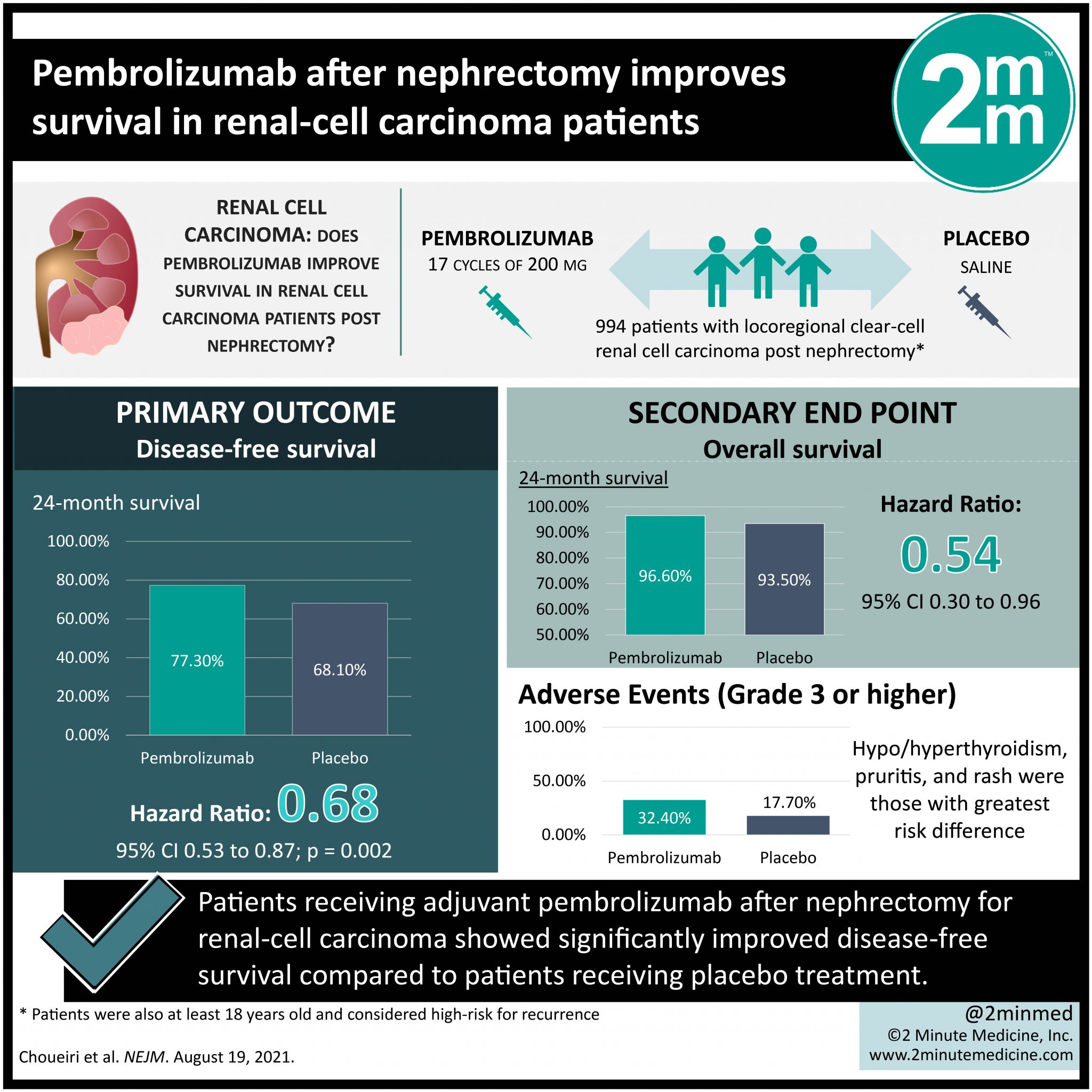
  1. Patients receiving adjuvant pembrolizumab after nephrectomy for renal-cell carcinoma showed significantly improved disease-free survival compared to patients receiving placebo treatment.
  2. Patients treated with pembrolizumab were shown to have a higher percentage of immune-mediated grade 3 or 4 events compared to patients treated with the placebo.

Evidence Rating Level: 1 (Excellent)

Study Rundown: Patients with locoregional clear-cell renal-cell carcinoma who undergo nephrectomy remain at risk for recurrence after surgery; however, no standard adjuvant treatments are available. Pembrolizumab, an anti-programmed death 1 (PD-1) antibody, is immunotherapy shown to effectively treat advanced renal-cell carcinoma. In this randomized control trial, patients who underwent nephrectomy for renal cell carcinoma and were considered high-risk for recurrence either received 17 cycles of adjuvant pembrolizumab or placebo treatment. The primary measured endpoint was disease-free survival, which was measured from time to first local or distant recurrence, or death of any cause. The study found significantly improved disease-free and overall survival in the group receiving pembrolizumab compared to the placebo. While a higher proportion of patients receiving pembrolizumab experienced severe adverse events, the treatment regimen itself was not associated with any deaths. Together, this phase 3 trial clearly supports the use of pembrolizumab as an adjuvant therapy to nephrectomy in renal-cell carcinoma. The largest limitation to this study was the short follow-up time; therefore, longer intervals are needed to fully assess the effect of adjuvant pembrolizumab on overall survival.

Click to read the study in NEJM

Relevant Reading: Recurrence in Localized Renal Cell Carcinoma: a Systematic Review of Contemporary Data

In-Depth [randomized controlled trial]: This open-label, multicenter, phase 3 randomized control trial enrolled 496 patients from 213 sites in 21 countries. Patients who were at least 18 years of age, previously underwent nephrectomy for locoregional clear-cell renal-cell carcinoma, and were considered high-risk for recurrence were included in the study. Patients who received any previous systemic therapy or had not undergone gone surgery were excluded from the study. Participants were randomized in a 1:1 ratio to receive 17 cycles of 200mg adjuvant pembrolizumab or placebo saline treatment, respectively. The primary assessed endpoint was disease-free survival defined as the time of treatment to first local or distant recurrence, or death for any reason. At 24 months, patients receiving pembrolizumab showed significantly improved disease-free survival compared to their placebo counterparts (hazard ratio for recurrence or death [HR], 0.68; 95% confidence interval [CI], 0.53 to 0.87, P=0.002). Pembrolizumab was able to improve the percentage of patients who remained recurrence-free and alive at 24 months (77.3%) compared to the placebo group (68.1%). Patients receiving pembrolizumab also experienced improved overall survival at 96.6% after 24 months compared to 93.5% in the placebo (HR, 0.54; 95%CI, 0.30 to 0.96). No deaths were directly attributable to the treatment regimen. Finally, a greater proportion of immune-mediated adverse events were shown in the pembrolizumab group (34.6%) compared to the placebo group (5.8%). Together, at its first interim analysis, this study supports the use of adjuvant pembrolizumab after partial or complete nephrectomy in patients with clear-cell renal-cell carcinoma.

Image: PD

RELATED REPORTS

Enfortumab vedotin plus pembrolizumab associated with improved survival in bladder cancer

Enfortumab vedotin plus pembrolizumab is more effective than platinum-based chemotherapy in metastatic urothelial carcinoma

Dietary changes and pharmacologic interventions may prevent recurrent nephrolithiasis

©2021 2 Minute Medicine, Inc. All rights reserved. No works may be reproduced without expressed written consent from 2 Minute Medicine, Inc. Inquire about licensing here. No article should be construed as medical advice and is not intended as such by the authors or by 2 Minute Medicine, Inc.

Tags: #clear cell carcinoma#clear-cell renal-cell carcinomakidneyNephrectomyPembrolizumabrenal-cell carcinoma
Previous Post

Efficacy and safety of therapeutic or intermediate-dose heparins for thromboprophylaxis in high-risk hospitalized patients with COVID-19

Next Post

Adolescent mental health trajectories negatively impacted by the COVID-19 pandemic

RelatedReports

Niraparib may lengthen progression-free survival for patients with recurrent ovarian cancer
Oncology

Enfortumab vedotin plus pembrolizumab associated with improved survival in bladder cancer

August 27, 2026
Chronic Disease

Enfortumab vedotin plus pembrolizumab is more effective than platinum-based chemotherapy in metastatic urothelial carcinoma

July 9, 2026
Being overweight and obese associated with increased incidence of chronic kidney disease
Nephrology

Dietary changes and pharmacologic interventions may prevent recurrent nephrolithiasis

March 23, 2026
Preoperative bilateral breast imaging may reduce contralateral cancer recurrence
Oncology

Sacituzumab govitecan plus pembrolizumab improves survival in advanced triple-negative breast cancer

January 28, 2026
Next Post
AAP reaffirms support for adolescents’ rights to confidential reproductive care

Adolescent mental health trajectories negatively impacted by the COVID-19 pandemic

#VisualAbstract: Addition of everolimus to letrozole improves survival in patients with HR⁺ breast cancer and disease progression on tamoxifen

#VisualAbstract: Addition of everolimus to letrozole improves survival in patients with HR⁺ breast cancer and disease progression on tamoxifen

Thrombophilia-associated stillbirth risk appears limited to factor V Leiden

Utility of D-dimer testing and modified thresholds for ruling out pulmonary embolism in COVID-19 patients

EvidencePulse™ by 2 Minute Medicine 2026 evidence scan 3 reports You asked top stroke trials 2026 Synthesizing medical evidence... Top 2026 stroke trial results: OCEANIC — ischemic stroke: 6.2% vs 8.4% OPTION* — mRS 0–1: 43.6% vs 34.2% ORIENTAL* — mRS 0–2: 58.6% vs 46.6% *Higher sICH in intervention arms Participants randomizedN OCEANIC 12,327 OPTION 570 ORIENTAL 564 Ask about guidelines or landmark trials... ↑ Try EvidencePulse™ Get the signal. Try it now → Physician-trained medical AI by 2 Minute Medicine

2MM+ All Access

Full details →
$4.99 /month

3-day free trial · cancel anytime

  • ✓100+ physician-written reports
  • ✓EvidencePulse™ + HypeCheck™
  • ✓Ad-free reading + newsletters
Start 5-day free trial

Then $4.99/month. Manage renewal in your account.

2 Minute Medicine® is an award winning, physician-run, expert medical media company. Our content is curated, written and edited by practicing health professionals who have clinical and scientific expertise in their field of reporting. Our editorial management team is comprised of highly-trained MD physicians. Join numerous brands, companies, and hospitals who trust our licensed content.

Recent Reports

  • Nirsevimab (Beyfortus) may reduce severe respiratory syncytial virus infections among infants
  • An artificial intelligence (AI) tool achieved high diagnostic accuracy for the identification and prediction of sepsis
  • Use of long-acting broadly neutralizing antibodies may delay human immunodeficiency virus (HIV) rebound following discontinuation of antiretroviral therapy
License Content
Terms of Use | Disclaimer
Cookie Policy
Cleantalk Pixel
2MM+ All Access Full details →

The medical literature, distilled daily.

Monthly plan selected: $4.99 /month.

$4.99/month

3-day free trial · cancel anytime

Start 3-day free trial

Then $4.99/month. Manage renewal in your account.

Yearly plan selected: $49.90 /year.

$49.90/year

2 months free

Start 3-day free trial

Then $49.90/year.

Membership benefits

  • ✓100+ physician-written reports
  • ✓AI EvidencePulse™ + HypeCheck™
  • ✓Ad-free reading + newsletters

Already a member? Sign in

  • About
  • Specialties
    • All Specialties, All Recent Reports
    • Cardiology
    • Chronic Disease
    • Dermatology
    • Emergency
    • Endocrinology
    • Gastroenterology
    • Imaging and Intervention
    • Infectious Disease
    • Nephrology
    • Neurology
    • Obstetrics
    • Oncology
    • Ophthalmology
    • Pediatrics
    • Pharma
    • Preclinical
    • Psychiatry
    • Public Health
    • Pulmonology
    • Rheumatology
    • Surgery
  • Tools
    • EvidencePulse™
    • HypeCheck™
    • NPI Registry Lookup
    • RVU Search
  • Pharma
  • AI Roundup
  • The Scan
  • Classics™
    • 2MM+ Online Access
    • Paperback and Ebook
  • Rewinds
  • Partners
    • License Content
    • Submit Press Release
    • Advertise with Us
  • Account
    • Subscribe
    • My account
    • Cart
    • Sign-in
No Result
View All Result

© 2026 2 Minute Medicine, Inc. - Physician-written medical news.