




• About
  • Masthead
  • License Content
  • Advertise
  • Submit Press Release
  • RSS/Email List
  • 2MM Podcast
  • Write for us
  • Contact Us
2 Minute Medicine
No Result
View All Result

No products in the cart.

SUBSCRIBE
  • Specialties
    • All Specialties, All Recent Reports
    • Cardiology
    • Chronic Disease
    • Dermatology
    • Emergency
    • Endocrinology
    • Gastroenterology
    • Imaging and Intervention
    • Infectious Disease
    • Nephrology
    • Neurology
    • Obstetrics
    • Oncology
    • Ophthalmology
    • Pediatrics
    • Pharma
    • Preclinical
    • Psychiatry
    • Public Health
    • Pulmonology
    • Rheumatology
    • Surgery
  • Tools
    • EvidencePulse™
    • RVU Search
    • NPI Registry Lookup
  • Pharma
  • AI News
  • The Scan+
  • Classics™+
    • 2MM+ Online Access
    • Paperback and Ebook
  • Rewinds
  • Partners
    • License Content
    • Submit Press Release
    • Advertise with Us
  • Account
    • Subscribe
    • Sign-in
    • My account
2 Minute Medicine
  • Specialties
    • All Specialties, All Recent Reports
    • Cardiology
    • Chronic Disease
    • Dermatology
    • Emergency
    • Endocrinology
    • Gastroenterology
    • Imaging and Intervention
    • Infectious Disease
    • Nephrology
    • Neurology
    • Obstetrics
    • Oncology
    • Ophthalmology
    • Pediatrics
    • Pharma
    • Preclinical
    • Psychiatry
    • Public Health
    • Pulmonology
    • Rheumatology
    • Surgery
  • Tools
    • EvidencePulse™
    • RVU Search
    • NPI Registry Lookup
  • Pharma
  • AI News
  • The Scan+
  • Classics™+
    • 2MM+ Online Access
    • Paperback and Ebook
  • Rewinds
  • Partners
    • License Content
    • Submit Press Release
    • Advertise with Us
  • Account
    • Subscribe
    • Sign-in
    • My account
SUBSCRIBE
2 Minute Medicine
Subscribe
Home All Specialties Pediatrics

Electronic cigarette advertising linked to increased use among students

bySara RubinandLeah Carr, MD
November 5, 2017
in Pediatrics, Public Health
Reading Time: 3 mins read
0
Share on FacebookShare on Twitter

1. Exposure to electronic cigarette advertising was greater among middle and high school students who use electronic cigarettes compared to nonusers.

2. The odds of electronic cigarette use increased with greater exposure to electronic cigarette advertising, with Internet advertisements having the strongest effect.

Study Rundown: Electronic cigarette (e-cigarette) use has been rapidly rising among adolescents in the United States. As opposed to cigarettes, no federal regulations currently exist for e-cigarette advertising. A large number of outlets promote e-cigarette sales including retail stores, the Internet, and digital and print media. Although previous work has suggested a connection between tobacco advertisement exposure and product use, the influence of different advertisement sources, specifically for e-cigarettes, had not been investigated. By reviewing the results of the 2014 National Youth Tobacco Survey, researchers found that e-cigarette users tended to have greater exposure to e-cigarette advertising. Furthermore, the odds of e-cigarette use were significantly increased in middle and high school students who frequently encountered advertisements when compared to those who rarely or never saw them. Among the outlets considered, frequent Internet advertisement exposure was associated with the largest increase in the odds of e-cigarette use. Reliance upon self-report data collected in a school setting increased the potential risk of response bias. . Additionally, trends over time were not considered. Despite these limitations, clinicians may wish to consider speaking with middle and high school-aged students about the dangers of all tobacco-based products, including e-cigarettes.

Click to read the study, published today in Pediatrics

Relevant Reading: A randomized trial of the effect of e-cigarette TV advertisements on intentions to use e-cigarettes

Study Author, Tushar Singh, MD, PhD, MS, talks to 2 Minute Medicine: Office on Smoking and Health, National Center Chronic Disease Prevention and Health Promotion, Centers for Disease Control and Prevention, Atlanta, Georgia.

RELATED REPORTS

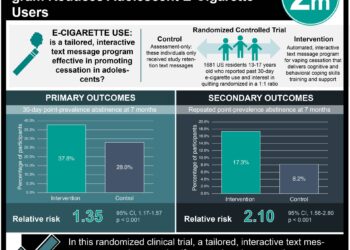
#VisualAbstract: A Vaping Cessation Text Message Program Reduces Adolescent E-Cigarette Users

Advancing bedtime with constant wake times increases sleep duration in adolescents

Physical activity interventions may improve symptom resolution in children following concussion

“E-cigarettes typically contain tobacco-derived nicotine, which is highly addictive, could lead to sustained tobacco use, and may cause lasting harm to brain development among youth. E-cigarettes became the most commonly used tobacco product among U.S. youth in 2014, and e-cigarette advertising uses many of the same themes and tactics that have led to increases in traditional cigarette smoking among youth. Health care providers can ask about youth’s e-cigarette use and provide counseling on dangers of use of all tobacco products among youth, including e-cigarettes; and advise parents and caregivers to actively participate in deciding which websites and media children may view and discuss media content with them.”

In-Depth [cross-sectional survey]: Participants included 10 419 middle school (grades 6 to 8) and 11 399 high school (grades 9 to 12) students who completed the 2014 National Youth Tobacco Survey (NYTS). A binary classification of e-cigarette use was determined based on response to use in the past 30 days (user: ≥1 day; nonuser: 0 days). Exposure to Internet, newspaper/magazine, retail store, and TV/movie e-cigarette advertising was measured categorically and analyzed as “never/rarely,” “sometimes,” and “most of the time/always.” Adjusting for gender, race/ethnicity, grade, and other tobacco use, the odds of using e-cigarettes was significantly (p < 0.05) increased in the “most of the time/always” group relative to the “never/rarely” group across all advertisement sources for both middle and high school students. The greatest increase in odds was observed with exposure to Internet advertising (middle school students: OR = 2.91, 95%CI: 1.89-4.47; high school students: OR = 2.02, 95%CI: 1.66-2.46). A significant (p < 0.05) increase in the odds ratio was also noted for moderate (i.e., those that responded “sometimes”) relative to low/no exposure in the high school students for all advertisement sources but only for Internet and retail store advertisement exposure in the middle school student sample. Of the current middle school e-cigarette users, 31.4% (95%CI: 26.8%-36.4%) had frequent exposure to Internet e-cigarette advertisements compared to only 10.8% (95%CI: 9.5%-12.4%) of the current nonusers. A similar pattern of advertisement exposure was observed among the high school e-cigarette users and nonusers.

Image: CC/Wiki/Lindsay Fox

©2015 2 Minute Medicine, Inc. All rights reserved. No works may be reproduced without expressed written consent from 2 Minute Medicine, Inc. Inquire about licensing here. No article should be construed as medical advice and is not intended as such by the authors or by 2 Minute Medicine, Inc.

Tags: adolescent medicineelectronic cigarettes (e-cigs)
Previous Post

BRCA1 mutation linked to lower AMH levels

Next Post

New guidelines define brief resolved unexplained events

RelatedReports

#VisualAbstract: A Vaping Cessation Text Message Program Reduces Adolescent E-Cigarette Users
StudyGraphics

#VisualAbstract: A Vaping Cessation Text Message Program Reduces Adolescent E-Cigarette Users

August 19, 2024
Sleep duration, sleepiness, chronotype have variable associations with teen self-regulation
Neurology

Advancing bedtime with constant wake times increases sleep duration in adolescents

June 27, 2023
Prolonged rest after concussion not linked to improved outcomes
Chronic Disease

Physical activity interventions may improve symptom resolution in children following concussion

May 2, 2023
Greater prenatal alcohol exposure trajectories linked to impaired growth and neurodevelopment
Chronic Disease

Drinking characteristics in adolescence predict alcohol behaviors in early adulthood

March 24, 2023
Next Post
Increasing C-section room temperature linked to reduced neonatal, maternal hypothermia

New guidelines define brief resolved unexplained events

Normal renal ultrasound only rules out high grade vesicoureteral reflux in infants

Gut microbiome alteration may improve survival in graft-versus-host disease [PreClinical]

Disparities exist in economic impact of childhood food allergy

Disparities exist in economic impact of childhood food allergy

2 Minute Medicine® is an award winning, physician-run, expert medical media company. Our content is curated, written and edited by practicing health professionals who have clinical and scientific expertise in their field of reporting. Our editorial management team is comprised of highly-trained MD physicians. Join numerous brands, companies, and hospitals who trust our licensed content.

Recent Reports

  • Knee bracing may provide small improvements in patient-reported outcomes in knee osteoarthritis
  • Second-stage cesarean and operative vaginal deliveries are associated with similar neurodevelopmental outcomes in children
  • Isotonic Fluids Reduce Hyponatremia in Hospitalized Children
License Content
Terms of Use | Disclaimer
Cookie Policy
Privacy Statement (EU)
Disclaimer

© 2025 2 Minute Medicine, Inc. - Physician-written medical news.

  • Specialties
    • All Specialties, All Recent Reports
    • Cardiology
    • Chronic Disease
    • Dermatology
    • Emergency
    • Endocrinology
    • Gastroenterology
    • Imaging and Intervention
    • Infectious Disease
    • Nephrology
    • Neurology
    • Obstetrics
    • Oncology
    • Ophthalmology
    • Pediatrics
    • Pharma
    • Preclinical
    • Psychiatry
    • Public Health
    • Pulmonology
    • Rheumatology
    • Surgery
  • Tools
    • EvidencePulse™
    • RVU Search
    • NPI Registry Lookup
  • Pharma
  • AI News
  • The Scan
  • Classics™
    • 2MM+ Online Access
    • Paperback and Ebook
  • Rewinds
  • Partners
    • License Content
    • Submit Press Release
    • Advertise with Us
  • Account
    • Subscribe
    • Sign-in
    • My account
No Result
View All Result

© 2025 2 Minute Medicine, Inc. - Physician-written medical news.