• About
  • Masthead
  • License Content
  • Advertise
  • Submit Press Release
  • RSS/Email List
  • 2MM Podcast
  • Write for us
  • Contact Us
2 Minute Medicine
No Result
View All Result

No products in the cart.

SUBSCRIBE
  • Specialties
    • All Specialties, All Recent Reports
    • Cardiology
    • Chronic Disease
    • Dermatology
    • Emergency
    • Endocrinology
    • Gastroenterology
    • Imaging and Intervention
    • Infectious Disease
    • Nephrology
    • Neurology
    • Obstetrics
    • Oncology
    • Ophthalmology
    • Pediatrics
    • Pharma
    • Preclinical
    • Psychiatry
    • Public Health
    • Pulmonology
    • Rheumatology
    • Surgery
  • Tools
    • EvidencePulse™
    • RVU Search
    • NPI Registry Lookup
  • Pharma
  • AI News
  • The Scan+
  • Classics™+
    • 2MM+ Online Access
    • Paperback and Ebook
  • Rewinds
  • Partners
    • License Content
    • Submit Press Release
    • Advertise with Us
  • Account
    • Subscribe
    • Sign-in
    • My account
2 Minute Medicine
  • Specialties
    • All Specialties, All Recent Reports
    • Cardiology
    • Chronic Disease
    • Dermatology
    • Emergency
    • Endocrinology
    • Gastroenterology
    • Imaging and Intervention
    • Infectious Disease
    • Nephrology
    • Neurology
    • Obstetrics
    • Oncology
    • Ophthalmology
    • Pediatrics
    • Pharma
    • Preclinical
    • Psychiatry
    • Public Health
    • Pulmonology
    • Rheumatology
    • Surgery
  • Tools
    • EvidencePulse™
    • RVU Search
    • NPI Registry Lookup
  • Pharma
  • AI News
  • The Scan+
  • Classics™+
    • 2MM+ Online Access
    • Paperback and Ebook
  • Rewinds
  • Partners
    • License Content
    • Submit Press Release
    • Advertise with Us
  • Account
    • Subscribe
    • Sign-in
    • My account
SUBSCRIBE
2 Minute Medicine
Subscribe
Home All Specialties Chronic Disease

Hypercortisolism of bilateral macronodular adrenal hyperplasia may be corticotropin-dependent

bys25qthea
November 28, 2013
in Chronic Disease, Endocrinology
Reading Time: 3 mins read
0
Share on FacebookShare on Twitter

Image: PD 

1. Messenger RNA encoding proopiomelanocortin, a corticotropin precursor, was detected in all samples of hyperplastic adrenal tissue. 

2. In two patients, corticotropin concentration was higher in the adrenal veins than peripheral veins, suggesting local production. 

3. Although bilateral macronodular adrenal hyperplasia has been thought to be corticotropin-independent, these findings suggest that the disease is associated with ectopic corticotropin secretion from the adrenal cortex. 

Evidence Rating Level: 4 (Below average)           

Study Rundown: “Corticotropin-independent macronodular adrenal hyperplasia” may be a misnomer in light of new findings regarding the pathophysiology of this disease. In this study, Louiset et al. suggest that hypercortisolism in patients with bilateral adrenal macronodular hyperplasia may result from ectopic production of corticotropin in the adrenal cortex. Despite the small sample of 30 patients, the results were convincing with a high degree of consistency among cases. Additionally, the current study found that corticotropin-synthesizing cells co-expressed Leydig- and luteal-cell marker insulin-like 3, which suggests that the these aberrant cells may result from abnormal gonadal-like differentiation or from migration of gonadal stem cells during embryogenesis. Finally, in vitro studies showed that cortisol secretion was reduced with melanocortin 2 receptor antagonists. This may be clinically important as future therapies involving targeted molecular agents may be more effective and less invasive than the current standard therapy – bilateral adrenalectomy.

RELATED REPORTS

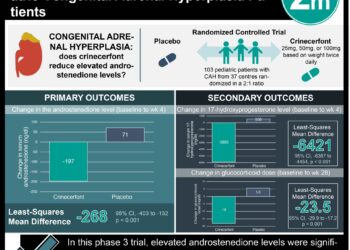
#VisualAbstract: Crinecerfont Improves Outcomes in Pediatric Congenital Adrenal Hyperplasia Patients

ARMC5 mutation identified in patients with macronodular adrenal hyperplasia

Click to read the study, published today in NEJM

Click to read an accompanying editorial in NEJM

Relevant Reading: Adrenocortical-pituitary hybrid tumor causing Cushing’s syndrome

In-Depth [case series]: This study investigated the possibility that cortisol secretion in “corticotropin-independent” macronodular adrenal hyperplasia may be driven by local corticotropin production. The study analyzed samples from 30 patients: 13 were collected prospectively at surgery and 17 were analyzed retrospectively with fixed or frozen samples.

Conventional and RT-PCR tests were positive for proopiomelanocortin mRNA in all 26 samples tested, with values from 4.2 to 62.6 pg of proopiomelanocortin mRNA per 1 ng of cyclophilin mRNA (median, 32.5). Immunohistochemical analysis with anti-corticotropin antibodies were positive in all 25 samples analyzed. The immunoreactive cells were in isolated patterns in 4 of the 25 samples (16%) and in clustered patterns in the other 21 samples (84%). As a negative control, corticotropin immunostaining were all negative in six normal adrenal glands and four cortisol-secreting adenomas.

In two patients, plasma corticotropin levels were measured from the right and left adrenal veins and were found to be higher than those in the peripheral veins (26.6±5.5 and 15.0±2.0 pg/ml in adrenal veins, respectively vs. 2.0±0.5 pg/ml peripherally in patient 12; 54.0±3.6 and 36.0±3.0 pg/ml in adrenal veins, respectively vs. 4.6±1.2 pg/ml in patient 13).

Based on these results, the authors concluded that cortisol secretion by the adrenal glands in bilateral macronodular adrenal hyperplasia may be regulated by local production of corticotropin and thus, may be corticotropin-dependent.

By Xiaozhou Liu and Adrienne Cheung

More from this author: Nivolumab plus ipilimumab shows promise for metastatic melanoma, Prophylactic platelet transfusions prevent bleeding in hematologic cancers, Azithromycin is not associated with increased cardiovascular death in low-risk groups, Health education module reduces parasitic infections, New chemotherapy precludes the need for radiotherapy in primary mediastinal B-cell lymphoma

©2012-2013 2minutemedicine.com. All rights reserved. No works may be reproduced without expressed written consent from 2minutemedicine.com. Disclaimer: We present factual information directly from peer reviewed medical journals. No post should be construed as medical advice and is not intended as such by the authors, editors, staff or by 2minutemedicine.com. PLEASE SEE A HEALTHCARE PROVIDER IN YOUR AREA IF YOU SEEK MEDICAL ADVICE OF ANY SORT. 
Tags: adrenal hyperplasiacorticotropin
Previous Post

Thalidomide may be effective in refractory pediatric Crohn’s disease

Next Post

Micronutrient supplementation linked with decreased HIV-disease progression

RelatedReports

#VisualAbstract: Crinecerfont Improves Outcomes in Pediatric Congenital Adrenal Hyperplasia Patients
StudyGraphics

#VisualAbstract: Crinecerfont Improves Outcomes in Pediatric Congenital Adrenal Hyperplasia Patients

June 11, 2024
ARMC5 mutation identified in patients with macronodular adrenal hyperplasia
Chronic Disease

ARMC5 mutation identified in patients with macronodular adrenal hyperplasia

November 29, 2013
Next Post
New pathogenic dimorphic fungal species suggested in HIV-positive patients

Micronutrient supplementation linked with decreased HIV-disease progression

The RIVAL trial: Radial vs femoral artery access for PCI [Classics Series]

ARMC5 mutation identified in patients with macronodular adrenal hyperplasia

ARMC5 mutation identified in patients with macronodular adrenal hyperplasia

2 Minute Medicine® is an award winning, physician-run, expert medical media company. Our content is curated, written and edited by practicing health professionals who have clinical and scientific expertise in their field of reporting. Our editorial management team is comprised of highly-trained MD physicians. Join numerous brands, companies, and hospitals who trust our licensed content.

Recent Reports

  • Next-generation yellow fever vaccine shows comparable efficacy to standard vaccine
  • Amazon Health Services expands generative artificial intelligence assistant to all United States customers
  • Atezolizumab may improve disease-free survival in mismatch repair deficiency locally advanced colon cancer
License Content
Terms of Use | Disclaimer
Cookie Policy
Privacy Statement (EU)
Disclaimer

The Classics in Medicine Paperback Released!

Over the past 30 years, the transition from print to digital media has contributed to an exponential increase in medical literature. In response, 2 Minute Medicine presents 160+ authoritative, physician-written summaries of the most cited landmark trials in medicine.

amazon-logo_blackGet-it-on-iBooks-badge

Click anywhere to close this announcement

  • Specialties
    • All Specialties, All Recent Reports
    • Cardiology
    • Chronic Disease
    • Dermatology
    • Emergency
    • Endocrinology
    • Gastroenterology
    • Imaging and Intervention
    • Infectious Disease
    • Nephrology
    • Neurology
    • Obstetrics
    • Oncology
    • Ophthalmology
    • Pediatrics
    • Pharma
    • Preclinical
    • Psychiatry
    • Public Health
    • Pulmonology
    • Rheumatology
    • Surgery
  • Tools
    • EvidencePulse™
    • RVU Search
    • NPI Registry Lookup
  • Pharma
  • AI News
  • The Scan
  • Classics™
    • 2MM+ Online Access
    • Paperback and Ebook
  • Rewinds
  • Partners
    • License Content
    • Submit Press Release
    • Advertise with Us
  • Account
    • Subscribe
    • Sign-in
    • My account
No Result
View All Result

© 2026 2 Minute Medicine, Inc. - Physician-written medical news.