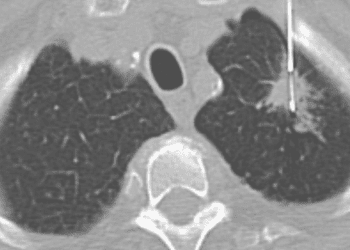
Lung cancer screening models show variable performance across populations
1. In this cohort study, 16 lung cancer risk prediction models demonstrated variation in screening efficiency and sensitivity across racial and ethnic groups, while generally identifying more individuals for screening compared with current guideline-based criteria.
2. Most models underestimated lung cancer risk in non-Hispanic White participants, and all models underestimated risk in non-Hispanic Black participants.
Evidence Rating Level: 2 (Good)
Study Rundown: Lung cancer screening is currently recommended for adults aged 50 years or older with at least a 20 pack-year smoking history. These expanded eligibility criteria were introduced to reduce disparities in screening access by sex and race or ethnicity. However, tailored eligibility criteria based on individualized risk prediction models may better address these disparities. This study evaluated the performance of 16 lung cancer risk prediction models among racially and ethnically diverse individuals with a history of smoking. All but one model underestimated lung cancer risk in non-Hispanic White participants. All models underestimated risk in non-Hispanic Black participants, with substantial underestimation observed in most models. Risk estimates for Hispanic and Asian participants were more uncertain but appeared to be well calibrated on average. Although differences in discrimination were small overall, model performance was consistently poorer among non-Hispanic Black and Asian participants than among non-Hispanic White participants. Compared with current screening guidelines, all models improved screening efficiency for non-Hispanic White participants and most improved efficiency for non-Hispanic Black participants. All models identified more screening-eligible non-Hispanic White participants and demonstrated greater sensitivity for future lung cancer, while six models achieved similar improvements among non-Hispanic Black participants. In contrast, none of the models meaningfully improved screening eligibility or sensitivity for Hispanic or Asian participants. The generalizability of these findings is limited by the relatively small number of Hispanic and Asian participants. Nevertheless, this study suggests that risk-based screening strategies may outperform current eligibility criteria across several racial and ethnic groups, while highlighting the need for further refinement to ensure equitable performance across the diverse U.S. population.
Click to read this study in AIM
Relevant Reading: Lung Cancer Risk Prediction Models for Asian Ever-Smokers
In-Depth [prospective cohort]: This cohort study evaluated the performance of 16 lung cancer risk prediction models across non-Hispanic White, non-Hispanic Black, Hispanic, and Asian populations in the United States. The analysis included 641,830 adults aged 50 to 80 years with a smoking history, including 585,787 non-Hispanic White, 39,872 non-Hispanic Black, 9,781 Hispanic, and 6,390 Asian participants. Compared with other groups, non-Hispanic Black participants were younger (mean age 59.5 vs. 61-63 years), more often current smokers (51% vs. 24-33%), and had lower educational attainment (high school or less: 46% vs. 15-34%). Model performance was evaluated using calibration (agreement between expected and observed events), discrimination (ability to distinguish future cases from non-cases), eligibility (proportion selected for screening), sensitivity (proportion of future cases identified), and efficiency (screened-to-case ratio, with lower values indicating better performance). For calibration, 15 of 16 models underestimated risk in non-Hispanic White participants, and all models underestimated risk in non-Hispanic Black participants. Substantial underestimation (expected-to-observed ratio <0.75) occurred in 11 models for non-Hispanic Black participants, indicating fewer than 75 cases were predicted when 100 occurred. Hispanic and Asian estimates were more uncertain due to smaller sample sizes but were generally well calibrated (ratios ~0.85-1.25). Discrimination was similar for non-Hispanic White participants, but lower for Asian participants in 13 models and for non-Hispanic Black participants in 15 models. Compared with USPSTF-2021 criteria, which made 28% of Asian and Hispanic, 34% of non-Hispanic Black, and 39% of non-Hispanic White participants eligible, risk-based models improved overall efficiency and increased sensitivity from 41-63% under guidelines to 69-75% across models. Among non-Hispanic Black participants, six models increased both eligibility (37-43%) and sensitivity (68-77%). Gains were less consistent for Hispanic and Asian participants. Sensitivity analyses using inverse probability weighting showed generally higher calibration ratios in non-Hispanic Black and Hispanic participants and lower ratios in Asian participants. Overall, risk-based models improved lung cancer screening efficiency and sensitivity compared with current guidelines, but important differences in calibration and performance across racial and ethnic groups remain.
Image: PD
©2026 2 Minute Medicine, Inc. All rights reserved. No works may be reproduced without expressed written consent from 2 Minute Medicine, Inc. Inquire about licensing here. No article should be construed as medical advice and is not intended as such by the authors or by 2 Minute Medicine, Inc.