• About
  • Masthead
  • License Content
  • Advertise
  • Submit Press Release
  • RSS/Email List
  • 2MM Podcast
  • Write for us
  • Contact Us
2 Minute Medicine
No Result
View All Result

No products in the cart.

SUBSCRIBE
  • About
  • Specialties
    • All Specialties, All Recent Reports
    • Cardiology
    • Chronic Disease
    • Dermatology
    • Emergency
    • Endocrinology
    • Gastroenterology
    • Imaging and Intervention
    • Infectious Disease
    • Nephrology
    • Neurology
    • Obstetrics
    • Oncology
    • Ophthalmology
    • Pediatrics
    • Pharma
    • Preclinical
    • Psychiatry
    • Public Health
    • Pulmonology
    • Rheumatology
    • Surgery
  • Tools+
    • EvidencePulse™
    • HypeCheck™
    • NPI Registry Lookup
    • RVU Search
  • Pharma
  • AI Roundup
  • The Scan+
  • Classics™+
    • 2MM+ Online Access
    • Paperback and Ebook
  • Rewinds
  • Partners
    • License Content
    • Submit Press Release
    • Advertise with Us
  • Account
    • Subscribe
    • My account
    • Cart
    • Sign in
2 Minute Medicine
  • About
  • Specialties
    • All Specialties, All Recent Reports
    • Cardiology
    • Chronic Disease
    • Dermatology
    • Emergency
    • Endocrinology
    • Gastroenterology
    • Imaging and Intervention
    • Infectious Disease
    • Nephrology
    • Neurology
    • Obstetrics
    • Oncology
    • Ophthalmology
    • Pediatrics
    • Pharma
    • Preclinical
    • Psychiatry
    • Public Health
    • Pulmonology
    • Rheumatology
    • Surgery
  • Tools+
    • EvidencePulse™
    • HypeCheck™
    • NPI Registry Lookup
    • RVU Search
  • Pharma
  • AI Roundup
  • The Scan+
  • Classics™+
    • 2MM+ Online Access
    • Paperback and Ebook
  • Rewinds
  • Partners
    • License Content
    • Submit Press Release
    • Advertise with Us
  • Account
    • Subscribe
    • My account
    • Cart
    • Sign in
SUBSCRIBE
2 Minute Medicine
Subscribe
EvidencePulse™ by 2 Minute Medicine 2026 evidence scan 3 reports You asked top stroke trials 2026 Synthesizing medical evidence... Top 2026 stroke trial results: OCEANIC — ischemic stroke: 6.2% vs 8.4% OPTION* — mRS 0–1: 43.6% vs 34.2% ORIENTAL* — mRS 0–2: 58.6% vs 46.6% *Higher sICH in intervention arms Participants randomizedN OCEANIC 12,327 OPTION 570 ORIENTAL 564 Ask about guidelines or landmark trials... ↑ Try EvidencePulse™ Ask the evidence.
Get the signal.
Try it now → Physician-trained medical AI by 2 Minute Medicine
Home All Specialties Chronic Disease

Osimertinib improves progression-free survival in EGFR-mutated non-small-cell lung cancer: The FLAURA trial
byJames RoebkerandAnees Daud
January 11, 2018
in Chronic Disease, Imaging and Intervention, Oncology, Surgery
Reading Time: 3 mins read
Lessons from real-world implementation of lung cancer screening
Share on FacebookShare on Twitter

1. Osimertinib demonstrated a significantly longer duration of progression-free survival compared to standard of care epidermal growth factor receptor (EGFR)-tyrosine kinase inhibitors (TKI) in patients with untreated EGFR-mutated locally-advanced or metastatic non-small-cell lung cancer (NSCLC).

2. Osimertinib treated patients had fewer grade 3 or higher adverse events compared to patients treated with standard EGFR-TKI therapy.

Evidence Rating Level: 1 (Excellent)   

Study Rundown: Osimertinib is an oral third-generation, irreversible EGFR-TKI that inhibits both EGFR-sensitizing and EGFR T790M resistance mutations presently approved for previously treated patients with T790M-positive NSCLC. Although recent phase 1 data suggests osimertinib may be effective as first-line therapy for locally-advanced or metastatic EGFR-mutated NSCLC, it is not yet approved for this purpose. This study evaluated osimertinib versus standard of care EGFR-TKI therapy (gefitinib or erlotinib) in treatment naïve patients with locally-advanced or metastatic EGFR-mutated NSCLC. The duration of progression-free survival (primary end point) was significantly longer in the osimertinib group compared to standard therapy. Among secondary end points, osimertinib was associated with improved disease-control rate, reduction in tumor size, and fewer adverse events. The significant increase in progression-free survival supports use of osimertinib as the new standard of care for EGFR-mutated NSCLC.

Major strengths of this trial are the confirmation of EGFR-mutation type in the majority of patients, inclusion of patients with and without CNS metastases, and the comparison to the two most widely used EGFR-TKIs. As data for overall survival is still pending, however, universal use of osimertinib as first-line therapy may not be universally implemented. Additionally, magnetic resonance imaging was not required to detect brain metastasis, and asymptomatic metastases are well-documented in NSCLC.

Click to read the study, published today in NEJM

RELATED REPORTS

Lung cancer screening models show variable performance across populations

Guideline-based lymph node sampling is not associated with increased postoperative complications in lung cancer

2 Minute Medicine Rewind June 8, 2026

Relevant Reading: Activating mutations in the epidermal growth factor receptor underlying responsiveness of non-small-cell lung cancer to gefitinib

In-Depth [randomized controlled trial]: This was a double-blind, phase 3 trial of patients with locally-advanced or metastatic NSCLC with a confirmed EGFR exon 19 deletion and/or p.Leu858Arg mutation. Patients (n = 556) were randomized in a 1:1 ratio to either oral osimertinib (n = 279) or a standard oral EGFR-TKI (gefitinib or erlotinib; n = 277) and assessed via the Response Evaluation Criteria in Solid Tumors (RECIST) criteria until disease progression. The primary end point was the duration of progression-free survival according to RECIST. Secondary end points included overall survival, objective response rate, duration of response, disease-control rate, and safety.

The median progression-free survival was 18.9 months (95% confidence interval [CI], 15.2 to 21.4) in the osimertinib group versus 10.2 months (95% CI, 9.6 to 11.1) in the standard EGFR-TKI group (hazard ratio [HR], 0.46; 95% CI, 0.37 to 0.57; p < 0.001). This increased duration was consistent across all predefined subgroups (including Asian versus non-Asian, EGFR mutation type, and presence or absence of central nervous system [CNS] metastases at trial entry). A statistically significant benefit was found in the osimertinib group with respect to disease-control rate (97% vs. 92%; odds ratio, 2.78; 95% CI, 1.25 to 6.78; p = 0.01) and median best percentage change in target-lesion size (-54.7% vs. -48.5% in standard group; p = 0.003). Events of CNS progression occurred in 6% in the osimertinib group versus 15% in the standard therapy group. No significant difference in objective response rate (odds ratio [OR], 1.27; 95% CI, 0.85 to 1.90; p = 0.24) was found. Median overall survival could not be calculated due to data immaturity. Adverse events of grade 3 or higher were reported in fewer patients in the osimertinib group (34% vs. 45%) and osimertinib was associated with a lower rate of adverse events leading to treatment discontinuation. QT interval prolongation was reported in a higher percentage of patients in the osimertinib group (10% vs. 5%); however, the majority were grade 1 or grade 2 and no fatal cases of torsades des pointes were reported in either group.

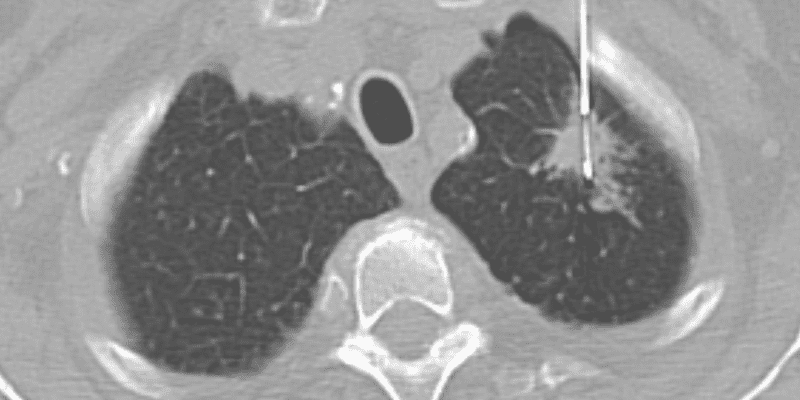
Image: CC/Wiki

©2018 2 Minute Medicine, Inc. All rights reserved. No works may be reproduced without expressed written consent from 2 Minute Medicine, Inc. Inquire about licensing here. No article should be construed as medical advice and is not intended as such by the authors or by 2 Minute Medicine, Inc.
Tags: lung cancernon-small cell lung cancerosimertinib
Previous Post

School-based telemedicine enhances asthma management in children

Next Post

No long-term neurodevelopmental effects of inhaled budesonide in preterm infants

RelatedReports

Thoracic radiotherapy improves survival in small-cell lung cancer patients
Oncology

Lung cancer screening models show variable performance across populations

June 29, 2026
Lessons from real-world implementation of lung cancer screening
Chronic Disease

Guideline-based lymph node sampling is not associated with increased postoperative complications in lung cancer

June 9, 2026
Weekly Rewinds

2 Minute Medicine Rewind June 8, 2026

June 8, 2026
Pulmonary MRI with ultrashort echo time is comparable to pulmonary CT
Oncology

Positive lung cancer screens frequently receive suboptimal follow-up

December 15, 2025
Next Post
Poverty, preterm birth demonstrate additive effect on cognition

No long-term neurodevelopmental effects of inhaled budesonide in preterm infants

Infertility treatments not associated with increased short-term cancer risk

Live-birth rates similar among ovulating women undergoing fresh- or frozen-embryo transfer

Smoking during pregnancy associated with aerobic fitness of children

Risk-based lung cancer screening may prevent more deaths than current guidelines

EvidencePulse™ by 2 Minute Medicine 2026 evidence scan 3 reports You asked top stroke trials 2026 Synthesizing medical evidence... Top 2026 stroke trial results: OCEANIC — ischemic stroke: 6.2% vs 8.4% OPTION* — mRS 0–1: 43.6% vs 34.2% ORIENTAL* — mRS 0–2: 58.6% vs 46.6% *Higher sICH in intervention arms Participants randomizedN OCEANIC 12,327 OPTION 570 ORIENTAL 564 Ask about guidelines or landmark trials... ↑ Try EvidencePulse™ Get the signal. Try it now → Physician-trained medical AI by 2 Minute Medicine

2MM+ All Access

Full details →
$4.99 /month

3-day free trial · cancel anytime

  • ✓100+ physician-written reports
  • ✓EvidencePulse™ + HypeCheck™
  • ✓Ad-free reading + newsletters
Start 3-day free trial

Then $4.99/month. Manage renewal in your account.

2 Minute Medicine® is an award winning, physician-run, expert medical media company. Our content is curated, written and edited by practicing health professionals who have clinical and scientific expertise in their field of reporting. Our editorial management team is comprised of highly-trained MD physicians. Join numerous brands, companies, and hospitals who trust our licensed content.

Recent Reports

  • Low-dose radiotherapy may be effective as a short-term therapeutic option in knee osteoarthritis
  • Physician edits to artificial intelligence (AI)-generated messages to patients were associated with different response time burdens
  • Male sex is associated with higher mortality among patients with hepatocellular carcinoma
License Content
Terms of Use | Disclaimer
Cookie Policy
Cleantalk Pixel
2MM+ All Access Full details →

The medical literature, distilled daily.

Monthly plan selected: $4.99 /month.

$4.99/month

3-day free trial · cancel anytime

Start 3-day free trial

Then $4.99/month. Manage renewal in your account.

Yearly plan selected: $49.90 /year.

$49.90/year

2 months free

Start 3-day free trial

Then $49.90/year.

Membership benefits

  • ✓100+ physician-written reports
  • ✓AI EvidencePulse™ + HypeCheck™
  • ✓Ad-free reading + newsletters

Already a member? Sign in

  • About
  • Specialties
    • All Specialties, All Recent Reports
    • Cardiology
    • Chronic Disease
    • Dermatology
    • Emergency
    • Endocrinology
    • Gastroenterology
    • Imaging and Intervention
    • Infectious Disease
    • Nephrology
    • Neurology
    • Obstetrics
    • Oncology
    • Ophthalmology
    • Pediatrics
    • Pharma
    • Preclinical
    • Psychiatry
    • Public Health
    • Pulmonology
    • Rheumatology
    • Surgery
  • Tools
    • EvidencePulse™
    • HypeCheck™
    • NPI Registry Lookup
    • RVU Search
  • Pharma
  • AI Roundup
  • The Scan
  • Classics™
    • 2MM+ Online Access
    • Paperback and Ebook
  • Rewinds
  • Partners
    • License Content
    • Submit Press Release
    • Advertise with Us
  • Account
    • Subscribe
    • My account
    • Cart
    • Sign in
No Result
View All Result

© 2026 2 Minute Medicine, Inc. - Physician-written medical news.