• About
  • Masthead
  • License Content
  • Advertise
  • Submit Press Release
  • RSS/Email List
  • 2MM Podcast
  • Write for us
  • Contact Us
2 Minute Medicine
No Result
View All Result

No products in the cart.

SUBSCRIBE
  • About
  • Specialties
    • All Specialties, All Recent Reports
    • Cardiology
    • Chronic Disease
    • Dermatology
    • Emergency
    • Endocrinology
    • Gastroenterology
    • Imaging and Intervention
    • Infectious Disease
    • Nephrology
    • Neurology
    • Obstetrics
    • Oncology
    • Ophthalmology
    • Pediatrics
    • Pharma
    • Preclinical
    • Psychiatry
    • Public Health
    • Pulmonology
    • Rheumatology
    • Surgery
  • Tools+
    • EvidencePulse™
    • HypeCheck™
    • NPI Registry Lookup
    • RVU Search
  • Pharma
  • AI Roundup
  • The Scan+
  • Classics™+
    • 2MM+ Online Access
    • Paperback and Ebook
  • Rewinds
  • Partners
    • License Content
    • Submit Press Release
    • Advertise with Us
  • Account
    • Subscribe
    • My account
    • Cart
    • Sign-in
2 Minute Medicine
  • About
  • Specialties
    • All Specialties, All Recent Reports
    • Cardiology
    • Chronic Disease
    • Dermatology
    • Emergency
    • Endocrinology
    • Gastroenterology
    • Imaging and Intervention
    • Infectious Disease
    • Nephrology
    • Neurology
    • Obstetrics
    • Oncology
    • Ophthalmology
    • Pediatrics
    • Pharma
    • Preclinical
    • Psychiatry
    • Public Health
    • Pulmonology
    • Rheumatology
    • Surgery
  • Tools+
    • EvidencePulse™
    • HypeCheck™
    • NPI Registry Lookup
    • RVU Search
  • Pharma
  • AI Roundup
  • The Scan+
  • Classics™+
    • 2MM+ Online Access
    • Paperback and Ebook
  • Rewinds
  • Partners
    • License Content
    • Submit Press Release
    • Advertise with Us
  • Account
    • Subscribe
    • My account
    • Cart
    • Sign-in
SUBSCRIBE
2 Minute Medicine
Subscribe
EvidencePulse™ by 2 Minute Medicine 2026 evidence scan 3 reports You asked top stroke trials 2026 Synthesizing medical evidence... Top 2026 stroke trial results: OCEANIC — ischemic stroke: 6.2% vs 8.4% OPTION* — mRS 0–1: 43.6% vs 34.2% ORIENTAL* — mRS 0–2: 58.6% vs 46.6% *Higher sICH in intervention arms Participants randomizedN OCEANIC 12,327 OPTION 570 ORIENTAL 564 Ask about guidelines or landmark trials... ↑ Try EvidencePulse™ Ask the evidence.
Get the signal.
Try it now → Physician-trained medical AI by 2 Minute Medicine
Home Health A to Z

Patient Basics: Alopecia Areata

byHarvard Health
November 30, 2014
in Health A to Z
Reading Time: 4 mins read
Share on FacebookShare on Twitter

Originally published by Harvard Health.

What Is It?

Alopecia areata is a skin disorder that causes hair loss, usually in patches, most often on the scalp. Usually, the bald patches appear suddenly and affect only a limited area. The hair grows back within 12 months or less. For some people, however, the problem can last longer and be more severe, causing total baldness (alopecia totalis) or total loss of body hair (alopecia universalis).

The cause of alopecia areata is probably an autoimmune reaction. This means the body’s immune system incorrectly attacks the body’s own cells. In the case of alopecia areata, the cells under attack are in the hair follicles (structures that grow hair), especially follicles within the scalp.

Genetic (inherited) factors may play a role, too, particularly when the disorder strikes those under age 30. Almost 40% of people younger than age 30 with alopecia areata have at least one family member who has been diagnosed with the same disorder.

The risk of developing alopecia areata is unusually high in people who have asthma, hay fever, thyroid disease, vitiligo (a condition in which patches of skin lose their color), pernicious anemia and Down syndrome.

Although experts once believed episodes of alopecia areata could be triggered by stress, newer research has failed to prove that stress is a factor.

RELATED REPORTS

#VisualAbstract: Ritlecitinib superior to placebo in the treatment of alopecia areata among teens and adults

Ritlecitinib superior to placebo in the treatment of alopecia areata among teens and adults

The Scan by 2 Minute Medicine®: Tennis Legends, Sausage Fingers, Alopecia Awareness Month and Starbucks Recalls!

About 60% of people with alopecia areata experience the first episode of hair loss before age 20. It is usually followed by hair regrowth. However, it’s common for the problem to come back. New bald patches can develop at the same time older ones are regrowing hair.

Symptoms

In its most common form, alopecia areata causes small round or oval patches of baldness on the scalp. The area of bald skin looks smooth and normal. In most cases, there are no other scalp symptoms. Occasionally, there is mild itching, tingling, tenderness or a burning sensation in the affected area. Some people with alopecia areata also have abnormalities in the surface of their fingernails, such as tiny pits or dents, grooves, superficial splitting, or an abnormal area of redness.
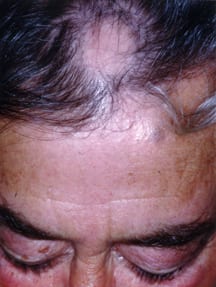
Alopecia


In rarer, more severe forms of the disorder, hair loss can involve the entire scalp or the entire body, including the eyebrows, eyelashes, beard, underarm hair and pubic hair (hair around the genitals).

Diagnosis

Your doctor will usually be able to diagnose alopecia areata based on examination of the areas of your hair loss and your symptoms. To look for further evidence, your doctor may pull gently on the hairs near the edge of the bald area to determine whether these hairs come out very easily and to inspect them for any structural abnormalities of the root or shaft. If there is still doubt as to diagnosis, a small skin biopsy of your scalp may confirm the diagnosis. In a biopsy, a small piece of skin is removed and examined in a laboratory.

Expected Duration

In most small patches of alopecia areata, the hair regrows within 6 to 12 months. However, it’s common for the problem to happen again.

Prevention

Alopecia areata cannot be prevented.

Treatment

Although there is no permanent cure for alopecia areata, there are ways that may short-circuit the body’s autoimmune reaction in the scalp and encourage hair regrowth. Options include:

  • Cortisone cream applied on the bald patches or cortisone solution injected into the bald patches to suppress the immune reaction
  • Immunotherapy using chemicals such as diphenylcyclopropenone (also called diphencyprone or DCP) or squaric acid dibutyl ester (SADBE) on the scalp that can produce an allergic reaction, which may neutralize the turned-on immune cells.
  • Topical minoxidil (Rogaine), which may increase hair growth by accelerating the speed of the natural hair cycle and increasing the diameter of hairs that begin to grow.
  • Anthralin (Drithocreme, Dritho-Scalp, Micanol) applied to the scalp, which causes a scalp irritation that may stimulate early hair regrowth, and can be used with minoxidil
  • Psoralen and ultraviolet A phototherapy (controlled exposure of the affected skin to ultraviolet light)
  • A short course of corticosteroids (such as prednisone) by mouth, or rarely, intravenously (through a vein) for adult patients with extensive hair loss

Your treatment depends on several factors, including your age (some treatments are only for adults), the amount of your hair loss, and your willingness to deal with any treatment-related discomfort or side effects.

If you have mild hair loss, you may choose to simply modify your hairstyle or wear a hairpiece until the bald area fills in.

If you lost a large amount of hair on your scalp, you may choose to wear a wig or hairpiece until your treatment starts to work. If you have an obvious loss of eyebrow hair, you may choose to have injections of tiny dots of colored pigments into the eyebrow area (a procedure called dermatography). If you find it hard to cope with the change in your appearance, mention this to your doctor or seek advice from a mental health professional.

When To Call a Professional

Make an appointment to see your doctor if:

  • You suddenly develop a bald spot on your scalp
  • Your hair stylist tells you that your hair is thinning, or that you have small bald areas
  • You have lost your eyebrows or eyelashes, your beard is thinning, or you have noticeably less hair on your underarms or pubic area

Prognosis

In more than 90% of cases, hair grows back and fills the bald spot within one year, even without treatment. However, recurrences are common, and most people have several episodes of the disorder during a lifetime. Despite treatment, about 7% of people experience prolonged large areas of hair loss with little hair regrowth.

Additional Info

American Academy of Dermatology
P.O. Box 4014
Schaumburg, IL 60168-4014
Phone: 847-330-0230
Toll-Free: 1-888-462-3376
Fax: 847-330-0050
http://www.aad.org/

National Alopecia Areata Foundation
P.O. Box 150760
San Rafael, CA 94915-0760
Phone: 415-472-3780
Fax: 415-473-5343
http://www.naaf.org/



Tags: alopecia
Previous Post

Patient Basics: Morton’s Neuroma

Next Post

Patient Basics: Amyotrophic Lateral Sclerosis (ALS)

RelatedReports

#VisualAbstract: Ritlecitinib superior to placebo in the treatment of alopecia areata among teens and adults
StudyGraphics

#VisualAbstract: Ritlecitinib superior to placebo in the treatment of alopecia areata among teens and adults

January 29, 2024
Patient Basics: Alopecia Areata
Chronic Disease

Ritlecitinib superior to placebo in the treatment of alopecia areata among teens and adults

May 18, 2023
The Scan by 2 Minute Medicine®:  Ultra-Trail du Mont-Blanc, Taylor Swift, NBA rookie Chet Holmgren and Magic Mushrooms!
The Scan by 2 Minute Medicine®

The Scan by 2 Minute Medicine®: Tennis Legends, Sausage Fingers, Alopecia Awareness Month and Starbucks Recalls!

September 20, 2022
#VisualAbstract: Dutasteride 0.5mg daily has the highest probability of being the most efficacious treatment for male androgenetic alopecia
StudyGraphics

#VisualAbstract: Dutasteride 0.5mg daily has the highest probability of being the most efficacious treatment for male androgenetic alopecia

February 10, 2022
Next Post

Patient Basics: Amyotrophic Lateral Sclerosis (ALS)

Patient Basics: Altitude Sickness

Patient Basics: Alzheimer's Disease

EvidencePulse™ by 2 Minute Medicine 2026 evidence scan 3 reports You asked top stroke trials 2026 Synthesizing medical evidence... Top 2026 stroke trial results: OCEANIC — ischemic stroke: 6.2% vs 8.4% OPTION* — mRS 0–1: 43.6% vs 34.2% ORIENTAL* — mRS 0–2: 58.6% vs 46.6% *Higher sICH in intervention arms Participants randomizedN OCEANIC 12,327 OPTION 570 ORIENTAL 564 Ask about guidelines or landmark trials... ↑ Try EvidencePulse™ Ask the evidence.
Get the signal.
Try it now → Physician-trained medical AI by 2 Minute Medicine

2MM+ All Access

Full details →
$4.99 /month

5-day free trial · cancel anytime

  • ✓100+ physician-written reports
  • ✓EvidencePulse™ + HypeCheck™
  • ✓Ad-free reading + newsletters
Start 5-day free trial

Then $4.99/month. Manage renewal in your account.

2 Minute Medicine® is an award winning, physician-run, expert medical media company. Our content is curated, written and edited by practicing health professionals who have clinical and scientific expertise in their field of reporting. Our editorial management team is comprised of highly-trained MD physicians. Join numerous brands, companies, and hospitals who trust our licensed content.

Recent Reports

  • First messenger RNA influenza vaccine outperforms standard-dose vaccination
  • Few interventions improve posthospitalization follow-up for alcohol use disorder
  • Borderline-low hemoglobin levels linked to increased mortality
License Content
Terms of Use | Disclaimer
Cookie Policy
Cleantalk Pixel
2MM+ All Access Full details →

The medical literature, distilled daily.

Monthly plan selected: $4.99 /month.

$4.99/month

5-day free trial · cancel anytime

Start 5-day free trial

Then $4.99/month. Manage renewal in your account.

Yearly plan selected: $49.90 /year.

$49.90/year

2 months free · only $4.16/month

Start 5-day free trial

Then $49.90/year. Manage renewal in your account.

Membership benefits

  • ✓100+ physician-written reports
  • ✓AI EvidencePulse™ + HypeCheck™
  • ✓Ad-free reading + newsletters

Already a member? Sign in

  • About
  • Specialties
    • All Specialties, All Recent Reports
    • Cardiology
    • Chronic Disease
    • Dermatology
    • Emergency
    • Endocrinology
    • Gastroenterology
    • Imaging and Intervention
    • Infectious Disease
    • Nephrology
    • Neurology
    • Obstetrics
    • Oncology
    • Ophthalmology
    • Pediatrics
    • Pharma
    • Preclinical
    • Psychiatry
    • Public Health
    • Pulmonology
    • Rheumatology
    • Surgery
  • Tools
    • EvidencePulse™
    • HypeCheck™
    • NPI Registry Lookup
    • RVU Search
  • Pharma
  • AI Roundup
  • The Scan
  • Classics™
    • 2MM+ Online Access
    • Paperback and Ebook
  • Rewinds
  • Partners
    • License Content
    • Submit Press Release
    • Advertise with Us
  • Account
    • Subscribe
    • My account
    • Cart
    • Sign-in
No Result
View All Result

© 2026 2 Minute Medicine, Inc. - Physician-written medical news.