
• About
  • Masthead
  • License Content
  • Advertise
  • Press Releases
  • Newsroom
  • RSS/Email List
  • 2MM Podcast
  • Write for us
  • Contact Us
2 Minute Medicine
No Result
View All Result

No products in the cart.

Sign in
SUBSCRIBE
  • About
  • Specialties
    • All Specialties, All Recent Reports
    • Cardiology
    • Chronic Disease
    • Dermatology
    • Emergency
    • Endocrinology
    • Gastroenterology
    • Imaging and Intervention
    • Infectious Disease
    • Nephrology
    • Neurology
    • Obstetrics
    • Oncology
    • Ophthalmology
    • Pediatrics
    • Pharma
    • Preclinical
    • Psychiatry
    • Public Health
    • Pulmonology
    • Rheumatology
    • Surgery
    • Rewinds
    • The Scan
  • EvidencePulse™
  • HypeCheck™
  • AI News
  • Classics™
    • 2MM+ Online Access
    • Paperback and Ebook
  • Tools
    • Medical Calculators
    • Clinical Guidelines
    • Physician Pay by Specialty
    • FDA Drug Approvals
    • RVU Search
    • ICD-10 Code Lookup
    • Drug Safety for Breastfeeding/Pregnancy
    • ECG Reference
      • QTc Calculator
      • Sgarbossa Criteria
      • ECG Axis Calculator
      • AV Block Helper
    • NPI Registry Lookup
  • Rankings
    • Medical School Rankings
    • Residency Rankings
  • Partners
    • License Content
    • Advertise with Us
2 Minute Medicine
  • About
  • Specialties
    • All Specialties, All Recent Reports
    • Cardiology
    • Chronic Disease
    • Dermatology
    • Emergency
    • Endocrinology
    • Gastroenterology
    • Imaging and Intervention
    • Infectious Disease
    • Nephrology
    • Neurology
    • Obstetrics
    • Oncology
    • Ophthalmology
    • Pediatrics
    • Pharma
    • Preclinical
    • Psychiatry
    • Public Health
    • Pulmonology
    • Rheumatology
    • Surgery
    • Rewinds
    • The Scan
  • EvidencePulse™
  • HypeCheck™
  • AI News
  • Classics™
    • 2MM+ Online Access
    • Paperback and Ebook
  • Tools
    • Medical Calculators
    • Clinical Guidelines
    • Physician Pay by Specialty
    • FDA Drug Approvals
    • RVU Search
    • ICD-10 Code Lookup
    • Drug Safety for Breastfeeding/Pregnancy
    • ECG Reference
      • QTc Calculator
      • Sgarbossa Criteria
      • ECG Axis Calculator
      • AV Block Helper
    • NPI Registry Lookup
  • Rankings
    • Medical School Rankings
    • Residency Rankings
  • Partners
    • License Content
    • Advertise with Us
Sign in
SUBSCRIBE
2 Minute Medicine
Sign in
Subscribe
2 Minute MedicineFree on Google PlayGet
✦EvidencePulse™by 2 Minute Medicine3 reportsYou askedtop stroke trials 2026Synthesizing medical evidence...Top 2026 stroke trial results:OCEANIC — ischemic stroke: 6.2% vs 8.4%OPTION* — mRS 0–1: 43.6% vs 34.2%ORIENTAL* — mRS 0–2: 58.6% vs 46.6%*Higher sICH in intervention armsParticipants randomizedNOCEANIC12,327OPTION570ORIENTAL564Ask about guidelines or landmark trials...↑Try EvidencePulse™Ask the evidence. Get the signal.Try it now →
Home Health A to Z

Patient Basics: Bone Density Test
by2 Minute Medicine
October 30, 2026
in Health A to Z
Reading Time: 5 mins read
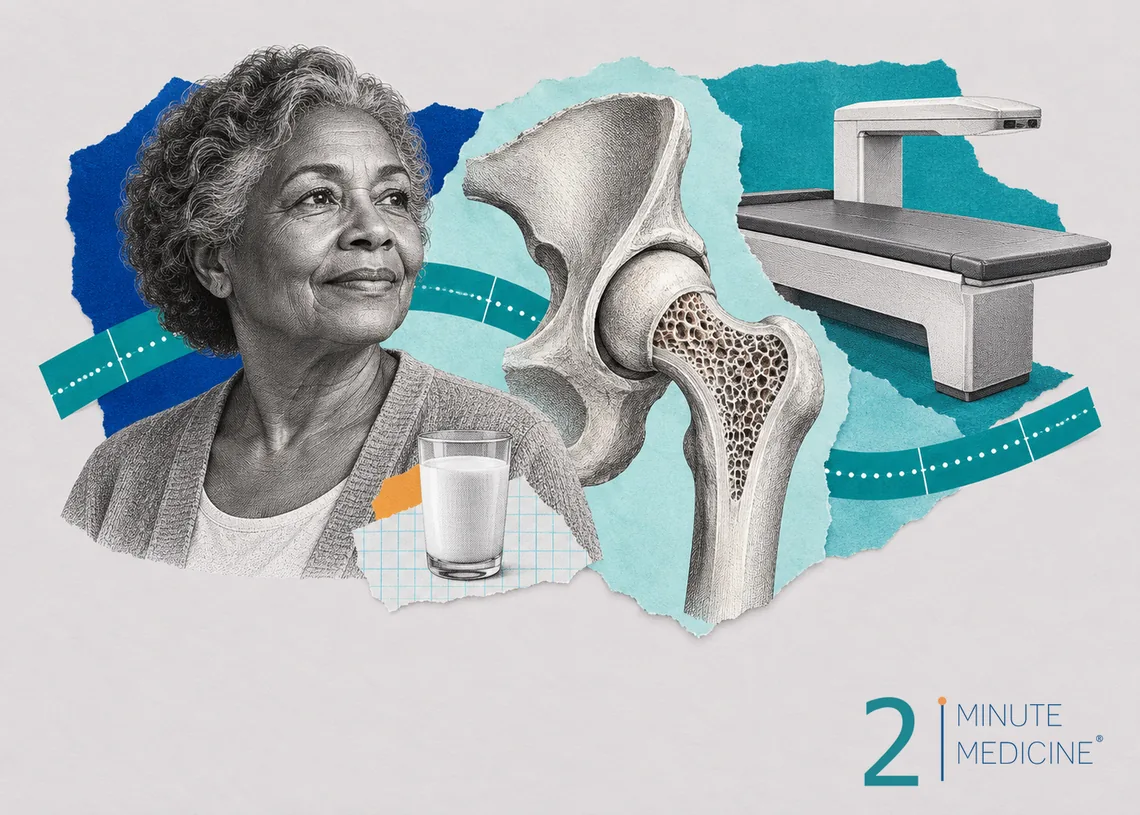
Bone density test collage: an older woman beside an engraved hip bone, a DXA scanner and a glass of milk
Share on FacebookShare on TwitterShare on LinkedIn

A bone density test measures how much mineral, mostly calcium, is packed into your bones. It shows whether you have osteoporosis or low bone mass (osteopenia) and how likely you are to break a bone. The standard test is a DXA scan (also called a DEXA scan), a quick, painless, low-dose X-ray of the hip and lower spine. You lie on a table fully clothed for about 10 to 20 minutes.

Key points

  • Women 65 and older should have a bone density test. Younger women past menopause, and some men, need one if they have risk factors.
  • The DXA scan uses much less radiation than a regular chest X-ray.
  • Stop calcium pills the day before, and wear clothes without metal.
  • Results come as a T-score. A score of -2.5 or lower means osteoporosis.
  • Your doctor combines the result with your other risks to decide on treatment.

Why a bone density test is done

Bone is living tissue that is always being broken down and rebuilt. After about age 30, and much faster in the years after menopause, the body loses bone faster than it makes it. Bones can become thin and break easily, often without any warning signs. Doctors use bone densitometry to:

  • Find osteoporosis before a bone breaks
  • Confirm osteoporosis after a fracture from a minor fall
  • Estimate your chance of a fracture in the next 10 years
  • Check whether osteoporosis treatment is working

Who should be tested

  • All women 65 and older
  • Women past menopause who are younger than 65 but at higher risk, for example because of low body weight, smoking, heavy drinking, or a parent who broke a hip
  • Men 70 and older, and younger men with risk factors, according to many bone health groups
  • Adults who break a bone after age 50 from a fall from standing height or less
  • People who take steroid pills such as prednisone for months, or other medicines that thin bone, such as some breast and prostate cancer treatments
  • People with rheumatoid arthritis, an overactive thyroid or parathyroid gland, celiac disease, or another condition linked to bone loss

Before the test

  • Eat normally. Don’t take calcium supplements for 24 hours before the scan, because the pills can show up on the image.
  • Wear loose, comfortable clothes without metal zippers, buttons, belts or underwire. You may be asked to change into a gown.
  • Leave jewelry at home.
  • Tell the staff if you might be pregnant, or if you had a barium X-ray, a CT scan with contrast dye or a nuclear medicine scan in the past 2 weeks. These can affect the results.
  • If you’ve had a bone density test before, try to have the next one on the same machine, or bring your old results.

What happens during a bone density test

The test is the same for women and men. You lie on your back on a padded table. For the spine scan, your legs rest on a padded box so your lower back lies flat. For the hip scan, a brace turns your foot slightly inward. A scanner arm passes slowly over your body while a low-dose X-ray beam measures how much of the beam the bone absorbs. You need to lie still and may be asked to hold your breath for a few seconds. The machine doesn’t close around you, and you won’t feel anything.

Sometimes the forearm is scanned too, or the scan includes a side view of the spine to look for small spine fractures you didn’t know about.

Other ways to measure bone density

  • Heel ultrasound and small scanners for the finger or wrist are sometimes used at health fairs or pharmacies. They use little or no radiation and can flag people who need a full test. They can’t diagnose osteoporosis or track treatment, so a low result should be followed by a DXA scan.
  • Quantitative CT measures spine density in 3D. It uses more radiation and is used less often.

Afterward

You can get dressed, drive and go straight back to your usual day. There are no side effects.

Possible risks

The radiation dose from a DXA scan is very small, about the same as what you get from nature over a day or so. Pregnant women usually wait until after the baby is born.

RELATED REPORTS

No Content Available

Your bone density test results

Your result is usually given as two numbers.

T-score. This compares your bone density with that of a healthy young adult of the same sex. It is used for women past menopause and men 50 and older.

  • -1.0 or higher: normal bone density
  • Between -1.0 and -2.5: low bone mass (osteopenia)
  • -2.5 or lower: osteoporosis

Each step down of 1 point means a noticeably higher chance of a fracture.

Z-score. This compares you with people of your own age, sex and size. It is used for children, women before menopause and men under 50. A Z-score of -2.0 or lower means your bone density is lower than expected, and your doctor may look for a cause, such as a hormone problem or a medicine.

Your doctor may also use a tool called FRAX, which combines your bone density with age, weight, smoking, steroid use and other risks to estimate your chance of a broken hip or other major fracture in the next 10 years.

What happens next

Everyone benefits from enough calcium and vitamin D, regular weight-bearing and strength exercise, not smoking, limiting alcohol, and steps to prevent falls. If you have osteoporosis, or osteopenia with a high fracture risk, your doctor may suggest medicine. Common choices include alendronate, risedronate, zoledronic acid and denosumab. For people at very high risk, bone-building shots such as teriparatide, abaloparatide or romosozumab are options.

Repeat scans are often done every 2 years while on treatment. If your bones are healthy, you may not need another test for several years.

When to call your doctor

Ask when your results will be ready and what they mean for you. Call your doctor if you break a bone from a minor fall, lose height, develop a curve in your upper back, or have sudden back pain, which can be a sign of a spine fracture.

Common questions about bone density tests

What is a DEXA bone scan?

A DEXA scan is the same thing as a DXA bone density test. The letters stand for dual-energy X-ray absorptiometry. Two low-dose X-ray beams pass through the bone, and the machine measures how much each one is blocked. Denser bone blocks more of the X-rays.

Is a bone density test the same as a bone scan?

No. A bone scan is a nuclear medicine test in which a small amount of radioactive tracer is injected into a vein to look for fractures, infection or cancer in the bones. A bone density test needs no injection and only measures how dense your bones are.

What does osteopenia mean?

Osteopenia means your bones are thinner than normal but not thin enough to count as osteoporosis, with a T-score between -1.0 and -2.5. It is common after 50. Many people with osteopenia don’t need medicine, but your doctor will check your other risks to decide.

Questions to ask your doctor

  • What are my T-score and fracture risk?
  • Do I need medicine, or will lifestyle changes be enough?
  • How much calcium and vitamin D should I get?
  • Are any of my medicines thinning my bones?
  • When should I have my next bone density test?

Learn more

  • Bone density scan (MedlinePlus, U.S. National Library of Medicine)
  • Osteoporosis (National Institute of Arthritis and Musculoskeletal and Skin Diseases)

This guide is general information and doesn’t replace advice from your own doctor. Last updated October 2026.

Tags: Bone Density Test
Previous Post

Patient Basics: Prostate Biopsy and Transrectal Ultrasound

Next Post

Patient Basics: Amniocentesis

RelatedReports

No Content Available
Next Post
Amniocentesis collage: a calm woman in her late 30s, a capped sample tube of pale fluid and a DNA spiral of teal ribbon

Patient Basics: Amniocentesis

Anoscopy collage: a textbook drawing of the lower rectum and anal canal, a folded gown, an exam lamp and a clipboard

Patient Basics: Anoscopy

Collage of a lower leg with leg blood pressure cuffs at the calf and ankle, a pen-shaped Doppler probe and a teal ribbon

Patient Basics: Arterial Blood Flow Studies of the Legs (Segmental Doppler Pressures)

✦ EvidencePulse™ by 2 Minute Medicine 3 reports You asked top stroke trials 2026 Synthesizing medical evidence... Top 2026 stroke trial results: OCEANIC — ischemic stroke: 6.2% vs 8.4% OPTION* — mRS 0–1: 43.6% vs 34.2% ORIENTAL* — mRS 0–2: 58.6% vs 46.6% *Higher sICH in intervention arms Participants randomizedN OCEANIC 12,327 OPTION 570 ORIENTAL 564 Ask about guidelines or landmark trials... Try EvidencePulse™ Get the signal. Try it now → Physician-trained medical AI by 2 Minute Medicine

2MM+ All Access

Full details →
$4.99 /month

3-day free trial · cancel anytime

  • ✓100+ physician-written reports
  • ✓EvidencePulse™ + HypeCheck™
  • ✓Ad-free reading + newsletters
Start 3-day free trial

Then $4.99/month. Manage renewal in your account.

2 Minute Medicine® is an award winning, physician-run, expert medical media company. Our content is curated, written and edited by practicing health professionals who have clinical and scientific expertise in their field of reporting. Our editorial management team is comprised of highly-trained MD physicians. Join numerous brands, companies, and hospitals who trust our licensed content.

Recent Reports

  • AI health chatbot shows no benefit for perinatal anxiety or depression
  • ADCE-D01 showed a 30% objective response rate in topline phase 1 results for previously treated advanced soft tissue sarcoma
  • Less social media usage is associated with improved internalizing symptoms in high-risk young adults.
License Content
Terms of Use | Disclaimer
Cookie Policy

Get the app

Read 2 Minute Medicine on iPhone, iPad and Android.

Download on the App StoreGet it on Google Play
QR code for www.2minutemedicine.com/app
On a computer? Scan this with your phone’s camera.
2MM+ All Access Full details →

The medical literature, distilled daily.

Monthly plan selected: $4.99 /month.

$4.99/month

3-day free trial · cancel anytime

Start 3-day free trial

Then $4.99/month. Manage renewal in your account.

Yearly plan selected: $49.90 /year.

$49.90/year

2 months free

Start 3-day free trial

Then $49.90/year.

Membership benefits

  • ✓100+ new physician-written study summaries monthly, 12,000+ searchable
  • ✓AI EvidencePulse™ + HypeCheck™
  • ✓Ad-free reading + newsletters
  • ✓FDA drug approvals + clinical calculators

Already a member? Sign in

  • Get the app
  • About
  • Specialties
    • All Specialties, All Recent Reports
    • Cardiology
    • Chronic Disease
    • Dermatology
    • Emergency
    • Endocrinology
    • Gastroenterology
    • Imaging and Intervention
    • Infectious Disease
    • Nephrology
    • Neurology
    • Obstetrics
    • Oncology
    • Ophthalmology
    • Pediatrics
    • Pharma
    • Preclinical
    • Psychiatry
    • Public Health
    • Pulmonology
    • Rheumatology
    • Surgery
    • Rewinds
    • The Scan
  • EvidencePulse™
  • HypeCheck™
  • AI News
  • Classics™
    • 2MM+ Online Access
    • Paperback and Ebook
  • Tools
    • Medical Calculators
    • Clinical Guidelines
    • Physician Pay by Specialty
    • FDA Drug Approvals
    • RVU Search
    • ICD-10 Code Lookup
    • Drug Safety for Breastfeeding/Pregnancy
    • ECG Reference
      • QTc Calculator
      • Sgarbossa Criteria
      • ECG Axis Calculator
      • AV Block Helper
    • NPI Registry Lookup
  • Rankings
    • Medical School Rankings
    • Residency Rankings
  • Partners
    • License Content
    • Advertise with Us
No Result
View All Result

© 2026 2 Minute Medicine, Inc. - Physician-written medical news.


