

Patient Basics: Arterial Blood Flow Studies of the Legs (Segmental Doppler Pressures)
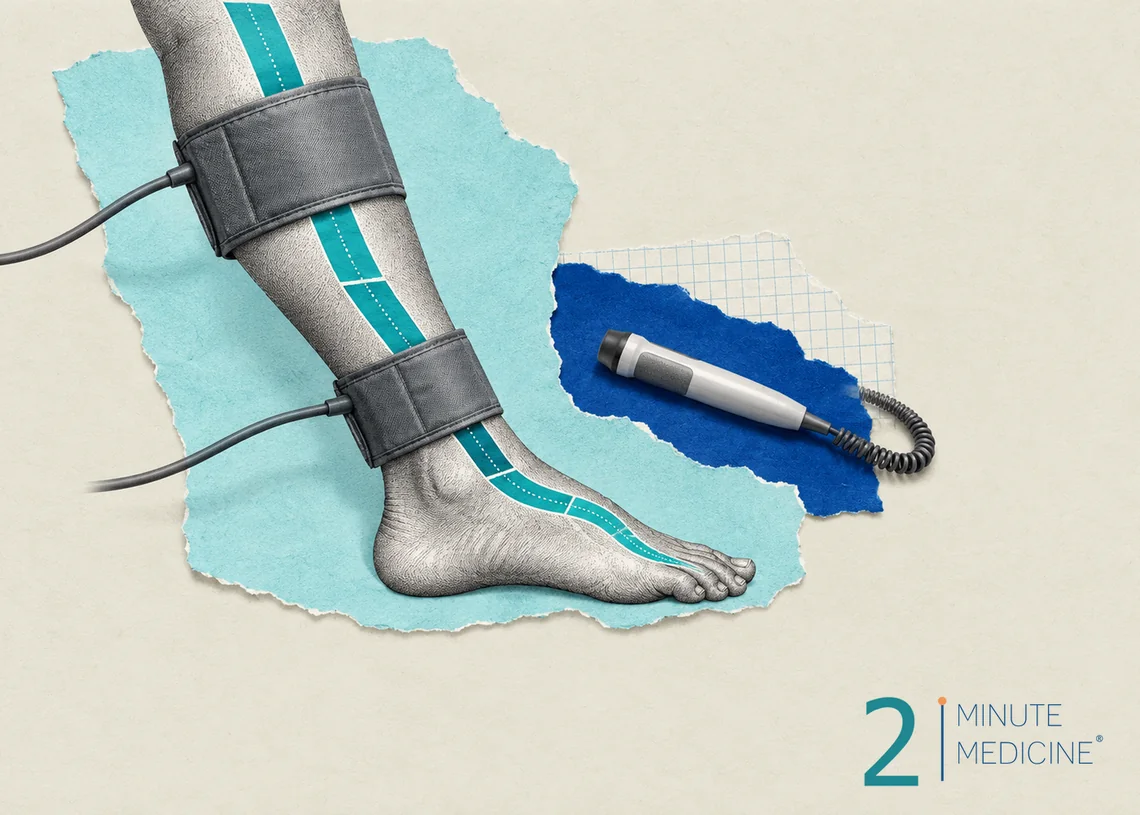
Arterial blood flow studies of the legs, also called segmental Doppler pressures, compare leg blood pressure with arm blood pressure to check how well blood reaches your legs and feet. Blood pressure cuffs are wrapped around your arms and at several levels on each leg, and a small handheld ultrasound device called a Doppler picks up the pulse under each cuff. The test is painless, uses no needles or radiation, and is the main way to find and measure peripheral artery disease (PAD).
Key points
- The test looks for narrowed or blocked leg arteries, most often caused by fatty buildup (plaque).
- The ankle-brachial index (ABI) compares the blood pressure at your ankle with the pressure in your arm.
- Pressures taken at the thigh, knee, calf and ankle (segmental pressures) show roughly where a blockage is.
- An ABI of 0.90 or lower means PAD. PAD also raises the risk of heart attack and stroke.
- The test takes about 30 to 60 minutes. You may also walk on a treadmill.
Why it’s done
- Cramping, aching or tiredness in the calves, thighs or buttocks that comes on with walking and eases with rest (claudication)
- Sores on the feet or toes that heal slowly or not at all
- Cold feet, shiny skin, hair loss on the legs, or weak pulses in the feet
- Pain in the feet at rest, often at night, that eases when you hang your legs over the bed
- Checking people at high risk of PAD, such as those who smoke or used to smoke, people with diabetes and older adults
- Checking blood flow before or after a procedure to open a leg artery
What leg blood pressure readings show
- Ankle-brachial index (ABI). Brachial means the upper arm. In healthy people, the pressure at the ankle is about the same as, or a little higher than, the pressure in the arm. If an artery in the leg is narrowed, the ankle pressure is lower.
- Segmental pressures. Cuffs at the upper thigh, above the knee, below the knee and at the ankle each take a reading. A big drop in pressure from one cuff to the next points to a narrowing between them.
- Pulse volume recordings. The cuffs are partly inflated and record the shape of each pulse. A healthy pulse makes a sharp peak. Below a blockage, the peak becomes flat and rounded.
- Doppler sound. In a healthy artery, the Doppler makes a crisp, pulsing “whoosh.” Below a narrowing it sounds softer and duller.
- Toe pressures. If the leg arteries are too stiff to squeeze, which is common with diabetes and kidney disease, a small cuff on the big toe gives a more reliable reading.
Getting ready
- Wear loose, comfortable clothes. You may be asked to change into shorts or a gown.
- Some labs ask you not to smoke or use nicotine for a few hours before, because nicotine tightens arteries.
- Take your usual medicines unless your doctor says otherwise.
- Tell the staff if you have a blood clot in your leg, open sores, a recent bypass in the leg, or a dialysis access in your arm. They will avoid putting a cuff there.
- If you’ll have the treadmill part, wear walking shoes.
During the test
You lie on your back on an exam table and rest for about 10 minutes so your blood pressure settles. A vascular technologist (a specialist in blood vessel tests) wraps cuffs around both upper arms and at several places on each leg.
The technologist puts a little gel on the skin over a pulse, such as on top of the foot or inside the ankle, and holds the Doppler probe there. You’ll hear the whooshing sound of your pulse. One cuff at a time is pumped up until it squeezes the artery shut and the sound stops. As the cuff is slowly let down, blood pushes through again once the cuff pressure drops below the pressure in the artery. The sound comes back, and that pressure is recorded. The cuff squeezes firmly for a few seconds, but the test doesn’t hurt.
Exercise test
If your resting results are normal or borderline but you have symptoms when walking, you may walk on a slightly sloped treadmill for up to about 5 minutes, or until leg pain makes you stop. The ankle pressures are measured again right after. In people with PAD, the ankle pressure falls after exercise. Tell the staff right away if you feel chest pain or very short of breath.
Afterward
The gel is wiped off, and you can go back to your usual activities right away.
Possible risks
There are almost no risks. The cuffs can feel tight for a moment. The treadmill part can bring on your usual leg pain, which eases with rest.
Your leg blood pressure results
The ABI is found by dividing the highest ankle pressure by the highest arm pressure.
- 1.00 to 1.40: normal
- 0.91 to 0.99: borderline
- 0.90 or lower: PAD. The lower the number, the more serious the blockage. A value below about 0.40 means blood flow is very poor.
- Above 1.40: the arteries are too stiff for the cuff to squeeze, so the result isn’t reliable. Toe pressures are used instead.
Segmental pressures and pulse recordings help show whether the narrowing is in the belly and pelvis, the thigh or below the knee. If you might need a procedure, your doctor may order a duplex ultrasound, which shows the artery directly, or a CT or MRI scan of the arteries.
If you have PAD
PAD is a sign of hardened arteries elsewhere in the body, so treatment protects your heart and brain as well as your legs. It usually includes quitting smoking, a regular walking program (often a supervised exercise program), a statin to lower cholesterol, a blood thinner such as aspirin or clopidogrel, and good control of blood pressure and diabetes. Cilostazol can help some people walk farther. If symptoms limit your life or a foot sore won’t heal, a doctor may open the artery with a balloon or stent, or bypass it with surgery.
When to call your doctor
- A sore on your foot or toe that isn’t healing
- A toe that turns dark or black
- Foot pain at rest or at night
- Leg pain with walking that is getting worse
Call 911 if a leg or foot suddenly becomes cold, pale, painful, numb or weak. This can mean an artery has suddenly blocked.
Common questions about leg blood pressure
Can you use a blood pressure cuff on your leg?
Yes. A cuff sized for the thigh or calf can measure blood pressure in the leg. Besides this test, nurses sometimes use the leg when neither arm can be used, for example after breast surgery or with a dialysis access. Leg readings usually run a little higher than arm readings, so one can’t simply stand in for the other.
How do you take blood pressure on the leg?
Lie flat and rest for several minutes. A cuff goes around the calf just above the ankle, or a larger one around the thigh, and the pulse is found below it with a stethoscope or Doppler. Home arm monitors aren’t made for the leg and can give wrong numbers, so leave leg readings to trained staff.
What is a Doppler test for the legs?
A Doppler test uses sound waves to pick up blood flow. This guide covers the pressure test for leg arteries. A duplex ultrasound is a different Doppler test that makes pictures of the arteries or veins, and it is the usual test for a blood clot in the leg (deep vein thrombosis).
Questions to ask your doctor
- What was my ABI, and what does it mean?
- Where in my legs is the narrowing?
- Do I need more tests, such as an ultrasound?
- What walking or exercise program should I follow?
- Should I take a statin or a blood thinner?
Learn more
- Peripheral artery disease (National Heart, Lung, and Blood Institute)
- Doppler ultrasound exam of an arm or leg (MedlinePlus, U.S. National Library of Medicine)
This guide is general information and doesn’t replace advice from your own doctor. Last updated October 2026.






 Get the app