
• About
  • Masthead
  • License Content
  • Advertise
  • Press Releases
  • Newsroom
  • RSS/Email List
  • 2MM Podcast
  • Write for us
  • Contact Us
2 Minute Medicine
No Result
View All Result

No products in the cart.

Sign in
SUBSCRIBE
  • About
  • Specialties
    • All Specialties, All Recent Reports
    • Cardiology
    • Chronic Disease
    • Dermatology
    • Emergency
    • Endocrinology
    • Gastroenterology
    • Imaging and Intervention
    • Infectious Disease
    • Nephrology
    • Neurology
    • Obstetrics
    • Oncology
    • Ophthalmology
    • Pediatrics
    • Pharma
    • Preclinical
    • Psychiatry
    • Public Health
    • Pulmonology
    • Rheumatology
    • Surgery
    • Rewinds
    • The Scan
  • EvidencePulse™
  • HypeCheck™
  • AI News
  • Classics™
    • 2MM+ Online Access
    • Paperback and Ebook
  • Tools
    • NPI Registry Lookup
    • RVU Search
    • Physician Pay by Specialty
    • ICD-10 Code Lookup
    • FDA Drug Approvals
    • Drug Safety for Breastfeeding/Pregnancy
    • Clinical Guidelines
    • Medical Calculators
    • ECG Reference
      • QTc Calculator
      • Sgarbossa Criteria
      • ECG Axis Calculator
      • AV Block Helper
  • Rankings
    • Medical School Rankings
    • Residency Rankings
  • Partners
    • License Content
    • Advertise with Us
2 Minute Medicine
  • About
  • Specialties
    • All Specialties, All Recent Reports
    • Cardiology
    • Chronic Disease
    • Dermatology
    • Emergency
    • Endocrinology
    • Gastroenterology
    • Imaging and Intervention
    • Infectious Disease
    • Nephrology
    • Neurology
    • Obstetrics
    • Oncology
    • Ophthalmology
    • Pediatrics
    • Pharma
    • Preclinical
    • Psychiatry
    • Public Health
    • Pulmonology
    • Rheumatology
    • Surgery
    • Rewinds
    • The Scan
  • EvidencePulse™
  • HypeCheck™
  • AI News
  • Classics™
    • 2MM+ Online Access
    • Paperback and Ebook
  • Tools
    • NPI Registry Lookup
    • RVU Search
    • Physician Pay by Specialty
    • ICD-10 Code Lookup
    • FDA Drug Approvals
    • Drug Safety for Breastfeeding/Pregnancy
    • Clinical Guidelines
    • Medical Calculators
    • ECG Reference
      • QTc Calculator
      • Sgarbossa Criteria
      • ECG Axis Calculator
      • AV Block Helper
  • Rankings
    • Medical School Rankings
    • Residency Rankings
  • Partners
    • License Content
    • Advertise with Us
Sign in
SUBSCRIBE
2 Minute Medicine
Sign in
Subscribe
2 Minute MedicineFree on Google PlayGet
✦EvidencePulse™by 2 Minute Medicine3 reportsYou askedtop stroke trials 2026Synthesizing medical evidence...Top 2026 stroke trial results:OCEANIC — ischemic stroke: 6.2% vs 8.4%OPTION* — mRS 0–1: 43.6% vs 34.2%ORIENTAL* — mRS 0–2: 58.6% vs 46.6%*Higher sICH in intervention armsParticipants randomizedNOCEANIC12,327OPTION570ORIENTAL564Ask about guidelines or landmark trials...↑Try EvidencePulse™Ask the evidence. Get the signal.Try it now →
Home Health A to Z

Patient Basics: Venous Thromboembolism (Deep Vein Thrombosis and Pulmonary Embolism)
by2 Minute Medicine
October 30, 2026
in Health A to Z
Reading Time: 6 mins read
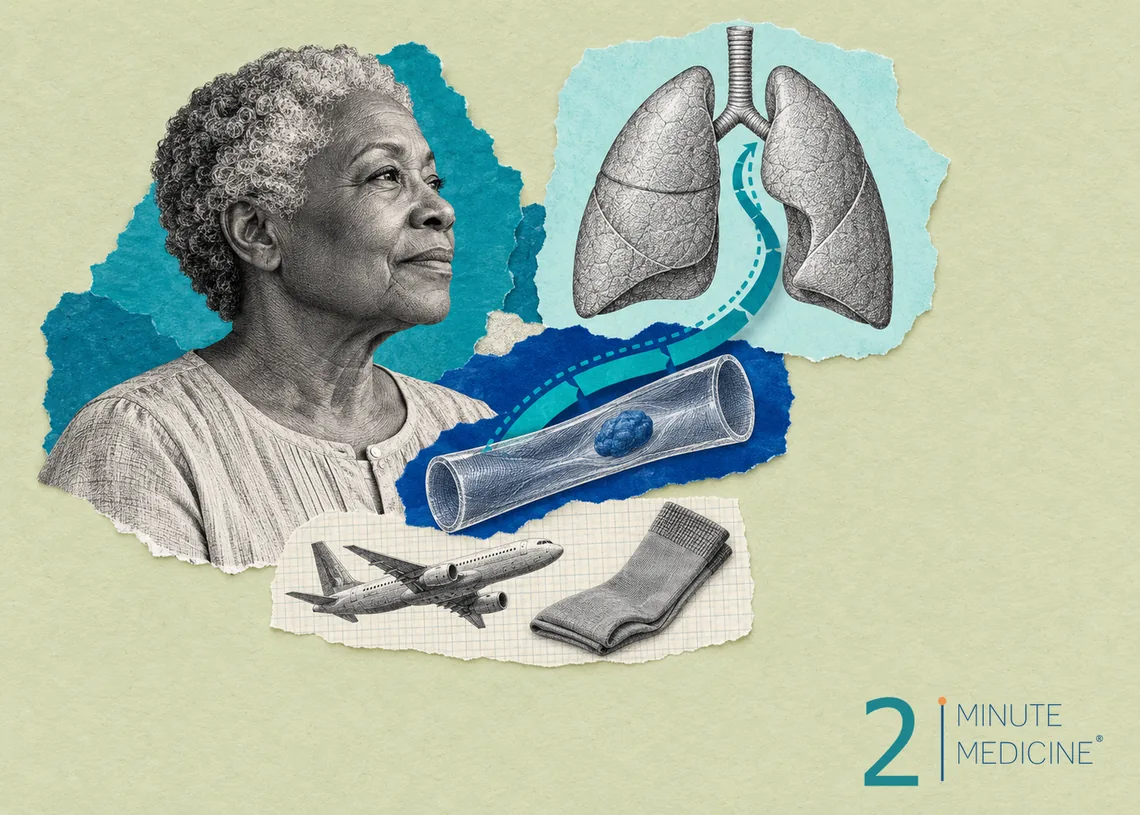
Deep vein thrombosis collage: older woman in profile, engraved lungs, a vein with a clot, model plane, compression stocking
Share on FacebookShare on TwitterShare on LinkedIn

Deep vein thrombosis (DVT) is a blood clot in a deep vein, most often in the leg. If part of the clot breaks off and travels to the lungs, it becomes a pulmonary embolism (PE), which can be deadly. Doctors call both of these venous thromboembolism (VTE). Both are treated with blood thinners, and sudden shortness of breath or chest pain needs a 911 call.

Key points

  • Surgery, a hospital stay, long periods of sitting, cancer, pregnancy and estrogen-containing medicines all raise the risk of clots.
  • A DVT often causes swelling, pain or warmth in one leg. A PE causes sudden shortness of breath, chest pain or fainting.
  • Ultrasound finds most leg clots. A CT scan of the chest finds most lung clots.
  • Blood thinners stop clots from growing and lower the chance of new ones. Most people take them for at least three months.
  • Moving your legs, staying active and taking clot-prevention medicine when advised can prevent many clots.

What causes deep vein thrombosis

Blood clots form more easily when blood flows slowly, when a vein wall is damaged, or when the blood itself clots too easily. Common risks include:

  • Major surgery, especially hip or knee replacement, and injuries such as a broken leg
  • Being in the hospital or on bed rest
  • Sitting for long stretches, such as on flights or drives of more than four hours
  • Cancer and some cancer treatments
  • Pregnancy and the first weeks after giving birth
  • Birth control pills, patches or rings that contain estrogen, and menopause hormone therapy
  • Being older, carrying extra weight or smoking
  • A past clot, or a family history of clots
  • Inherited clotting conditions, such as factor V Leiden
  • Serious infections, including COVID-19, and long-term illnesses such as heart failure or inflammatory bowel disease

Sometimes a clot forms with no clear trigger.

Symptoms

Deep vein thrombosis

  • Swelling in one leg, ankle or foot, or less often in one arm
  • Pain, cramping or tenderness, often in the calf
  • Warm skin that may look red or darker than usual
  • Larger veins near the skin’s surface

As many as half of people with a DVT have no symptoms.

Pulmonary embolism

  • Sudden shortness of breath
  • Sharp chest pain that gets worse with a deep breath or cough
  • A fast heartbeat
  • Coughing up blood
  • Feeling lightheaded or fainting

How doctors check for blood clots

  • Risk check. Your doctor will ask about symptoms and risks to judge how likely a clot is.
  • D-dimer blood test. A normal result, when the chance of a clot is low, makes a clot unlikely. A high result isn’t specific and needs more tests.
  • Ultrasound of the leg shows clots in the veins and how blood is flowing. You may hear it called a venous Doppler or LENIs (lower extremity noninvasive studies).
  • CT pulmonary angiogram. Dye is injected into a vein and a CT scan shows clots in the lung arteries.
  • Ventilation-perfusion (V/Q) scan, which compares air and blood flow in the lungs. It is used when CT dye isn’t safe, for example in some people with kidney disease or during pregnancy.

After a clot with no clear cause, your doctor may suggest tests for clotting disorders or make sure your cancer screenings are up to date.

How deep vein thrombosis and PE are treated

Blood thinners

Blood thinners (anticoagulants) stop a clot from growing and keep new clots from forming. Over weeks to months, the body slowly breaks the clot down on its own. Options include:

RELATED REPORTS

Artificial intelligence-guided ultrasound lacks sufficient accuracy for deep vein thrombosis detection

  • Pills such as apixaban (Eliquis), rivaroxaban (Xarelto), edoxaban and dabigatran
  • Shots of low-molecular-weight heparin, such as enoxaparin. This is the usual choice during pregnancy.
  • Warfarin, which needs regular blood tests and care with diet and other medicines

Most people take blood thinners for at least three months. If the clot had no clear trigger, or the risk is ongoing, your doctor may advise taking them long term. Many people with a DVT, and some with a small PE, are treated at home.

Other treatments

  • Clot-busting medicine (thrombolytics) for a large PE that strains the heart or drops blood pressure
  • Catheter procedures that break up or remove a clot through a thin tube in a vein
  • A filter placed in the large vein in the belly to catch clots, for people who can’t take blood thinners. Most filters should be removed once they are no longer needed.
  • Compression stockings may ease leg swelling and aching after a DVT.

Living with it

Blood thinners raise the risk of bleeding. Tell every doctor and dentist that you take one, and ask before using aspirin, ibuprofen, naproxen or supplements. Get emergency care for black or bloody stool, vomiting blood, a severe headache, or a fall that hits your head.

Some people have long-lasting leg swelling, aching or skin changes after a DVT (post-thrombotic syndrome). A few people stay short of breath months after a PE. Tell your doctor if this happens, because there are tests and treatments for it.

Lowering your risk

  • After surgery or during a hospital stay, ask about clot prevention. This may include blood-thinner shots or pills, leg pumps, and getting up and walking soon.
  • On long trips, stand and walk every hour or two. When seated, flex your ankles and squeeze your calf muscles often. Drink water.
  • If you’ve had a clot or have other risks, ask whether compression stockings help on long flights.
  • Stay active, keep a healthy weight and don’t smoke.
  • Tell your doctor about any past clot before starting estrogen or having surgery.

When to see a doctor

See a doctor the same day for swelling, pain or warmth in one leg or arm, especially after surgery, travel or a period of being less active.

Call 911 for sudden shortness of breath, chest pain, coughing up blood, a racing heart or fainting.

Common questions about deep vein thrombosis

Does a blood clot in the leg hurt?

Often, but not always. A DVT usually causes a steady ache, cramp or tenderness in the calf or thigh that gets worse when you stand or walk, along with swelling. Up to half of people have no pain at all, so swelling or warmth in one leg is reason enough to get checked.

Can a blood clot cause pain behind the knee?

Yes. A clot in the vein behind the knee can hurt there, usually with lower-leg swelling that doesn’t go away. Pain behind the knee that comes and goes is more often from a fluid-filled lump (Baker’s cyst), arthritis or a strained tendon. A burst Baker’s cyst can look like a DVT, so get it checked.

Is DVT more common in the left leg?

Yes, somewhat. The main vein from the left leg passes under an artery in the pelvis, which can press on it and slow blood flow. When this pressure is strong, it is called May-Thurner syndrome. Clots still form in either leg, so new swelling on either side matters.

How long does a DVT take to go away?

Pain and swelling usually ease over a few weeks once you start a blood thinner. The body breaks the clot down slowly over weeks to months, and some scarring may stay in the vein. Keep taking your medicine for as long as your doctor advises, even after you feel better.

Questions to ask your doctor

  • What do you think caused my clot?
  • Which blood thinner is best for me, and how long should I take it?
  • What signs of bleeding should I watch for?
  • Should I have tests for a clotting disorder?
  • How can I lower my risk before surgery or long trips?

Learn more

  • Venous thromboembolism (National Heart, Lung, and Blood Institute)
  • About venous thromboembolism (blood clots) (Centers for Disease Control and Prevention)

This guide is general information and doesn’t replace advice from your own doctor. Last updated October 2026.
Tags: Thromboembolism (Deep Vein Thrombosis and Pulmonary
Previous Post

Patient Basics: Throat Cancer (Larynx and Pharynx)

Next Post

Patient Basics: Thrombotic Stroke

RelatedReports

Ultrasound collage: a handheld probe sending dotted sound waves toward a kidney, with a bottle of gel on graph paper
2 Minute Medicine

Artificial intelligence-guided ultrasound lacks sufficient accuracy for deep vein thrombosis detection

August 22, 2025
Next Post
Tension headache collage of a young man with a loose teal ribbon around his forehead, a desk lamp, a laptop and a heat wrap

Patient Basics: Tension Headache

Testicular cancer collage: an ultrasound probe, a folded hospital blanket, a small potted plant and a looped teal ribbon

Patient Basics: Testicular Cancer

Swimmer's ear collage: an engraved outer ear with water droplets near the canal, swim goggles, earplugs and a swim cap

Patient Basics: Swimmer's Ear (Otitis Externa)

✦ EvidencePulse™ by 2 Minute Medicine 3 reports You asked top stroke trials 2026 Synthesizing medical evidence... Top 2026 stroke trial results: OCEANIC — ischemic stroke: 6.2% vs 8.4% OPTION* — mRS 0–1: 43.6% vs 34.2% ORIENTAL* — mRS 0–2: 58.6% vs 46.6% *Higher sICH in intervention arms Participants randomizedN OCEANIC 12,327 OPTION 570 ORIENTAL 564 Ask about guidelines or landmark trials... Try EvidencePulse™ Get the signal. Try it now → Physician-trained medical AI by 2 Minute Medicine

2MM+ All Access

Full details →
$4.99 /month

3-day free trial · cancel anytime

  • ✓100+ physician-written reports
  • ✓EvidencePulse™ + HypeCheck™
  • ✓Ad-free reading + newsletters
Start 3-day free trial

Then $4.99/month. Manage renewal in your account.

2 Minute Medicine® is an award winning, physician-run, expert medical media company. Our content is curated, written and edited by practicing health professionals who have clinical and scientific expertise in their field of reporting. Our editorial management team is comprised of highly-trained MD physicians. Join numerous brands, companies, and hospitals who trust our licensed content.

Recent Reports

  • Medicaid status, race and ethnicity are independently associated with increased odds of severe maternal morbidity
  • Artificial intelligence-generated pre-visit summaries improved communication outcomes in neurosurgical consultations
  • Midline catheters may reduce catheter-related bloodstream infections compared with peripherally inserted central catheters in intensive care unit patients
License Content
Terms of Use | Disclaimer
Cookie Policy

Get the app

Read 2 Minute Medicine on iPhone, iPad and Android.

Download on the App StoreGet it on Google Play
QR code for www.2minutemedicine.com/app
On a computer? Scan this with your phone’s camera.
2MM+ All Access Full details →

The medical literature, distilled daily.

Monthly plan selected: $4.99 /month.

$4.99/month

3-day free trial · cancel anytime

Start 3-day free trial

Then $4.99/month. Manage renewal in your account.

Yearly plan selected: $49.90 /year.

$49.90/year

2 months free

Start 3-day free trial

Then $49.90/year.

Membership benefits

  • ✓100+ physician-written reports
  • ✓AI EvidencePulse™ + HypeCheck™
  • ✓Ad-free reading + newsletters
  • ✓FDA drug approvals + clinical calculators

Already a member? Sign in

  • Get the app
  • About
  • Specialties
    • All Specialties, All Recent Reports
    • Cardiology
    • Chronic Disease
    • Dermatology
    • Emergency
    • Endocrinology
    • Gastroenterology
    • Imaging and Intervention
    • Infectious Disease
    • Nephrology
    • Neurology
    • Obstetrics
    • Oncology
    • Ophthalmology
    • Pediatrics
    • Pharma
    • Preclinical
    • Psychiatry
    • Public Health
    • Pulmonology
    • Rheumatology
    • Surgery
    • Rewinds
    • The Scan
  • EvidencePulse™
  • HypeCheck™
  • AI News
  • Classics™
    • 2MM+ Online Access
    • Paperback and Ebook
  • Tools
    • NPI Registry Lookup
    • RVU Search
    • Physician Pay by Specialty
    • ICD-10 Code Lookup
    • FDA Drug Approvals
    • Drug Safety for Breastfeeding/Pregnancy
    • Clinical Guidelines
    • Medical Calculators
    • ECG Reference
      • QTc Calculator
      • Sgarbossa Criteria
      • ECG Axis Calculator
      • AV Block Helper
  • Rankings
    • Medical School Rankings
    • Residency Rankings
  • Partners
    • License Content
    • Advertise with Us
No Result
View All Result

© 2026 2 Minute Medicine, Inc. - Physician-written medical news.


