Patient Basics: Carcinoid Tumors of the Lung
Originally published by Harvard Health.
What Is It?
Carcinoid tumors have been called “cancers in slow motion” because they grow slowly. They are also less likely than other tumors to spread (metastasize) to other parts of the body. However, this is not always the case. Sometimes, they grow and spread rather quickly.
Most carcinoid tumors start in the small intestine, but about 25% of them begin in the lungs. They account for only a small percentage of all lung cancers. Some carcinoid tumors, especially those arising from the gastrointestinal tract or the appendix, produce hormones that can cause a number of symptoms. Carcinoid tumors in the lung are much less likely to produce hormones.
There are two types of carcinoid tumors of the lung: typical and atypical. Typical carcinoid tumors are about nine times more common than atypical carcinoid tumors. Typical carcinoid tumors are also less likely to spread beyond the lungs.
Carcinoid tumors of the lung occur equally in women and men, usually between ages 45 and 55.
Symptoms
Sometimes, carcinoid tumors of the lungs don’t produce any symptoms; often, they are detected when a chest x-ray is taken for another condition. But if you do have symptoms, their severity depends on the size of the tumor and whether it produces abnormal hormones. Potential symptoms include
- a persistent cough
- coughing up blood
- shortness of breath or wheezing
- pneumonia (a lung infection)
- facial flushing
- diarrhea
- a fast heartbeat
- weight gain
- increased facial and body hair.
Diagnosis
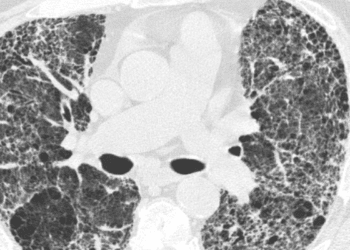
Carcinoid tumors can be seen on chest x-rays and computed tomography (CT) scans. When a tumor is spotted, your doctor will need to remove cells from the tumor so they can be examined under a microscope. This is called a biopsy. A lung biopsy can be taken in several ways:
- In bronchoscopy, a fiberoptic viewing tube is inserted into your throat and passed into the lungs. Your doctor examines the tumor and can remove cells for testing. This procedure is most effective when the tumor is near the center of the lung.
- A needle biopsy removes cells from tumors at the edges of the lungs, closer to your chest wall. Guided by a CT scan, your doctor inserts a long needle between the ribs and uses it to remove tissue from the tumor.
- Thoracotomy is the surgical opening of the chest cavity. In some cases, this procedure may be necessary to remove tissue for a biopsy. Sometimes, the chest cavity may be entered using a thoracoscope, a tube that allows your doctor to see and remove a piece of tissue for a biopsy. This method can be less traumatic than an open thoracotomy.
- In video-assisted thoracoscopic surgery (VATS), your surgeon makes a small incision in the chest wall. Next, he or she inserts a tube that has a small video camera at the tip into the space between the inside of the chest wall and the lung. This way, your surgeon can look directly at the lung to identify abnormal lung tissue. He or she can use the same tube to direct a biopsy tool to the abnormal tissue. The sample is sent to the laboratory for examination under the microscope.
Your doctor may also order blood and urine tests to look for any abnormal hormones the tumor might be producing. You may be asked to collect your urine over a 24-hour period.
A test called octreotide scintigraphy can help to determine if the carcinoid tumor has spread beyond the lungs. A small amount of a radioactive drug is injected into a vein. The drug is attracted to carcinoid tumors. Your doctor will use a camera that detects radioactivity to see where the drug accumulates. A similar test uses a different radioactive material—meta-iodobenzylguanidine (MIBG).
Alternatively, PET scanning, which looks at a tumor’s metabolic activity, is often used to determine whether the cancer has spread.
Expected Duration
As with any cancer, carcinoid tumors will continue to grow until they are treated. And even if these tumors seem to be cured, there is a chance they can return.
Prevention
Unlike most lung tumors, carcinoid tumors have not been associated with smoking, air pollution, or exposure to chemicals. There are no known ways to prevent this type of cancer.
Treatment
Surgery is the main treatment for carcinoid tumors; the exact procedure depends on where the tumor is located. If it is in a large airway, the surgeon may remove just the section of the airway containing the tumor. If a tumor is located at the edge of a lung, the surgeon removes a small wedge of lung. Larger tumors or multiple tumors may require removing a lobe of a lung or an entire lung.
For carcinoids that arise in the gastrointestinal tract, the preferred treatment is surgical removal of the tumor and the surrounding lymph nodes. Additional treatment will depend upon whether the surgeon could remove the entire tumor and whether the cancer had spread to the lymph nodes.
Chemotherapy does not work well on carcinoid tumors. Currently, it is used only when the tumors have spread to other parts of the body and when the side effects can be tolerated.
If your tumor produces hormones that cause uncomfortable symptoms, your doctor may prescribe octreotide (Sandostatin). This drug can relieve flushing, diarrhea, and other symptoms. There is some evidence that it also may help to prevent or reverse the growth of the tumor. Octreotide isn’t a cure, however. It is used only when the disease has spread.
A long-acting version of octreotide, which is given monthly, is now available. A similar drug can be given every 10 days. Alpha-interferon may be used along with octreotide. This substance stimulates the body’s immune system, may help shrink tumors, and eases symptoms.
Researchers are studying MIBG, a chemical used to see if a tumor has spread beyond the lung, as a possible therapy. Because MIBG is absorbed by carcinoid cells and damages them, it may effectively shrink the tumor and relieve symptoms.
When to Call a Professional
Most people diagnosed with carcinoid tumors of the lung do not have symptoms. (The tumors are usually found when a chest x-ray is taken for another reason.) But if you do have symptoms, see your doctor as soon as possible.
Prognosis
Because carcinoid tumors grow and spread slowly, they often are discovered at an early stage. The prognosis for people with early-stage typical carcinoid tumors of the lung is usually very good. An atypical carcinoid tumor is more likely to spread to nearby tissues or lymph nodes. Survival rates are lower for people with atypical carcinoid tumors and tumors that have spread to other parts of the body.
Additional Information
National Cancer Institute (NCI)
U.S. National Institutes of Health
Public Inquiries Office
Building 31, Room 10A03
31 Center Drive, MSC 8322
Bethesda, MD 20892-2580
Phone: 301-435-3848
Toll-Free: 800-422-6237
TTY: 800-332-8615
http://www.nci.nih.gov/
American Lung Association
61 Broadway, 6th Floor
New York, NY 10006
Phone: 212-315-8700
Toll-Free: 800-548-8252
http://www.lungusa.org/
National Heart, Lung, and Blood Institute (NHLBI)
P.O. Box 30105
Bethesda, MD 20824-0105
Phone: 301-592-8573
TTY: 240-629-3255
Fax: 301-592-8563
http://www.nhlbi.nih.gov/
RelatedReports