

Patient Basics: Crossed Eyes (Strabismus)
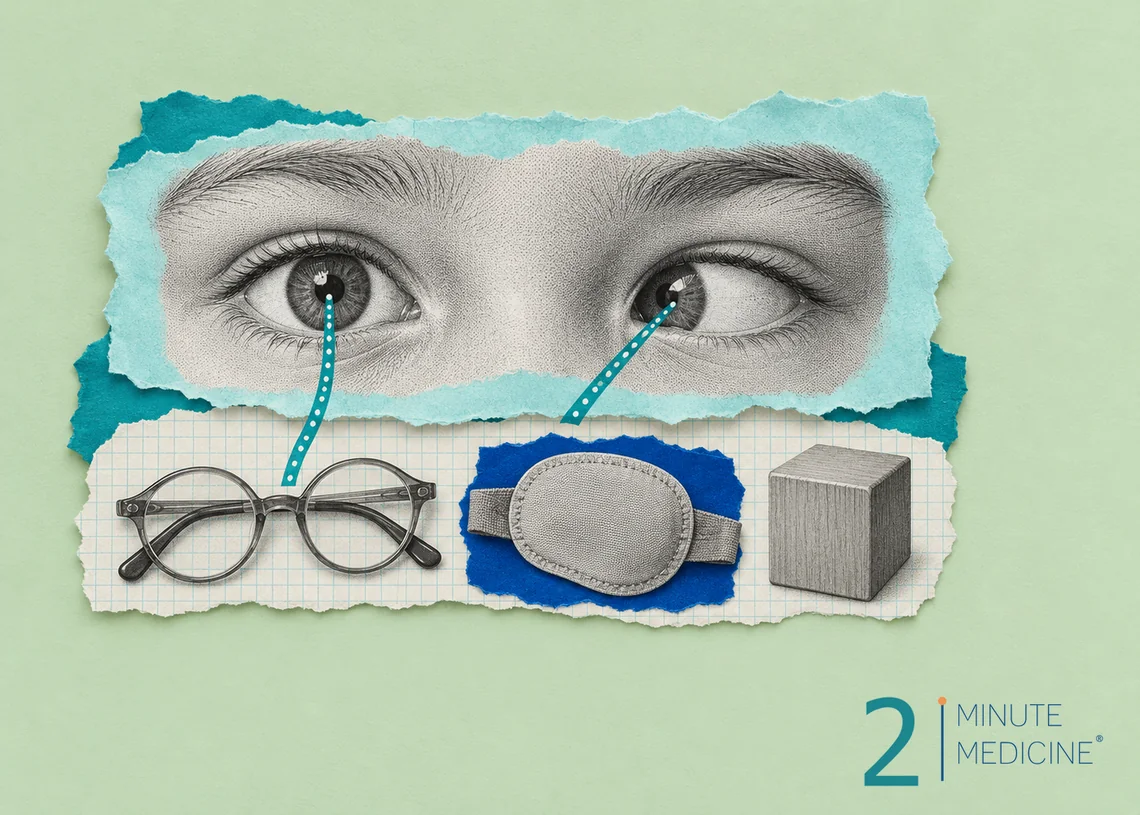
Strabismus, often called crossed eyes, is a condition in which the two eyes don’t point in the same direction. One eye may turn in, out, up or down while the other looks straight ahead. It’s common in children, and early treatment helps, because a child’s brain can start to ignore the turned eye and that eye’s vision may stay weak (lazy eye). Adults can get strabismus too, often with double vision.
Key points
- An eye can turn in (esotropia), out (exotropia), up or down. The turn can be constant or come and go.
- A newborn’s eyes often wander until about 4 months of age. After that, an eye turn should be checked.
- Without treatment, children can develop lazy eye (amblyopia) and poor depth perception.
- Treatment may include glasses, patching or eye drops, and sometimes eye muscle surgery.
- Sudden double vision or a new eye turn in an adult can signal a nerve or brain problem and needs urgent care.
Types of strabismus
- Esotropia. One eye turns in toward the nose. It may start in the first months of life (infantile esotropia) or around ages 2 to 3 because of farsightedness. This second kind (accommodative esotropia) often straightens with glasses.
- Exotropia. One eye drifts outward. It is often intermittent, showing up when a child is tired, sick, daydreaming or in bright sun, when they may close one eye.
- Hypertropia and hypotropia. One eye sits higher or lower than the other. People may tilt their head to keep from seeing double.
- Pseudostrabismus. Some babies have a wide, flat bridge of the nose and skin folds at the inner corners of the eyes. This can make them look cross-eyed when the eyes are lined up. A doctor can tell the difference.
What causes strabismus
Six small muscles move each eye, and the brain coordinates them so both eyes aim at the same spot. Most strabismus in children comes from a problem in the brain’s control of these muscles, not the muscles themselves. It’s more likely with:
- A parent or sibling with strabismus
- Farsightedness
- Being born early or at a low birth weight
- Conditions such as cerebral palsy, Down syndrome or hydrocephalus
- Poor vision in one eye, such as from a cataract or, rarely, an eye tumor
In adults, a new eye turn often comes from weakness of a nerve that controls eye muscles (a nerve palsy). This can happen with diabetes, high blood pressure, a stroke, a head injury and, rarely, an aneurysm or tumor. Thyroid eye disease, myasthenia gravis, eye surgery and age-related loosening of eye tissues can also cause it. Some adults had strabismus as children that returns later.
Symptoms
- Eyes that don’t look in the same direction
- Squinting or closing one eye, especially in bright light
- Tilting or turning the head to look at things
- Double vision, mostly in adults. Children’s brains tend to ignore the second image.
- Eye strain or headaches
- Bumping into things or trouble judging distance
How it’s diagnosed
Pediatricians check eye alignment at well-child visits. An eye doctor (ophthalmologist or optometrist) can do a full exam:
- Light reflex test. The doctor shines a light and checks that the reflection sits in the same place in each pupil.
- Cover test. The doctor covers one eye at a time and watches whether the other eye moves to focus.
- Vision check of each eye, using pictures or letters suited to the child’s age.
- Dilating drops to check for farsightedness and look at the back of the eye.
Adults with a new eye turn may need blood tests and an MRI of the brain.
Strabismus treatment
- Glasses correct farsightedness and can fully straighten some eyes that turn in.
- Lazy eye treatment. Covering the stronger eye with a patch for part of each day, or blurring it with atropine drops, makes the brain use the weaker eye. FDA-cleared viewing programs that show each eye a different image are another option. Results are best in young children, though older children can still improve.
- Eye exercises help one specific problem, convergence insufficiency, where the eyes drift out during close work. They don’t fix most other types.
- Prism glasses bend light to reduce double vision, mostly in adults.
- Botulinum toxin. A tiny injection weakens an overactive eye muscle for a few months, and sometimes the eyes stay straight afterward.
- Eye muscle surgery. The surgeon loosens or tightens one or more muscles on the surface of the eye. The eye is never removed. It’s usually a same-day operation under general anesthesia. The eye is red and sore for a few days, and redness can last a few weeks. Some people need more than one surgery.
Surgery helps adults as well as children. It can ease double vision, widen side vision and improve how people feel about their appearance.
Outlook
With early treatment, most children with strabismus develop good vision in both eyes. Strabismus can come back, so regular eye checks continue through childhood.
When to see a doctor
- A baby’s eyes still turn or wander after about 4 months
- An eye turn that stays all the time, at any age
- A child who squints one eye, tilts their head or sits very close to screens
- A white or gray glow in the pupil in photos, which needs a prompt eye exam
- New double vision or an eye turn in an adult
Call 911 for sudden double vision or an eye turn along with a severe headache, drooping eyelid, weakness, numbness, trouble speaking or confusion.
Common questions about strabismus
Are newborns cross-eyed?
Often, yes, for short periods. A newborn’s eyes may drift in or out while the brain learns to work them together. This usually settles by about 4 months of age. If the eyes still turn after that, or one eye turns all the time at any age, have your baby’s eyes checked.
Can your eyes get stuck if you cross them?
No. Crossing your eyes on purpose, or looking at screens up close, won’t make them stay crossed. The eye muscles relax as soon as you stop. Strabismus comes from problems with how the brain, nerves and muscles control the eyes, and making faces has nothing to do with it.
Why do my eyes cross when I’m tired?
Many people have a slight tendency for the eyes to drift, which the brain usually controls without effort. When you’re very tired, ill or have been drinking alcohol, that control slips, and an eye may drift in or out, sometimes with double vision. If it happens often, an eye exam can check for intermittent strabismus.
Questions to ask your doctor
- What type of strabismus is this, and what is causing it?
- Does my child have lazy eye in either eye?
- Will glasses be enough, or will surgery be needed?
- How long will patching or drops take to work?
- How often should we come back for checks?
Learn more
- Strabismus (MedlinePlus, U.S. National Library of Medicine)
- Amblyopia (lazy eye) (National Eye Institute)
This guide is general information and doesn’t replace advice from your own doctor. Last updated October 2026.






 Get the app