• About
  • Masthead
  • License Content
  • Advertise
  • Press Releases
  • Newsroom
  • RSS/Email List
  • 2MM Podcast
  • Write for us
  • Contact Us
2 Minute Medicine
No Result
View All Result

No products in the cart.

Sign in
SUBSCRIBE
  • About
  • Specialties
    • All Specialties, All Recent Reports
    • Cardiology
    • Chronic Disease
    • Dermatology
    • Emergency
    • Endocrinology
    • Gastroenterology
    • Imaging and Intervention
    • Infectious Disease
    • Nephrology
    • Neurology
    • Obstetrics
    • Oncology
    • Ophthalmology
    • Pediatrics
    • Pharma
    • Preclinical
    • Psychiatry
    • Public Health
    • Pulmonology
    • Rheumatology
    • Surgery
    • Rewinds
    • The Scan
  • EvidencePulse™
  • HypeCheck™
  • AI News
  • Classics™
    • 2MM+ Online Access
    • Paperback and Ebook
  • Tools
    • Medical Calculators
    • Clinical Guidelines
    • Physician Pay by Specialty
    • FDA Drug Approvals
    • RVU Search
    • ICD-10 Code Lookup
    • Drug Safety for Breastfeeding/Pregnancy
    • ECG Reference
      • QTc Calculator
      • Sgarbossa Criteria
      • ECG Axis Calculator
      • AV Block Helper
    • NPI Registry Lookup
  • Rankings
    • Medical School Rankings
    • Residency Rankings
  • Partners
    • License Content
    • Advertise with Us
2 Minute Medicine
  • About
  • Specialties
    • All Specialties, All Recent Reports
    • Cardiology
    • Chronic Disease
    • Dermatology
    • Emergency
    • Endocrinology
    • Gastroenterology
    • Imaging and Intervention
    • Infectious Disease
    • Nephrology
    • Neurology
    • Obstetrics
    • Oncology
    • Ophthalmology
    • Pediatrics
    • Pharma
    • Preclinical
    • Psychiatry
    • Public Health
    • Pulmonology
    • Rheumatology
    • Surgery
    • Rewinds
    • The Scan
  • EvidencePulse™
  • HypeCheck™
  • AI News
  • Classics™
    • 2MM+ Online Access
    • Paperback and Ebook
  • Tools
    • Medical Calculators
    • Clinical Guidelines
    • Physician Pay by Specialty
    • FDA Drug Approvals
    • RVU Search
    • ICD-10 Code Lookup
    • Drug Safety for Breastfeeding/Pregnancy
    • ECG Reference
      • QTc Calculator
      • Sgarbossa Criteria
      • ECG Axis Calculator
      • AV Block Helper
    • NPI Registry Lookup
  • Rankings
    • Medical School Rankings
    • Residency Rankings
  • Partners
    • License Content
    • Advertise with Us
Sign in
SUBSCRIBE
2 Minute Medicine
Sign in
Subscribe
2 Minute MedicineFree on Google PlayGet
✦EvidencePulse™by 2 Minute Medicine3 reportsYou askedtop stroke trials 2026Synthesizing medical evidence...Top 2026 stroke trial results:OCEANIC — ischemic stroke: 6.2% vs 8.4%OPTION* — mRS 0–1: 43.6% vs 34.2%ORIENTAL* — mRS 0–2: 58.6% vs 46.6%*Higher sICH in intervention armsParticipants randomizedNOCEANIC12,327OPTION570ORIENTAL564Ask about guidelines or landmark trials...↑Try EvidencePulse™Ask the evidence. Get the signal.Try it now →
Home Health A to Z

Patient Basics: Chronic Obstructive Pulmonary Disease (COPD)
by2 Minute Medicine
October 30, 2026
in Health A to Z, Uncategorized
Reading Time: 6 mins read
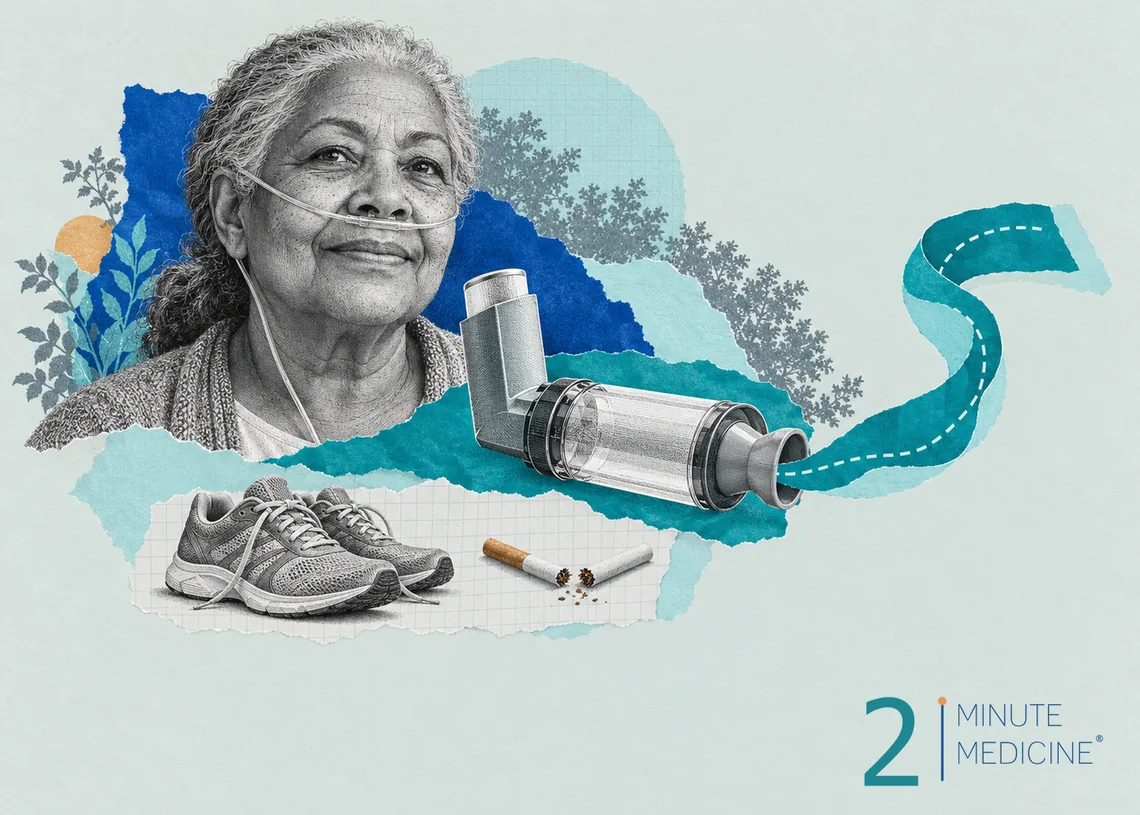
COPD collage of a calm older woman with a thin oxygen tube, an inhaler with a spacer, walking shoes and a snapped cigarette
Share on FacebookShare on TwitterShare on LinkedIn

COPD stands for chronic obstructive pulmonary disease, a long-term lung disease that makes it hard to move air out of the lungs. It includes emphysema and chronic bronchitis, and smoking causes most cases. The damage can’t be undone, but treatment and quitting smoking can slow it down and help you breathe and do more.

Key points

  • Shortness of breath with activity, a long-lasting cough and thick mucus are the main symptoms.
  • A simple breathing test called spirometry confirms the diagnosis.
  • Quitting smoking is the most important step at any stage.
  • Inhalers, exercise programs called pulmonary rehab, and vaccines help people breathe better and stay out of the hospital.
  • Severe shortness of breath, blue lips or confusion need emergency care. Call 911.

What COPD does to the lungs

Air travels down the windpipe into branching tubes (airways) and ends in millions of tiny air sacs, where oxygen passes into the blood. COPD damages these parts in two main ways, and most people have some of both:

  • Emphysema. The walls of the air sacs break down. The lungs lose their springiness, so air gets trapped and stale air can’t get out.
  • Chronic bronchitis. The lining of the airways stays swollen and makes extra mucus. Doctors define it as a cough with mucus on most days for at least 3 months a year, two years in a row.

Along with asthma, COPD is one of the two most common long-term lung diseases.

What causes COPD

  • Smoking cigarettes, and less often pipes, cigars or marijuana
  • Years of secondhand smoke
  • Dust, fumes and chemicals at work, such as in mining, farming and construction
  • Smoke from burning wood or other fuels indoors, and heavy air pollution
  • Alpha-1 antitrypsin deficiency, an inherited condition that can cause COPD at a young age
  • Asthma, or lungs that didn’t fully develop because of early birth or childhood infections

Some people who never smoked still get COPD.

COPD symptoms

  • Shortness of breath or labored breathing, first with activity and later at rest
  • A cough that lasts for months, often worst in the morning
  • Thick mucus (phlegm) that may be white, yellow or green
  • Wheezing, a whistling sound when breathing out
  • Chest tightness
  • Frequent chest colds and lung infections
  • Tiredness, weight loss and, in later stages, swollen ankles

With a stethoscope, a doctor may also hear crackles or rattles, which are other abnormal lung sounds. Symptoms often creep in slowly, and many people first blame them on getting older or out of shape.

A flare-up (exacerbation) is a spell of a few days when breathing gets much worse, with more coughing and more or darker mucus. Shortness of breath that comes and goes this way is often set off by a cold, the flu or air pollution.

RELATED REPORTS

Artificial intelligence decision support software improved spirometry diagnosis performance in primary care

#VisualAbstract: Tezepelumab Does Not Reduce Exacerbations in Adults with Chronic Obstructive Pulmonary Disease

Thick mucus and phlegm

Phlegm is the mucus that the airways make and you cough up. COPD makes more of it, and it can be thick, sticky or come up in hard chunks. Drinking enough fluids can thin it. A breathing therapist can teach you a “huff cough,” a gentle way to clear mucus without tiring yourself out. Some people use small handheld devices that vibrate the airways to loosen it. Call your doctor if the mucus changes color, increases a lot or has blood in it.

How COPD is diagnosed

  • Spirometry. You take a deep breath and blow out as hard and fast as you can into a tube. The test shows how much air you can move and how fast. It is repeated after an inhaler to see how much the airways open.
  • Chest X-ray or CT scan to look for emphysema and rule out other problems, such as lung cancer.
  • Oxygen level with a clip on your finger, and sometimes a blood test from an artery.
  • Alpha-1 antitrypsin blood test. Everyone with COPD should have this once.
  • Heart tests such as an ECG or echocardiogram, since heart problems can also cause shortness of breath.

COPD treatment

Inhalers and other medicines

  • Rescue inhalers such as albuterol open the airways within minutes when you’re short of breath.
  • Long-acting inhalers keep the airways open all day. They include tiotropium and similar drugs (LAMAs) and salmeterol or formoterol (LABAs), often combined in one inhaler.
  • Inhaled steroids are added for people who have frequent flare-ups.
  • Other medicines. Roflumilast pills, daily low-dose azithromycin and the nebulized medicine ensifentrine help some people. Injected biologics, such as dupilumab, help people with a type of inflammation marked by high levels of eosinophils, a white blood cell.

Using an inhaler the right way matters as much as which one you use. Ask your pharmacist or nurse to watch your technique, and ask whether a spacer would help.

Pulmonary rehabilitation

Rehab is a program of supervised exercise, breathing training and education, usually two or three times a week for several weeks. It eases shortness of breath, builds strength and lowers hospital visits.

Oxygen and procedures

People with low oxygen levels may need oxygen at home, which can help them live longer. Never smoke or allow open flames near oxygen. For severe emphysema, some people benefit from tiny one-way valves placed in the airways, surgery to remove the most damaged lung tissue, or a lung transplant.

How to slow COPD

  • Quit smoking. It slows lung damage more than anything else. Call 1-800-QUIT-NOW (1-800-784-8669) for free help. Medicines and nicotine replacement double your chances.
  • Stay active. Walk or exercise most days at a pace your doctor approves.
  • Get vaccinated. Ask about vaccines for flu, COVID-19, pneumonia, RSV and whooping cough.
  • Take your daily inhalers even when you feel well.
  • Avoid smoke, fumes and dust, and stay indoors on poor air quality days.
  • Make an action plan with your doctor that says what to do when a flare-up starts.

When to see a doctor

See a doctor if you have a cough or shortness of breath that lasts more than a few weeks, especially if you smoke or used to. If you have COPD, call your doctor when you need your rescue inhaler more often, your mucus changes, or you have a fever.

Call 911 for severe shortness of breath, trouble speaking in full sentences, blue or gray lips or fingertips, confusion or extreme sleepiness, or chest pain.

Common questions about COPD

Can COPD lung damage be reversed?

No, the damage to the air sacs and airways can’t be undone. But quitting smoking slows the loss of lung function to close to the normal rate for your age. Inhalers, rehab and staying active can also make breathing easier and help you do more each day.

How can you tell if shortness of breath is from the heart or the lungs?

You often can’t tell by how it feels, and some people have both problems. Swollen legs and trouble breathing when lying flat point more toward the heart, while cough and mucus point toward the lungs. Your doctor can sort it out with spirometry, a chest X-ray, an ECG and blood tests.

Do lung detox products work?

No. There is no proof that teas, pills or supplements sold to “detox” or cleanse the lungs repair COPD damage, and your lungs clear themselves best once they stop breathing in smoke. Spend your money on quitting aids and rehab instead, and ask your doctor before trying any supplement.

What is the difference between COPD and asthma?

Both narrow the airways, but asthma often starts in childhood, comes and goes, and the airways usually open fully with treatment. COPD usually starts after age 40, mostly in people who smoked, and the narrowing doesn’t fully go away. Some people have features of both.

Questions to ask your doctor

  • How severe is my COPD?
  • Am I using my inhalers the right way?
  • Would pulmonary rehab help me?
  • Do I need oxygen, at rest or with activity?
  • What should I do when a flare-up starts?

Learn more

  • COPD (National Heart, Lung, and Blood Institute)
  • COPD (MedlinePlus, U.S. National Library of Medicine)

This guide is general information and doesn’t replace advice from your own doctor. Last updated October 2026.

Tags: Chronic Obstructive Pulmonary Disease
Previous Post

Patient Basics: Premature Ejaculation

Next Post

Patient Basics: Sutures (Stitches)

RelatedReports

AI-read breathing tests collage: an older woman in a cardigan, a teal breathing loop on graph paper and a mouthpiece tube
Artificial Intelligence

Artificial intelligence decision support software improved spirometry diagnosis performance in primary care

May 12, 2026
#VisualAbstract: Tezepelumab Does Not Reduce Exacerbations in Adults with Chronic Obstructive Pulmonary Disease
StudyGraphics

#VisualAbstract: Tezepelumab Does Not Reduce Exacerbations in Adults with Chronic Obstructive Pulmonary Disease

December 23, 2024
#VisualAbstract: Dupilumab Improves Outcomes in COPD with Blood Eosinophil Evidence of Type 2 Inflammation
StudyGraphics

#VisualAbstract: Dupilumab Improves Outcomes in COPD with Blood Eosinophil Evidence of Type 2 Inflammation

June 4, 2024
2 Minute Medicine Rewind May 20, 2019
Chronic Disease

Generic and brand-name fluticasone-salmeterol are equally effective in COPD management

September 18, 2023
Next Post
Collage of a calm teenage boy with a small bandage above his eyebrow, a curved needle and holder for sutures, and scissors

Patient Basics: Sutures (Stitches)

Hearing loss in children collage: a young girl with a small hearing aid, a drawing of the ear, a toy drum and a tuning fork

Patient Basics: Hearing Loss in Children

Collage for hot flashes: a calm woman about 50 with a paper fan, an open window with a curtain and a rising teal ribbon

Patient Basics: Hot Flashes

✦ EvidencePulse™ by 2 Minute Medicine 3 reports You asked top stroke trials 2026 Synthesizing medical evidence... Top 2026 stroke trial results: OCEANIC — ischemic stroke: 6.2% vs 8.4% OPTION* — mRS 0–1: 43.6% vs 34.2% ORIENTAL* — mRS 0–2: 58.6% vs 46.6% *Higher sICH in intervention arms Participants randomizedN OCEANIC 12,327 OPTION 570 ORIENTAL 564 Ask about guidelines or landmark trials... Try EvidencePulse™ Get the signal. Try it now → Physician-trained medical AI by 2 Minute Medicine

2MM+ All Access

Full details →
$4.99 /month

3-day free trial · cancel anytime

  • ✓100+ physician-written reports
  • ✓EvidencePulse™ + HypeCheck™
  • ✓Ad-free reading + newsletters
Start 3-day free trial

Then $4.99/month. Manage renewal in your account.

2 Minute Medicine® is an award winning, physician-run, expert medical media company. Our content is curated, written and edited by practicing health professionals who have clinical and scientific expertise in their field of reporting. Our editorial management team is comprised of highly-trained MD physicians. Join numerous brands, companies, and hospitals who trust our licensed content.

Recent Reports

  • In online experiment, AI disagreement increased perceived laziness and uncertainty toward an LLM-simulated doctor
  • Long-term use of mometasone (Asmanex) in adults with sickle cell disease without formal diagnosis of asthma may worsen disease activity
  • Few patients had ED lumbar CT or MRI within 30 days after low-acuity back-pain radiography at urgent care centers
License Content
Terms of Use | Disclaimer
Cookie Policy

Get the app

Read 2 Minute Medicine on iPhone, iPad and Android.

Download on the App StoreGet it on Google Play
QR code for www.2minutemedicine.com/app
On a computer? Scan this with your phone’s camera.
2MM+ All Access Full details →

The medical literature, distilled daily.

Monthly plan selected: $4.99 /month.

$4.99/month

3-day free trial · cancel anytime

Start 3-day free trial

Then $4.99/month. Manage renewal in your account.

Yearly plan selected: $49.90 /year.

$49.90/year

2 months free

Start 3-day free trial

Then $49.90/year.

Membership benefits

  • ✓100+ new physician-written study summaries monthly, 12,000+ searchable
  • ✓AI EvidencePulse™ + HypeCheck™
  • ✓Ad-free reading + newsletters
  • ✓FDA drug approvals + clinical calculators

Already a member? Sign in

  • Get the app
  • About
  • Specialties
    • All Specialties, All Recent Reports
    • Cardiology
    • Chronic Disease
    • Dermatology
    • Emergency
    • Endocrinology
    • Gastroenterology
    • Imaging and Intervention
    • Infectious Disease
    • Nephrology
    • Neurology
    • Obstetrics
    • Oncology
    • Ophthalmology
    • Pediatrics
    • Pharma
    • Preclinical
    • Psychiatry
    • Public Health
    • Pulmonology
    • Rheumatology
    • Surgery
    • Rewinds
    • The Scan
  • EvidencePulse™
  • HypeCheck™
  • AI News
  • Classics™
    • 2MM+ Online Access
    • Paperback and Ebook
  • Tools
    • Medical Calculators
    • Clinical Guidelines
    • Physician Pay by Specialty
    • FDA Drug Approvals
    • RVU Search
    • ICD-10 Code Lookup
    • Drug Safety for Breastfeeding/Pregnancy
    • ECG Reference
      • QTc Calculator
      • Sgarbossa Criteria
      • ECG Axis Calculator
      • AV Block Helper
    • NPI Registry Lookup
  • Rankings
    • Medical School Rankings
    • Residency Rankings
  • Partners
    • License Content
    • Advertise with Us
No Result
View All Result

© 2026 2 Minute Medicine, Inc. - Physician-written medical news.