

Patient Basics: Hearing Loss in Children
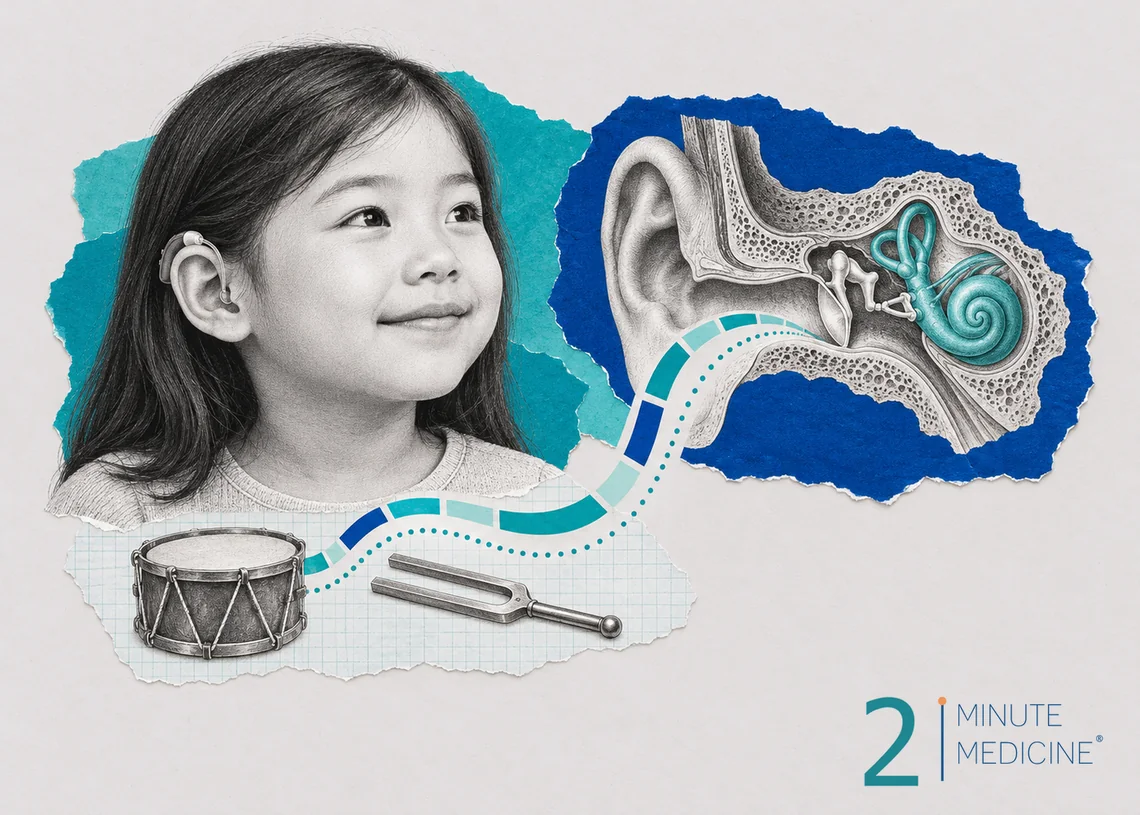
Hearing loss in children may start before birth or appear later, and it can be mild, moderate, severe or profound. Even mild hearing loss can slow speech, language and learning, because children learn to talk by listening. The sooner it’s found, the better a child does, so all newborns get a quick hearing check in the first weeks of life. Hearing aids, cochlear implants, sign language and early speech support all help children with hearing loss thrive.
Key points
- About 2 or 3 in every 1,000 babies in the US are born with hearing loss in one or both ears.
- Fluid behind the eardrum after ear infections is the most common cause of temporary hearing loss in young children.
- Babies should be screened by 1 month, have a full test by 3 months if needed, and start support by 6 months.
- If your child doesn’t react to sounds, has delayed speech, or says “what?” a lot, ask for a hearing test. Children of any age can be tested.
- Hearing loss can start or worsen after birth, so passing the newborn screen doesn’t rule it out later.
Types of hearing loss in children
- Conductive hearing loss. Sound can’t pass well through the ear canal, eardrum or the tiny bones of the middle ear. It’s often temporary and treatable. Common causes are fluid in the middle ear, earwax, a hole in the eardrum, or an ear canal or middle ear that formed differently before birth.
- Sensorineural hearing loss. The problem is in the inner ear (cochlea) or the hearing nerve. It’s usually permanent.
- Mixed hearing loss combines both.
Hearing loss can affect one ear (unilateral) or both (bilateral). With moderate loss, a child can’t hear normal conversation clearly. With profound loss, they may hear only very loud sounds, or none.
What causes hearing loss in children
Present at birth (congenital)
- Genes. About half of hearing loss at birth is genetic. Most children with genetic hearing loss have parents who hear normally. Some have a syndrome that also affects the eyes, kidneys, heart or other parts of the body.
- Infection during pregnancy. Cytomegalovirus (CMV), a common virus, is the leading non-genetic cause. Rubella, toxoplasmosis and syphilis are others.
- Birth problems. Being born very early, a long stay in newborn intensive care, low oxygen, or severe jaundice raise the risk.
Starting after birth
- Fluid behind the eardrum from ear infections or colds
- Meningitis, measles or mumps
- Some medicines, such as certain strong antibiotics and cancer drugs
- A head injury
- Loud noise, including headphones turned up too high
- Late-onset genetic hearing loss, or CMV that causes loss months or years after birth
Signs of hearing loss in children
Babies
- Doesn’t startle at loud noises
- Doesn’t turn toward sounds by about 6 months
- Doesn’t babble, or stops babbling
- Doesn’t say single words like “mama” or “dada” by about 12 months
- Responds when they see you, but not when you call from behind
Toddlers and older children
- Speech is late or hard to understand
- Often says “huh?” or “what?”
- Turns the TV or tablet up loud
- Doesn’t follow directions, or seems not to pay attention
- Struggles at school or in noisy rooms
- Turns one ear toward sounds, or speaks too loudly
Newborn hearing screening
Most US hospitals test babies before they go home. The tests are quick and painless, and are usually done while the baby sleeps. One test measures a faint echo the inner ear makes in response to soft clicks (otoacoustic emissions). The other uses small sensors on the head to measure how the hearing nerve responds (auditory brainstem response). If your baby doesn’t pass, it doesn’t mean they have hearing loss. Fluid or a fussy baby can cause it. Don’t skip the follow-up test, which should happen before 3 months.
How a child’s hearing is tested
An audiologist, a hearing specialist, picks tests to suit your child’s age:
- Brain response testing (ABR) for babies and young children who can’t respond reliably
- Visual reinforcement audiometry from about 6 months. A baby turns toward a sound and is rewarded with a lighted toy.
- Play audiometry from about age 2 or 3. The child drops a block in a bucket each time they hear a sound.
- Standard testing with headphones from about age 5
- Tympanometry, which checks how well the eardrum moves and shows fluid behind it
If hearing loss is found, an ear, nose and throat doctor (ENT) looks for the cause. Tests may include genetic testing, CMV testing, an MRI or CT scan of the inner ear, and an eye exam.
Treatment and support
- Treating fluid. Fluid often clears within 3 months. If it lasts and affects hearing, small ear tubes can drain it.
- Hearing aids can be fitted in babies a few weeks old.
- Cochlear implants help children with severe to profound loss who don’t get enough help from hearing aids. They can be placed in babies as young as 9 months.
- Bone conduction devices send sound through the skull bone, for some conductive loss or hearing in only one ear.
- Remote microphone systems carry a teacher’s voice straight to a child’s hearing device in class.
- Early intervention. From birth to age 3, states provide services such as speech and language therapy at little or no cost. Ask your doctor for a referral.
- Communication choices. Families may choose spoken language, American Sign Language, or both. Starting early with any full language matters most.
- School support. An IEP or 504 plan can provide seating near the teacher, captions and other help.
Babies born with symptoms from CMV may get antiviral medicine. Gene therapy for one rare genetic form of deafness is being tested in research studies.
Lowering the risk
- Keep your child up to date on vaccines, including measles, mumps and those that prevent meningitis.
- During pregnancy, wash your hands after changing diapers or wiping a young child’s nose, and don’t share cups or utensils with toddlers. This lowers the chance of catching CMV.
- Use ear protection at loud events, and keep headphone volume at about 60 percent or lower.
- Keep your child away from tobacco smoke, which raises the risk of ear infections.
When to see a doctor
- Your baby didn’t pass the newborn screen, or missed it
- You notice any of the signs above, or you’re simply worried about your child’s hearing
- Speech is delayed, or your child’s speech is hard to understand
- Your child had meningitis
- Ear pain, drainage, or hearing that seems worse after a cold
Get care right away for sudden hearing loss in one or both ears, especially with dizziness.
Common questions about hearing loss in children
How can I test my baby’s hearing at home?
You can watch whether your baby startles at a clap, quiets at your voice, or turns toward a rattle or their name. These checks can’t rule out hearing loss, because babies also react to movement, shadows and vibration. If you have any doubt, ask for a proper test with an audiologist.
Is hearing loss from ear infections permanent?
Usually not. Fluid behind the eardrum causes mild, temporary hearing loss that goes away when the fluid clears. If fluid stays for many months or keeps returning, it can delay speech, and ear tubes may help. Rarely, repeated infections damage the eardrum or middle ear bones.
Is it a speech problem or hearing loss?
It can be hard to tell. Children with a speech sound disorder (phonological disorder) mix up or leave out sounds, but so do children who can’t hear certain sounds clearly. That’s why speech therapists usually ask for a hearing test before starting therapy.
Questions to ask your doctor
- What type and degree of hearing loss does my child have?
- What is the likely cause, and should we have genetic or CMV testing?
- Would hearing aids or a cochlear implant help?
- How do we start early intervention services?
- How often should my child’s hearing be rechecked?
Learn more
- About hearing loss in children (Centers for Disease Control and Prevention)
- Your baby’s hearing screening and next steps (National Institute on Deafness and Other Communication Disorders)
This guide is general information and doesn’t replace advice from your own doctor. Last updated October 2026.






 Get the app