
• About
  • Masthead
  • License Content
  • Advertise
  • Press Releases
  • Newsroom
  • RSS/Email List
  • 2MM Podcast
  • Write for us
  • Contact Us
2 Minute Medicine
No Result
View All Result

No products in the cart.

Sign in
SUBSCRIBE
  • About
  • Specialties
    • All Specialties, All Recent Reports
    • Cardiology
    • Chronic Disease
    • Dermatology
    • Emergency
    • Endocrinology
    • Gastroenterology
    • Imaging and Intervention
    • Infectious Disease
    • Nephrology
    • Neurology
    • Obstetrics
    • Oncology
    • Ophthalmology
    • Pediatrics
    • Pharma
    • Preclinical
    • Psychiatry
    • Public Health
    • Pulmonology
    • Rheumatology
    • Surgery
    • Rewinds
    • The Scan
  • EvidencePulse™
  • HypeCheck™
  • AI News
  • Classics™
    • 2MM+ Online Access
    • Paperback and Ebook
  • Tools
    • NPI Registry Lookup
    • RVU Search
    • Physician Pay by Specialty
    • ICD-10 Code Lookup
    • FDA Drug Approvals
    • Drug Safety for Breastfeeding/Pregnancy
    • Clinical Guidelines
    • Medical Calculators
    • ECG Reference
      • QTc Calculator
      • Sgarbossa Criteria
      • ECG Axis Calculator
      • AV Block Helper
  • Rankings
    • Medical School Rankings
    • Residency Rankings
  • Partners
    • License Content
    • Advertise with Us
2 Minute Medicine
  • About
  • Specialties
    • All Specialties, All Recent Reports
    • Cardiology
    • Chronic Disease
    • Dermatology
    • Emergency
    • Endocrinology
    • Gastroenterology
    • Imaging and Intervention
    • Infectious Disease
    • Nephrology
    • Neurology
    • Obstetrics
    • Oncology
    • Ophthalmology
    • Pediatrics
    • Pharma
    • Preclinical
    • Psychiatry
    • Public Health
    • Pulmonology
    • Rheumatology
    • Surgery
    • Rewinds
    • The Scan
  • EvidencePulse™
  • HypeCheck™
  • AI News
  • Classics™
    • 2MM+ Online Access
    • Paperback and Ebook
  • Tools
    • NPI Registry Lookup
    • RVU Search
    • Physician Pay by Specialty
    • ICD-10 Code Lookup
    • FDA Drug Approvals
    • Drug Safety for Breastfeeding/Pregnancy
    • Clinical Guidelines
    • Medical Calculators
    • ECG Reference
      • QTc Calculator
      • Sgarbossa Criteria
      • ECG Axis Calculator
      • AV Block Helper
  • Rankings
    • Medical School Rankings
    • Residency Rankings
  • Partners
    • License Content
    • Advertise with Us
Sign in
SUBSCRIBE
2 Minute Medicine
Sign in
Subscribe
2 Minute MedicineFree on Google PlayGet
✦EvidencePulse™by 2 Minute Medicine3 reportsYou askedtop stroke trials 2026Synthesizing medical evidence...Top 2026 stroke trial results:OCEANIC — ischemic stroke: 6.2% vs 8.4%OPTION* — mRS 0–1: 43.6% vs 34.2%ORIENTAL* — mRS 0–2: 58.6% vs 46.6%*Higher sICH in intervention armsParticipants randomizedNOCEANIC12,327OPTION570ORIENTAL564Ask about guidelines or landmark trials...↑Try EvidencePulse™Ask the evidence. Get the signal.Try it now →
Home Health A to Z

Patient Basics: Fifth Disease (Erythema Infectiosum)
by2 Minute Medicine
October 30, 2026
in Health A to Z
Reading Time: 5 mins read
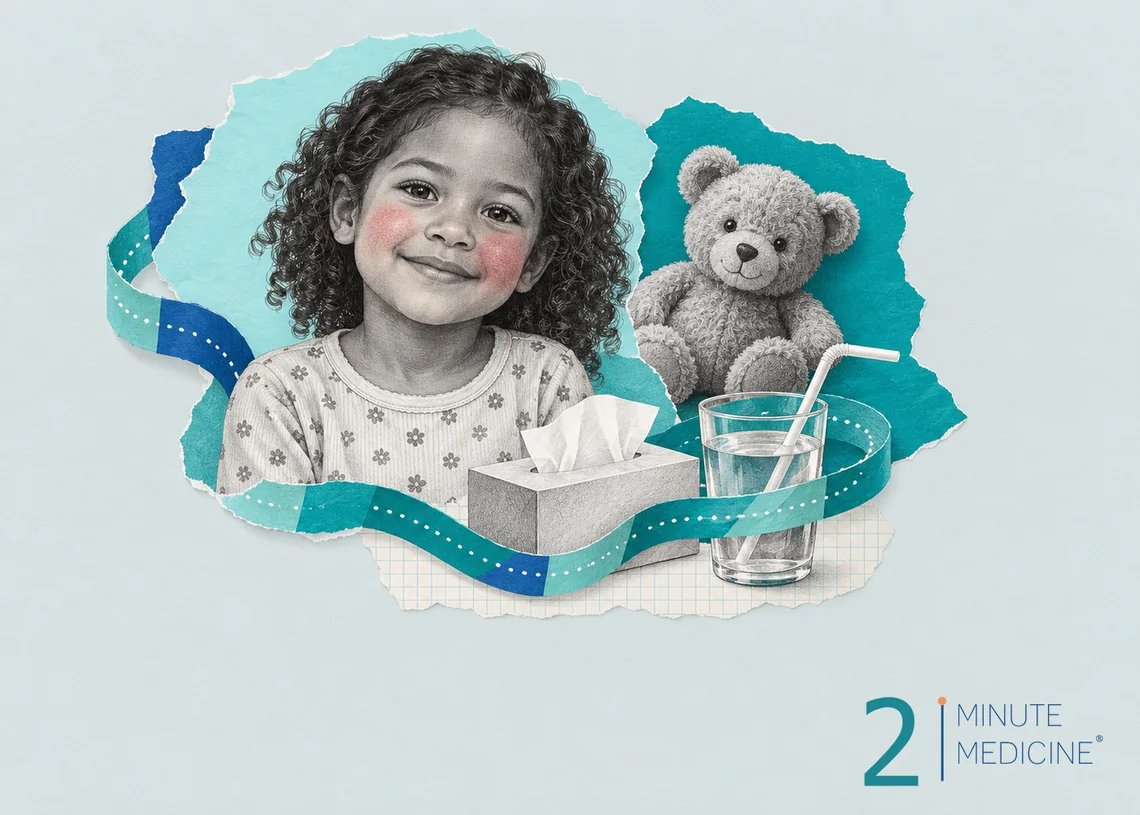
Fifth disease collage: a calm young girl with rosy slapped cheeks, a teddy bear, a box of tissues and a cup with a straw
Share on FacebookShare on TwitterShare on LinkedIn

Fifth disease is a common, usually mild viral illness in children that causes bright red cheeks, which is why it’s also called slapped cheek syndrome. Its medical name is erythema infectiosum, and it’s caused by parvovirus B19. Most children feel only a little unwell and get better on their own. It matters more for pregnant women and for people with certain blood disorders or a weak immune system.

Key points

  • Fifth disease starts like a cold. A red rash on the cheeks follows several days later, then a lacy rash on the body.
  • People are most contagious before the rash appears. Once the rash shows up, a child usually can’t spread it.
  • Adults often get painful, swollen joints instead of the classic rash.
  • There’s no specific medicine. Rest, fluids and fever relievers help.
  • Pregnant women who are exposed, and people with sickle cell disease or a weak immune system, should call a doctor.

What causes fifth disease

Fifth disease is caused by a virus called parvovirus B19. It’s the fifth of six common childhood rash illnesses doctors once numbered, which is how it got its name. It’s most common in children aged 5 to 15, and outbreaks often happen in schools in late winter and spring.

The virus spreads through droplets from coughs and sneezes, and through saliva and runny noses. It can also pass through blood and from a pregnant woman to her baby. Symptoms usually start 4 to 14 days after contact, sometimes later.

Fifth disease symptoms

Some people never have symptoms. In children, the illness tends to come in stages.

Stage 1: cold-like symptoms

  • Mild fever
  • Runny nose
  • Sore throat
  • Headache
  • Tiredness

Stage 2: slapped cheeks

A few days to a week later, both cheeks turn bright red, as if they’ve been slapped. The skin around the mouth often stays pale. By now, most children feel better.

Stage 3: body rash

A few days after that, a pink rash with a lacy, net-like pattern may appear on the arms, legs, chest, back or buttocks. It can itch. This rash can fade and come back for 1 to 3 weeks, especially after a warm bath, time in the sun, exercise or stress. That’s normal and doesn’t mean the illness has returned.

RELATED REPORTS

No Content Available

Fifth disease in adults

Adults who catch parvovirus B19 often don’t get the slapped-cheek rash. Instead, many have:

  • Pain and swelling in both hands, wrists, knees or ankles
  • Flu-like symptoms
  • A faint rash, or none

Joint pain is more common in women. It usually goes away within a few weeks but can last for months. It doesn’t cause lasting joint damage.

Who needs extra care

  • Pregnant women. About half of adults are already immune from a past infection. If a pregnant woman does catch it, the baby is usually fine. In a small number of cases, especially in the first half of pregnancy, the virus causes severe anemia in the baby, fluid buildup or miscarriage. Your doctor may order a blood test and extra ultrasounds. Babies with severe anemia can be treated with a blood transfusion before birth.
  • People with sickle cell disease or other blood disorders. The virus can briefly stop the bone marrow from making red blood cells, causing a sudden, severe drop in blood count (aplastic crisis). Signs are paleness, extreme tiredness and a racing heart. This needs urgent care and sometimes a blood transfusion.
  • People with a weak immune system, such as from cancer treatment, HIV or an organ transplant, can have long-lasting anemia. Treatment may include antibody infusions (IVIG).

How it’s diagnosed

Doctors can usually recognize fifth disease from the slapped-cheek rash and the lacy body rash. Blood tests for antibodies or for the virus itself are used for pregnant women, people with blood disorders, people with a weak immune system, and adults with unexplained joint pain.

Treatment and home care

There’s no antiviral medicine for fifth disease, and antibiotics don’t help. Most people get better on their own. To ease symptoms:

  • Rest and drink plenty of fluids.
  • Give acetaminophen or ibuprofen for fever, aches or joint pain. Don’t give aspirin to children or teens.
  • For an itchy rash, try cool compresses, fragrance-free moisturizer or an antihistamine. Ask your child’s doctor which kind and how much.
  • Keep your child out of hot baths and strong sun if they make the rash flare.

Preventing spread

There’s no vaccine. Washing hands often, covering coughs and sneezes, and not sharing cups or utensils lower the chance of passing it on. Because people are contagious before anyone knows they’re sick, it’s hard to stop outbreaks completely. After one infection, most people are immune for life.

Other causes of red cheeks

Red cheeks or a rash on the face can also come from sunburn, eczema, cold wind, scarlet fever (often with a sore throat and a sandpaper-like rash), rosacea in adults, or the butterfly-shaped rash of lupus. A rash that lasts for weeks, comes with joint pain and tiredness in an adult, or doesn’t fit the usual pattern should be checked.

When to see a doctor

  • You’re pregnant and have been around someone with fifth disease, or you develop a rash or joint pain
  • Your child has sickle cell disease, another blood disorder or a weak immune system and catches it
  • Your child seems very pale, unusually tired or short of breath
  • A fever lasts more than a few days, or your child seems quite ill
  • Joint pain lasts more than a few weeks

Common questions about fifth disease

Is slapped cheek syndrome contagious?

Yes, but mostly before the rash appears, during the cold-like stage. By the time the cheeks turn red, a healthy child usually can’t spread it. People with sickle cell disease or a weak immune system may stay contagious longer, so they should follow their doctor’s advice.

Can my child go to school or daycare with fifth disease?

Usually, yes. Once the slapped-cheek rash shows up, a healthy child is no longer contagious and can return if they feel well and have no fever. Let the school know, so pregnant staff and families of children with blood disorders can talk to their doctors.

How long does the fifth disease rash last?

The cheek rash usually fades in a few days. The lacy rash on the body can come and go for 1 to 3 weeks, often flaring with heat, sunlight, exercise or stress. This is expected and doesn’t mean your child is contagious again.

Can you get fifth disease twice?

It’s very unlikely. After one infection with parvovirus B19, most people are immune for life. A blood test can show whether you’ve had it before, which is useful for pregnant women who’ve been exposed.

Questions to ask your doctor

  • Is this rash fifth disease or something else?
  • When can my child go back to school or daycare?
  • I’m pregnant and was exposed. Do I need a blood test or extra ultrasounds?
  • Which medicine is best for the fever or itching, and how much should I give?
  • What signs mean we should come back?

Learn more

  • About parvovirus B19 and fifth disease (CDC)
  • Fifth disease (MedlinePlus, U.S. National Library of Medicine)

This guide is general information and doesn’t replace advice from your own doctor. Last updated October 2026.

Tags: Fifth Disease
Previous Post

Patient Basics: Earwax Blockage (Wax Blockage of the Ear Canal)

Next Post

Patient Basics: Friction Blisters

RelatedReports

No Content Available
Next Post
Chondrosarcoma collage: an engraved thigh bone and hip joint with a pale cartilage cap, a blank X-ray and a cane

Patient Basics: Chondrosarcoma

Diabetic nephropathy collage: a pair of kidneys with a dotted teal ribbon, a blood sugar meter, sugar cubes and a sample cup

Patient Basics: Diabetic Nephropathy (Diabetic Kidney Disease)

Down syndrome collage: pairs of chromosomes with one set of three, a heart drawing, toy building blocks and a picture book

Patient Basics: Down Syndrome

✦ EvidencePulse™ by 2 Minute Medicine 3 reports You asked top stroke trials 2026 Synthesizing medical evidence... Top 2026 stroke trial results: OCEANIC — ischemic stroke: 6.2% vs 8.4% OPTION* — mRS 0–1: 43.6% vs 34.2% ORIENTAL* — mRS 0–2: 58.6% vs 46.6% *Higher sICH in intervention arms Participants randomizedN OCEANIC 12,327 OPTION 570 ORIENTAL 564 Ask about guidelines or landmark trials... Try EvidencePulse™ Get the signal. Try it now → Physician-trained medical AI by 2 Minute Medicine

2MM+ All Access

Full details →
$4.99 /month

3-day free trial · cancel anytime

  • ✓100+ physician-written reports
  • ✓EvidencePulse™ + HypeCheck™
  • ✓Ad-free reading + newsletters
Start 3-day free trial

Then $4.99/month. Manage renewal in your account.

2 Minute Medicine® is an award winning, physician-run, expert medical media company. Our content is curated, written and edited by practicing health professionals who have clinical and scientific expertise in their field of reporting. Our editorial management team is comprised of highly-trained MD physicians. Join numerous brands, companies, and hospitals who trust our licensed content.

Recent Reports

  • Pelacarsen lowers lipoprotein(a) but does not reduce major cardiovascular events in patients with established cardiovascular disease
  • Durvalumab plus enfortumab vedotin was approved for perioperative treatment of muscle-invasive bladder cancer
  • CDC reports 5,412 confirmed measles cases in the United States in 2026
License Content
Terms of Use | Disclaimer
Cookie Policy

Get the app

Read 2 Minute Medicine on iPhone, iPad and Android.

Download on the App StoreGet it on Google Play
QR code for www.2minutemedicine.com/app
On a computer? Scan this with your phone’s camera.
2MM+ All Access Full details →

The medical literature, distilled daily.

Monthly plan selected: $4.99 /month.

$4.99/month

3-day free trial · cancel anytime

Start 3-day free trial

Then $4.99/month. Manage renewal in your account.

Yearly plan selected: $49.90 /year.

$49.90/year

2 months free

Start 3-day free trial

Then $49.90/year.

Membership benefits

  • ✓100+ new physician-written study summaries monthly, 12,000+ searchable
  • ✓AI EvidencePulse™ + HypeCheck™
  • ✓Ad-free reading + newsletters
  • ✓FDA drug approvals + clinical calculators

Already a member? Sign in

  • Get the app
  • About
  • Specialties
    • All Specialties, All Recent Reports
    • Cardiology
    • Chronic Disease
    • Dermatology
    • Emergency
    • Endocrinology
    • Gastroenterology
    • Imaging and Intervention
    • Infectious Disease
    • Nephrology
    • Neurology
    • Obstetrics
    • Oncology
    • Ophthalmology
    • Pediatrics
    • Pharma
    • Preclinical
    • Psychiatry
    • Public Health
    • Pulmonology
    • Rheumatology
    • Surgery
    • Rewinds
    • The Scan
  • EvidencePulse™
  • HypeCheck™
  • AI News
  • Classics™
    • 2MM+ Online Access
    • Paperback and Ebook
  • Tools
    • NPI Registry Lookup
    • RVU Search
    • Physician Pay by Specialty
    • ICD-10 Code Lookup
    • FDA Drug Approvals
    • Drug Safety for Breastfeeding/Pregnancy
    • Clinical Guidelines
    • Medical Calculators
    • ECG Reference
      • QTc Calculator
      • Sgarbossa Criteria
      • ECG Axis Calculator
      • AV Block Helper
  • Rankings
    • Medical School Rankings
    • Residency Rankings
  • Partners
    • License Content
    • Advertise with Us
No Result
View All Result

© 2026 2 Minute Medicine, Inc. - Physician-written medical news.


