

Patient Basics: Gallstones
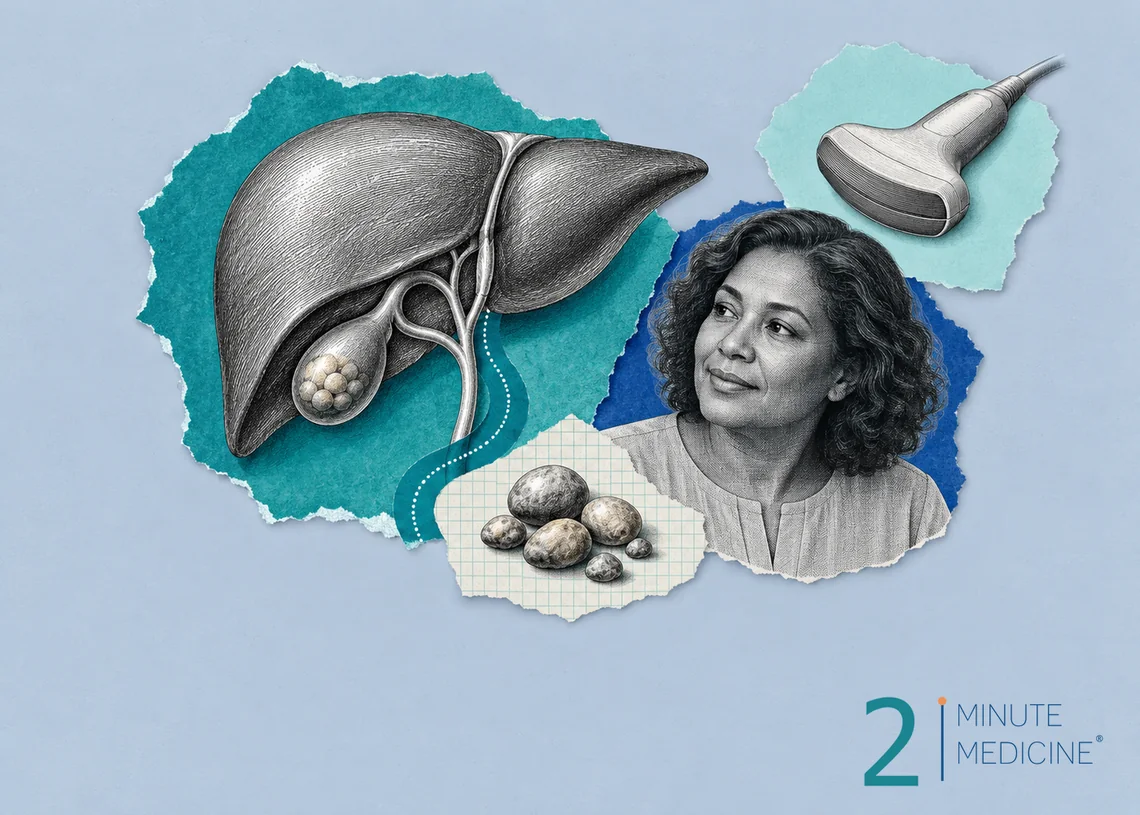
Gallstones are hard lumps that form in the gallbladder, a small pouch under the liver that stores bile. Many people have gallstones and never know it, and they need no treatment. When a stone blocks the flow of bile, it can cause sudden, severe pain in the upper belly. If that keeps happening, the usual fix is surgery to remove the gallbladder.
Key points
- Roughly 1 in 10 adults in the US has gallstones. Most never have symptoms.
- A gallstone attack causes steady pain in the upper right or middle of the belly, often after a large meal.
- An ultrasound is the main test.
- Removing the gallbladder is a common, safe operation, and you can digest food normally without it.
- Pain lasting more than a few hours, fever, or yellow skin or eyes needs urgent care.
How gallstones form
The liver makes bile, a fluid that helps digest fat. Between meals, bile is stored in the gallbladder. When you eat, the gallbladder squeezes bile through small tubes (bile ducts) into the small intestine.
If bile holds too much cholesterol, or the gallbladder doesn’t empty well, crystals form and slowly grow into stones. Most gallstones in the US are made mostly of cholesterol. Others, called pigment stones, form from a substance in bile called bilirubin. These are more common in people with liver scarring (cirrhosis) or blood disorders such as sickle cell disease. Stones can be as small as a grain of sand or as large as a golf ball.
Who is more likely to get them
- Women, especially during pregnancy or when taking estrogen
- People over 40
- People with obesity
- People who lose weight very quickly, including after weight-loss surgery
- People with a family history of gallstones
- American Indian and Mexican American people
- People with diabetes, cirrhosis or Crohn’s disease
Symptoms
A gallstone attack (biliary colic) happens when a stone blocks the outlet of the gallbladder for a while. Typical signs are:
- Steady, strong pain in the upper right belly or just below the breastbone
- Pain that may spread to the right shoulder blade or the back
- Pain lasting from about 30 minutes to a few hours, then easing
- Nausea or vomiting
Attacks often come after a big or fatty meal, and often at night. Bloating and burping on their own usually aren’t caused by gallstones.
Complications
- Inflamed gallbladder (cholecystitis). A stone stays stuck, and the gallbladder swells and may become infected. Pain lasts many hours, often with fever and tenderness.
- Stone in the bile duct. A stone slips into the main bile duct and blocks it. This can cause yellow skin or eyes (jaundice), dark urine and pale stools.
- Bile duct infection (cholangitis). Fever, chills, jaundice and belly pain together. This is an emergency.
- Pancreatitis. A stone blocks the opening the bile duct shares with the pancreas. It causes severe upper belly pain that often spreads to the back, with vomiting.
How gallstones are diagnosed
- Ultrasound. This painless scan uses sound waves and is the best first test for gallstones. You may be asked not to eat for several hours before it.
- Blood tests check for infection and look at liver and pancreas enzymes, which rise when a duct is blocked.
- Other scans. A special MRI can show the bile ducts. A nuclear scan (HIDA scan) can show whether the gallbladder is blocked or not emptying well. A CT scan may be done to look for other causes of belly pain.
Treatment for gallstones
No symptoms
Stones found by chance on a scan usually don’t need treatment. Only a small share of people with silent stones go on to have attacks.
Surgery
If you’ve had gallstone attacks or a complication, doctors usually advise removing the gallbladder (cholecystectomy). Without treatment, attacks tend to return. Most operations are done through a few small cuts using a camera (laparoscopic surgery). Many people go home the same day or the next, and return to normal activities within a week or two.
After the gallbladder is gone, bile flows straight from the liver into the intestine. Most people eat normally. Some have looser stools for a few weeks or longer, which usually improves.
Removing stones from the bile duct
If a stone is stuck in the bile duct, a specialist can remove it with ERCP. A thin, flexible scope is passed through the mouth and stomach into the small intestine, where the bile duct opens. Tiny tools pull the stone out. The gallbladder is usually removed later. If ERCP can’t reach the stone, a surgeon may remove it during the gallbladder operation, sometimes through a cut into the bile duct itself (choledochotomy).
Other options
For people who can’t have surgery, a pill called ursodiol can slowly dissolve small cholesterol stones. It takes months to years, and stones often come back after stopping it. Very ill people with an infected gallbladder may have a thin tube placed through the skin to drain it until they’re well enough for surgery.
Lowering your risk
- Stay at a healthy weight. If you need to lose weight, aim to lose it slowly.
- Avoid very low-calorie crash diets and long periods without eating.
- Be active most days.
- Eat plenty of fiber, fruit and vegetables.
- If you’re having weight-loss surgery, ask whether you need medicine to prevent gallstones.
When to see a doctor
- Episodes of upper belly pain after meals, even if they pass
- Gallstones found on a scan, if you’re unsure what to do next
Get emergency care for belly pain lasting more than a few hours, pain with fever or chills, yellow skin or eyes, dark urine with pale stools, or severe pain with vomiting.
Common questions about gallstones
Can gallstones pass on their own?
Small ones sometimes do. A stone can slip out of the gallbladder, travel down the bile duct and leave the body without you noticing. A stone that gets stuck on the way can cause pain, jaundice or pancreatitis. Stones that stay in the gallbladder rarely go away by themselves.
Where do gallstones go when you pass them?
They end up in your stool. A passed stone moves from the gallbladder down the bile duct, which empties into the first part of the small intestine, and then travels through the bowel. Most passed stones are small, so you usually won’t see them in the toilet.
Can bile duct stones pass on their own?
Sometimes, if they’re small. A stone stuck in the bile duct can cause a serious infection or pancreatitis, so doctors usually remove it with ERCP rather than wait. If blood tests and scans suggest the stone has already passed, your doctor may hold off and watch.
Does a gallbladder flush help you pass gallstones?
No. The soft green lumps people pass after drinking olive oil and lemon juice form from the oil itself, not from the gallbladder. A large dose of oil can even set off an attack in someone with gallstones. No diet or home remedy has been shown to flush stones out.
Questions to ask your doctor
- Are my symptoms caused by gallstones?
- Do I need my gallbladder removed, and how soon?
- What are the risks of waiting?
- Will I need to change how I eat after surgery?
- Which symptoms should make me go to the emergency department?
Learn more
- Gallstones (National Institute of Diabetes and Digestive and Kidney Diseases)
This guide is general information and doesn’t replace advice from your own doctor. Last updated October 2026.






 Get the app