

Patient Basics: Snellen Test for Visual Acuity
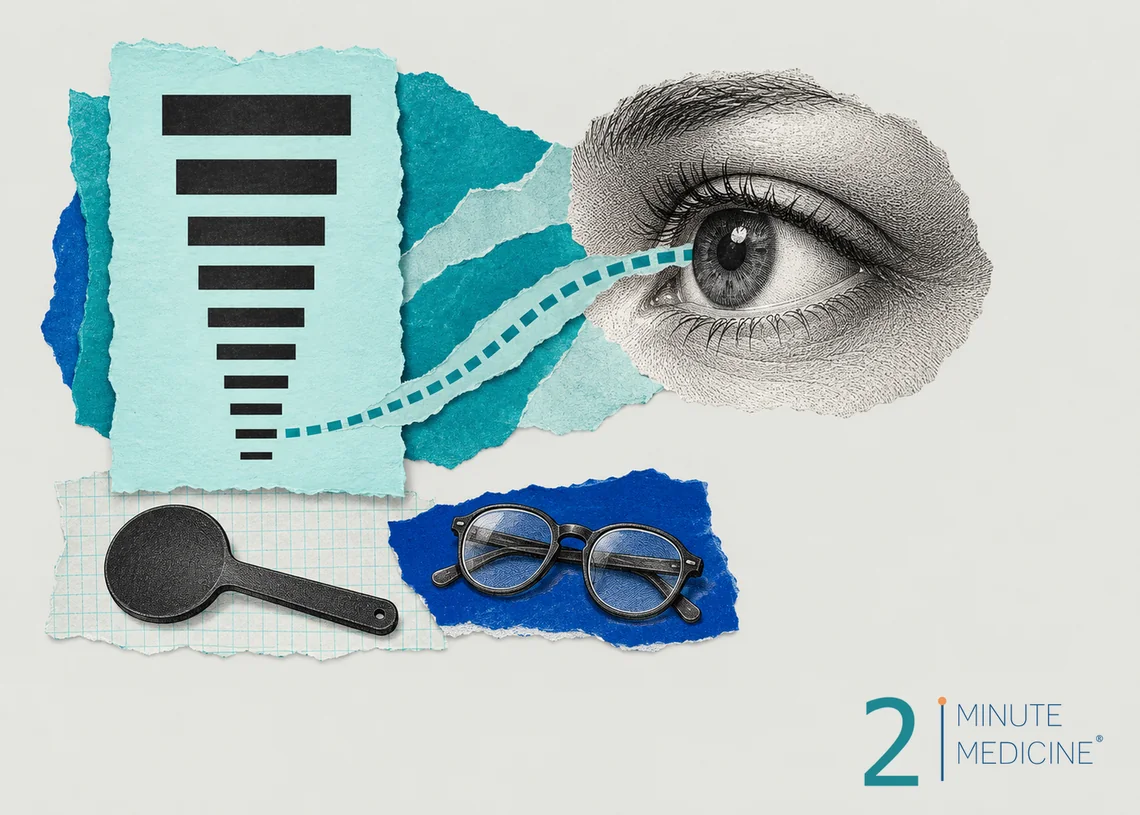
The Snellen test is the familiar eye chart with rows of letters that get smaller toward the bottom. It measures visual acuity, meaning how sharply you can see details at a distance. The test takes a few minutes and doesn’t hurt. Your result is written as a fraction, such as 20/20 or 20/40.
Key points
- You read the chart from 20 feet away, one eye at a time.
- 20/20 is normal distance vision. A larger bottom number means blurrier vision.
- The test checks sharpness only. It doesn’t check eye pressure, side vision or the health of the eye.
- Most blurry results improve with glasses or contact lenses.
- Sudden vision loss needs emergency care, not a chart test.
Why the Snellen test is done
A Dutch eye doctor, Herman Snellen, designed the chart in 1862, and it is still the most common vision test. It is used:
- At routine eye exams and checkups
- For school vision screening
- To get or renew a driver’s license
- For job and sports physicals
- To track eye conditions such as cataracts or macular degeneration
- After an eye injury or eye surgery
People who can’t read letters, including young children, can use charts with simple pictures, or a “tumbling E” chart. They point in the direction the E faces.
Getting ready
There is no special preparation. Bring your glasses or contact lenses, since you will usually be tested wearing them. Tell the tester if you have recently had eye surgery or an eye problem.
During the Snellen test
- You stand or sit 20 feet (about 6 meters) from the chart. In smaller rooms, a mirror or screen creates the same distance.
- You cover one eye with a small paddle or the palm of your hand. Don’t press on the eye.
- You read the letters aloud, starting at the top and working down until most of the letters on a line are too small to make out. It’s fine to guess.
- You repeat the test with the other eye, and sometimes with both eyes open.
- If a line is blurry, the tester may have you look through a card with a tiny hole in it (a pinhole). If your vision gets clearer, glasses will likely help.
Try not to squint or peek with the covered eye, because that changes the result.
Your Snellen test results
The top number is your distance from the chart, usually 20 feet. The bottom number is the distance at which a person with normal vision can read the same line.
- 20/20. Normal sharpness. You see at 20 feet what most people see at 20 feet.
- 20/15 or 20/10. Sharper than average.
- 20/40. You need to be at 20 feet to read what a person with normal vision reads at 40 feet. Many states require at least 20/40 in one eye, with glasses if needed, to drive without limits.
- 20/200 or worse. If this is the best you can see in your better eye, even with glasses, it meets the US definition of legal blindness.
Outside the US, the same results are often written in meters, so 20/20 becomes 6/6.
What a low score can mean
The most common cause is a need for glasses. This includes nearsightedness, farsightedness and astigmatism. Other causes include cataracts, macular degeneration, diabetic eye disease, advanced glaucoma, and lazy eye (amblyopia) in children. A big difference between your two eyes is worth checking, even if one eye sees well.
Afterward
If your vision is less than 20/20, or worse than before, an eye doctor can measure you for glasses or contacts and examine the eye. They may test near vision with a reading card, check side vision, measure eye pressure and widen your pupils with drops to look inside the eye.
When to call your doctor
- Your vision is getting blurry, at a distance or up close
- You see halos around lights, or have trouble driving at night
- Straight lines look wavy
- A child squints, holds things very close, tilts the head or fails a school screening
Get emergency care for sudden vision loss, a curtain or shadow over your vision, a sudden shower of floaters or flashes, or eye pain with redness.
Common questions about the Snellen test
Is 20/20 vision perfect vision?
Not exactly. 20/20 means your distance vision is normal, and many people see better than that. You can still have trouble reading up close, poor side vision or an eye disease such as glaucoma with 20/20 vision, so it doesn’t replace a full eye exam.
Can I do a Snellen test at home?
You can try a printed chart or an app, and these can help you notice a change. Home tests are less accurate, because lighting, chart size and distance are hard to get right. They don’t check the health of your eyes, so see an eye doctor for any concern.
How often should I get my vision checked?
Children should have vision screening at checkups, and adults with no eye problems should have a full eye exam every few years. After age 40, and for anyone with diabetes or a family history of glaucoma, exams are usually needed more often. Your eye doctor can suggest the right schedule for you.
Questions to ask your doctor
- What is my visual acuity in each eye?
- Do I need glasses or contact lenses, and for what activities?
- Is my vision good enough to drive?
- Did you see any signs of eye disease?
- When should I have my eyes checked again?
Learn more
- Visual acuity test (MedlinePlus, U.S. National Library of Medicine)
This guide is general information and doesn’t replace advice from your own doctor. Last updated October 2026.






 Get the app