

Patient Basics: Sun-Damaged Skin
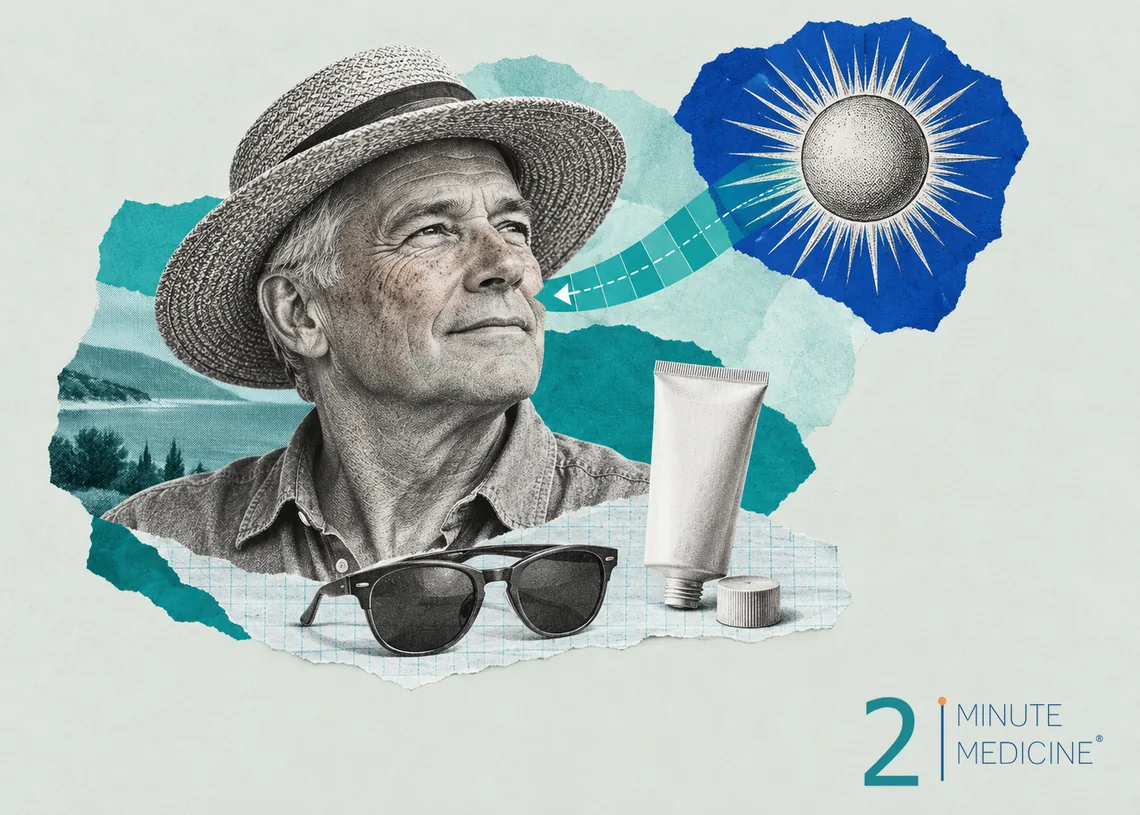
Sun-damaged skin is skin that has been changed by years of ultraviolet (UV) light from the sun or tanning beds. It can become wrinkled, leathery, spotted and rough. Sun damage also raises the risk of skin cancer, so any spot that is new, growing or not healing needs a doctor’s look. Protecting your skin every day slows further damage at any age.
Key points
- Sun exposure causes most of the wrinkles, brown spots and rough texture on the face, neck, arms and hands.
- Rough, scaly patches called actinic keratoses can turn into a type of skin cancer. They are easy to treat.
- Broad-spectrum sunscreen with SPF 30 or higher, shade, hats and clothing all help.
- Creams, peels, freezing and lasers can improve the look of damaged skin and remove precancer spots.
- See a doctor for any spot that bleeds, grows, changes or doesn’t heal.
How the sun damages skin
Sunlight carries two main kinds of UV rays. UVB rays burn the top layer of skin. UVA rays reach deeper and pass through window glass and clouds. Both damage the genetic material (DNA) in skin cells and break down collagen and elastin, the fibers that keep skin firm and springy. The skin repairs some of this damage, but not all of it, and the rest adds up over a lifetime. Much of it comes from everyday time outdoors, such as walking, driving and gardening, as well as from beach days and sunburns.
You are at higher risk if you have fair skin that burns easily, freckles, light eyes or red or blond hair. Working outdoors, living somewhere sunny or at high altitude, using tanning beds, and taking medicines that weaken the immune system, such as after an organ transplant, raise the risk too. Smoking adds to wrinkling.
Signs of sun-damaged skin
- Wrinkles and texture changes. Fine lines, deep creases and thick, leathery skin, often worst on the back of the neck.
- Sunspots. Flat brown spots on the face, chest and backs of the hands. They are sometimes called age spots or liver spots, though the liver has nothing to do with them.
- Uneven color. Blotchy brown areas and small white spots on the arms and shins.
- Small visible blood vessels and redness on the cheeks and nose.
- Thin, fragile skin. Purple bruises on the forearms after minor bumps.
- Actinic keratoses. Rough, dry patches that feel like sandpaper. They may be pink, red or tan, and are often easier to feel than to see. They show up on the face, ears, scalp, lips and backs of the hands.
- A dry, scaly lower lip that doesn’t clear up, a lip form of actinic keratosis.
Skin cancers linked to the sun
- Basal cell carcinoma, the most common type, often looks like a shiny, pearly bump or a sore that bleeds and heals and then comes back.
- Squamous cell carcinoma may look like a firm, scaly bump or a sore that won’t heal. Some start from actinic keratoses.
- Melanoma is less common but more dangerous. Watch for a mole that is uneven in shape, has ragged edges or several colors, is larger than a pencil eraser, or is changing.
How it’s diagnosed
A doctor, often a dermatologist (skin specialist), can usually tell by looking and feeling. They may use a handheld magnifying light called a dermatoscope. If a spot could be cancer, the doctor numbs the skin and removes a small piece (a biopsy) to check it under a microscope. Ask how often you should have a full skin check, since this depends on your risk.
Treating sun-damaged skin
For actinic keratoses
- Freezing (cryotherapy). Liquid nitrogen is sprayed on single spots. The area blisters or crusts, then peels off in a week or two.
- Creams and gels. Fluorouracil, imiquimod or tirbanibulin are put on a whole area to treat spots you can see and ones still forming. The skin gets red and crusty for a while before it heals.
- Photodynamic therapy. A liquid that makes the damaged cells sensitive to light is painted on, then the area is exposed to blue or red light.
- Peels and laser treatment can also remove damaged layers.
For wrinkles and spots
- Retinoid creams, such as prescription tretinoin, can soften fine lines and fade spots over several months. They can cause dryness and make skin more sensitive to the sun. Don’t use them during pregnancy.
- Lightening creams, such as hydroquinone, can fade brown spots.
- Chemical peels remove the outer layers so newer skin grows in.
- Lasers and intense pulsed light can treat brown spots, redness and small blood vessels. Stronger lasers smooth wrinkles but need more healing time.
- Moisturizers ease dryness and help skin look smoother.
Skin cancers are treated by removing them or with other methods, depending on the type, size and place.
Protecting your skin
It’s never too late to start. Studies show that daily sunscreen slows visible aging and lowers the number of new precancer spots.
- Use broad-spectrum sunscreen with SPF 30 or higher on all exposed skin every day, even when it’s cloudy. Reapply every 2 hours, and after swimming or sweating.
- Stay in the shade when the sun is strongest, roughly 10 a.m. to 4 p.m.
- Wear a wide-brimmed hat, sunglasses that block UV, and long sleeves. Clothing labeled with a UPF rating gives steady protection.
- Use a lip balm with SPF.
- Skip tanning beds.
- Keep babies under 6 months out of direct sun.
- Check your skin once a month for new or changing spots.
When to see a doctor
- A spot that is new, growing, changing color or shape, itching or bleeding
- A sore that hasn’t healed in about 3 to 4 weeks
- Rough, scaly patches that keep coming back
- A mole that looks different from your other moles
- A lip sore or scaly patch that won’t clear
Common questions about sun-damaged skin
Can sun-damaged skin be repaired?
Partly, yes. Daily sunscreen lets the skin repair some damage and prevents more. Retinoid creams, peels and lasers can fade spots and soften fine lines over several months. Deep wrinkles and leathery texture are harder to reverse, and the higher skin cancer risk from past sun stays, so keep up with skin checks.
Can I treat actinic keratosis at home?
Yes, with a doctor’s guidance. Prescription creams such as fluorouracil or imiquimod are put on at home, but a doctor should check the spots first and guide the treatment. Home remedies like apple cider vinegar haven’t been shown to work and can burn the skin. Daily sunscreen helps prevent new spots and lets some mild ones fade.
Do people with dark skin get sun damage?
Yes, though less often and usually later in life. Darker skin has more melanin, a pigment that blocks some UV light. Sun can still cause dark patches, uneven tone and skin cancer, and skin cancer is often found at a later stage in people with darker skin. Sunscreen and skin checks help everyone.
Questions to ask your doctor
- Are any of my spots precancer or cancer?
- Which treatment fits my skin and my schedule?
- How much downtime will this treatment need?
- How often should I have my skin checked?
- Which sunscreen would suit my skin best?
Learn more
- Actinic keratosis (MedlinePlus, U.S. National Library of Medicine)
- Sun safety facts (Centers for Disease Control and Prevention)
This guide is general information and doesn’t replace advice from your own doctor. Last updated October 2026.
RelatedReports






 Get the app