• About
  • Masthead
  • License Content
  • Advertise
  • Press Releases
  • Newsroom
  • RSS/Email List
  • 2MM Podcast
  • Write for us
  • Contact Us
2 Minute Medicine
No Result
View All Result

No products in the cart.

Sign in
SUBSCRIBE
  • About
  • Specialties
    • All Specialties, All Recent Reports
    • Cardiology
    • Chronic Disease
    • Dermatology
    • Emergency
    • Endocrinology
    • Gastroenterology
    • Imaging and Intervention
    • Infectious Disease
    • Nephrology
    • Neurology
    • Obstetrics
    • Oncology
    • Ophthalmology
    • Pediatrics
    • Pharma
    • Preclinical
    • Psychiatry
    • Public Health
    • Pulmonology
    • Rheumatology
    • Surgery
    • Rewinds
    • The Scan
  • EvidencePulse™
  • HypeCheck™
  • AI News
  • Classics™
    • 2MM+ Online Access
    • Paperback and Ebook
  • Tools
    • NPI Registry Lookup
    • RVU Search
    • ICD-10 Code Lookup
    • Medical School Rankings
    • FDA Drug Approvals
    • Drug Safety for Breastfeeding/Pregnancy
    • Clinical Guidelines
    • Medical Calculators
  • Partners
    • License Content
    • Advertise with Us
2 Minute Medicine
  • About
  • Specialties
    • All Specialties, All Recent Reports
    • Cardiology
    • Chronic Disease
    • Dermatology
    • Emergency
    • Endocrinology
    • Gastroenterology
    • Imaging and Intervention
    • Infectious Disease
    • Nephrology
    • Neurology
    • Obstetrics
    • Oncology
    • Ophthalmology
    • Pediatrics
    • Pharma
    • Preclinical
    • Psychiatry
    • Public Health
    • Pulmonology
    • Rheumatology
    • Surgery
    • Rewinds
    • The Scan
  • EvidencePulse™
  • HypeCheck™
  • AI News
  • Classics™
    • 2MM+ Online Access
    • Paperback and Ebook
  • Tools
    • NPI Registry Lookup
    • RVU Search
    • ICD-10 Code Lookup
    • Medical School Rankings
    • FDA Drug Approvals
    • Drug Safety for Breastfeeding/Pregnancy
    • Clinical Guidelines
    • Medical Calculators
  • Partners
    • License Content
    • Advertise with Us
Sign in
SUBSCRIBE
2 Minute Medicine
Sign in
Subscribe
2 Minute MedicineFree on Google PlayGet
✦EvidencePulse™by 2 Minute Medicine3 reportsYou askedtop stroke trials 2026Synthesizing medical evidence...Top 2026 stroke trial results:OCEANIC — ischemic stroke: 6.2% vs 8.4%OPTION* — mRS 0–1: 43.6% vs 34.2%ORIENTAL* — mRS 0–2: 58.6% vs 46.6%*Higher sICH in intervention armsParticipants randomizedNOCEANIC12,327OPTION570ORIENTAL564Ask about guidelines or landmark trials...↑Try EvidencePulse™Ask the evidence. Get the signal.Try it now →
Home All Specialties Imaging and Intervention

Prolonged DAPT following PCI linked to fewer ischemic events in patients with PAD

byJames EnglandandAnees Daud
August 30, 2016
in Imaging and Intervention, Surgery
Reading Time: 3 mins read
Prolonged DAPT following PCI linked to fewer ischemic events in patients with PAD
Share on FacebookShare on TwitterShare on LinkedIn

1. Subgroup analysis of the PRODIGY trial demonstrated that there were lower rates of ischemic events in patients with baseline peripheral artery disease (PAD) who received prolonged (24 months vs. <6 months) dual antiplatelet therapy (DAPT) following percutaneous coronary intervention (PCI).

2. Patients without PAD at baseline were less likely to experience subsequent ischemic events and were not shown to benefit from prolonged DAPT therapy.

Evidence Rating Level: 2 (Good)       

Study Rundown: Optimal duration of DAPT following PCI remains an area of ongoing investigation with the benefits of preventing further ischemic events needing to be weighed against bleeding risk and other side effects. Patients with PAD are known to have higher risk of coronary artery disease and have been shown to be at higher risk of cardiovascular mortality following PCI. This study was a subgroup analysis of the Prolonging Dual Antiplatelet Treatment After Grading Stent-Induced Intimal Hyperplasia Study (PRODIGY) randomized control trial and sought to evaluate whether the presence of PAD influenced outcomes with short vs. prolonged DAPT following PCI.

The PRODIGY trial was designed to compare prolonged (24 months) use of DAPT with short duration (<6 months) following PCI. Subgroup analysis showed that patients with PAD at baseline had increased risk of the primary combined outcome of death, MI, or CVA, as well as increased mortality. Prolonged DAPT was associated with improved primary outcomes for those with PAD but not for those without PAD. Prolonged DAPT was not shown to have increased risk of major clinical bleeding. This subgroup analysis demonstrated the significant prognostic importance of baseline PAD on future ischemic risk. The benefit from prolonged DAPT in this population offers an option to reduce the risk of subsequent ischemic events. PAD may therefore be used as a way to stratify patients for decision to continue DAPT. The limitations of this study included the use of only ASA and clopidogrel for anti-platelet agents when newer agents are available, and the potential bias of the retrospective analysis given that PAD was not initially used to help balance the randomization of the trial.

Click to read the study, published today in JAMA Cardiology

RELATED REPORTS

Paclitaxel-coated devices do not reduce rates of major amputations in chronic limb-threatening ischemia

Semaglutide improves walking ability in patients with peripheral artery disease and type 2 diabetes

Relevant Reading: Randomized comparison of 6- versus 24-month clopidogrel therapy after balancing anti-intimal hyperplasia stent potency in all-comer patients undergoing percutaneous coronary intervention

In-Depth [randomized controlled trial]: This study was a subgroup analysis of the previously reported Prolonging Dual Antiplatelet Treatment After Grading Stent-Induced Hyperplasia Study (PRODIGY) trial that compared outcomes with short (≤6 months) and prolonged (24 months) DAPT with ASA plus clopidogrel following PCI. The subgroup analysis compared those with baseline PAD (n = 246) to those without (n = 1724). Patients were followed up to 24 months after the PCI with primary outcome defined as a composite of death, myocardial infarction, or cerebrovascular accident. The key safety end point of bleeding was evaluated using the Bleeding Academic Research Consortium criteria. Patients were defined as having PAD if they had a history of intermittent claudication, prior amputation, or peripheral revascularization.

Patients with PAD had increased rates of the primary outcome (21.9% vs. 8.4%, p = 0.001), and mortality (HR 1.87, 95%CI 1.25-2.79, p = 0.002) compared to those without. Bleeding events were not significantly different between the groups (6.0% vs. 5.5%, p = 0.32). In patients with PAD, prolonged DAPT had lower risk of the primary outcome (HR 0.53, 95%CI 0.31-0.95, p = 0.3). This benefit was not apparent amongst patients without PAD (HR 1.28, 95%CI 0.92-1.77, p = 0.15). Bleeding risk was not significantly different between prolonged and short duration groups.

Image: PD

©2016 2 Minute Medicine, Inc. All rights reserved. No works may be reproduced without expressed written consent from 2 Minute Medicine, Inc. Inquire about licensing here. No article should be construed as medical advice and is not intended as such by the authors or by 2 Minute Medicine, Inc.

Tags: peripheral artery diseaseperipheral vascular disease
Previous Post

Gap in depression treatment may exist in America

Next Post

Formoterol-budesonide combination therapy for asthma does not increase adverse events

RelatedReports

Blocked leg arteries collage: a cutaway artery with plaque and a balloon catheter inside, above a pair of folded wool socks
Cardiology

Paclitaxel-coated devices do not reduce rates of major amputations in chronic limb-threatening ischemia

October 31, 2025
Walking for health collage: a pair of walking shoes and a fitness band at the start of a winding path toward a tree
Chronic Disease

Semaglutide improves walking ability in patients with peripheral artery disease and type 2 diabetes

May 29, 2025
#VisualAbstract: Paclitaxel-coated balloon may be superior to uncoated balloon for coronary in-stent restenosis
Chronic Disease

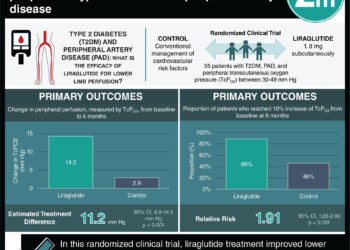
#VisualAbstract: Liraglutide may improve lower limb perfusion in people with type 2 diabetes and peripheral artery disease

March 28, 2024
Cardiology

No increase in mortality with paclitaxel-coated devices among patients with femoropopliteal disease

December 13, 2023
Next Post

Formoterol-budesonide combination therapy for asthma does not increase adverse events

Early ART therapy for HIV-1 linked to decreased transmission: The HPTN 052 trial

Combination salmeterol-fluticasone therapy noninferior to fluticasone monotherapy for asthma events: The VESTRI trial

✦ EvidencePulse™ by 2 Minute Medicine 3 reports You asked top stroke trials 2026 Synthesizing medical evidence... Top 2026 stroke trial results: OCEANIC — ischemic stroke: 6.2% vs 8.4% OPTION* — mRS 0–1: 43.6% vs 34.2% ORIENTAL* — mRS 0–2: 58.6% vs 46.6% *Higher sICH in intervention arms Participants randomizedN OCEANIC 12,327 OPTION 570 ORIENTAL 564 Ask about guidelines or landmark trials... Try EvidencePulse™ Get the signal. Try it now → Physician-trained medical AI by 2 Minute Medicine

2MM+ All Access

Full details →
$4.99 /month

3-day free trial · cancel anytime

  • ✓100+ physician-written reports
  • ✓EvidencePulse™ + HypeCheck™
  • ✓Ad-free reading + newsletters
Start 3-day free trial

Then $4.99/month. Manage renewal in your account.

NPI Lookup · Free

Look up any US clinician

Search by name or NPI number, live from the CMS NPI Registry.

  • OIG exclusion check
  • Licenses and specialties
  • No account needed
Open NPI Lookup →

2 Minute Medicine® is an award winning, physician-run, expert medical media company. Our content is curated, written and edited by practicing health professionals who have clinical and scientific expertise in their field of reporting. Our editorial management team is comprised of highly-trained MD physicians. Join numerous brands, companies, and hospitals who trust our licensed content.

Recent Reports

  • Early mitral valve surgery may improve long-term survival in asymptomatic severe mitral regurgitation
  • CDC reports increasing early-season influenza activity and at least 900 deaths nationwide
  • A concentrated exposure therapy intervention may be more effective than digital cognitive behavioural therapy in obsessive-compulsive disorder
License Content
Terms of Use | Disclaimer
Cookie Policy

Get the app

Read 2 Minute Medicine on iPhone, iPad and Android.

Download on the App StoreGet it on Google Play
QR code for www.2minutemedicine.com/app
On a computer? Scan this with your phone’s camera.
2MM+ All Access Full details →

The medical literature, distilled daily.

Monthly plan selected: $4.99 /month.

$4.99/month

3-day free trial · cancel anytime

Start 3-day free trial

Then $4.99/month. Manage renewal in your account.

Yearly plan selected: $49.90 /year.

$49.90/year

2 months free

Start 3-day free trial

Then $49.90/year.

Membership benefits

  • ✓100+ physician-written reports
  • ✓AI EvidencePulse™ + HypeCheck™
  • ✓Ad-free reading + newsletters
  • ✓NPI watchlist + bulk NPI verification

Already a member? Sign in

  • Get the app
  • About
  • Specialties
    • All Specialties, All Recent Reports
    • Cardiology
    • Chronic Disease
    • Dermatology
    • Emergency
    • Endocrinology
    • Gastroenterology
    • Imaging and Intervention
    • Infectious Disease
    • Nephrology
    • Neurology
    • Obstetrics
    • Oncology
    • Ophthalmology
    • Pediatrics
    • Pharma
    • Preclinical
    • Psychiatry
    • Public Health
    • Pulmonology
    • Rheumatology
    • Surgery
    • Rewinds
    • The Scan
  • EvidencePulse™
  • HypeCheck™
  • AI News
  • Classics™
    • 2MM+ Online Access
    • Paperback and Ebook
  • Tools
    • NPI Registry Lookup
    • RVU Search
    • ICD-10 Code Lookup
    • Medical School Rankings
    • FDA Drug Approvals
    • Drug Safety for Breastfeeding/Pregnancy
    • Clinical Guidelines
    • Medical Calculators
  • Partners
    • License Content
    • Advertise with Us
No Result
View All Result

© 2026 2 Minute Medicine, Inc. - Physician-written medical news.