



• About
  • Masthead
  • License Content
  • Advertise
  • Submit Press Release
  • RSS/Email List
  • 2MM Podcast
  • Write for us
  • Contact Us
2 Minute Medicine
No Result
View All Result

No products in the cart.

SUBSCRIBE
  • Specialties
    • All Specialties, All Recent Reports
    • Cardiology
    • Chronic Disease
    • Dermatology
    • Emergency
    • Endocrinology
    • Gastroenterology
    • Imaging and Intervention
    • Infectious Disease
    • Nephrology
    • Neurology
    • Obstetrics
    • Oncology
    • Ophthalmology
    • Pediatrics
    • Pharma
    • Preclinical
    • Psychiatry
    • Public Health
    • Pulmonology
    • Rheumatology
    • Surgery
  • Tools
    • EvidencePulse™
    • RVU Search
    • NPI Registry Lookup
  • Pharma
  • AI News
  • The Scan+
  • Classics™+
    • 2MM+ Online Access
    • Paperback and Ebook
  • Rewinds
  • Partners
    • License Content
    • Submit Press Release
    • Advertise with Us
  • Account
    • Subscribe
    • Sign-in
    • My account
2 Minute Medicine
  • Specialties
    • All Specialties, All Recent Reports
    • Cardiology
    • Chronic Disease
    • Dermatology
    • Emergency
    • Endocrinology
    • Gastroenterology
    • Imaging and Intervention
    • Infectious Disease
    • Nephrology
    • Neurology
    • Obstetrics
    • Oncology
    • Ophthalmology
    • Pediatrics
    • Pharma
    • Preclinical
    • Psychiatry
    • Public Health
    • Pulmonology
    • Rheumatology
    • Surgery
  • Tools
    • EvidencePulse™
    • RVU Search
    • NPI Registry Lookup
  • Pharma
  • AI News
  • The Scan+
  • Classics™+
    • 2MM+ Online Access
    • Paperback and Ebook
  • Rewinds
  • Partners
    • License Content
    • Submit Press Release
    • Advertise with Us
  • Account
    • Subscribe
    • Sign-in
    • My account
SUBSCRIBE
2 Minute Medicine
Subscribe
Home All Specialties Chronic Disease

Vagus nerve stimulation therapy improves motor function after stroke

byCyrus AyubchaandTeddy Guo
May 4, 2021
in Chronic Disease, Neurology
Reading Time: 3 mins read
0
Share on FacebookShare on Twitter

1. Individuals with moderate-to-severe arm impairment after ischemic stroke experienced greater improvements in arm function after vagus nerve stimulation therapy as compared to those without.

2. There were no severe adverse events reported as related to the trial device.

Evidence Rating Level: 1 (Excellent)

Study Rundown: Loss of motor function is one of the most common and debilitating chronic sequelae arising from ischemic brain injuries. Prior studies in animal models and two small pilot studies have suggested the possible benefit of vagus nerve stimulation in recovering upper extremity motor function; however, no large scale in-vivo study has been performed thus far. This study assessed the value of vagus nerve stimulation (VNS) when combined with rehabilitation for those with chronic moderate-to-severe arm impairment as a result of a unilateral supratentorial ischemic stroke. The study found a significant improvement in return of upper extremity function in the VNS group compared to the control group in the end of the six-week intervention period. This difference persisted after evaluating patients three months after the end of the trial period. As compared to previous pilot studies in this domain, this study had a large subject pool; furthermore, the randomized control trial structure of the study lends itself to best determining causality. Nevertheless, the subject pool notably lacked diversity and the nature of this intervention (i.e., requiring surgical implantation) likely limited the total number of subjects that would be optimal to include to achieve the most ideal degree of certainty. Further geographic variation was correlated to outcomes which may imply possible confounding. Moreover, the durability of such improvements was not noted beyond 90 days after treatment.

Click to read the study in The Lancet

Relevant Reading: Vagus nerve stimulation paired with upper limb rehabilitation after chronic stroke

RELATED REPORTS

2 Minute Medicine Rewind November 3rd, 2025

Clopidogrel monotherapy is superior to aspirin for secondary prevention in coronary artery disease

DAWN Trial: Redefining the Treatment Window for Stroke Thrombectomy

In-Depth [randomized controlled trial]: This study was a randomized, triple-blind, placebo-controlled trial. The subject pool consisted of 108 patients in the United States and the United Kingdom between the ages of 22 and 80 years, with a prior unilateral supratentorial ischemic stroke that had taken place 9 months to 10 years before enrollment in the study. All included subjects reported moderate-to-severe motor function loss as graded by the Fugl-Meyer Assessment-Upper Extremity (FMA-UE) scale. Subjects were randomly assigned to vagus nerve stimulation with rehabilitation (n=53) or rehabilitation with sham stimulation (n=55). Subjects underwent surgical operation to implant the stimulator lead to the vagus nerve; the patients’ baseline FMA-UE scores were assessed 1 week after implantation. In-clinic rehabilitation commenced the day after the procedure and occurred three times per week for six total weeks in both groups. During rehabilitation therapy, a 0.8 mA, lasting 0.5 s was applied following each repeated movement while the control group received 0 mA pulses. Improvements from baseline were measured 1 day and 90 days after cessation of therapy. FMA-UE score improvements at post-therapy day 1 were higher in the VNS group (mean change 5.0 [SD 4.4] compared to the control group 2.4 [SD 3.8]). Similar findings were replicated at 90 days.

Image: PD

©2021 2 Minute Medicine, Inc. All rights reserved. No works may be reproduced without expressed written consent from 2 Minute Medicine, Inc. Inquire about licensing here. No article should be construed as medical advice and is not intended as such by the authors or by 2 Minute Medicine, Inc.

Tags: Fugl-Meyer Assessment (FMA)Fugl-Meyer Assessment-Upper Extremity (FMA-UE)motor dysfunctionmotor neuropathystrokestroke complicationsvagus nervevagus nerve stimulation
Previous Post

Younger age of onset of type 2 diabetes linked to higher risk of dementia

Next Post

#VisualAbstract: Sacituzumab govitecan increased survival in metastatic triple-negative breast cancer

RelatedReports

Rivaroxaban likely reduces risk of recurrent stroke in specific subgroup of patients with embolic stroke of undetermined source
Weekly Rewinds

2 Minute Medicine Rewind November 3rd, 2025

January 13, 2026
Nearly Half of All Pediatric Buprenorphine Exposures Result in Hospitalization
Cardiology

Clopidogrel monotherapy is superior to aspirin for secondary prevention in coronary artery disease

October 30, 2025
Non-alcoholic fatty liver disease and risk of incident acute myocardial infarction and stroke: findings from matched cohort study of 18 million European adults
Career Development

DAWN Trial: Redefining the Treatment Window for Stroke Thrombectomy

October 3, 2025
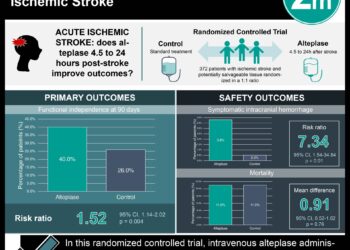
#VisualAbstract: Alteplase Improves Outcomes in Acute Ischemic Stroke
StudyGraphics

#VisualAbstract: Alteplase Improves Outcomes in Acute Ischemic Stroke

August 22, 2025
Next Post
#VisualAbstract: ChAdOx1 nCov-19 AstraZeneca COVID-19 vaccine not effective against B.1.351 variant

#VisualAbstract: Sacituzumab govitecan increased survival in metastatic triple-negative breast cancer

Being overweight and obese associated with increased incidence of chronic kidney disease

Prediction of individuals at high risk of chronic kidney disease during treatment with lithium for bipolar disorder

Novel coronavirus identified from patients with pneumonia in Wuhan, China

Convalescent plasma transfusion provides mortality benefit in early COVID-19 disease stage

2 Minute Medicine® is an award winning, physician-run, expert medical media company. Our content is curated, written and edited by practicing health professionals who have clinical and scientific expertise in their field of reporting. Our editorial management team is comprised of highly-trained MD physicians. Join numerous brands, companies, and hospitals who trust our licensed content.

Recent Reports

  • An electronic intervention may increase chances of benzodiazepine cessation
  • Fremanezumab reduces migraine frequency in children and adolescents with episodic migraine
  • Illumina’s billion cell atlas tries to solve artificial intelligence’s data bottleneck in biology
License Content
Terms of Use | Disclaimer
Cookie Policy
Privacy Statement (EU)
Disclaimer

© 2025 2 Minute Medicine, Inc. - Physician-written medical news.

  • Specialties
    • All Specialties, All Recent Reports
    • Cardiology
    • Chronic Disease
    • Dermatology
    • Emergency
    • Endocrinology
    • Gastroenterology
    • Imaging and Intervention
    • Infectious Disease
    • Nephrology
    • Neurology
    • Obstetrics
    • Oncology
    • Ophthalmology
    • Pediatrics
    • Pharma
    • Preclinical
    • Psychiatry
    • Public Health
    • Pulmonology
    • Rheumatology
    • Surgery
  • Tools
    • EvidencePulse™
    • RVU Search
    • NPI Registry Lookup
  • Pharma
  • AI News
  • The Scan
  • Classics™
    • 2MM+ Online Access
    • Paperback and Ebook
  • Rewinds
  • Partners
    • License Content
    • Submit Press Release
    • Advertise with Us
  • Account
    • Subscribe
    • Sign-in
    • My account
No Result
View All Result

© 2025 2 Minute Medicine, Inc. - Physician-written medical news.
