• About
  • Masthead
  • License Content
  • Advertise
  • Submit Press Release
  • RSS/Email List
  • 2MM Podcast
  • Write for us
  • Contact Us
2 Minute Medicine
No Result
View All Result

No products in the cart.

SUBSCRIBE
  • About
  • Specialties
    • All Specialties, All Recent Reports
    • Cardiology
    • Chronic Disease
    • Dermatology
    • Emergency
    • Endocrinology
    • Gastroenterology
    • Imaging and Intervention
    • Infectious Disease
    • Nephrology
    • Neurology
    • Obstetrics
    • Oncology
    • Ophthalmology
    • Pediatrics
    • Pharma
    • Preclinical
    • Psychiatry
    • Public Health
    • Pulmonology
    • Rheumatology
    • Surgery
  • Tools+
    • EvidencePulse™
    • HypeCheck™
    • NPI Registry Lookup
    • RVU Search
  • Pharma
  • AI Roundup
  • The Scan+
  • Classics™+
    • 2MM+ Online Access
    • Paperback and Ebook
  • Rewinds
  • Partners
    • License Content
    • Submit Press Release
    • Advertise with Us
  • Account
    • Subscribe
    • My account
    • Cart
    • Sign-in
2 Minute Medicine
  • About
  • Specialties
    • All Specialties, All Recent Reports
    • Cardiology
    • Chronic Disease
    • Dermatology
    • Emergency
    • Endocrinology
    • Gastroenterology
    • Imaging and Intervention
    • Infectious Disease
    • Nephrology
    • Neurology
    • Obstetrics
    • Oncology
    • Ophthalmology
    • Pediatrics
    • Pharma
    • Preclinical
    • Psychiatry
    • Public Health
    • Pulmonology
    • Rheumatology
    • Surgery
  • Tools+
    • EvidencePulse™
    • HypeCheck™
    • NPI Registry Lookup
    • RVU Search
  • Pharma
  • AI Roundup
  • The Scan+
  • Classics™+
    • 2MM+ Online Access
    • Paperback and Ebook
  • Rewinds
  • Partners
    • License Content
    • Submit Press Release
    • Advertise with Us
  • Account
    • Subscribe
    • My account
    • Cart
    • Sign-in
SUBSCRIBE
2 Minute Medicine
Subscribe
EvidencePulse™ by 2 Minute Medicine 2026 evidence scan 3 reports You asked top stroke trials 2026 Synthesizing medical evidence... Top 2026 stroke trial results: OCEANIC — ischemic stroke: 6.2% vs 8.4% OPTION* — mRS 0–1: 43.6% vs 34.2% ORIENTAL* — mRS 0–2: 58.6% vs 46.6% *Higher sICH in intervention arms Participants randomizedN OCEANIC 12,327 OPTION 570 ORIENTAL 564 Ask about guidelines or landmark trials... ↑ Try EvidencePulse™ Ask the evidence.
Get the signal.
Try it now → Physician-trained medical AI by 2 Minute Medicine
Home StudyGraphics

#VisualAbstract: Functional testing nonsuperior to routine care for percutaneous coronary intervention patients
byMinjee Kim
September 14, 2022
in StudyGraphics
Reading Time: 3 mins read
#VisualAbstract: Functional testing nonsuperior to routine care for percutaneous coronary intervention patients
Share on FacebookShare on Twitter

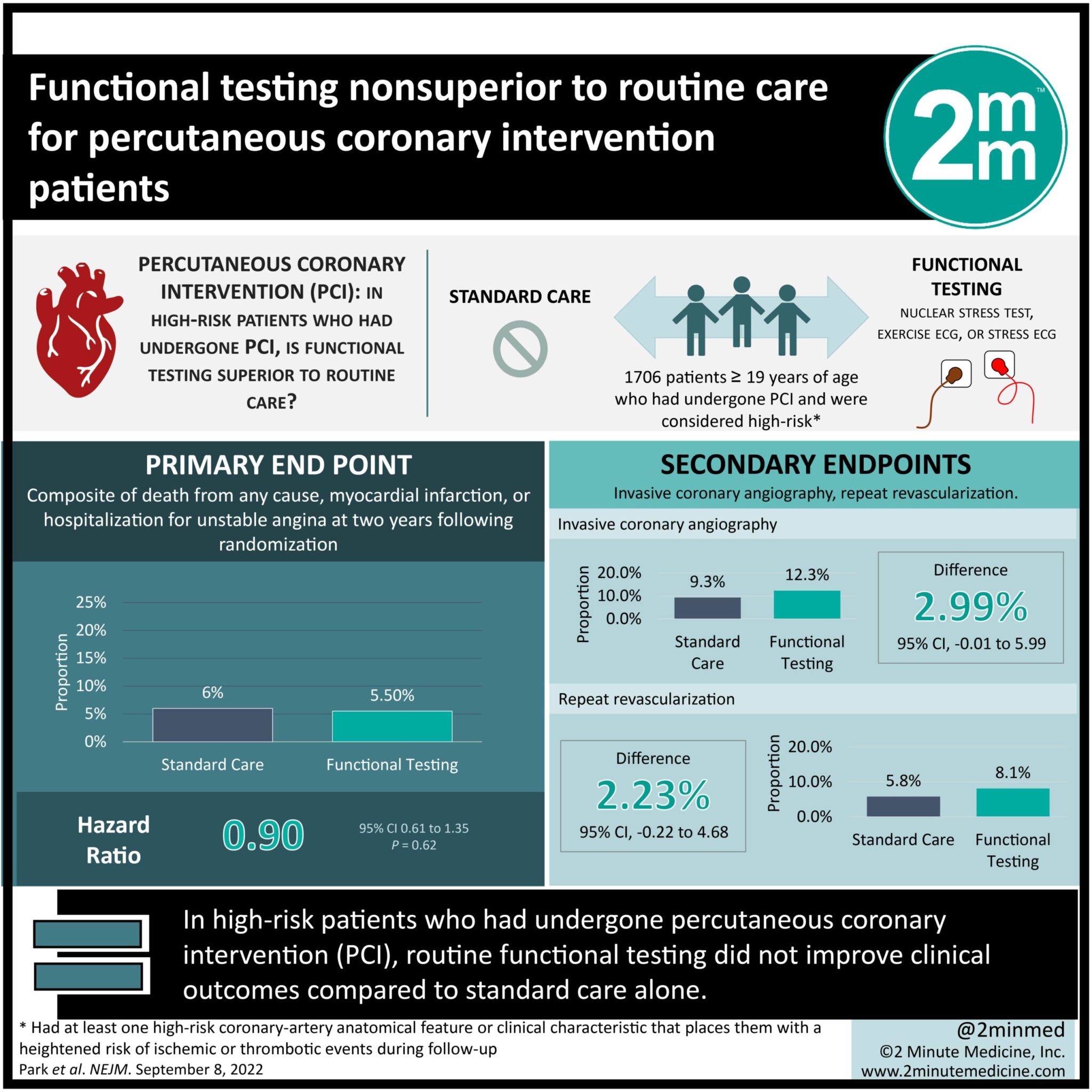
1. In high-risk patients who had undergone percutaneous coronary intervention (PCI), routine functional testing did not improve clinical outcomes compared to standard care alone. 

2. There was no difference in mortality between those undergoing routine functional testing versus standard care.

Evidence Rating Level: 1 (Excellent)

Study Rundown: Patients who undergo myocardial revascularization for coronary artery disease are at risk of recurrences of ischemia and should receive secondary prevention. Several strategies exist, but levels of post-PCI complications remain unacceptably high. While functional testing is part of the initial diagnostics for coronary disease, it has also been used in practice following revascularization procedures. It may therefore work as a secondary prevention strategy. Nevertheless, it is unclear if routine functional testing in high-risk patients after revascularization leads to meaningful changes in prevention and management approaches. The current study was a pragmatic randomized superiority trial comparing routine functional testing with standard care following PCI in high-risk patients. At two-year follow-up, patients in both groups exhibited similar mortality and the need for invasive coronary angiography and repeat revascularization. Overall, routine functional testing as a follow-up strategy did not show superiority when compared to standard care alone. Despite the inherently non-blinded study design and non-adherence owing to the pragmatic trial, the study demonstrated that routine functional testing was not superior to standard care at two years for high-risk patients who had undergone PCI.

Click here to read the study in NEJM

RELATED REPORTS

Invasive management for non-ST-segment elevation myocardial infarction in frail patients may not improve mortality

The preoperative combination of evolocumab and rosuvastatin may not reduce major adverse cardiovascular events

The efficacy 3 months of dual antiplatelet therapy is similar to 12 months in patients with acute coronary syndrome

In-Depth [randomized control trial]: This multicenter, pragmatic, randomized superiority trial compared routine functional testing against standard care as follow-up strategies in high-risk patients who had undergone PCI. Patients 19 years of age or older were included if they had undergone PCI and had at least one high-risk coronary-artery anatomical feature or clinical characteristic that places them with a heightened risk of ischemic or thrombotic events during follow-up. Exclusion criteria were minimal and included cardiogenic shock, pregnancy, and limited life expectancy. Overall, 1,706 patients were enrolled and randomized to a follow-up strategy of routine functional testing (nuclear stress test, exercise electrocardiography, or stress echocardiography) or standard care. The primary endpoint was a composite of death from any cause, myocardial infarction, or hospitalization for unstable angina at two years following randomization. The mean age of patients was 64.7 years. At two years, the primary endpoint had occurred in 5.5% of patients in the functional testing group and 6.0% in the standard care group (Hazard Ratio, 0.90; 95% Confidence Interval [CI], 0.61 to 1.35; p=0.62). A total of 12.3% of patients undergoing functional testing and 9.3% of patients receiving standard care had undergone further invasive coronary angiography, resulting in a difference of 2.99 percentage points (95% CI, -0.01 to 5.99). Further, 8.1% of patients undergoing functional testing and 5.8% of patients receiving standard care needed repeat revascularization, resulting in a difference of 2.23 percentage points (95% CI, -0.22 to 4.68). In summary, the results showed that routine functional testing was not superior to standard care in lowering mortality rates and further intervention needs among high-risk patients at two years post-PCI.

©2022 2 Minute Medicine, Inc. All rights reserved. No works may be reproduced without expressed written consent from 2 Minute Medicine, Inc. Inquire about licensing here. No article should be construed as medical advice and is not intended as such by the authors or by 2 Minute Medicine, Inc.
Tags: CADcardiac stress testingcoronary angiographyCoronary artery diseaseheartmyocardial revascularizationnuclear stress testPCIpercutaneous coronary interventionrevascularizationroutine functional testingstentstress echostress testing
Previous Post

SGLT-2 inhibitors provide morbidity and mortality benefits for patients with heart failure

Next Post

Children with inborn errors of metabolism have increased risk of long-term mortality

RelatedReports

PCI not superior to medical therapy alone in stable coronary disease: The COURAGE study
Cardiology

Invasive management for non-ST-segment elevation myocardial infarction in frail patients may not improve mortality

April 30, 2026
Using HEART score to risk stratify patients with chest pain is safe but underutilized in the ED
Cardiology

The preoperative combination of evolocumab and rosuvastatin may not reduce major adverse cardiovascular events

January 12, 2026
Using HEART score to risk stratify patients with chest pain is safe but underutilized in the ED
Cardiology

The efficacy 3 months of dual antiplatelet therapy is similar to 12 months in patients with acute coronary syndrome

January 12, 2026
Admission may not be needed following sleep apnea surgery
Weekly Rewinds

2 Minute Medicine Rewind December 29th, 2025

January 12, 2026
Next Post
Large proportion of late preterm infants and older admitted to the NICU

Children with inborn errors of metabolism have increased risk of long-term mortality

ABCD2 Score: Predicting Early Stroke Risk After Transient Ischemic Attack (TIA) [Classics Series]

POINT trial: Clopidogrel and Aspirin for Acute Ischemic Stroke [Classics Series]

Patient Basics: Lazy Eye (Amblyopia)

Race and insurance status may affect amblyopia treatment outcomes

EvidencePulse™ by 2 Minute Medicine 2026 evidence scan 3 reports You asked top stroke trials 2026 Synthesizing medical evidence... Top 2026 stroke trial results: OCEANIC — ischemic stroke: 6.2% vs 8.4% OPTION* — mRS 0–1: 43.6% vs 34.2% ORIENTAL* — mRS 0–2: 58.6% vs 46.6% *Higher sICH in intervention arms Participants randomizedN OCEANIC 12,327 OPTION 570 ORIENTAL 564 Ask about guidelines or landmark trials... ↑ Try EvidencePulse™ Get the signal. Try it now → Physician-trained medical AI by 2 Minute Medicine

2MM+ All Access

Full details →
$4.99 /month

3-day free trial · cancel anytime

  • ✓100+ physician-written reports
  • ✓EvidencePulse™ + HypeCheck™
  • ✓Ad-free reading + newsletters
Start 3-day free trial

Then $4.99/month. Manage renewal in your account.

2 Minute Medicine® is an award winning, physician-run, expert medical media company. Our content is curated, written and edited by practicing health professionals who have clinical and scientific expertise in their field of reporting. Our editorial management team is comprised of highly-trained MD physicians. Join numerous brands, companies, and hospitals who trust our licensed content.

Recent Reports

  • Nirsevimab (Beyfortus) may reduce severe respiratory syncytial virus infections among infants
  • An artificial intelligence (AI) tool achieved high diagnostic accuracy for the identification and prediction of sepsis
  • Use of long-acting broadly neutralizing antibodies may delay human immunodeficiency virus (HIV) rebound following discontinuation of antiretroviral therapy
License Content
Terms of Use | Disclaimer
Cookie Policy
Cleantalk Pixel
2MM+ All Access Full details →

The medical literature, distilled daily.

Monthly plan selected: $4.99 /month.

$4.99/month

3-day free trial · cancel anytime

Start 3-day free trial

Then $4.99/month. Manage renewal in your account.

Yearly plan selected: $49.90 /year.

$49.90/year

2 months free

Start 3-day free trial

Then $49.90/year.

Membership benefits

  • ✓100+ physician-written reports
  • ✓AI EvidencePulse™ + HypeCheck™
  • ✓Ad-free reading + newsletters

Already a member? Sign in

  • About
  • Specialties
    • All Specialties, All Recent Reports
    • Cardiology
    • Chronic Disease
    • Dermatology
    • Emergency
    • Endocrinology
    • Gastroenterology
    • Imaging and Intervention
    • Infectious Disease
    • Nephrology
    • Neurology
    • Obstetrics
    • Oncology
    • Ophthalmology
    • Pediatrics
    • Pharma
    • Preclinical
    • Psychiatry
    • Public Health
    • Pulmonology
    • Rheumatology
    • Surgery
  • Tools
    • EvidencePulse™
    • HypeCheck™
    • NPI Registry Lookup
    • RVU Search
  • Pharma
  • AI Roundup
  • The Scan
  • Classics™
    • 2MM+ Online Access
    • Paperback and Ebook
  • Rewinds
  • Partners
    • License Content
    • Submit Press Release
    • Advertise with Us
  • Account
    • Subscribe
    • My account
    • Cart
    • Sign-in
No Result
View All Result

© 2026 2 Minute Medicine, Inc. - Physician-written medical news.