• About
  • Masthead
  • License Content
  • Advertise
  • Submit Press Release
  • RSS/Email List
  • 2MM Podcast
  • Write for us
  • Contact Us
2 Minute Medicine
No Result
View All Result

No products in the cart.

SUBSCRIBE
  • Specialties
    • All Specialties, All Recent Reports
    • Cardiology
    • Chronic Disease
    • Dermatology
    • Emergency
    • Endocrinology
    • Gastroenterology
    • Imaging and Intervention
    • Infectious Disease
    • Nephrology
    • Neurology
    • Obstetrics
    • Oncology
    • Ophthalmology
    • Pediatrics
    • Pharma
    • Preclinical
    • Psychiatry
    • Public Health
    • Pulmonology
    • Rheumatology
    • Surgery
  • Tools
    • EvidencePulse™
    • RVU Search
    • NPI Registry Lookup
  • Pharma
  • AI News
  • The Scan+
  • Classics™+
    • 2MM+ Online Access
    • Paperback and Ebook
  • Rewinds
  • Partners
    • License Content
    • Submit Press Release
    • Advertise with Us
  • Account
    • Subscribe
    • Sign-in
    • My account
2 Minute Medicine
  • Specialties
    • All Specialties, All Recent Reports
    • Cardiology
    • Chronic Disease
    • Dermatology
    • Emergency
    • Endocrinology
    • Gastroenterology
    • Imaging and Intervention
    • Infectious Disease
    • Nephrology
    • Neurology
    • Obstetrics
    • Oncology
    • Ophthalmology
    • Pediatrics
    • Pharma
    • Preclinical
    • Psychiatry
    • Public Health
    • Pulmonology
    • Rheumatology
    • Surgery
  • Tools
    • EvidencePulse™
    • RVU Search
    • NPI Registry Lookup
  • Pharma
  • AI News
  • The Scan+
  • Classics™+
    • 2MM+ Online Access
    • Paperback and Ebook
  • Rewinds
  • Partners
    • License Content
    • Submit Press Release
    • Advertise with Us
  • Account
    • Subscribe
    • Sign-in
    • My account
SUBSCRIBE
2 Minute Medicine
Subscribe
Home StudyGraphics

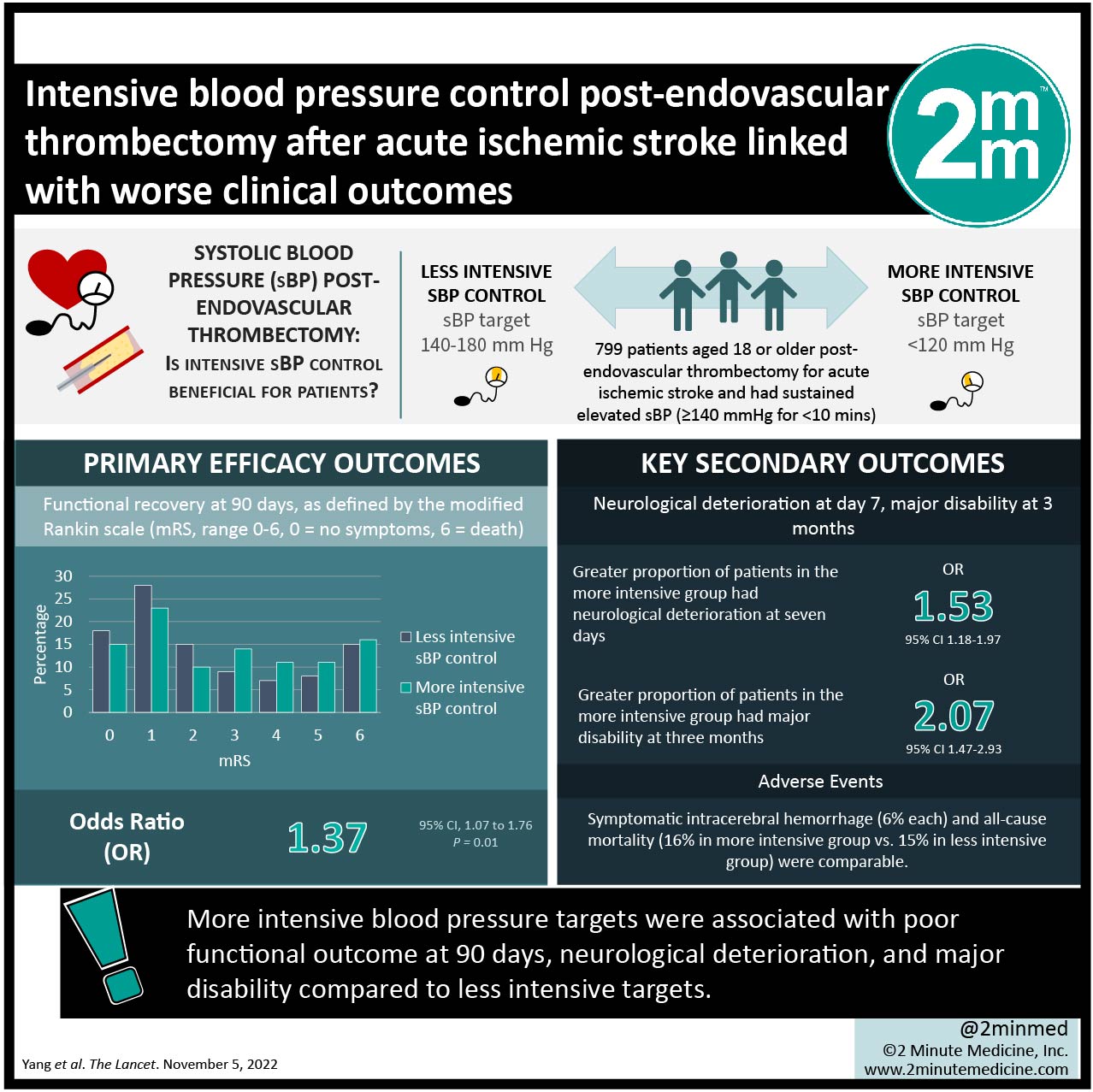
#VisualAbstract: Intensive blood pressure control post-endovascular thrombectomy after acute ischemic stroke linked with worse clinical outcomes
byMinjee Kim
November 24, 2022
in StudyGraphics
Reading Time: 2 mins read
0
Share on FacebookShare on Twitter

1. More intensive blood pressure targets were associated with poor functional outcome at 90 days, neurological deterioration, and major disability compared to less intensive targets.

2. Major intracerebral hemorrhage and all-cause mortality were comparable between groups.

Evidence Rating Level: 1 (Excellent)

Study Rundown: Management of systolic blood pressure (sBP) post-endovascular thrombectomy is critical for preventing complications following acute ischemic strokes. However, this must be done with caution as a significant drop in sBP may compromise tissue perfusion. The optimal sBP target in patients following endovascular thrombectomy remains unclear. This randomized trial aimed to compare the safety and efficacy of different blood pressure targets in patients with elevated systolic blood pressure post-endovascular thrombectomy. The primary outcome was functional recovery at 90 days, as defined by the modified Rankin scale (range 0-6, 0 = no symptoms, 6 = death) while key secondary outcomes included death or neurological deterioration at day 7. According to study results, more intensive BP management (sBP <120 mmHg) may compromise functional recovery and should be avoided in patients with recent endovascular thrombectomy. The more intensive BP target group was more likely to have neurologic deterioration and major disabilities compared to the less intensive group. However, major cerebral hemorrhage was comparable between study groups. This study was strengthened by a large sample size with patients from multiple hospitals in China, thus increasing its validity.

Click to read the study in The Lancet

RELATED REPORTS

A novel validated, imaging-based risk model may predict poststroke epilepsy more accurately than existing tools

2 Minute Medicine Rewind January 12th, 2026

The addition of interacting antiarrhythmics to direct oral anticoagulants in patients with non-valvular atrial fibrillation may not increase ischemic stroke risk compared to non-interacting antiarrhythmics

Relevant Reading: Trial of Intensive Blood-Pressure Control in Older Patients with Hypertension

In-depth [randomized-controlled trial]: Between July 20, 2020, and March 7, 2022, 1828 patients were screened for eligibility at 44 tertiary care centers in China. Included were ≥ 18 years old who had undergone endovascular thrombectomy for acute ischemic stroke and had a sustained elevated systolic blood pressure (≥140 mmHg for <10 mins). Altogether, 799 patients (398 to more intensive treatment group and 401 to less intensive treatment group) were included in the per-protocol analysis. The primary outcome of poor functional outcome at 90 days post-thrombectomy was greater in the more intensive group than in the less intensive blood pressure control group (odds ratio [OR] 1.37, 95% confidence interval [CI] 1.07-1.76). Similarly, a greater proportion of patients in the more intensive group had neurological deterioration at seven days (OR 1.53, 95% CI 1.18-1.97) and major disability at three months (OR 2.07, 95% CI 1.47-2.93). Symptomatic intracerebral hemorrhage (6% each) and all-cause mortality (16% in more intensive group vs. 15% in less intensive group) were comparable. Overall, findings from this study suggest that less intensive therapy (sBP <140-180 mmHg) is preferred in patients with elevated sBP post-endovascular thrombectomy.

©2022 2 Minute Medicine, Inc. All rights reserved. No works may be reproduced without expressed written consent from 2 Minute Medicine, Inc. Inquire about licensing here. No article should be construed as medical advice and is not intended as such by the authors or by 2 Minute Medicine, Inc.


Tags: acute ischemic strokeblood pressureblood pressure controlblood pressure targetischemic strokepost-strokereperfusionstroke
Previous Post

Opioid-reduced analgesia using esketamine for gynecological surgery associated with similar outcomes as opioid analgesia

Next Post

Various single and multistructure knee injuries increase the odds of knee osteoarthritis

RelatedReports

Non-alcoholic fatty liver disease and risk of incident acute myocardial infarction and stroke: findings from matched cohort study of 18 million European adults
Chronic Disease

A novel validated, imaging-based risk model may predict poststroke epilepsy more accurately than existing tools

January 12, 2026
Contrast-enhanced computed tomography associated with high sensitivity to renal stone detection
Weekly Rewinds

2 Minute Medicine Rewind January 12th, 2026

January 13, 2026
Rivaroxaban likely reduces risk of recurrent stroke in specific subgroup of patients with embolic stroke of undetermined source
Cardiology

The addition of interacting antiarrhythmics to direct oral anticoagulants in patients with non-valvular atrial fibrillation may not increase ischemic stroke risk compared to non-interacting antiarrhythmics

January 13, 2026
Rivaroxaban likely reduces risk of recurrent stroke in specific subgroup of patients with embolic stroke of undetermined source
Weekly Rewinds

2 Minute Medicine Rewind November 3rd, 2025

January 13, 2026
Next Post
Physical therapy reduces pain in adults with knee osteoarthritis

Various single and multistructure knee injuries increase the odds of knee osteoarthritis

Modified FOLFIRINOX results in longer disease-free survival in metastatic pancreatic cancer patients compared to gemcitabine

Preoperative biliary draining prior to pancreaticoduodenectomy not associated with increased complication risk

AAP recommends telemedicine to improve access to care

Virtual pediatric acute care visits within the medical home are safe and acceptable to parents

2 Minute Medicine® is an award winning, physician-run, expert medical media company. Our content is curated, written and edited by practicing health professionals who have clinical and scientific expertise in their field of reporting. Our editorial management team is comprised of highly-trained MD physicians. Join numerous brands, companies, and hospitals who trust our licensed content.

Recent Reports

  • One in three people with cystic fibrosis may experience nephrolithiasis during their life
  • Nuzolvence (Zoliflodacin) first oral Gonorrhea treatment shows non-inferior cure rates
  • Brain-penetrant enzyme replacement therapy improves biomarkers in mucopolysaccharidosis type II
License Content
Terms of Use | Disclaimer
Cookie Policy
Privacy Statement (EU)
Disclaimer

© 2025 2 Minute Medicine, Inc. - Physician-written medical news.

  • Specialties
    • All Specialties, All Recent Reports
    • Cardiology
    • Chronic Disease
    • Dermatology
    • Emergency
    • Endocrinology
    • Gastroenterology
    • Imaging and Intervention
    • Infectious Disease
    • Nephrology
    • Neurology
    • Obstetrics
    • Oncology
    • Ophthalmology
    • Pediatrics
    • Pharma
    • Preclinical
    • Psychiatry
    • Public Health
    • Pulmonology
    • Rheumatology
    • Surgery
  • Tools
    • EvidencePulse™
    • RVU Search
    • NPI Registry Lookup
  • Pharma
  • AI News
  • The Scan
  • Classics™
    • 2MM+ Online Access
    • Paperback and Ebook
  • Rewinds
  • Partners
    • License Content
    • Submit Press Release
    • Advertise with Us
  • Account
    • Subscribe
    • Sign-in
    • My account
No Result
View All Result

© 2025 2 Minute Medicine, Inc. - Physician-written medical news.