

• About
  • Masthead
  • License Content
  • Advertise
  • Submit Press Release
  • RSS/Email List
  • 2MM Podcast
  • Write for us
  • Contact Us
2 Minute Medicine
No Result
View All Result

No products in the cart.

SUBSCRIBE
  • About
  • Specialties
    • All Specialties, All Recent Reports
    • Cardiology
    • Chronic Disease
    • Dermatology
    • Emergency
    • Endocrinology
    • Gastroenterology
    • Imaging and Intervention
    • Infectious Disease
    • Nephrology
    • Neurology
    • Obstetrics
    • Oncology
    • Ophthalmology
    • Pediatrics
    • Pharma
    • Preclinical
    • Psychiatry
    • Public Health
    • Pulmonology
    • Rheumatology
    • Surgery
  • Tools+
    • EvidencePulse™
    • HypeCheck™
    • NPI Registry Lookup
    • RVU Search
  • Pharma
  • AI Roundup
  • The Scan+
  • Classics™+
    • 2MM+ Online Access
    • Paperback and Ebook
  • Rewinds
  • Partners
    • License Content
    • Submit Press Release
    • Advertise with Us
  • Account
    • Subscribe
    • My account
    • Cart
    • Sign-in
2 Minute Medicine
  • About
  • Specialties
    • All Specialties, All Recent Reports
    • Cardiology
    • Chronic Disease
    • Dermatology
    • Emergency
    • Endocrinology
    • Gastroenterology
    • Imaging and Intervention
    • Infectious Disease
    • Nephrology
    • Neurology
    • Obstetrics
    • Oncology
    • Ophthalmology
    • Pediatrics
    • Pharma
    • Preclinical
    • Psychiatry
    • Public Health
    • Pulmonology
    • Rheumatology
    • Surgery
  • Tools+
    • EvidencePulse™
    • HypeCheck™
    • NPI Registry Lookup
    • RVU Search
  • Pharma
  • AI Roundup
  • The Scan+
  • Classics™+
    • 2MM+ Online Access
    • Paperback and Ebook
  • Rewinds
  • Partners
    • License Content
    • Submit Press Release
    • Advertise with Us
  • Account
    • Subscribe
    • My account
    • Cart
    • Sign-in
SUBSCRIBE
2 Minute Medicine
Subscribe
EvidencePulse™ by 2 Minute Medicine 2026 evidence scan 3 reports You asked top stroke trials 2026 Synthesizing medical evidence... Top 2026 stroke trial results: OCEANIC — ischemic stroke: 6.2% vs 8.4% OPTION* — mRS 0–1: 43.6% vs 34.2% ORIENTAL* — mRS 0–2: 58.6% vs 46.6% *Higher sICH in intervention arms Participants randomizedN OCEANIC 12,327 OPTION 570 ORIENTAL 564 Ask about guidelines or landmark trials... ↑ Try EvidencePulse™ Ask the evidence.
Get the signal.
Try it now → Physician-trained medical AI by 2 Minute Medicine
Home StudyGraphics

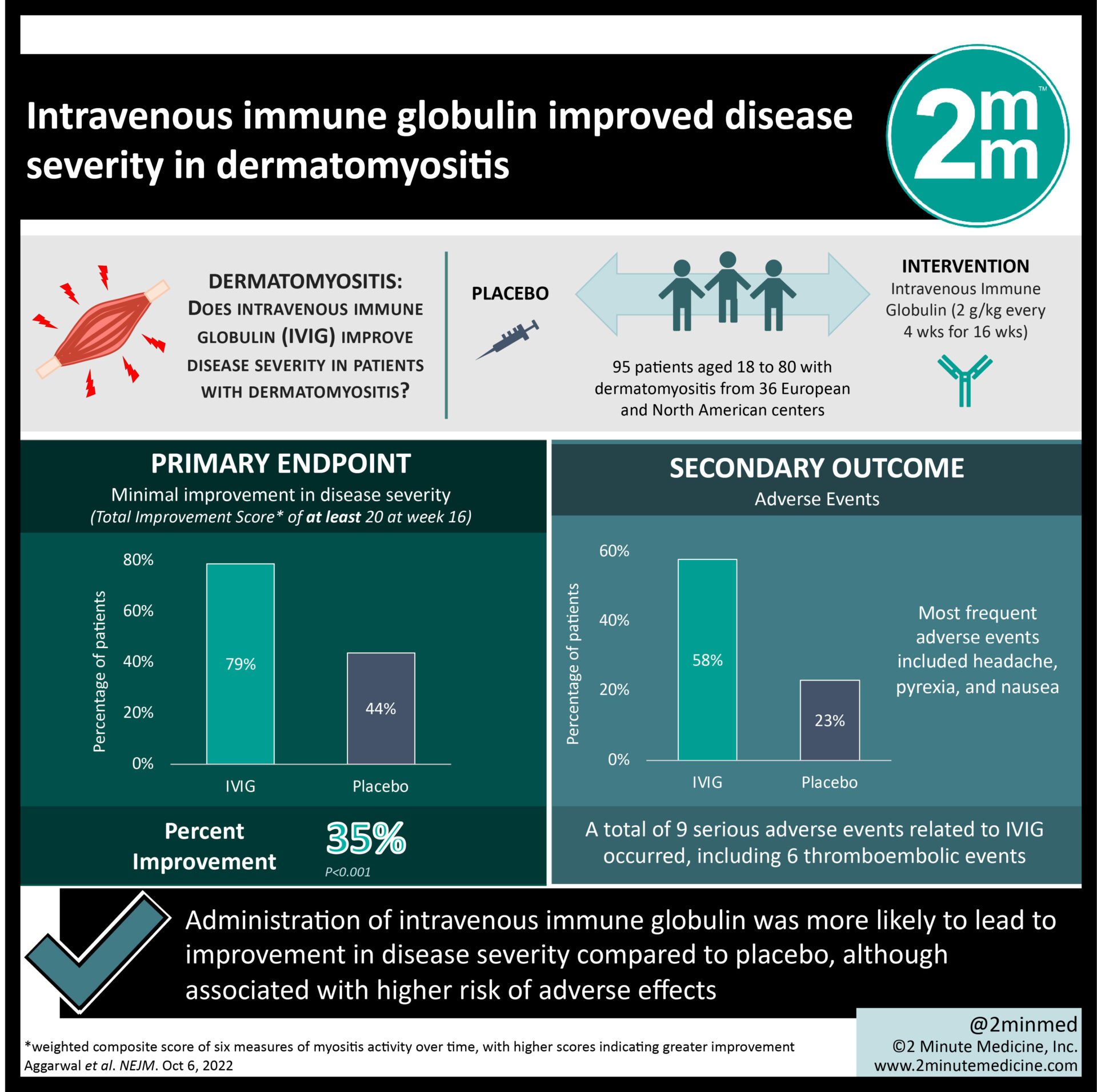
#VisualAbstract: Intravenous immune globulin improved disease severity in dermatomyositis
byZain Cheema
May 2, 2023
in StudyGraphics
Reading Time: 3 mins read
#VisualAbstract: Intravenous immune globulin improved disease severity in dermatomyositis
Share on FacebookShare on Twitter

1. Patients with dermatomyositis treated with intravenous immune globulin (IVIG) were more likely to see improvement in their disease severity compared to placebo at 16 weeks of follow-up. 

2. Treatment with IVIG reduced the need for concomitant treatments such as glucocorticoids in patients with dermatomyositis.

Evidence Rating Level: 1 (Excellent)

Study Rundown: Dermatomyositis is characterized by chronic inflammation affecting the skin and muscles, which leads to rashes and progressive muscle weakness. IVIG is currently approved by various regulatory agencies around the world as a second-line treatment for dermatomyositis. A response of minimal improvement was significantly higher in the IVIG group compared to a placebo at 16 weeks. In subgroup analyses, the IVIG group had more improvements with more severe disease. However, these analyses were underpowered. A response of moderate and major improvement was higher in the IVIG group compared to the placebo at 16 weeks. After the open-label extension phase, the percentage of patients with minimal improvement was similar between both groups. The total improvement score (TIS) was similar between both groups after the placebo group was given IVIG by week 40. Patients receiving concomitant glucocorticoid treatment were able to decrease or discontinue the treatment after receiving IVIG. During the placebo-controlled phase, three patients in the placebo group and no patients in the IVIG had clinical deterioration. Adverse events occurred at a higher rate in the IVIG group, most commonly headache, pyrexia, and nausea. Due to the low threshold for minimal improvement, the high rate of response in the placebo group could describe a natural timeline of dermatomyositis that was also seen in the IVIG group.

Click to read the study in NEJM

Relevant Reading: A controlled trial of high-dose intravenous immune globulin infusions as treatment for dermatomyositis

RELATED REPORTS

Brepocitinib becomes first oral therapy approved for adult dermatomyositis

2MM: Pharma Roundup – mRNA flu vaccine debuts, RAS inhibition extends pancreatic cancer survival, and new therapies advance for dermatomyositis and Tourette syndrome

Illumina’s billion cell atlas tries to solve artificial intelligence’s data bottleneck in biology

In-Depth [randomized controlled trial]: The ProDERM trial was a double-blind, parallel-group, randomized, placebo-controlled trial that examined the effectiveness of IVIG for patients with dermatomyositis. Patients between the ages of 18 to 80 years with definite or probably active dermatomyositis were eligible for this study. Concomitant treatment with glucocorticoids and a maximum of two immunosuppressive drugs were allowed if the treatment was initiated at least three months prior, at a stable dose, and not exceeding the maximum allowable dose. Patients received either IVIG at a dose of 2.0 grams per kilogram of body weight or a placebo (0.9% sodium chloride) every 4 weeks. TIS was the primary endpoint for a response, which is a weighted composite score reflecting changes in six measures of myositis activity over time. A total of 79% of patients in the IVIG group and 44% in the placebo group had at least minimal improvement defined as TIS>=20 at 16 weeks (95% confidence interval [CI], 16.7 to 53.2; p<0.001). In subgroup analyses, the percentage of patients who had a response in the IVIG group compared to placebo were the following: mild disease (73% vs. 27%), moderate disease (79% vs. 52%), and severe disease (86% vs. 50%). However, these analyses were underpowered to determine a difference in outcomes. A moderate response (TIS>=40) was observed in 68% of patients in the IVIG group and 23% in the placebo group. Additionally, a major improvement of TIS>=60 was seen in 32% and 8% respectively. At the end of the open-label extension phase, both the IVIG and placebo groups saw similar rates of minimum improvement (71% vs. 70%). A total of 113 IVIG-related adverse events were recorded, and five serious adverse events occurred after an IVIG infusion. No deaths and no hemolytic transfusion reactions were reported during the trial. In summary, IVIG shows promise as a therapeutic for dermatomyositis.

©2022 2 Minute Medicine, Inc. All rights reserved. No works may be reproduced without expressed written consent from 2 Minute Medicine, Inc. Inquire about licensing here. No article should be construed as medical advice and is not intended as such by the authors or by 2 Minute Medicine, Inc.


Tags: dermatomyositisdiseaseIVIgmyopathynejmrctthromboembolic risk
Previous Post

Changes in technique, footwear and intervention prevent running-related knee injuries

Next Post

Artificial intelligence-aided analysis of retinal imaging may predict cardiovascular mortality

RelatedReports

Chronic Disease

Brepocitinib becomes first oral therapy approved for adult dermatomyositis

September 18, 2026
Pharma Roundup

2MM: Pharma Roundup – mRNA flu vaccine debuts, RAS inhibition extends pancreatic cancer survival, and new therapies advance for dermatomyositis and Tourette syndrome

September 15, 2026
CRISPR-mediated gene activation rescues obesity caused by haploinsufficiency [PreClinical]
Pharma

Illumina’s billion cell atlas tries to solve artificial intelligence’s data bottleneck in biology

September 4, 2026
#VisualAbstract: Vepdegestrant Increased Progres-sion-Free Survival in Advaced Breast 2m TM Cancer with ESR1 Mutations
StudyGraphics

#VisualAbstract: Vepdegestrant Increased Progres-sion-Free Survival in Advaced Breast 2m TM Cancer with ESR1 Mutations

August 22, 2025
Next Post
Patient Basics: Retinopathy

Artificial intelligence-aided analysis of retinal imaging may predict cardiovascular mortality

Using HEART score to risk stratify patients with chest pain is safe but underutilized in the ED

2 Minute Medicine Rewind October 17, 2022

Few older adolescents meet recommended levels of physical activity

Exercise is an effective alternative in the management of non-severe depression

EvidencePulse™ by 2 Minute Medicine 2026 evidence scan 3 reports You asked top stroke trials 2026 Synthesizing medical evidence... Top 2026 stroke trial results: OCEANIC — ischemic stroke: 6.2% vs 8.4% OPTION* — mRS 0–1: 43.6% vs 34.2% ORIENTAL* — mRS 0–2: 58.6% vs 46.6% *Higher sICH in intervention arms Participants randomizedN OCEANIC 12,327 OPTION 570 ORIENTAL 564 Ask about guidelines or landmark trials... ↑ Try EvidencePulse™ Ask the evidence.
Get the signal.
Try it now → Physician-trained medical AI by 2 Minute Medicine

2MM+ All Access

Full details →
$4.99 /month

5-day free trial · cancel anytime

  • ✓100+ physician-written reports
  • ✓EvidencePulse™ + HypeCheck™
  • ✓Ad-free reading + newsletters
Start 5-day free trial

Then $4.99/month. Manage renewal in your account.

2 Minute Medicine® is an award winning, physician-run, expert medical media company. Our content is curated, written and edited by practicing health professionals who have clinical and scientific expertise in their field of reporting. Our editorial management team is comprised of highly-trained MD physicians. Join numerous brands, companies, and hospitals who trust our licensed content.

Recent Reports

  • The rate of urethrocutaneous fistula following caudal and penile blocks for hypospadias repair may be similar
  • Adjuvant chemotherapy not linked to improved outcomes in localized appendiceal adenocarcinoma
  • Deep learning model improved cancer recurrence prediction for pediatric glioma using serial imaging
License Content
Terms of Use | Disclaimer
Cookie Policy
Cleantalk Pixel
2MM+ All Access Full details →

The medical literature, distilled daily.

Monthly plan selected: $4.99 /month.

$4.99/month

5-day free trial · cancel anytime

Start 5-day free trial

Then $4.99/month. Manage renewal in your account.

Yearly plan selected: $49.90 /year.

$49.90/year

2 months free · only $4.16/month

Start 5-day free trial

Then $49.90/year. Manage renewal in your account.

Membership benefits

  • ✓100+ physician-written reports
  • ✓AI EvidencePulse™ + HypeCheck™
  • ✓Ad-free reading + newsletters

Already a member? Sign in

  • About
  • Specialties
    • All Specialties, All Recent Reports
    • Cardiology
    • Chronic Disease
    • Dermatology
    • Emergency
    • Endocrinology
    • Gastroenterology
    • Imaging and Intervention
    • Infectious Disease
    • Nephrology
    • Neurology
    • Obstetrics
    • Oncology
    • Ophthalmology
    • Pediatrics
    • Pharma
    • Preclinical
    • Psychiatry
    • Public Health
    • Pulmonology
    • Rheumatology
    • Surgery
  • Tools
    • EvidencePulse™
    • HypeCheck™
    • NPI Registry Lookup
    • RVU Search
  • Pharma
  • AI Roundup
  • The Scan
  • Classics™
    • 2MM+ Online Access
    • Paperback and Ebook
  • Rewinds
  • Partners
    • License Content
    • Submit Press Release
    • Advertise with Us
  • Account
    • Subscribe
    • My account
    • Cart
    • Sign-in
No Result
View All Result

© 2026 2 Minute Medicine, Inc. - Physician-written medical news.