• About
  • Masthead
  • License Content
  • Advertise
  • Press Releases
  • Newsroom
  • RSS/Email List
  • 2MM Podcast
  • Write for us
  • Contact Us
2 Minute Medicine
No Result
View All Result

No products in the cart.

Sign in
SUBSCRIBE
  • About
  • Specialties
    • All Specialties, All Recent Reports
    • Cardiology
    • Chronic Disease
    • Dermatology
    • Emergency
    • Endocrinology
    • Gastroenterology
    • Imaging and Intervention
    • Infectious Disease
    • Nephrology
    • Neurology
    • Obstetrics
    • Oncology
    • Ophthalmology
    • Pediatrics
    • Pharma
    • Preclinical
    • Psychiatry
    • Public Health
    • Pulmonology
    • Rheumatology
    • Surgery
    • Rewinds
    • The Scan
  • EvidencePulse™
  • HypeCheck™
  • AI News
  • Classics™
    • 2MM+ Online Access
    • Paperback and Ebook
  • Tools
    • NPI Registry Lookup
    • RVU Search
    • ICD-10 Code Lookup
    • Medical School Rankings
    • FDA Drug Approvals
    • Drug Safety for Breastfeeding/Pregnancy
    • Clinical Guidelines
    • Medical Calculators
    • ECG Reference
      • QTc Calculator
      • Sgarbossa Criteria
      • ECG Axis Calculator
      • AV Block Helper
  • Partners
    • License Content
    • Advertise with Us
2 Minute Medicine
  • About
  • Specialties
    • All Specialties, All Recent Reports
    • Cardiology
    • Chronic Disease
    • Dermatology
    • Emergency
    • Endocrinology
    • Gastroenterology
    • Imaging and Intervention
    • Infectious Disease
    • Nephrology
    • Neurology
    • Obstetrics
    • Oncology
    • Ophthalmology
    • Pediatrics
    • Pharma
    • Preclinical
    • Psychiatry
    • Public Health
    • Pulmonology
    • Rheumatology
    • Surgery
    • Rewinds
    • The Scan
  • EvidencePulse™
  • HypeCheck™
  • AI News
  • Classics™
    • 2MM+ Online Access
    • Paperback and Ebook
  • Tools
    • NPI Registry Lookup
    • RVU Search
    • ICD-10 Code Lookup
    • Medical School Rankings
    • FDA Drug Approvals
    • Drug Safety for Breastfeeding/Pregnancy
    • Clinical Guidelines
    • Medical Calculators
    • ECG Reference
      • QTc Calculator
      • Sgarbossa Criteria
      • ECG Axis Calculator
      • AV Block Helper
  • Partners
    • License Content
    • Advertise with Us
Sign in
SUBSCRIBE
2 Minute Medicine
Sign in
Subscribe
2 Minute MedicineFree on Google PlayGet
✦EvidencePulse™by 2 Minute Medicine3 reportsYou askedtop stroke trials 2026Synthesizing medical evidence...Top 2026 stroke trial results:OCEANIC — ischemic stroke: 6.2% vs 8.4%OPTION* — mRS 0–1: 43.6% vs 34.2%ORIENTAL* — mRS 0–2: 58.6% vs 46.6%*Higher sICH in intervention armsParticipants randomizedNOCEANIC12,327OPTION570ORIENTAL564Ask about guidelines or landmark trials...↑Try EvidencePulse™Ask the evidence. Get the signal.Try it now →
Home StudyGraphics

#VisualAbstract: Whole-genome sequencing changes clinical management in significant number of critically ill infants
byMinjee Kim
June 10, 2022
in StudyGraphics
Reading Time: 3 mins read
#VisualAbstract: Only one quarter of benzodiazepine prescriptions in youth are for approved indication
Share on FacebookShare on TwitterShare on LinkedIn

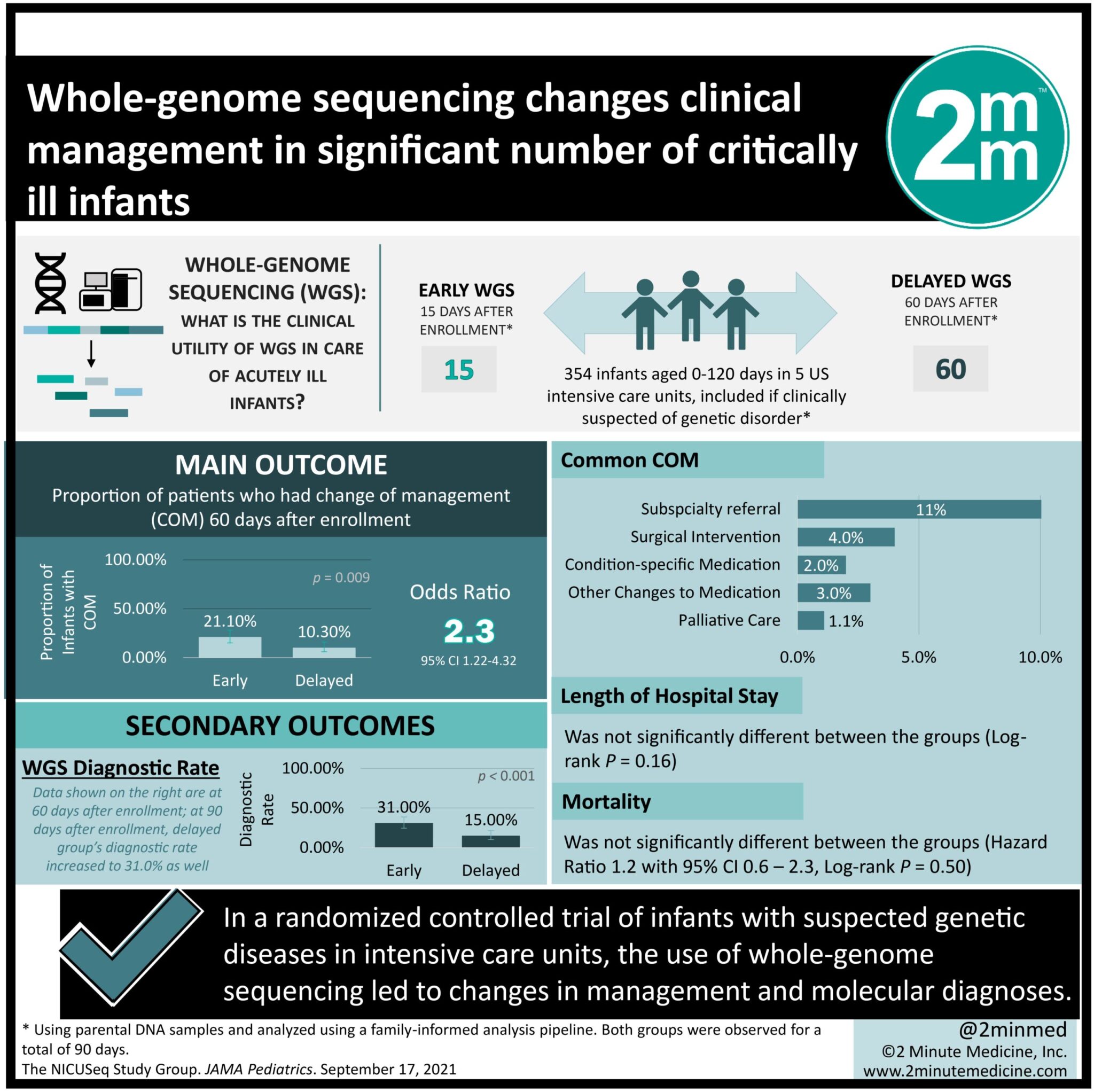
1. In a randomized controlled trial of about 350 infants with suspected genetic diseases in intensive care units, the use of whole-genome sequencing (WGS) lead to changes in management and molecular diagnoses.

2. WGS did not significantly affect survival or length of hospital stay.

Evidence Rating Level: 1 (Excellent)

Study Rundown: Whole-genome sequencing (WGS) continues to become rapidly cheaper and more accessible. However, the clinical utility of WGS remains incompletely understood. This study aimed to examine the effects of WGS on care for acutely ill infants with suspected genetic disease. 354 infants aged 0-120 days in 5 US intensive care units (ICUs) were randomized to receive WGS either 15 or 60 days after study enrollment. At 60 days, a change had been made in addition to standard supportive care in 21% of patients receiving early WGS, compared to 10% for those in the late group. Among the changes in management, subspecialty referrals and medication changes were more common than disease-specific therapeutics and surgical interventions in both groups. 31% of infants in the early WGS group had received a diagnosis compared to 15% in the late group at 60 days. At 90 days, these roughly 2-fold increases in rates of management changes and diagnosis were replicated in the late WGS group. WGS had no significant effect on total length of stay or patient survival. This study provides high-quality evidence for the clinical benefit of WGS as compared to usual diagnostic testing. The effect on clinical management here was incremental, with many patients receiving nondiagnostic results and relatively few diagnosed patients receiving targeted therapies. However, in the context of neonatal critical illness, these findings are encouraging and provide a strong case for use of WGS. 35% of families approached for this study declined, which indicates a known but significant challenge to widespread use of this technology.

Click to read the study in JAMA Pediatrics

RELATED REPORTS

Use of selective serotonin reuptake inhibitors guided by pharmacogenetic testing may improve treatment response in depression

One in three people with cystic fibrosis may experience nephrolithiasis during their life

Relevant Reading: Long-read human genome sequencing and its applications

In-Depth [randomized controlled trial]: Infants were included based on clinical suspicion of genetic disease and excluded if a genetic diagnosis had already been made. For 57% of the cohort, the indication for testing was multiple congenital anomalies; other indications included neurologic disorders and single major features. WGS was performed using parental DNA samples as available, then analyzed using a family-informed analysis pipeline. Infants in both the early and delayed WGS groups were observed for a total of 90 days. Changes of management were assessed using a standardized rubric and included changes after initial ICU discharge. Study site was controlled for in assessing the effect of WGS on changes in management. Among all patients, 7 (2%) received therapy specific to genetic etiology. A proportional hazard model was used to assess time to diagnosis, which was found to be significantly associated with time to return of WGS results.

©2021 2 Minute Medicine, Inc. All rights reserved. No works may be reproduced without expressed written consent from 2 Minute Medicine, Inc. Inquire about licensing here. No article should be construed as medical advice and is not intended as such by the authors or by 2 Minute Medicine, Inc.

Tags: DNAgenetic disordersgenetic testinggeneticspediatric ICUPICUsequencingwhole genome sequencing (WGS)
Previous Post

The DAPA-HF trial: Dapagliflozin in patients with heart failure [Classics Series]

Next Post

#VisualAbstract: Only one quarter of benzodiazepine prescriptions in youth are for approved indication

RelatedReports

Depression treatment collage: a barometer dial with its needle turning from cloud to sun, a paper kite and a daisy in a vase
Chronic Disease

Use of selective serotonin reuptake inhibitors guided by pharmacogenetic testing may improve treatment response in depression

May 13, 2026
Kidney stones collage: a halved kidney holding three small stones, a halved lemon, a teal water drop and smooth pebbles
Chronic Disease

One in three people with cystic fibrosis may experience nephrolithiasis during their life

January 15, 2026
Genetic carrier screening collage: two plain silver rings on a blue paper DNA double helix beside a sprig of baby's breath
Public Health

Australian couple-based genetic screening program feasible and accepted

August 27, 2025
Pain in critically ill children collage: a smiling girl with braids in star-print pajamas under three paper cranes
Emergency

Critical-care pain observation tool demonstrates reliability for critically ill pediatric patients

April 26, 2025
Next Post
#VisualAbstract: Only one quarter of benzodiazepine prescriptions in youth are for approved indication

#VisualAbstract: Only one quarter of benzodiazepine prescriptions in youth are for approved indication

#VisualAbstract Ponatinib with FLAG-IDA is a feasible and active treatment strategy in patients with blast-phase chronic myeloid leukaemia

#VisualAbstract Ponatinib with FLAG-IDA is a feasible and active treatment strategy in patients with blast-phase chronic myeloid leukaemia

2 Minute Medicine Rewind June 13, 2022 

✦ EvidencePulse™ by 2 Minute Medicine 3 reports You asked top stroke trials 2026 Synthesizing medical evidence... Top 2026 stroke trial results: OCEANIC — ischemic stroke: 6.2% vs 8.4% OPTION* — mRS 0–1: 43.6% vs 34.2% ORIENTAL* — mRS 0–2: 58.6% vs 46.6% *Higher sICH in intervention arms Participants randomizedN OCEANIC 12,327 OPTION 570 ORIENTAL 564 Ask about guidelines or landmark trials... Try EvidencePulse™ Get the signal. Try it now → Physician-trained medical AI by 2 Minute Medicine

2MM+ All Access

Full details →
$4.99 /month

3-day free trial · cancel anytime

  • ✓100+ physician-written reports
  • ✓EvidencePulse™ + HypeCheck™
  • ✓Ad-free reading + newsletters
Start 3-day free trial

Then $4.99/month. Manage renewal in your account.

NPI Lookup · Free

Look up any US clinician

Search by name or NPI number, live from the CMS NPI Registry.

  • OIG exclusion check
  • Licenses and specialties
  • No account needed
Open NPI Lookup →

2 Minute Medicine® is an award winning, physician-run, expert medical media company. Our content is curated, written and edited by practicing health professionals who have clinical and scientific expertise in their field of reporting. Our editorial management team is comprised of highly-trained MD physicians. Join numerous brands, companies, and hospitals who trust our licensed content.

Recent Reports

  • Intraosseous cefuroxime (Ceftin) may improve tissue delivery compared to intravenous administration during total knee arthroplasty
  • 2 Minute Medicine Rewind November 2, 2026
  • Early mitral valve surgery may improve long-term survival in asymptomatic severe mitral regurgitation
License Content
Terms of Use | Disclaimer
Cookie Policy

Get the app

Read 2 Minute Medicine on iPhone, iPad and Android.

Download on the App StoreGet it on Google Play
QR code for www.2minutemedicine.com/app
On a computer? Scan this with your phone’s camera.
2MM+ All Access Full details →

The medical literature, distilled daily.

Monthly plan selected: $4.99 /month.

$4.99/month

3-day free trial · cancel anytime

Start 3-day free trial

Then $4.99/month. Manage renewal in your account.

Yearly plan selected: $49.90 /year.

$49.90/year

2 months free

Start 3-day free trial

Then $49.90/year.

Membership benefits

  • ✓100+ physician-written reports
  • ✓AI EvidencePulse™ + HypeCheck™
  • ✓Ad-free reading + newsletters
  • ✓NPI watchlist + bulk NPI verification

Already a member? Sign in

  • Get the app
  • About
  • Specialties
    • All Specialties, All Recent Reports
    • Cardiology
    • Chronic Disease
    • Dermatology
    • Emergency
    • Endocrinology
    • Gastroenterology
    • Imaging and Intervention
    • Infectious Disease
    • Nephrology
    • Neurology
    • Obstetrics
    • Oncology
    • Ophthalmology
    • Pediatrics
    • Pharma
    • Preclinical
    • Psychiatry
    • Public Health
    • Pulmonology
    • Rheumatology
    • Surgery
    • Rewinds
    • The Scan
  • EvidencePulse™
  • HypeCheck™
  • AI News
  • Classics™
    • 2MM+ Online Access
    • Paperback and Ebook
  • Tools
    • NPI Registry Lookup
    • RVU Search
    • ICD-10 Code Lookup
    • Medical School Rankings
    • FDA Drug Approvals
    • Drug Safety for Breastfeeding/Pregnancy
    • Clinical Guidelines
    • Medical Calculators
    • ECG Reference
      • QTc Calculator
      • Sgarbossa Criteria
      • ECG Axis Calculator
      • AV Block Helper
  • Partners
    • License Content
    • Advertise with Us
No Result
View All Result

© 2026 2 Minute Medicine, Inc. - Physician-written medical news.