• About
  • Masthead
  • License Content
  • Advertise
  • Submit Press Release
  • RSS/Email List
  • 2MM Podcast
  • Write for us
  • Contact Us
2 Minute Medicine
No Result
View All Result

No products in the cart.

SUBSCRIBE
  • About
  • Specialties
    • All Specialties, All Recent Reports
    • Cardiology
    • Chronic Disease
    • Dermatology
    • Emergency
    • Endocrinology
    • Gastroenterology
    • Imaging and Intervention
    • Infectious Disease
    • Nephrology
    • Neurology
    • Obstetrics
    • Oncology
    • Ophthalmology
    • Pediatrics
    • Pharma
    • Preclinical
    • Psychiatry
    • Public Health
    • Pulmonology
    • Rheumatology
    • Surgery
  • Tools+
    • EvidencePulse™
    • HypeCheck™
    • NPI Registry Lookup
    • RVU Search
  • Pharma
  • AI Roundup
  • The Scan+
  • Classics™+
    • 2MM+ Online Access
    • Paperback and Ebook
  • Rewinds
  • Partners
    • License Content
    • Submit Press Release
    • Advertise with Us
  • Account
    • Subscribe
    • My account
    • Cart
    • Sign-in
2 Minute Medicine
  • About
  • Specialties
    • All Specialties, All Recent Reports
    • Cardiology
    • Chronic Disease
    • Dermatology
    • Emergency
    • Endocrinology
    • Gastroenterology
    • Imaging and Intervention
    • Infectious Disease
    • Nephrology
    • Neurology
    • Obstetrics
    • Oncology
    • Ophthalmology
    • Pediatrics
    • Pharma
    • Preclinical
    • Psychiatry
    • Public Health
    • Pulmonology
    • Rheumatology
    • Surgery
  • Tools+
    • EvidencePulse™
    • HypeCheck™
    • NPI Registry Lookup
    • RVU Search
  • Pharma
  • AI Roundup
  • The Scan+
  • Classics™+
    • 2MM+ Online Access
    • Paperback and Ebook
  • Rewinds
  • Partners
    • License Content
    • Submit Press Release
    • Advertise with Us
  • Account
    • Subscribe
    • My account
    • Cart
    • Sign-in
SUBSCRIBE
2 Minute Medicine
Subscribe
EvidencePulse™ by 2 Minute Medicine 2026 evidence scan 3 reports You asked top stroke trials 2026 Synthesizing medical evidence... Top 2026 stroke trial results: OCEANIC — ischemic stroke: 6.2% vs 8.4% OPTION* — mRS 0–1: 43.6% vs 34.2% ORIENTAL* — mRS 0–2: 58.6% vs 46.6% *Higher sICH in intervention arms Participants randomizedN OCEANIC 12,327 OPTION 570 ORIENTAL 564 Ask about guidelines or landmark trials... ↑ Try EvidencePulse™ Ask the evidence.
Get the signal.
Try it now → Physician-trained medical AI by 2 Minute Medicine
Home StudyGraphics

#VisualAbstract: Sarcopenia associated with reduced muscle mass and strength following liver resection for malignant neoplasms
byConstance Wu
October 8, 2020
in StudyGraphics
Reading Time: 2 mins read
#VisualAbstract: Sarcopenia associated with reduced muscle mass and strength following liver resection for malignant neoplasms
Share on FacebookShare on Twitter

1. Sarcopenia was an independent risk factor for reduced muscle mass and strength following liver resection for malignant neoplasms.

Evidence Rating Level: 2 (Good)

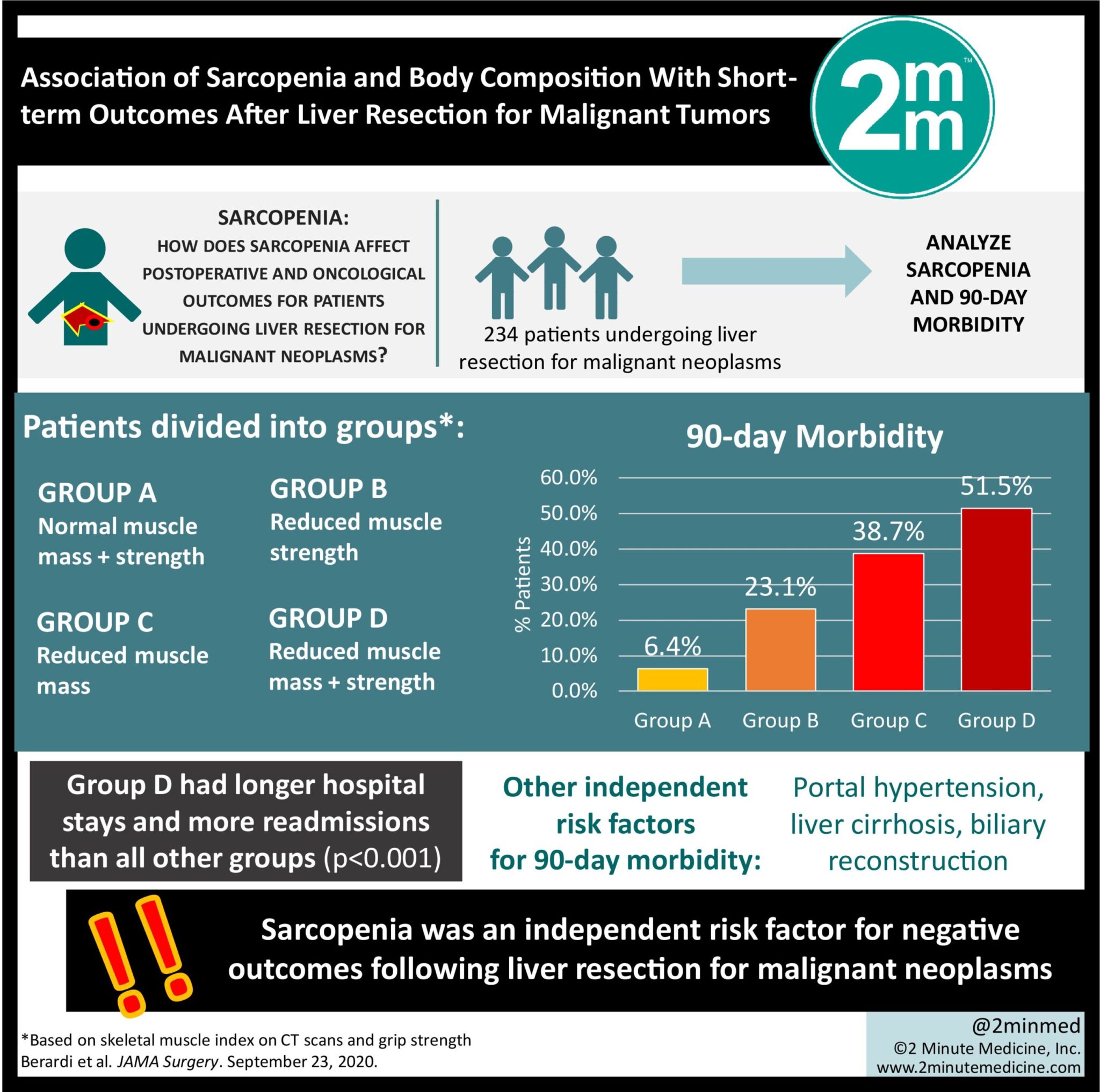
Sarcopenia is an involuntary, age-related loss of skeletal muscle mass and strength. This condition is known to drastically impact postoperative and oncological outcomes following liver resection for malignant neoplasms, yet evidence is limited to retrospective studies. This cohort study investigated the relationship between sarcopenia and 90-day morbidity after liver resection in this population.  A total of 234 patients undergoing liver resection for malignant neoplasms at one hospital in Rome, Italy between June 1, 2018 and December 15, 2019 were included in this study (median age [interquartile range, IQR] = 66.50 [58.00 to 74.25] years, 32.5% female). Variables of interest were skeletal muscle index (SMI) on preoperative computed tomography (CT) scans and grip strength. These patients were divided into Group A (normal muscle mass+strength), Group B (reduced muscle strength), Group C (reduced muscle mass), and Group D (reduced muscle mass+strength). One-hundred seventy minor and 64 major hepatectomies were performed among the patients. Group D comprised a subset of patients who had significantly higher rate of 90-day morbidity than patients in Group A (difference 45.1%, p<0.001), Group B (difference 28.4%, p<0.001), and Group C (difference 12.8%, p<0.001). Group D also exhibited longer hospital stays (p<0.001) and more readmissions (p = 0.02) than all other groups. Several independent risk factors were associated with 90-day morbidity: sarcopenia, portal hypertension, liver cirrhosis, biliary reconstruction. Overall, this study demonstrated that sarcopenia is associated with negative outcomes following liver resection for malignant neoplasms. Muscle mass via CT scans and muscle strength via grip test can adequately evaluate these outcomes.

Click to read the study in JAMA Surgery

©2020 2 Minute Medicine, Inc. All rights reserved. No works may be reproduced without expressed written consent from 2 Minute Medicine, Inc. Inquire about licensing here. No article should be construed as medical advice and is not intended as such by the authors or by 2 Minute Medicine, Inc.

RELATED REPORTS

Borderline-low hemoglobin levels linked to increased mortality

Seladelpar (Livdelzi) raises the bar for primary biliary cholangitis treatment

Exercise continues to outperform pharmacologic longevity strategies

Tags: cancerliverliver diseasemalignancysarcopenia
Previous Post

Active malignancy during COVID-19 infection not associated with increased risk of ICU admission, intubation, or death

Next Post

Disparity between premature mortality rates for highest and lowest SES groups growing in Canada

RelatedReports

Cardiology

Borderline-low hemoglobin levels linked to increased mortality

September 14, 2026
Increased risk of stillbirth recurrence after a previous stillbirth
All Specialties

Seladelpar (Livdelzi) raises the bar for primary biliary cholangitis treatment

June 9, 2026
Chronic Disease

Exercise continues to outperform pharmacologic longevity strategies

May 20, 2026
Intrapartum serum prolactin may predict risk of postpartum diabetes
Chronic Disease

Dipeptidyl peptidase-4 inhibitors may be associated with an increased incidence of malignancy

March 26, 2026
Next Post
Variability in out-of-hospital pediatric cardiac arrest outcomes

Disparity between premature mortality rates for highest and lowest SES groups growing in Canada

No differences in pain between suture and staple C-Section closure

Prior preterm cesarean delivery not associated with an increased risk of uterine rupture compared to term cesarean delivery

Contrast-enhanced computed tomography associated with high sensitivity to renal stone detection

Early surgical intervention for symptomatic renal and ureteral stones is associated with reduced narcotic requirement relative to trial of passage

EvidencePulse™ by 2 Minute Medicine 2026 evidence scan 3 reports You asked top stroke trials 2026 Synthesizing medical evidence... Top 2026 stroke trial results: OCEANIC — ischemic stroke: 6.2% vs 8.4% OPTION* — mRS 0–1: 43.6% vs 34.2% ORIENTAL* — mRS 0–2: 58.6% vs 46.6% *Higher sICH in intervention arms Participants randomizedN OCEANIC 12,327 OPTION 570 ORIENTAL 564 Ask about guidelines or landmark trials... ↑ Try EvidencePulse™ Ask the evidence.
Get the signal.
Try it now → Physician-trained medical AI by 2 Minute Medicine

2MM+ All Access

Full details →
$4.99 /month

5-day free trial · cancel anytime

  • ✓100+ physician-written reports
  • ✓EvidencePulse™ + HypeCheck™
  • ✓Ad-free reading + newsletters
Start 5-day free trial

Then $4.99/month. Manage renewal in your account.

2 Minute Medicine® is an award winning, physician-run, expert medical media company. Our content is curated, written and edited by practicing health professionals who have clinical and scientific expertise in their field of reporting. Our editorial management team is comprised of highly-trained MD physicians. Join numerous brands, companies, and hospitals who trust our licensed content.

Recent Reports

  • Deficits in executive function are not universal among patients with alcohol use disorder
  • Choice of bicarbonate-buffered solution versus compound sodium lactate as the intraoperative crystalloid solution during abdominal surgery remains unclear
  • Artificial intelligence (AI)-based coronary calcium quantification successfully identified patients who could benefit from lipid-lowering therapy
License Content
Terms of Use | Disclaimer
Cookie Policy
Cleantalk Pixel
2MM+ All Access Full details →

The medical literature, distilled daily.

Monthly plan selected: $4.99 /month.

$4.99/month

5-day free trial · cancel anytime

Start 5-day free trial

Then $4.99/month. Manage renewal in your account.

Yearly plan selected: $49.90 /year.

$49.90/year

2 months free · only $4.16/month

Start 5-day free trial

Then $49.90/year. Manage renewal in your account.

Membership benefits

  • ✓100+ physician-written reports
  • ✓AI EvidencePulse™ + HypeCheck™
  • ✓Ad-free reading + newsletters

Already a member? Sign in

  • About
  • Specialties
    • All Specialties, All Recent Reports
    • Cardiology
    • Chronic Disease
    • Dermatology
    • Emergency
    • Endocrinology
    • Gastroenterology
    • Imaging and Intervention
    • Infectious Disease
    • Nephrology
    • Neurology
    • Obstetrics
    • Oncology
    • Ophthalmology
    • Pediatrics
    • Pharma
    • Preclinical
    • Psychiatry
    • Public Health
    • Pulmonology
    • Rheumatology
    • Surgery
  • Tools
    • EvidencePulse™
    • HypeCheck™
    • NPI Registry Lookup
    • RVU Search
  • Pharma
  • AI Roundup
  • The Scan
  • Classics™
    • 2MM+ Online Access
    • Paperback and Ebook
  • Rewinds
  • Partners
    • License Content
    • Submit Press Release
    • Advertise with Us
  • Account
    • Subscribe
    • My account
    • Cart
    • Sign-in
No Result
View All Result

© 2026 2 Minute Medicine, Inc. - Physician-written medical news.