
• About
  • Masthead
  • License Content
  • Advertise
  • Press Releases
  • Newsroom
  • RSS/Email List
  • 2MM Podcast
  • Write for us
  • Contact Us
2 Minute Medicine
No Result
View All Result

No products in the cart.

Sign in
SUBSCRIBE
  • About
  • Specialties
    • All Specialties, All Recent Reports
    • Cardiology
    • Chronic Disease
    • Dermatology
    • Emergency
    • Endocrinology
    • Gastroenterology
    • Imaging and Intervention
    • Infectious Disease
    • Nephrology
    • Neurology
    • Obstetrics
    • Oncology
    • Ophthalmology
    • Pediatrics
    • Pharma
    • Preclinical
    • Psychiatry
    • Public Health
    • Pulmonology
    • Rheumatology
    • Surgery
    • Rewinds
    • The Scan
  • EvidencePulse™
  • HypeCheck™
  • AI News
  • Classics™
    • 2MM+ Online Access
    • Paperback and Ebook
  • Tools
    • Medical Calculators
    • Clinical Guidelines
    • Physician Pay by Specialty
    • FDA Drug Approvals
    • RVU Search
    • ICD-10 Code Lookup
    • Drug Safety for Breastfeeding/Pregnancy
    • ECG Reference
      • QTc Calculator
      • Sgarbossa Criteria
      • ECG Axis Calculator
      • AV Block Helper
    • NPI Registry Lookup
  • Rankings
    • Medical School Rankings
    • Residency Rankings
  • Partners
    • License Content
    • Advertise with Us
2 Minute Medicine
  • About
  • Specialties
    • All Specialties, All Recent Reports
    • Cardiology
    • Chronic Disease
    • Dermatology
    • Emergency
    • Endocrinology
    • Gastroenterology
    • Imaging and Intervention
    • Infectious Disease
    • Nephrology
    • Neurology
    • Obstetrics
    • Oncology
    • Ophthalmology
    • Pediatrics
    • Pharma
    • Preclinical
    • Psychiatry
    • Public Health
    • Pulmonology
    • Rheumatology
    • Surgery
    • Rewinds
    • The Scan
  • EvidencePulse™
  • HypeCheck™
  • AI News
  • Classics™
    • 2MM+ Online Access
    • Paperback and Ebook
  • Tools
    • Medical Calculators
    • Clinical Guidelines
    • Physician Pay by Specialty
    • FDA Drug Approvals
    • RVU Search
    • ICD-10 Code Lookup
    • Drug Safety for Breastfeeding/Pregnancy
    • ECG Reference
      • QTc Calculator
      • Sgarbossa Criteria
      • ECG Axis Calculator
      • AV Block Helper
    • NPI Registry Lookup
  • Rankings
    • Medical School Rankings
    • Residency Rankings
  • Partners
    • License Content
    • Advertise with Us
Sign in
SUBSCRIBE
2 Minute Medicine
Sign in
Subscribe
2 Minute MedicineFree on Google PlayGet
✦EvidencePulse™by 2 Minute Medicine3 reportsYou askedtop stroke trials 2026Synthesizing medical evidence...Top 2026 stroke trial results:OCEANIC — ischemic stroke: 6.2% vs 8.4%OPTION* — mRS 0–1: 43.6% vs 34.2%ORIENTAL* — mRS 0–2: 58.6% vs 46.6%*Higher sICH in intervention armsParticipants randomizedNOCEANIC12,327OPTION570ORIENTAL564Ask about guidelines or landmark trials...↑Try EvidencePulse™Ask the evidence. Get the signal.Try it now →
Home Health A to Z

Patient Basics: Carotid Ultrasound (Carotid Doppler)
by2 Minute Medicine
October 30, 2026
in Health A to Z
Reading Time: 5 mins read
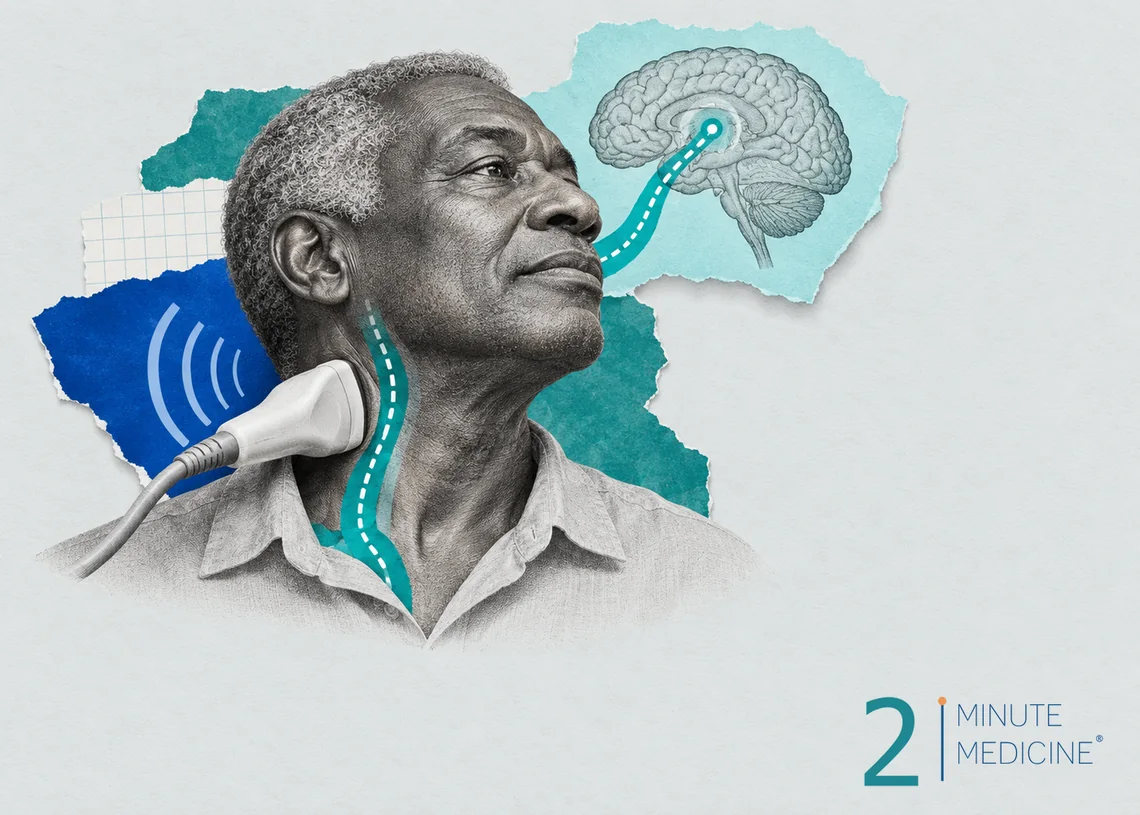
Carotid ultrasound collage: an older man with a probe on his neck, a teal carotid artery ribbon and a brain outline
Share on FacebookShare on TwitterShare on LinkedIn

A carotid ultrasound, often called a carotid Doppler, is a painless scan of the two large arteries on each side of your neck that carry blood to your brain. It shows whether fatty buildup (plaque) has narrowed them, which raises the risk of stroke. The test uses sound waves, with no radiation or needles, and takes about 30 minutes.

Key points

  • The test is mainly used after a stroke or mini-stroke, or when a doctor hears a whooshing sound over a neck artery.
  • No preparation is needed. Wear a top with an open neck.
  • You lie on your back while a technologist glides a probe along both sides of your neck.
  • Results describe how much each artery is narrowed. Severe narrowing may need surgery or a stent.
  • Call 911 for sudden face drooping, arm weakness, trouble speaking or loss of vision in one eye.

Why a carotid ultrasound is done

Your doctor may order this test if you:

  • Have had a stroke or a transient ischemic attack (TIA, or mini-stroke), where stroke symptoms come and go within minutes to hours
  • Had a sudden, brief loss of vision in one eye, like a curtain coming down
  • Have a whooshing sound (bruit) over a neck artery, heard with a stethoscope
  • Have known narrowing of a carotid artery that needs checking over time
  • Had surgery or a stent to open a carotid artery, to make sure it stays open
  • Are getting ready for heart bypass surgery, in some cases

Plaque in the carotid arteries builds up for the same reasons it does in heart arteries: smoking, high blood pressure, high cholesterol, diabetes and getting older. A piece of plaque or a clot can break off and travel to the brain, or the artery can narrow until too little blood gets through.

How carotid Doppler works

A handheld probe (transducer) beams high-pitched sound you can’t hear through the skin of your neck, then listens for what bounces back. A computer turns those echoes into a live picture of the artery wall and any plaque. The Doppler part measures how fast blood is flowing. Blood speeds up as it squeezes through a narrow spot, much as water speeds up when you pinch a garden hose, so faster flow means tighter narrowing. You’ll often hear the flow as a whooshing or pulsing sound. Doing both at once is called a duplex scan, and most carotid ultrasounds are duplex scans.

Before the test

  • You can eat, drink and take your medicines as usual.
  • Wear a shirt with an open collar, and leave necklaces and large earrings at home.
  • If you smoke, avoid it for a couple of hours beforehand, since it can narrow blood vessels for a short time.

During the test

  1. You lie on your back on an exam table, with your head on a small pillow.
  2. The technologist (sonographer) spreads a little warm gel on one side of your neck.
  3. You turn your head slightly away while they move the probe from the base of your neck up toward your jaw. You’ll feel light pressure.
  4. They repeat the scan on the other side. Checking both sides is called a bilateral carotid Doppler, and it’s the usual way the test is done.

Lie still and breathe normally. Tell the technologist if you feel dizzy or the pressure is uncomfortable. The whole scan usually takes 20 to 40 minutes.

Afterward

The gel is wiped off and you can go back to your usual day, including driving. A radiologist or vascular specialist reads the images, and your doctor usually gets the report within a day or two. If you’re in the hospital after a stroke, results may come the same day.

RELATED REPORTS

No Content Available

Possible risks

A carotid ultrasound has no known risks. It uses no radiation, dye or needles, and you can have it as often as needed.

Your carotid ultrasound results

The report gives the amount of narrowing (stenosis) in each artery, often as a range of percentages. It may also describe the plaque.

  • Normal or mild narrowing. Blood flows freely. Your doctor may still suggest steps to lower your risk of heart attack and stroke.
  • Moderate narrowing (about 50 to 69 percent). This is usually treated with medicines and habit changes. Surgery may be an option if you’ve had stroke symptoms.
  • Severe narrowing (70 percent or more). If you’ve had a stroke or TIA, a procedure to open the artery is often recommended. If you’ve had no symptoms, you and your doctor will weigh medicines alone against a procedure.
  • Complete blockage. A fully blocked artery usually can’t be reopened. Treatment focuses on protecting the other arteries.

Medicines usually include a statin to lower cholesterol, aspirin or another antiplatelet drug to prevent clots, and blood pressure medicine. Quitting smoking and controlling diabetes matter too. Procedures include carotid endarterectomy, where a surgeon opens the artery and removes the plaque, and carotid stenting, where a mesh tube holds the artery open. Before any procedure, you may need a CT or MR scan of the arteries to confirm the ultrasound findings.

When to call your doctor

  • You haven’t received your results when expected
  • You have new dizziness, numbness or tingling, even if it went away

Call 911 right away for any sign of stroke: sudden drooping of one side of the face, weakness or numbness in an arm or leg, slurred or confused speech, loss of vision in one eye, or sudden trouble walking. Note the time symptoms started. Don’t wait to see if they pass.

Common questions about carotid ultrasound

Is a carotid ultrasound the same as a carotid Doppler?

Mostly, yes. Doctors use the terms almost interchangeably. Strictly, the ultrasound makes the picture of the artery and the Doppler measures blood flow. Nearly all carotid scans today combine the two, which is why you may also see it called a carotid duplex scan.

Should I get a carotid ultrasound to screen for stroke risk?

For most people without symptoms, no. Expert groups in the US advise against routine screening, because it finds many narrowings that wouldn’t cause harm and can lead to risky procedures. Your doctor may suggest one if you have stroke symptoms, a neck bruit or other specific reasons.

Can a carotid ultrasound show if I’ve had a stroke?

No. It looks at blood flow in the neck, not at the brain itself. A CT or MRI scan of the head shows whether a stroke has happened. A carotid ultrasound helps find the cause and the risk of another one, so it’s often done after a stroke.

What is a transcranial Doppler?

A transcranial Doppler checks blood flow in the arteries inside the skull, with the probe placed on the temple or the back of the head. It’s sometimes done along with a carotid scan. Children with sickle cell disease have it regularly to check their stroke risk.

Questions to ask your doctor

  • Why do I need this test now?
  • How narrow are my arteries, and on which side?
  • Do I need surgery or a stent, or are medicines enough?
  • How often should the scan be repeated?
  • What can I do to lower my risk of stroke?

Learn more

  • Carotid duplex (MedlinePlus, U.S. National Library of Medicine)
  • Carotid artery disease (MedlinePlus, U.S. National Library of Medicine)

This guide is general information and doesn’t replace advice from your own doctor. Last updated October 2026.

Tags: Carotid Doppler
Previous Post

Patient Basics: Cystourethrogram (VCUG)

Next Post

Patient Basics: Chest X-Ray

RelatedReports

No Content Available
Next Post
Bone marrow biopsy collage: the back of a pelvis with the hip bone marked, a hollow needle, a microscope and a glass slide

Patient Basics: Bone Marrow Biopsy

Breast ultrasound collage: a handheld ultrasound probe, a bottle of gel, a clinic gown on a hook and a single tulip

Patient Basics: Breast Ultrasound

Back X-ray collage: an older man in profile, an engraved column of vertebrae, a blank film on a lightbox and a spirit level

Patient Basics: Back X-Rays (Spine X-Rays)

✦ EvidencePulse™ by 2 Minute Medicine 3 reports You asked top stroke trials 2026 Synthesizing medical evidence... Top 2026 stroke trial results: OCEANIC — ischemic stroke: 6.2% vs 8.4% OPTION* — mRS 0–1: 43.6% vs 34.2% ORIENTAL* — mRS 0–2: 58.6% vs 46.6% *Higher sICH in intervention arms Participants randomizedN OCEANIC 12,327 OPTION 570 ORIENTAL 564 Ask about guidelines or landmark trials... Try EvidencePulse™ Get the signal. Try it now → Physician-trained medical AI by 2 Minute Medicine

2MM+ All Access

Full details →
$4.99 /month

3-day free trial · cancel anytime

  • ✓100+ physician-written reports
  • ✓EvidencePulse™ + HypeCheck™
  • ✓Ad-free reading + newsletters
Start 3-day free trial

Then $4.99/month. Manage renewal in your account.

2 Minute Medicine® is an award winning, physician-run, expert medical media company. Our content is curated, written and edited by practicing health professionals who have clinical and scientific expertise in their field of reporting. Our editorial management team is comprised of highly-trained MD physicians. Join numerous brands, companies, and hospitals who trust our licensed content.

Recent Reports

  • In online experiment, AI disagreement increased perceived laziness and uncertainty toward an LLM-simulated doctor
  • Long-term use of mometasone (Asmanex) in adults with sickle cell disease without formal diagnosis of asthma may worsen disease activity
  • Few patients had ED lumbar CT or MRI within 30 days after low-acuity back-pain radiography at urgent care centers
License Content
Terms of Use | Disclaimer
Cookie Policy

Get the app

Read 2 Minute Medicine on iPhone, iPad and Android.

Download on the App StoreGet it on Google Play
QR code for www.2minutemedicine.com/app
On a computer? Scan this with your phone’s camera.
2MM+ All Access Full details →

The medical literature, distilled daily.

Monthly plan selected: $4.99 /month.

$4.99/month

3-day free trial · cancel anytime

Start 3-day free trial

Then $4.99/month. Manage renewal in your account.

Yearly plan selected: $49.90 /year.

$49.90/year

2 months free

Start 3-day free trial

Then $49.90/year.

Membership benefits

  • ✓100+ new physician-written study summaries monthly, 12,000+ searchable
  • ✓AI EvidencePulse™ + HypeCheck™
  • ✓Ad-free reading + newsletters
  • ✓FDA drug approvals + clinical calculators

Already a member? Sign in

  • Get the app
  • About
  • Specialties
    • All Specialties, All Recent Reports
    • Cardiology
    • Chronic Disease
    • Dermatology
    • Emergency
    • Endocrinology
    • Gastroenterology
    • Imaging and Intervention
    • Infectious Disease
    • Nephrology
    • Neurology
    • Obstetrics
    • Oncology
    • Ophthalmology
    • Pediatrics
    • Pharma
    • Preclinical
    • Psychiatry
    • Public Health
    • Pulmonology
    • Rheumatology
    • Surgery
    • Rewinds
    • The Scan
  • EvidencePulse™
  • HypeCheck™
  • AI News
  • Classics™
    • 2MM+ Online Access
    • Paperback and Ebook
  • Tools
    • Medical Calculators
    • Clinical Guidelines
    • Physician Pay by Specialty
    • FDA Drug Approvals
    • RVU Search
    • ICD-10 Code Lookup
    • Drug Safety for Breastfeeding/Pregnancy
    • ECG Reference
      • QTc Calculator
      • Sgarbossa Criteria
      • ECG Axis Calculator
      • AV Block Helper
    • NPI Registry Lookup
  • Rankings
    • Medical School Rankings
    • Residency Rankings
  • Partners
    • License Content
    • Advertise with Us
No Result
View All Result

© 2026 2 Minute Medicine, Inc. - Physician-written medical news.


