
• About
  • Masthead
  • License Content
  • Advertise
  • Press Releases
  • Newsroom
  • RSS/Email List
  • 2MM Podcast
  • Write for us
  • Contact Us
2 Minute Medicine
No Result
View All Result

No products in the cart.

Sign in
SUBSCRIBE
  • About
  • Specialties
    • All Specialties, All Recent Reports
    • Cardiology
    • Chronic Disease
    • Dermatology
    • Emergency
    • Endocrinology
    • Gastroenterology
    • Imaging and Intervention
    • Infectious Disease
    • Nephrology
    • Neurology
    • Obstetrics
    • Oncology
    • Ophthalmology
    • Pediatrics
    • Pharma
    • Preclinical
    • Psychiatry
    • Public Health
    • Pulmonology
    • Rheumatology
    • Surgery
    • Rewinds
    • The Scan
  • EvidencePulse™
  • HypeCheck™
  • AI News
  • Classics™
    • 2MM+ Online Access
    • Paperback and Ebook
  • Tools
    • Medical Calculators
    • Clinical Guidelines
    • Physician Pay by Specialty
    • FDA Drug Approvals
    • RVU Search
    • ICD-10 Code Lookup
    • Drug Safety for Breastfeeding/Pregnancy
    • ECG Reference
      • QTc Calculator
      • Sgarbossa Criteria
      • ECG Axis Calculator
      • AV Block Helper
    • NPI Registry Lookup
  • Rankings
    • Medical School Rankings
    • Residency Rankings
  • Partners
    • License Content
    • Advertise with Us
2 Minute Medicine
  • About
  • Specialties
    • All Specialties, All Recent Reports
    • Cardiology
    • Chronic Disease
    • Dermatology
    • Emergency
    • Endocrinology
    • Gastroenterology
    • Imaging and Intervention
    • Infectious Disease
    • Nephrology
    • Neurology
    • Obstetrics
    • Oncology
    • Ophthalmology
    • Pediatrics
    • Pharma
    • Preclinical
    • Psychiatry
    • Public Health
    • Pulmonology
    • Rheumatology
    • Surgery
    • Rewinds
    • The Scan
  • EvidencePulse™
  • HypeCheck™
  • AI News
  • Classics™
    • 2MM+ Online Access
    • Paperback and Ebook
  • Tools
    • Medical Calculators
    • Clinical Guidelines
    • Physician Pay by Specialty
    • FDA Drug Approvals
    • RVU Search
    • ICD-10 Code Lookup
    • Drug Safety for Breastfeeding/Pregnancy
    • ECG Reference
      • QTc Calculator
      • Sgarbossa Criteria
      • ECG Axis Calculator
      • AV Block Helper
    • NPI Registry Lookup
  • Rankings
    • Medical School Rankings
    • Residency Rankings
  • Partners
    • License Content
    • Advertise with Us
Sign in
SUBSCRIBE
2 Minute Medicine
Sign in
Subscribe
2 Minute MedicineFree on Google PlayGet
✦EvidencePulse™by 2 Minute Medicine3 reportsYou askedtop stroke trials 2026Synthesizing medical evidence...Top 2026 stroke trial results:OCEANIC — ischemic stroke: 6.2% vs 8.4%OPTION* — mRS 0–1: 43.6% vs 34.2%ORIENTAL* — mRS 0–2: 58.6% vs 46.6%*Higher sICH in intervention armsParticipants randomizedNOCEANIC12,327OPTION570ORIENTAL564Ask about guidelines or landmark trials...↑Try EvidencePulse™Ask the evidence. Get the signal.Try it now →
Home Health A to Z

Patient Basics: Wrist Sprain
by2 Minute Medicine
October 30, 2026
in Health A to Z
Reading Time: 5 mins read
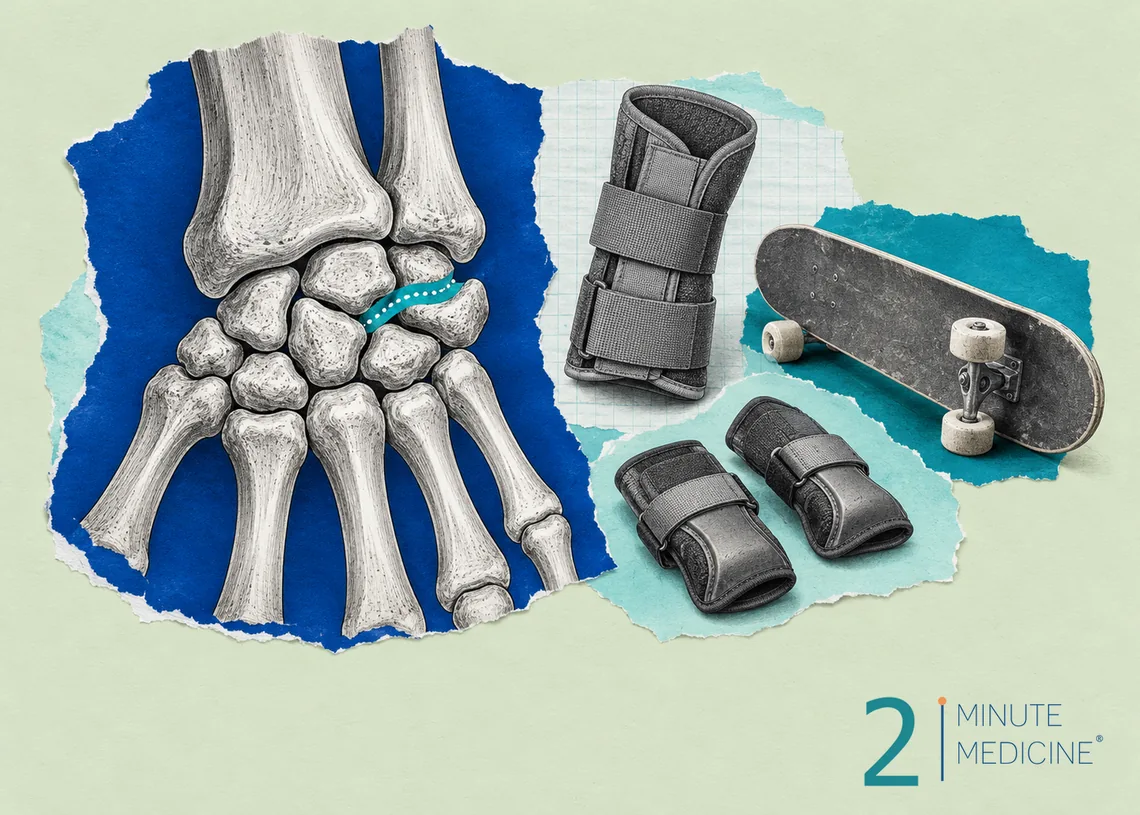
Collage for a wrist sprain: engraved wrist bones with a teal ligament band, a wrist brace, a skateboard and wrist guards
Share on FacebookShare on TwitterShare on LinkedIn

A sprained wrist means one or more of the ligaments that hold the wrist bones together has been stretched or torn. It usually happens when you fall onto an outstretched hand. Most wrist sprains heal in a few weeks with a splint and rest. A broken wrist bone can look and feel just like a sprain, though, so a painful wrist after a fall should be checked.

Key points

  • Falls while skating, snowboarding, biking or simply tripping are the most common cause.
  • Pain, swelling and bruising are the main symptoms. A pop at the time of injury can mean a bigger tear.
  • X-rays look for a broken bone. A small bone at the base of the thumb (the scaphoid) can break without showing on the first X-ray.
  • Rest, ice, a splint and pain relievers treat most sprains. A few torn ligaments need surgery.
  • Wrist guards cut the risk of injury in skating and snowboarding.

What causes a wrist sprain

The wrist is made of eight small bones (carpal bones) between the two forearm bones and the hand. Dozens of ligaments hold them in place while letting the wrist bend and twist. When you land on your palm with the wrist bent back, those ligaments can stretch or tear. Twisting the wrist hard, or a blow to it, can do the same.

Wrist sprains are common in skaters, snowboarders, gymnasts, basketball players and anyone who falls. Older adults with weaker bones are more likely to break a bone than sprain a ligament.

How bad is it?

  • Grade 1 (mild): ligaments are stretched but not torn.
  • Grade 2 (moderate): part of a ligament is torn. The wrist may feel weak and a bit loose.
  • Grade 3 (severe): a ligament is torn all the way through, or pulls off a small chip of bone. These often need surgery.

Symptoms

  • Pain when you move or press on the wrist
  • Swelling and bruising
  • Warmth around the wrist
  • A pop or tearing feeling when you fell
  • Weak grip, or pain when you pick things up
  • Later on, clicking, clunking or a feeling that the wrist gives way

How it’s diagnosed

Your doctor will ask how you fell and look for swelling and tender spots. They will check how well the wrist moves, how strong your grip is, and the feeling and blood flow in your fingers.

  • X-rays look for broken bones and for gaps between wrist bones that suggest a torn ligament.
  • Checking for a hidden scaphoid break. If you are tender in the small hollow at the base of the thumb, your doctor may treat the injury as a break even if the X-ray looks normal. You’ll wear a splint and have another X-ray in 1 to 2 weeks, or an MRI sooner. A missed scaphoid break can fail to heal and cause arthritis.
  • MRI can show torn ligaments and small breaks. Sometimes dye is injected into the joint first to make tears easier to see.
  • Arthroscopy, where a surgeon looks inside the joint with a thin camera, is used when other tests aren’t clear.

Treatment

Home care

  • Rest the wrist for a few days. Avoid lifting, pushing up from a chair, and sports.
  • Ice it for 15 to 20 minutes every 2 to 3 hours for the first 2 days. Wrap ice in a thin cloth to protect your skin.
  • Compress with an elastic wrap. Loosen it if your fingers tingle or change color.
  • Raise the wrist above your heart as much as you can.
  • Pain relievers such as acetaminophen, ibuprofen or naproxen help with pain and swelling.
  • Take off rings on that hand right away, before your fingers swell.

Splints and therapy

A removable wrist brace or splint keeps the joint still while the ligament heals, often for 1 to 6 weeks depending on the grade. When the pain settles, start gentle exercises to bring back movement and grip strength. A hand therapist can help, especially after a moderate or severe sprain.

Surgery

Some ligaments, such as the one between the scaphoid and the next bone (the scapholunate ligament), heal poorly on their own when fully torn. If the tear lets the bones drift apart, a hand surgeon may repair or rebuild the ligament. Repair works best when done within a few weeks of the injury, which is one reason to get a bad sprain checked early.

RELATED REPORTS

No Content Available

Recovery

A mild sprain often feels much better in 1 to 2 weeks. A moderate sprain can take 4 to 6 weeks. Recovery after surgery takes several months. Go back to sports and heavy work only when you have full movement and nearly normal grip strength, and you can bear weight on the hand without pain.

Lowering your risk

  • Wear wrist guards for in-line skating, skateboarding and snowboarding.
  • Learn to fall safely in your sport, for example by rolling instead of landing on straight arms.
  • Keep floors clear, use good lighting, and wear shoes with good grip to avoid falls.
  • Strengthen your forearm and grip muscles.

When to see a doctor

  • Pain or swelling after a fall that doesn’t start easing in 2 or 3 days
  • Pain on the thumb side of the wrist
  • A pop at the time of injury, or weakness, clicking or giving way later
  • Pain that still limits you after 2 weeks of home care

Get urgent care if the wrist looks bent or misshapen, if your fingers are numb, cold, pale or blue, or if you can’t move your fingers.

Common questions about wrist sprains

How can I tell if my wrist is sprained or broken?

An X-ray is usually needed to know for sure. A break is more likely if the wrist looks bent, if there is sharp pain on the thumb side, or if you can’t move it. Some breaks, especially of the scaphoid bone, only show up on a later X-ray or an MRI.

Should I wear a wrist brace to sleep?

Wearing a brace at night often helps in the first week or two, because it stops the wrist from bending into painful positions while you sleep. Follow your doctor’s advice on how long to keep wearing it, and take it off now and then to check your skin.

Can a sprained wrist heal on its own?

Most mild and moderate sprains heal on their own with rest, a brace and gentle exercise. A fully torn ligament may not, and if it’s missed it can lead to weakness, clicking and arthritis later. That’s why wrist pain lasting more than 2 weeks should be checked.

How can I get the swelling down in a sprained wrist?

Raise your wrist above heart level, ice it for 15 to 20 minutes every few hours for the first 2 days, and wrap it snugly but not tightly. Gently moving your fingers also helps fluid drain away. Swelling that keeps getting worse after 2 days should be checked by a doctor.

Questions to ask your doctor

  • How sure are you that this is a sprain and not a break?
  • Do I need a repeat X-ray or an MRI?
  • How long should I wear a splint, and can I take it off to wash?
  • When should I start exercises, and which ones?
  • When can I return to work, driving or sports?

Learn more

  • Sprains and strains (MedlinePlus, U.S. National Library of Medicine)
  • Sprains and strains (NHS)

This guide is general information and doesn’t replace advice from your own doctor. Last updated October 2026.

Tags: Wrist Sprain
Previous Post

Patient Basics: Warts

Next Post

Patient Basics: Vertigo

RelatedReports

No Content Available
Next Post
Vertigo collage: an older woman in calm portrait, an engraved inner ear with balance canals and a spiraling teal ribbon

Patient Basics: Vertigo

Collage for vocal cord disorders: a young woman in profile, open vocal cords, a vintage microphone and a small throat mirror

Patient Basics: Vocal Cord Disorders

Vaginal yeast infection collage: yeast cells under a microscope, a cotton boll, a blank cream tube and a folded towel

Patient Basics: Vaginal Yeast Infection

✦ EvidencePulse™ by 2 Minute Medicine 3 reports You asked top stroke trials 2026 Synthesizing medical evidence... Top 2026 stroke trial results: OCEANIC — ischemic stroke: 6.2% vs 8.4% OPTION* — mRS 0–1: 43.6% vs 34.2% ORIENTAL* — mRS 0–2: 58.6% vs 46.6% *Higher sICH in intervention arms Participants randomizedN OCEANIC 12,327 OPTION 570 ORIENTAL 564 Ask about guidelines or landmark trials... Try EvidencePulse™ Get the signal. Try it now → Physician-trained medical AI by 2 Minute Medicine

2MM+ All Access

Full details →
$4.99 /month

Billed monthly · cancel anytime

  • ✓100+ physician-written reports
  • ✓EvidencePulse™ + HypeCheck™
  • ✓Ad-free reading + newsletters
Join 2MM+

Renews at $4.99/month. Manage renewal in your account.

2 Minute Medicine® is an award winning, physician-run, expert medical media company. Our content is curated, written and edited by practicing health professionals who have clinical and scientific expertise in their field of reporting. Our editorial management team is comprised of highly-trained MD physicians. Join numerous brands, companies, and hospitals who trust our licensed content.

Recent Reports

  • In phase 3 ADORE results, oral edaravone did not improve functional decline in amyotrophic lateral sclerosis
  • Black-White mortality gap narrowed from 1993 to 2023, cross-sectional study shows
  • A combination of preoperative imaging findings and clinical parameters may more accurately determine cytoreduction score in peritoneal mesothelioma
License Content
Terms of Use | Disclaimer
Cookie Policy

Get the app

Read 2 Minute Medicine on iPhone, iPad and Android.

Download on the App StoreGet it on Google Play
QR code for www.2minutemedicine.com/app
On a computer? Scan this with your phone’s camera.
2MM+ All Access Full details →

The medical literature, distilled daily.

Monthly plan selected: $4.99 /month.

$4.99/month

Billed monthly · cancel anytime

Join 2MM+

Then $4.99/month. Manage renewal in your account.

Yearly plan selected: $49.90 /year.

$49.90/year

2 months free

Join 2MM+

Then $49.90/year.

Membership benefits

  • ✓100+ new physician-written study summaries monthly, 12,000+ searchable
  • ✓AI EvidencePulse™ + HypeCheck™
  • ✓Ad-free reading + newsletters
  • ✓FDA drug approvals + clinical calculators

Already a member? Sign in

  • Get the app
  • About
  • Specialties
    • All Specialties, All Recent Reports
    • Cardiology
    • Chronic Disease
    • Dermatology
    • Emergency
    • Endocrinology
    • Gastroenterology
    • Imaging and Intervention
    • Infectious Disease
    • Nephrology
    • Neurology
    • Obstetrics
    • Oncology
    • Ophthalmology
    • Pediatrics
    • Pharma
    • Preclinical
    • Psychiatry
    • Public Health
    • Pulmonology
    • Rheumatology
    • Surgery
    • Rewinds
    • The Scan
  • EvidencePulse™
  • HypeCheck™
  • AI News
  • Classics™
    • 2MM+ Online Access
    • Paperback and Ebook
  • Tools
    • Medical Calculators
    • Clinical Guidelines
    • Physician Pay by Specialty
    • FDA Drug Approvals
    • RVU Search
    • ICD-10 Code Lookup
    • Drug Safety for Breastfeeding/Pregnancy
    • ECG Reference
      • QTc Calculator
      • Sgarbossa Criteria
      • ECG Axis Calculator
      • AV Block Helper
    • NPI Registry Lookup
  • Rankings
    • Medical School Rankings
    • Residency Rankings
  • Partners
    • License Content
    • Advertise with Us
No Result
View All Result

© 2026 2 Minute Medicine, Inc. - Physician-written medical news.


