• About
  • Masthead
  • License Content
  • Advertise
  • Submit Press Release
  • RSS/Email List
  • 2MM Podcast
  • Write for us
  • Contact Us
2 Minute Medicine
No Result
View All Result

No products in the cart.

SUBSCRIBE
  • About
  • Specialties
    • All Specialties, All Recent Reports
    • Cardiology
    • Chronic Disease
    • Dermatology
    • Emergency
    • Endocrinology
    • Gastroenterology
    • Imaging and Intervention
    • Infectious Disease
    • Nephrology
    • Neurology
    • Obstetrics
    • Oncology
    • Ophthalmology
    • Pediatrics
    • Pharma
    • Preclinical
    • Psychiatry
    • Public Health
    • Pulmonology
    • Rheumatology
    • Surgery
  • Tools+
    • EvidencePulse™
    • HypeCheck™
    • NPI Registry Lookup
    • RVU Search
  • Pharma
  • AI Roundup
  • The Scan+
  • Classics™+
    • 2MM+ Online Access
    • Paperback and Ebook
  • Rewinds
  • Partners
    • License Content
    • Submit Press Release
    • Advertise with Us
  • Account
    • Subscribe
    • My account
    • Cart
    • Sign in
2 Minute Medicine
  • About
  • Specialties
    • All Specialties, All Recent Reports
    • Cardiology
    • Chronic Disease
    • Dermatology
    • Emergency
    • Endocrinology
    • Gastroenterology
    • Imaging and Intervention
    • Infectious Disease
    • Nephrology
    • Neurology
    • Obstetrics
    • Oncology
    • Ophthalmology
    • Pediatrics
    • Pharma
    • Preclinical
    • Psychiatry
    • Public Health
    • Pulmonology
    • Rheumatology
    • Surgery
  • Tools+
    • EvidencePulse™
    • HypeCheck™
    • NPI Registry Lookup
    • RVU Search
  • Pharma
  • AI Roundup
  • The Scan+
  • Classics™+
    • 2MM+ Online Access
    • Paperback and Ebook
  • Rewinds
  • Partners
    • License Content
    • Submit Press Release
    • Advertise with Us
  • Account
    • Subscribe
    • My account
    • Cart
    • Sign in
SUBSCRIBE
2 Minute Medicine
Subscribe
EvidencePulse™ by 2 Minute Medicine 2026 evidence scan 3 reports You asked top stroke trials 2026 Synthesizing medical evidence... Top 2026 stroke trial results: OCEANIC — ischemic stroke: 6.2% vs 8.4% OPTION* — mRS 0–1: 43.6% vs 34.2% ORIENTAL* — mRS 0–2: 58.6% vs 46.6% *Higher sICH in intervention arms Participants randomizedN OCEANIC 12,327 OPTION 570 ORIENTAL 564 Ask about guidelines or landmark trials... ↑ Try EvidencePulse™ Ask the evidence.
Get the signal.
Try it now → Physician-trained medical AI by 2 Minute Medicine
Home The Classics Critical, Emergent and Pulmonary Care Classics

Canadian C-Spine Rules superior to NEXUS Low-Risk Criteria for detecting cervical-spine injuries [Classics Series]

by2 Minute Medicine
January 1, 2025
in Critical, Emergent and Pulmonary Care Classics, Emergency Classics, Imaging Classics, The Classics
Reading Time: 4 mins read
ABCD2 Score: Predicting Early Stroke Risk After Transient Ischemic Attack (TIA) [Classics Series]
Share on FacebookShare on Twitter

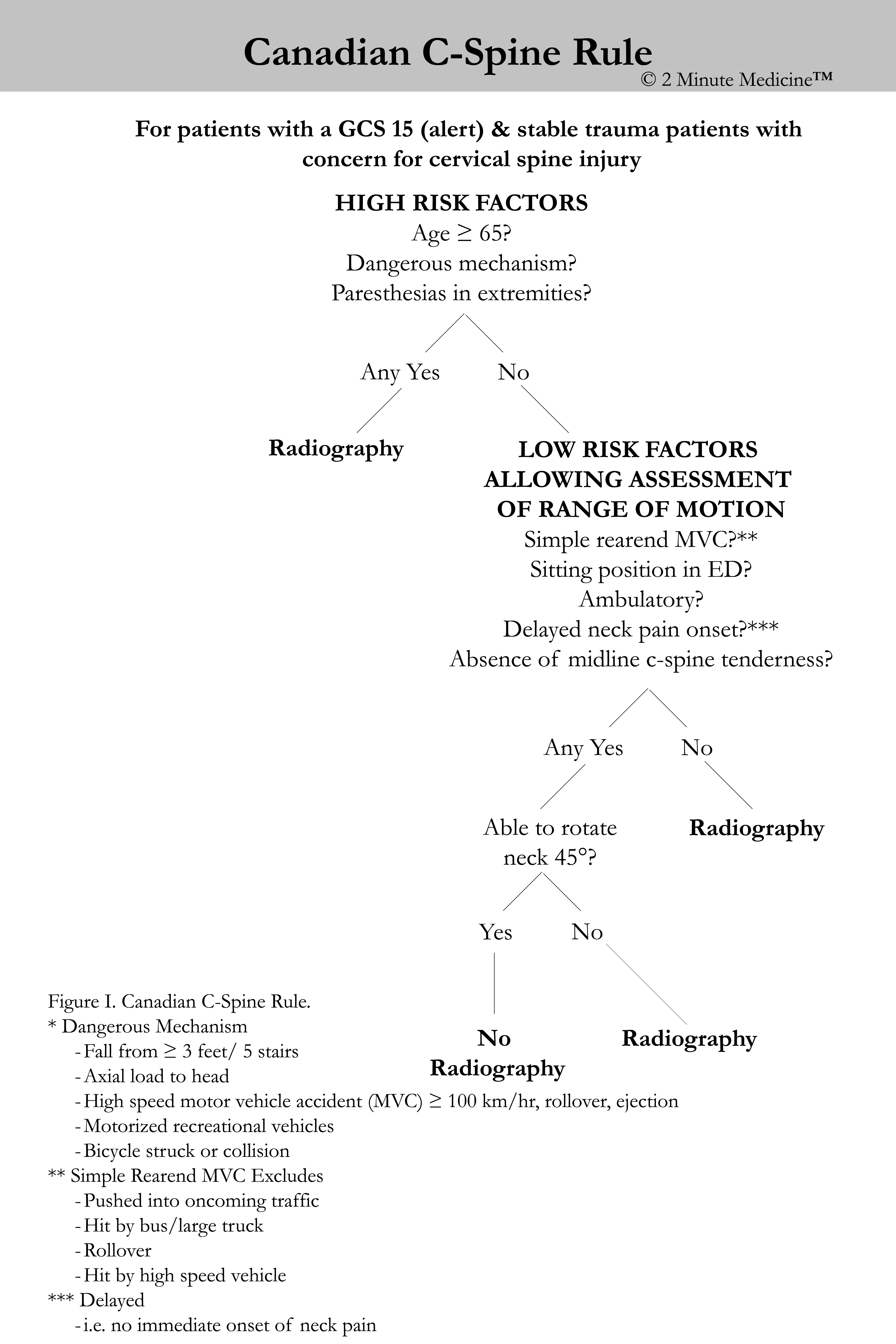
1. The Canadian C-Spine Rule (CCR, Figure I) demonstrated higher sensitivity and specificity for cervical-spine injury compared to the National Emergency X-Radiography Utilization Study (NEXUS) Low-Risk Criteria (NLC, Table I).

Original Date of Publication: December 2003

This study summary is an excerpt from the book 2 Minute Medicine’s The Classics in Medicine: Summaries of the Landmark Trials, 2e (The Classics Series).

Study Rundown: According to large trauma registries, approximately 3% of all blunt trauma victims sustain injuries to the spinal column, including injuries to the cervical spine (C-spine). Suspected C-spine fractures are frequently evaluated with radiography; however, there is a lack of consensus among published guidelines with regards to the use of radiography. Two independently validated clinical decision rules are commonly used to determine patient selection of C-spine radiography: the CCR and the NLC. The CCR is a three-step process that evaluates risk factors for serious injury, physical exam findings, and the ability for the patient to rotate their neck. The NLC is made up of five criteria based on patient history (no painful distracting injuries, normal level of consciousness) and physical examination (no midline cervical tenderness, no focal neurologic deficit, and no evidence of intoxication). The purpose of this landmark prospective trial was to compare the accuracy of both the CCR and the NLC in detecting C-spine injuries.

The prospective trial measured the frequency of clinically important C-spine injuries in over 8000 consecutive patients and reported the accuracy of both the CCR and NLC in detecting these injuries when applied to this cohort. At the conclusion of the trial, the CCR demonstrated a near 100% sensitivity for detecting clinically important C-spine fractures; this was significantly higher than the NLC (90.7%). Additionally, the CCR was also found to be more specific for C-spine injuries compared to NLC. When the sensitivity and specificity were applied to the cohort, the NLC would have missed 1 in 10 clinically important C-spine fractures while requiring a higher radiography rate. Ten percent (10%) of patients were not evaluated for neck range of motion and therefore did not complete the CCR algorithm. However, the sensitivity and specificity of the CCR remained significantly higher than the NLC even if all significant findings in this small subgroup were assumed to be missed by CCR.

The results of this trial demonstrated superior performance of the CCR over the NLC in detecting clinically significant C-spine injuries and supported the use of CCR as the preferred clinical prediction rule. However, the study population was only limited to patients aged greater than 16 years who were alert and in stable condition at the time of assessment. Additionally, the study was performed at institutions where the CCR was developed, precluding validation in alternative clinical settings.

RELATED REPORTS

Probiotic supplementation is associated with reduced risk of death and necrotizing enterocolitis among preterm infants

Frailty in older adults with atrial fibrillation is multifactorial and associated with metabolic and cognitive factors

An artificial intelligence (AI) tool achieved high diagnostic accuracy for the identification and prediction of sepsis

Please click to read study in NEJM

In-Depth [prospective cohort]: This was a prospective study of 8282 consecutive patients with acute trauma to the head and neck for assessment for C-spine injuries in nine tertiary care hospitals in Canada. Patients were included if they were at least 16 years of age and had a Glasgow Coma Scale score of 15 out of 15 at the time of assessment. Patients were excluded if they had penetrating neck trauma, acute paralysis, or were pregnant. All patients were assessed by the CCR and NLC for the study, which was completed by the evaluating emergency physician. Patients underwent plain radiography according to the judgement of the physician independent of the results of the clinical prediction rules. All injuries to the C-spine on radiography were considered significant unless one of the following benign fractures were isolated: transverse process not involving a facet joint, a spinous process not involving lamina, or simple vertebral compression of < 25% of body height. Patients who did not receive radiography were evaluated for C-spine injuries using the Proxy Outcome Assessment Tool, which assessed clinical symptoms 14-days following injury.

At the conclusion of the trial, a total of 169 patients (2%) demonstrated a clinically significant C-spine fracture. The sensitivity for detection of these C-spine fractures was significantly higher in the CCR compared to the NLC (99.4% versus 90.7%; p < 0.001). Additionally, the CCR also demonstrated significantly higher specificity for C-spine injuries compared to NLC (40.4% versus 33.0%; p < 0.001). In 845 patients (10.2%), the CCR assessment was indeterminate due to the lack of evaluating of neck range of motion. In secondary analysis, if all indeterminate cases were assumed to be negative by the CCR, the sensitivity and specificity was modified to 95.3% and 50.7%, respectively. This remained significantly higher when compared to the NLC.

Table I. NEXUS Low-Risk Criteria.

NEXUS Low-Risk Criteria
Cervical-spine radiography is indicated for trauma unless the patient exhibits all of the following criteria:
1. No posterior midline cervical tenderness
2. No focal neurological deficit
3. Normal alertness
4. No evidence of intoxication
5. No painful distracting injury

Canadian C-Spine Rule

Stiell IG, Clement CM, McKnight RD, Brison R, Schull MJ, Rowe BH, et al. The Canadian C-Spine Rule versus the NEXUS Low-Risk Criteria in Patients with Trauma. The New England Journal of Medicine. 2003 Dec 25;349(26):2510–8.

© 2 Minute Medicine, Inc. All rights reserved. No works may be reproduced without expressed written consent from 2 Minute Medicine, Inc. Inquire about licensing here. No article should be construed as medical advice and is not intended as such by the authors or by 2 Minute Medicine, Inc.
Tags: Clow-nexusriskspine
Previous Post

Ottawa ankle rules reduce the rate of referral for ankle radiography [Classics Series]

Next Post

The Harvey-Bradshaw Index is a practical alternative to the Crohn’s Disease Activity Index in measuring disease severity [Classics Series]

RelatedReports

Emergency

Probiotic supplementation is associated with reduced risk of death and necrotizing enterocolitis among preterm infants

October 2, 2026
Cardiology

Frailty in older adults with atrial fibrillation is multifactorial and associated with metabolic and cognitive factors

September 30, 2026
Artificial Intelligence

An artificial intelligence (AI) tool achieved high diagnostic accuracy for the identification and prediction of sepsis

September 25, 2026
Cardiology

Increased rapid eye movement (REM) sleep is associated with lower risks of several chronic diseases

September 23, 2026
Next Post
PFO closure equivalent to medical management in prevention of recurrent stroke [PC and RESPECT trials]

Artificial intelligence-augmented decision-making failed to show non-inferiority compared to clinician judgment alone for coronary angiography patient selection

Variability in interpretation of breast biopsy slides associated with low verification of atypia and ductal carcinoma in situ

Effect of adjuvant carboplatin intensified chemotherapy versus standard chemotherapy on survival in women with high risk, early stage, triple negative breast cancer (CITRINE): randomised, open label phase 3 trial

Variability in interpretation of breast biopsy slides associated with low verification of atypia and ductal carcinoma in situ

2 Minute Medicine Rewind January 6, 2025

EvidencePulse™ by 2 Minute Medicine 2026 evidence scan 3 reports You asked top stroke trials 2026 Synthesizing medical evidence... Top 2026 stroke trial results: OCEANIC — ischemic stroke: 6.2% vs 8.4% OPTION* — mRS 0–1: 43.6% vs 34.2% ORIENTAL* — mRS 0–2: 58.6% vs 46.6% *Higher sICH in intervention arms Participants randomizedN OCEANIC 12,327 OPTION 570 ORIENTAL 564 Ask about guidelines or landmark trials... ↑ Try EvidencePulse™ Get the signal. Try it now → Physician-trained medical AI by 2 Minute Medicine

2MM+ All Access

Full details →
$4.99 /month

3-day free trial · cancel anytime

  • ✓100+ physician-written reports
  • ✓EvidencePulse™ + HypeCheck™
  • ✓Ad-free reading + newsletters
Start 3-day free trial

Then $4.99/month. Manage renewal in your account.

2 Minute Medicine® is an award winning, physician-run, expert medical media company. Our content is curated, written and edited by practicing health professionals who have clinical and scientific expertise in their field of reporting. Our editorial management team is comprised of highly-trained MD physicians. Join numerous brands, companies, and hospitals who trust our licensed content.

Recent Reports

  • Probiotic supplementation is associated with reduced risk of death and necrotizing enterocolitis among preterm infants
  • Artificial intelligence (AI)-triggered rapid response notifications were associated with lower mortality among inpatients
  • Post-traumatic stress disorder is associated with increased risk of mild cognitive impairment and dementia among United States Veterans
License Content
Terms of Use | Disclaimer
Cookie Policy
2MM+ All Access Full details →

The medical literature, distilled daily.

Monthly plan selected: $4.99 /month.

$4.99/month

3-day free trial · cancel anytime

Start 3-day free trial

Then $4.99/month. Manage renewal in your account.

Yearly plan selected: $49.90 /year.

$49.90/year

2 months free

Start 3-day free trial

Then $49.90/year.

Membership benefits

  • ✓100+ physician-written reports
  • ✓AI EvidencePulse™ + HypeCheck™
  • ✓Ad-free reading + newsletters

Already a member? Sign in

  • About
  • Specialties
    • All Specialties, All Recent Reports
    • Cardiology
    • Chronic Disease
    • Dermatology
    • Emergency
    • Endocrinology
    • Gastroenterology
    • Imaging and Intervention
    • Infectious Disease
    • Nephrology
    • Neurology
    • Obstetrics
    • Oncology
    • Ophthalmology
    • Pediatrics
    • Pharma
    • Preclinical
    • Psychiatry
    • Public Health
    • Pulmonology
    • Rheumatology
    • Surgery
  • Tools
    • EvidencePulse™
    • HypeCheck™
    • NPI Registry Lookup
    • RVU Search
  • Pharma
  • AI Roundup
  • The Scan
  • Classics™
    • 2MM+ Online Access
    • Paperback and Ebook
  • Rewinds
  • Partners
    • License Content
    • Submit Press Release
    • Advertise with Us
  • Account
    • Subscribe
    • My account
    • Cart
    • Sign in
No Result
View All Result

© 2026 2 Minute Medicine, Inc. - Physician-written medical news.