• About
  • Masthead
  • License Content
  • Advertise
  • Submit Press Release
  • RSS/Email List
  • 2MM Podcast
  • Write for us
  • Contact Us
2 Minute Medicine
No Result
View All Result

No products in the cart.

SUBSCRIBE
  • About
  • Specialties
    • All Specialties, All Recent Reports
    • Cardiology
    • Chronic Disease
    • Dermatology
    • Emergency
    • Endocrinology
    • Gastroenterology
    • Imaging and Intervention
    • Infectious Disease
    • Nephrology
    • Neurology
    • Obstetrics
    • Oncology
    • Ophthalmology
    • Pediatrics
    • Pharma
    • Preclinical
    • Psychiatry
    • Public Health
    • Pulmonology
    • Rheumatology
    • Surgery
  • Tools+
    • EvidencePulse™
    • HypeCheck™
    • NPI Registry Lookup
    • RVU Search
  • Pharma
  • AI Roundup
  • The Scan+
  • Classics™+
    • 2MM+ Online Access
    • Paperback and Ebook
  • Rewinds
  • Partners
    • License Content
    • Submit Press Release
    • Advertise with Us
  • Account
    • Subscribe
    • My account
    • Cart
    • Sign-in
2 Minute Medicine
  • About
  • Specialties
    • All Specialties, All Recent Reports
    • Cardiology
    • Chronic Disease
    • Dermatology
    • Emergency
    • Endocrinology
    • Gastroenterology
    • Imaging and Intervention
    • Infectious Disease
    • Nephrology
    • Neurology
    • Obstetrics
    • Oncology
    • Ophthalmology
    • Pediatrics
    • Pharma
    • Preclinical
    • Psychiatry
    • Public Health
    • Pulmonology
    • Rheumatology
    • Surgery
  • Tools+
    • EvidencePulse™
    • HypeCheck™
    • NPI Registry Lookup
    • RVU Search
  • Pharma
  • AI Roundup
  • The Scan+
  • Classics™+
    • 2MM+ Online Access
    • Paperback and Ebook
  • Rewinds
  • Partners
    • License Content
    • Submit Press Release
    • Advertise with Us
  • Account
    • Subscribe
    • My account
    • Cart
    • Sign-in
SUBSCRIBE
2 Minute Medicine
Subscribe
EvidencePulse™ by 2 Minute Medicine 2026 evidence scan 3 reports You asked top stroke trials 2026 Synthesizing medical evidence... Top 2026 stroke trial results: OCEANIC — ischemic stroke: 6.2% vs 8.4% OPTION* — mRS 0–1: 43.6% vs 34.2% ORIENTAL* — mRS 0–2: 58.6% vs 46.6% *Higher sICH in intervention arms Participants randomizedN OCEANIC 12,327 OPTION 570 ORIENTAL 564 Ask about guidelines or landmark trials... ↑ Try EvidencePulse™ Ask the evidence.
Get the signal.
Try it now → Physician-trained medical AI by 2 Minute Medicine
Home All Specialties Preclinical

Cell-loaded scaffold implant may improve cell therapy [PreClinical]
byJessica LauandSarah Stapleton
December 20, 2014
in Preclinical
Reading Time: 3 mins read
Donor and recipient regulatory T-cells may promote transplant tolerance in mice
Share on FacebookShare on Twitter

1. A polymer scaffold modified with stimulatory molecules promoted the growth and migration of tumor-specific immune T cells in vitro and in vivo.

2. In mouse cancer models, the T cell-loaded polymer implant prevented disease relapse following surgical tumor removal and caused regression of inoperable tumors.

Evidence Rating Level: 2 (Good)

Study Rundown: Surgical removal of solid tumors can leave behind residual cancer cells that cause relapse, or in other cases such resection is not a feasible procedure. Adoptive T cell therapy, which uses infusions of anti-tumor primed immune T cells to target cancer cells, is considered an additional or alternative treatment for solid tumors. This study sought to address one of the major limitations in adoptive T cell therapy, effective delivery of activated T cells to the tumor site. Researchers developed a scaffold of alginate, a natural polymer approved by the U.S. Food and Drug Administration that degrades in the body; the scaffold was modified with collagen-like molecules and microparticles that mimicked T cell-stimulating cells. When tumor-specific T cells were loaded into the scaffold, T cell growth and migration into surrounding tissue was increased by the scaffold modifications. In a breast cancer mouse model of relapse after surgery, the polymer implant loaded with T cells improved survival and prevented tumor relapse when compared to bolus injections of the anti-tumor T cells. In an ovarian cancer mouse model of inoperable tumors, the implant improved survival and promoted tumor regression.

This study demonstrated a technology for effective T cell delivery to a specific tumor site. Compared to current methods of systemically infusing T cells, the surgical implant was more invasive, but had the advantage of improved anti-tumor activity due to localized, prolonged release of continuously stimulated large numbers of T cells. Overall, this modified, cell-loaded implant has great potential to improve adoptive T cell therapy for treating solid tumors.

Click to read the study in Nature Biotechnology

RELATED REPORTS

Nirsevimab (Beyfortus) may reduce severe respiratory syncytial virus infections among infants

An artificial intelligence (AI) tool achieved high diagnostic accuracy for the identification and prediction of sepsis

Use of long-acting broadly neutralizing antibodies may delay human immunodeficiency virus (HIV) rebound following discontinuation of antiretroviral therapy

Relevant Reading: Durable complete responses in heavily pretreated patients with metastatic melanoma using T-cell transfer immunotherapy

In-Depth [animal study]: The alginate macroporous scaffolds used in this study were functionalized with collagen-mimetic molecules, which promoted T cell migration, and with soluble-factor containing microparticles, intended to provide cell growth and activity signals. Because T cells respond to a variety of molecules that are soluble or attached to other cells, the microparticles were designed to release a form of the soluble factor interleukin 15 and have a lipid outer layer with bound signaling molecules. Over a seven-day period, tumor-specific T cells seeded onto the functionalized scaffold exhibited a 22-fold increase in proliferation and a 8.3-fold increase in migration out of the implant compared to cell activity in a scaffold lacking the microparticle modification.

Using a breast cancer mouse model, tumors were partially surgically removed with around 1% of residual tumor tissue left at the site. All animals that received the cell-loaded fully modified polymer implant survived for at least 80 days (last follow up) following the surgery with no tumor relapse. In contrast, animals receiving no treatment, intravenous T cell injection, or intracavitary T cell injection survived a median of 19, 21, and 25 days, respectively. In a separate experiment, a stage 3 ovarian carcinoma mouse system was used to model inoperable tumors. Tumor regression was observed only in the animals treated with the implant, with complete tumor eradication in 6 of 10 animals (at follow up of 80 days). Survival of animals with the implant was significantly higher than for animals receiving an injection of pre-activated T cells to the tumor site (p < 0.0001).

More from this author: Novel system rapidly detects low levels of bacteria in blood, Vaccines for predicted influenza strains may provide wide protection, Key gut bacteria may prevent Clostridium difficile infection, Modified embryonic stem cells may prolong survival of surgical grafts

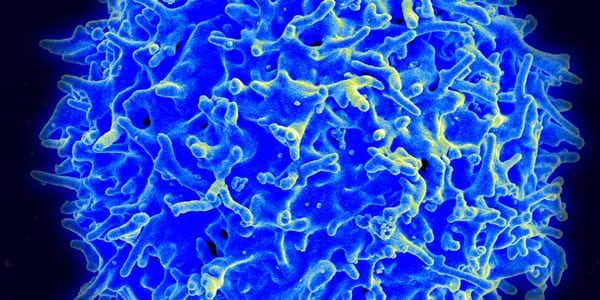
Image: PD

©2014 2 Minute Medicine, Inc. All rights reserved. No works may be reproduced without expressed written consent from 2 Minute Medicine, Inc. No article should be construed as medical advice and is not intended as such by the authors, editors, staff or by 2 Minute Medicine, Inc.


Previous Post

[UKGTS trial] Latanoprost helps preserve visual field in open-angle glaucoma

Next Post

Long-term active surveillance may be safe in low-risk prostate cancer

RelatedReports

Emergency

Nirsevimab (Beyfortus) may reduce severe respiratory syncytial virus infections among infants

September 25, 2026
Artificial Intelligence

An artificial intelligence (AI) tool achieved high diagnostic accuracy for the identification and prediction of sepsis

September 25, 2026
Chronic Disease

Use of long-acting broadly neutralizing antibodies may delay human immunodeficiency virus (HIV) rebound following discontinuation of antiretroviral therapy

September 24, 2026
Artificial Intelligence

Large language models (LLMs) demonstrated the ability to generate accurate research manuscripts but required human oversight for more complex analyses

September 24, 2026
Next Post
Long-term active surveillance may be safe in low-risk prostate cancer

Long-term active surveillance may be safe in low-risk prostate cancer

Ghrelin-receptor agonists may be beneficial in cancer anorexia-cachexia syndrome

Ghrelin-receptor agonists may be beneficial in cancer anorexia-cachexia syndrome

Less wound complications with suture skin closure after C-section

Less wound complications with suture skin closure after C-section

EvidencePulse™ by 2 Minute Medicine 2026 evidence scan 3 reports You asked top stroke trials 2026 Synthesizing medical evidence... Top 2026 stroke trial results: OCEANIC — ischemic stroke: 6.2% vs 8.4% OPTION* — mRS 0–1: 43.6% vs 34.2% ORIENTAL* — mRS 0–2: 58.6% vs 46.6% *Higher sICH in intervention arms Participants randomizedN OCEANIC 12,327 OPTION 570 ORIENTAL 564 Ask about guidelines or landmark trials... ↑ Try EvidencePulse™ Get the signal. Try it now → Physician-trained medical AI by 2 Minute Medicine

2MM+ All Access

Full details →
$4.99 /month

3-day free trial · cancel anytime

  • ✓100+ physician-written reports
  • ✓EvidencePulse™ + HypeCheck™
  • ✓Ad-free reading + newsletters
Start 3-day free trial

Then $4.99/month. Manage renewal in your account.

2 Minute Medicine® is an award winning, physician-run, expert medical media company. Our content is curated, written and edited by practicing health professionals who have clinical and scientific expertise in their field of reporting. Our editorial management team is comprised of highly-trained MD physicians. Join numerous brands, companies, and hospitals who trust our licensed content.

Recent Reports

  • Nirsevimab (Beyfortus) may reduce severe respiratory syncytial virus infections among infants
  • An artificial intelligence (AI) tool achieved high diagnostic accuracy for the identification and prediction of sepsis
  • Use of long-acting broadly neutralizing antibodies may delay human immunodeficiency virus (HIV) rebound following discontinuation of antiretroviral therapy
License Content
Terms of Use | Disclaimer
Cookie Policy
Cleantalk Pixel
2MM+ All Access Full details →

The medical literature, distilled daily.

Monthly plan selected: $4.99 /month.

$4.99/month

3-day free trial · cancel anytime

Start 3-day free trial

Then $4.99/month. Manage renewal in your account.

Yearly plan selected: $49.90 /year.

$49.90/year

2 months free

Start 3-day free trial

Then $49.90/year.

Membership benefits

  • ✓100+ physician-written reports
  • ✓AI EvidencePulse™ + HypeCheck™
  • ✓Ad-free reading + newsletters

Already a member? Sign in

  • About
  • Specialties
    • All Specialties, All Recent Reports
    • Cardiology
    • Chronic Disease
    • Dermatology
    • Emergency
    • Endocrinology
    • Gastroenterology
    • Imaging and Intervention
    • Infectious Disease
    • Nephrology
    • Neurology
    • Obstetrics
    • Oncology
    • Ophthalmology
    • Pediatrics
    • Pharma
    • Preclinical
    • Psychiatry
    • Public Health
    • Pulmonology
    • Rheumatology
    • Surgery
  • Tools
    • EvidencePulse™
    • HypeCheck™
    • NPI Registry Lookup
    • RVU Search
  • Pharma
  • AI Roundup
  • The Scan
  • Classics™
    • 2MM+ Online Access
    • Paperback and Ebook
  • Rewinds
  • Partners
    • License Content
    • Submit Press Release
    • Advertise with Us
  • Account
    • Subscribe
    • My account
    • Cart
    • Sign-in
No Result
View All Result

© 2026 2 Minute Medicine, Inc. - Physician-written medical news.