• About
  • Masthead
  • License Content
  • Advertise
  • Submit Press Release
  • RSS/Email List
  • 2MM Podcast
  • Write for us
  • Contact Us
2 Minute Medicine
No Result
View All Result

No products in the cart.

SUBSCRIBE
  • Specialties
    • All Specialties, All Recent Reports
    • Cardiology
    • Chronic Disease
    • Dermatology
    • Emergency
    • Endocrinology
    • Gastroenterology
    • Imaging and Intervention
    • Infectious Disease
    • Nephrology
    • Neurology
    • Obstetrics
    • Oncology
    • Ophthalmology
    • Pediatrics
    • Pharma
    • Preclinical
    • Psychiatry
    • Public Health
    • Pulmonology
    • Rheumatology
    • Surgery
  • Tools
    • EvidencePulse™
    • RVU Search
    • NPI Registry Lookup
  • Pharma
  • AI News
  • The Scan+
  • Classics™+
    • 2MM+ Online Access
    • Paperback and Ebook
  • Rewinds
  • Partners
    • License Content
    • Submit Press Release
    • Advertise with Us
  • Account
    • Subscribe
    • Sign-in
    • My account
2 Minute Medicine
  • Specialties
    • All Specialties, All Recent Reports
    • Cardiology
    • Chronic Disease
    • Dermatology
    • Emergency
    • Endocrinology
    • Gastroenterology
    • Imaging and Intervention
    • Infectious Disease
    • Nephrology
    • Neurology
    • Obstetrics
    • Oncology
    • Ophthalmology
    • Pediatrics
    • Pharma
    • Preclinical
    • Psychiatry
    • Public Health
    • Pulmonology
    • Rheumatology
    • Surgery
  • Tools
    • EvidencePulse™
    • RVU Search
    • NPI Registry Lookup
  • Pharma
  • AI News
  • The Scan+
  • Classics™+
    • 2MM+ Online Access
    • Paperback and Ebook
  • Rewinds
  • Partners
    • License Content
    • Submit Press Release
    • Advertise with Us
  • Account
    • Subscribe
    • Sign-in
    • My account
SUBSCRIBE
2 Minute Medicine
Subscribe
Home All Specialties Infectious Disease

Contamination during personal protective equipment removal may be common
byShayna BejaimalandJames Jiang
October 15, 2015
in Infectious Disease, Public Health
Reading Time: 3 mins read
0
Share on FacebookShare on Twitter

1. In this point-prevalence and quasi-experimental study, contamination of skin and clothing was common during personal protective equipment (PPE) removal.

2. Educational session interventions decreased risk of inadvertent contamination by 40% that persisted at 1 and 3 months post-intervention.

Evidence Rating Level: 2 (Good)

Study Rundown: Use of PPE is important to prevent transmission of pathogens within a health care setting. However, if the equipment is not applied or removed properly, there is risk of contamination, and thus transmission, of multi-drug resistant pathogens to other health care-workers and other patients. It has been suggested that a standardized protocol of PPE removal is associated with less inadvertent contamination. However, the literature on this topic is sparse. This study aimed to determine the frequency and sites of contamination on the skin and clothing of personnel during PPE removal, and to evaluate the effect of an intervention on the frequency of inadvertent contamination.

Contamination of skin or clothing occurred 46% of the time during PPE removal. It was more frequent with glove removal as compared to gown removal. Contamination was also more likely to occur when there was an observable lapse in technique, possibly indicating that appropriate technique can decrease risk of inadvertent contamination. An intervention teaching proper removal technique resulted in a 40% decrease in skin and clothing contamination that persisted 1 and 3 months post-intervention. The strengths of this study include using fluorescent lotion to determine whether contamination occurred, and also comparing this to bacteriophage MS2, a non-pathogenic virus, to compare ability to transfer. Limitations of this study include only conducting the quasi-experimental intervention in one medical facility and thus lowers generalizability.

Click to read the study, published today in JAMA Internal Medicine

RELATED REPORTS

Delayed initiation of antibiotic therapy is associated with worse outcomes in skin and soft tissue infections

Adjuvanted influenza vaccines and high-dose influenza vaccines may have similar effectiveness in adult patients

COVID-19 vaccination is associated with reduced risk of new-onset atrial fibrillation following COVID-19 infection

Relevant Reading: Contamination of healthcare workers’ hands with Clostridium difficile spores after caring for patients with C. difficile infection

In-Depth [quasi-experimental]: This point-prevalence and quasi-experimental study was conducted from October 2014 to March 2015 in 4 Northeast Ohio hospitals. Participants included a convenience sample of health care personnel from these institutions. They conducted PPE removal simulations and used visualization of fluorescent lotion to determine if inadvertent contamination occurred. They then conducted a quasi-experimental study using health care professionals from 1 of the 4 medical centers. The intervention was educational sessions with practice of PPE removal. The primary outcome was frequency and sites of contamination at baseline and after the educational intervention. Chi-squared and Fischer’s exact tests were used to compare contamination rates between institutions and pre- and post-intervention.

Of the 435 simulated PPE removal sessions, 200 (46%) had contamination of skin or clothing. Contamination occurred more frequently during removal of gloves as compared to gown removal (52.9% vs. 37.8%; p = 0.002). When incorrect technique was observed during PPE removal, there was greater occurrence of contamination (70.3% vs. 30.0%; p < 0.001). Incorrect technique included gloves not covering wrists, removing gown by pulling over head, donning gloves before gown and touching outside contaminated side of gloves during removal. The educational intervention sessions significantly reduced contamination post-PPE-removal (60.0% vs. 18.9%, p < 0.001). This reduction in contamination remained at 1 and 3 months post-intervention. Hands were the most frequently contaminated area during glove removal whereas the neck was most often contaminated during gown removal.

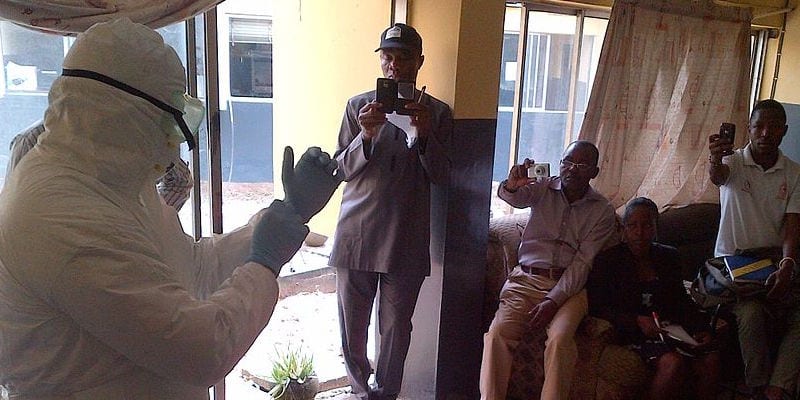
Image: CC/Wiki

©2015 2 Minute Medicine, Inc. All rights reserved. No works may be reproduced without expressed written consent from 2 Minute Medicine, Inc. Inquire about licensing here. No article should be construed as medical advice and is not intended as such by the authors or by 2 Minute Medicine, Inc.
Tags: contaminationinfectious disease
Previous Post

Choosing Wisely campaign not yet associated with reduced low-value testing

Next Post

Vitamin D, calcium not linked with reduced recurrent colorectal adenomas

RelatedReports

Transthoracic echocardiography can rule out endocarditis in low-risk bacteremic patients
Infectious Disease

Delayed initiation of antibiotic therapy is associated with worse outcomes in skin and soft tissue infections

May 22, 2026
Live attenuated vaccine less effective in recent influenza season
Emergency

Adjuvanted influenza vaccines and high-dose influenza vaccines may have similar effectiveness in adult patients

May 15, 2026
Novel coronavirus identified from patients with pneumonia in Wuhan, China
Cardiology

COVID-19 vaccination is associated with reduced risk of new-onset atrial fibrillation following COVID-19 infection

April 29, 2026
Normal renal ultrasound only rules out high grade vesicoureteral reflux in infants
Imaging and Intervention

Poly-L-lysine-coated catheters are safe and well-tolerated in adults requiring short-term catheterization

February 20, 2026
Next Post
Long-term gastric acid suppression associated with vitamin B12 deficiency

Vitamin D, calcium not linked with reduced recurrent colorectal adenomas

AAP issues update on iodine deficiency and associated pollutants

Dietary supplements linked to 23,000 emergency visits per year

Recurrent hemoptysis is effectively treated by bronchial artery embolization

Recurrent hemoptysis is effectively treated by bronchial artery embolization

2 Minute Medicine® is an award winning, physician-run, expert medical media company. Our content is curated, written and edited by practicing health professionals who have clinical and scientific expertise in their field of reporting. Our editorial management team is comprised of highly-trained MD physicians. Join numerous brands, companies, and hospitals who trust our licensed content.

Recent Reports

  • Why Pfizer Is Looking East for Its Next Generation of Cancer Drugs
  • 2MM: Pharma Roundup – Pfizer’s $10.5B Innovent oncology partnership, Guselkumab (Tremfya) gains a broader psoriatic arthritis label, Venetoclax (Venclyxto) expands first-line CLL options, and Seladelpar (Livdelzi) advances in primary biliary cholangitis
  • Two scores for risk stratification of adults presenting with syncope may be effective at identifying those with low risk
License Content
Terms of Use | Disclaimer
Cookie Policy
Privacy Statement (EU)
Disclaimer
  • Specialties
    • All Specialties, All Recent Reports
    • Cardiology
    • Chronic Disease
    • Dermatology
    • Emergency
    • Endocrinology
    • Gastroenterology
    • Imaging and Intervention
    • Infectious Disease
    • Nephrology
    • Neurology
    • Obstetrics
    • Oncology
    • Ophthalmology
    • Pediatrics
    • Pharma
    • Preclinical
    • Psychiatry
    • Public Health
    • Pulmonology
    • Rheumatology
    • Surgery
  • Tools
    • EvidencePulse™
    • RVU Search
    • NPI Registry Lookup
  • Pharma
  • AI News
  • The Scan
  • Classics™
    • 2MM+ Online Access
    • Paperback and Ebook
  • Rewinds
  • Partners
    • License Content
    • Submit Press Release
    • Advertise with Us
  • Account
    • Subscribe
    • Sign-in
    • My account
No Result
View All Result

© 2026 2 Minute Medicine, Inc. - Physician-written medical news.