• About
  • Masthead
  • License Content
  • Advertise
  • Submit Press Release
  • RSS/Email List
  • 2MM Podcast
  • Write for us
  • Contact Us
2 Minute Medicine
No Result
View All Result

No products in the cart.

SUBSCRIBE
  • Specialties
    • All Specialties, All Recent Reports
    • Cardiology
    • Chronic Disease
    • Dermatology
    • Emergency
    • Endocrinology
    • Gastroenterology
    • Imaging and Intervention
    • Infectious Disease
    • Nephrology
    • Neurology
    • Obstetrics
    • Oncology
    • Ophthalmology
    • Pediatrics
    • Pharma
    • Preclinical
    • Psychiatry
    • Public Health
    • Pulmonology
    • Rheumatology
    • Surgery
  • Tools
    • EvidencePulse™
    • RVU Search
    • NPI Registry Lookup
  • Pharma
  • AI News
  • The Scan+
  • Classics™+
    • 2MM+ Online Access
    • Paperback and Ebook
  • Rewinds
  • Partners
    • License Content
    • Submit Press Release
    • Advertise with Us
  • Account
    • Subscribe
    • Sign-in
    • My account
2 Minute Medicine
  • Specialties
    • All Specialties, All Recent Reports
    • Cardiology
    • Chronic Disease
    • Dermatology
    • Emergency
    • Endocrinology
    • Gastroenterology
    • Imaging and Intervention
    • Infectious Disease
    • Nephrology
    • Neurology
    • Obstetrics
    • Oncology
    • Ophthalmology
    • Pediatrics
    • Pharma
    • Preclinical
    • Psychiatry
    • Public Health
    • Pulmonology
    • Rheumatology
    • Surgery
  • Tools
    • EvidencePulse™
    • RVU Search
    • NPI Registry Lookup
  • Pharma
  • AI News
  • The Scan+
  • Classics™+
    • 2MM+ Online Access
    • Paperback and Ebook
  • Rewinds
  • Partners
    • License Content
    • Submit Press Release
    • Advertise with Us
  • Account
    • Subscribe
    • Sign-in
    • My account
SUBSCRIBE
2 Minute Medicine
Subscribe
Home All Specialties Imaging and Intervention

Matted nodes linked to higher failure risk in HPV-related oropharyngeal cancer
byDaniel LeeandChaz Carrier
May 3, 2015
in Imaging and Intervention, Oncology
Reading Time: 3 mins read
0
Share on FacebookShare on Twitter

1. Radiographic evidence of matted nodes was a significant independent predictor for distant failure and case-specific mortality in patients who were treated for oropharyngeal cancer with definitive chemotherapy.

2. Lack of matted nodes was associated with minimal distant failure risk.

Evidence Rating Level:  2 (Good)

Study Rundown: The incidence of human papillomavirus (HPV)-related oropharyngeal cancer (OPC) is rising in the United States. Although HPV-positive OPC has been shown to have favorable prognosis compared to HPV-negative OPC, there still exists a subpopulation of patients who are at increased risk of both locoregional failure and distant failure. Radiographically matted nodes (MNs) are defined as three nodes adjoining one another with radiographic extracapsular spread and have been identified as a poor prognostic factor. This study sought to investigate whether the presence of MNs could be used to stratify patients for treatment failure and patterns of failure. The authors found that patients with matted nodes presented with advanced cancer staging at baseline, compared to those without MNs. Patients with MNs also exhibited a higher incidence of distant failure, case-specific mortality and death. However, locoregional failure was not associated with the presence of MNs. This trend was preserved in subgroup analyses by nodal status and multivariate analysis controlling for HPV-positive OPC risks and other known risk factors. The results may indicate the need for treatment intensification among patients who present with radiographically matted nodes. Major strengths of this study are the large study population and long-term follow-up period. In addition, the study incorporated multiple previously identified risk factors for HPV-positive OPC in the analysis. However, the study is limited by its retrospective nature, which may have resulted in time-related bias for detecting MNs.

Click to read the study in Head and Neck

Relevant Reading: Matted nodes: Poor prognostic marker in oropharyngeal squamous cell carcinoma independent of HPV and EGFR status

RELATED REPORTS

Human papillomavirus vaccination may allow longer cervical cancer screening intervals

Human papillomavirus infection is associated with increased risk of developing Parkinson’s disease in men

Expanding human papillomavirus vaccination to high-risk mid-adults may be cost-effective

In-Depth [retrospective cohort]: A total of 178 patients, who completed definitive chemotherapy for histologically confirmed Stage III/IV HPV-related OPC between July 2003 and December 2010, were included in the study. The median follow-up from the start of therapy was 51.7 months. All the eligible patients had pre-treatment computer tomography (CT) imaging. Pre-treatment imaging was reviewed by either a neuroradiologist alone or in conjunction with a head and neck surgeon or radiation oncologist, who were blinded to the clinical outcome of each patient. Outcome measures included locoregional failure (LRF), distant failure (DF), any failure, cause-specific mortality (CSM) and overall survival (OS). Cox proportional hazards regression models were used for univariate and multivariate analysis to assess the impact of HPV-positive risk group, matted nodes and radiographic extracapsular spread (rECS). There were 30 (16%) patients with MNs. There were no differences between the groups in terms of age, smoking history and use of adjuvant neck dissection. At baseline, the patients with MNs presented with advanced nodal classification (N2b-N3, p<0.001) and rECS (100% vs. 57%, p<0.001). In addition, it was noted that patients with MNs only constituted a minority of patients with advanced nodal classification (7/74 N2b patients, 12/42 N2c patients and 11/25 N3 patients) or rECS (30/115). Overall, patients with MNs exhibited a higher DF (50.0% vs. 1.4%, p<0.001), CSM (56.7% vs. 5.4%, p<0.001) and death from any cause (56.7% vs. 13.5%, p<0.001), respectively. However, there was no difference in LRF between the patients with and without MNs (23.3% vs. 12.8%, p=0.16, respectively). The radiographic existence of MNs was the strongest statistically significant prognostic factor for DF, any failure, CSM and OS when controlled for previously identified risk factors for HPV-positive OPC (T4-classificaiton, N3-classification and ≥10 smoking pack-years).

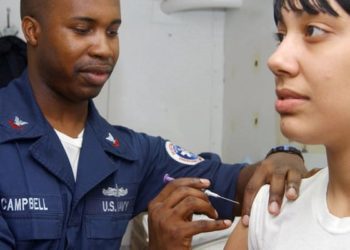
Image: PD/US Navy

©2015 2 Minute Medicine, Inc. All rights reserved. No works may be reproduced without expressed written consent from 2 Minute Medicine, Inc. Inquire about licensing here. No article should be construed as medical advice and is not intended as such by the authors or by 2 Minute Medicine, Inc.

Tags: Human Papilloma Virus (HPV)oropharyngeal cancer
Previous Post

Pessary side effects not improved with lubricant

Next Post

Low strength of evidence for ankyloglossia treatment outcomes

RelatedReports

American College of Physicians releases principles to guide patient partnership in health care
Oncology

Human papillomavirus vaccination may allow longer cervical cancer screening intervals

February 2, 2026
2 Minute Medicine Rewind August 19, 2019
Chronic Disease

Human papillomavirus infection is associated with increased risk of developing Parkinson’s disease in men

January 13, 2026
AAP releases 2016 recommendations for childhood and adolescent immunizations
Public Health

Expanding human papillomavirus vaccination to high-risk mid-adults may be cost-effective

November 26, 2024
#VisualAbstract: Ross procedure associated with long-term survival outcomes into third postoperative decade
StudyGraphics

#VisualAbstract: Liquid Biopsy for Diagnosis and Surveillance of Human Papillomavirus-Associated Oropharyngeal Cancer

December 6, 2023
Next Post
Low strength of evidence for ankyloglossia treatment outcomes

Low strength of evidence for ankyloglossia treatment outcomes

Waning Tdap vaccine effectiveness among adolescents

Waning Tdap vaccine effectiveness among adolescents

Novel combination therapy may be effective for noncirrhotic HCV infection [UNITY-1 trial]

Novel combination therapy may be effective for noncirrhotic HCV infection [UNITY-1 trial]

2 Minute Medicine® is an award winning, physician-run, expert medical media company. Our content is curated, written and edited by practicing health professionals who have clinical and scientific expertise in their field of reporting. Our editorial management team is comprised of highly-trained MD physicians. Join numerous brands, companies, and hospitals who trust our licensed content.

Recent Reports

  • Maternal exposure to environmental stressors is associated with decreased odds of infant survival among preterm infants
  • Oral remibrutinib hits Phase 3 primary endpoint for inducible hives
  • Higher sleep apnea-specific hypoxic burden may predict postoperative cardiovascular complications and mortality in obstructive sleep apnea
License Content
Terms of Use | Disclaimer
Cookie Policy
Privacy Statement (EU)
Disclaimer

© 2025 2 Minute Medicine, Inc. - Physician-written medical news.

  • Specialties
    • All Specialties, All Recent Reports
    • Cardiology
    • Chronic Disease
    • Dermatology
    • Emergency
    • Endocrinology
    • Gastroenterology
    • Imaging and Intervention
    • Infectious Disease
    • Nephrology
    • Neurology
    • Obstetrics
    • Oncology
    • Ophthalmology
    • Pediatrics
    • Pharma
    • Preclinical
    • Psychiatry
    • Public Health
    • Pulmonology
    • Rheumatology
    • Surgery
  • Tools
    • EvidencePulse™
    • RVU Search
    • NPI Registry Lookup
  • Pharma
  • AI News
  • The Scan
  • Classics™
    • 2MM+ Online Access
    • Paperback and Ebook
  • Rewinds
  • Partners
    • License Content
    • Submit Press Release
    • Advertise with Us
  • Account
    • Subscribe
    • Sign-in
    • My account
No Result
View All Result

© 2025 2 Minute Medicine, Inc. - Physician-written medical news.