
• About
  • Masthead
  • License Content
  • Advertise
  • Press Releases
  • Newsroom
  • RSS/Email List
  • 2MM Podcast
  • Write for us
  • Contact Us
2 Minute Medicine
No Result
View All Result

No products in the cart.

Sign in
SUBSCRIBE
  • About
  • Specialties
    • All Specialties, All Recent Reports
    • Cardiology
    • Chronic Disease
    • Dermatology
    • Emergency
    • Endocrinology
    • Gastroenterology
    • Imaging and Intervention
    • Infectious Disease
    • Nephrology
    • Neurology
    • Obstetrics
    • Oncology
    • Ophthalmology
    • Pediatrics
    • Pharma
    • Preclinical
    • Psychiatry
    • Public Health
    • Pulmonology
    • Rheumatology
    • Surgery
    • Rewinds
    • The Scan
  • EvidencePulse™
  • HypeCheck™
  • AI News
  • Classics™
    • 2MM+ Online Access
    • Paperback and Ebook
  • Tools
    • NPI Registry Lookup
    • RVU Search
    • ICD-10 Code Lookup
    • Medical School Rankings
    • FDA Drug Approvals
    • Drug Safety for Breastfeeding/Pregnancy
    • Clinical Guidelines
    • Medical Calculators
  • Partners
    • License Content
    • Advertise with Us
2 Minute Medicine
  • About
  • Specialties
    • All Specialties, All Recent Reports
    • Cardiology
    • Chronic Disease
    • Dermatology
    • Emergency
    • Endocrinology
    • Gastroenterology
    • Imaging and Intervention
    • Infectious Disease
    • Nephrology
    • Neurology
    • Obstetrics
    • Oncology
    • Ophthalmology
    • Pediatrics
    • Pharma
    • Preclinical
    • Psychiatry
    • Public Health
    • Pulmonology
    • Rheumatology
    • Surgery
    • Rewinds
    • The Scan
  • EvidencePulse™
  • HypeCheck™
  • AI News
  • Classics™
    • 2MM+ Online Access
    • Paperback and Ebook
  • Tools
    • NPI Registry Lookup
    • RVU Search
    • ICD-10 Code Lookup
    • Medical School Rankings
    • FDA Drug Approvals
    • Drug Safety for Breastfeeding/Pregnancy
    • Clinical Guidelines
    • Medical Calculators
  • Partners
    • License Content
    • Advertise with Us
Sign in
SUBSCRIBE
2 Minute Medicine
Sign in
Subscribe
2 Minute MedicineFree on Google PlayGet
✦EvidencePulse™by 2 Minute Medicine3 reportsYou askedtop stroke trials 2026Synthesizing medical evidence...Top 2026 stroke trial results:OCEANIC — ischemic stroke: 6.2% vs 8.4%OPTION* — mRS 0–1: 43.6% vs 34.2%ORIENTAL* — mRS 0–2: 58.6% vs 46.6%*Higher sICH in intervention armsParticipants randomizedNOCEANIC12,327OPTION570ORIENTAL564Ask about guidelines or landmark trials...↑Try EvidencePulse™Ask the evidence. Get the signal.Try it now →
Home Health A to Z

Patient Basics: Digital Rectal Exam
by2 Minute Medicine
October 30, 2026
in Health A to Z
Reading Time: 5 mins read
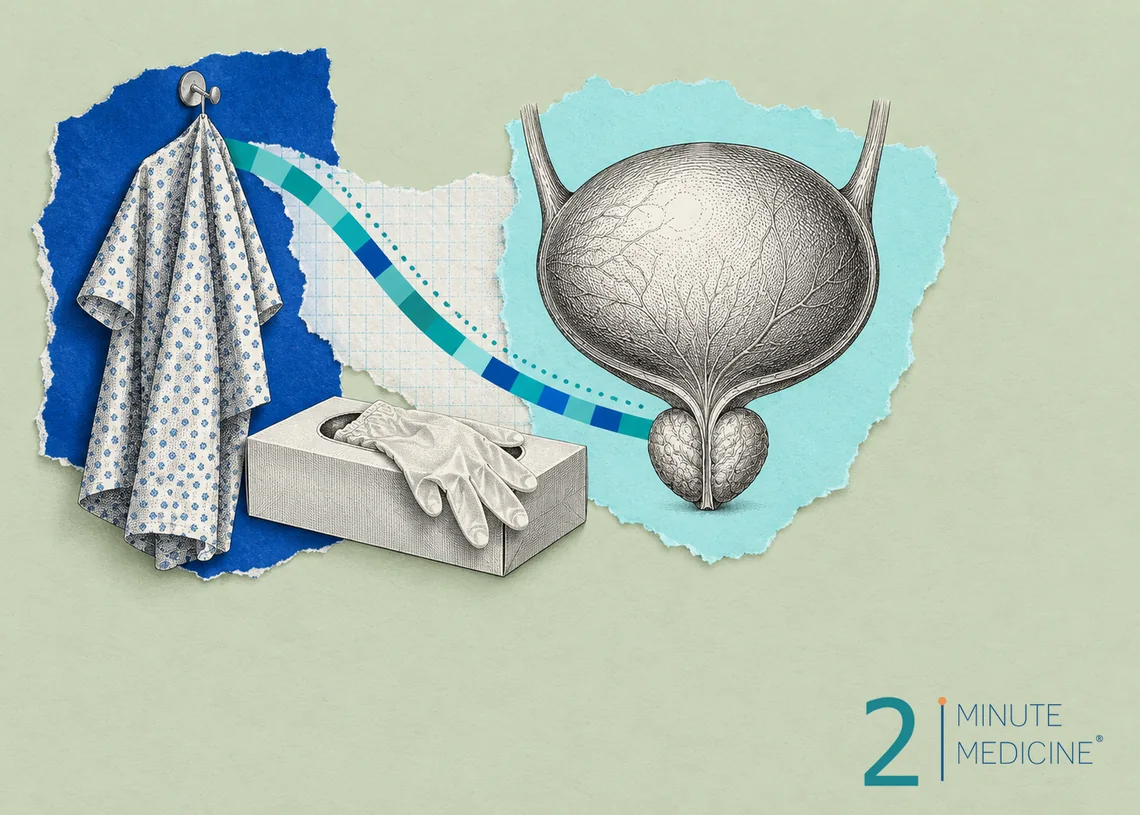
Collage for a digital rectal exam: a bladder with the walnut-shaped prostate below it, exam gloves and a gown on a hook
Share on FacebookShare on TwitterShare on LinkedIn

A digital rectal exam is a quick check in which a doctor or nurse slides a gloved, lubricated finger a short way into the rectum (the last part of the bowel) to feel for problems. In men it’s also the simplest way to feel the prostate gland. The exam takes less than a minute. It may feel awkward or cause pressure, but it shouldn’t be painful.

Key points

  • “Digital” refers to the finger, so some people call it the finger test. It is also called a rectal or anal exam. No scope or machine is used.
  • It can find hemorrhoids, lumps, tender areas, blood in the stool, and an enlarged or unusual prostate.
  • For prostate cancer screening, the PSA blood test is now the main test. A rectal exam on its own isn’t recommended for screening.
  • You can ask for a chaperone, ask the doctor to talk you through each step, or ask them to stop at any time.
  • Results are usually known right away.

Why a digital rectal exam is done

A doctor may suggest this exam if you have:

  • Bleeding from the rectum, or dark or bloody stool
  • Pain, itching or a lump near the anus
  • A change in bowel habits, such as new constipation or leaking stool
  • Trouble urinating, a weak stream, or getting up often at night to urinate, which can point to an enlarged prostate
  • Pain in the lower pelvis or between the legs that could come from an inflamed prostate (prostatitis)
  • A raised PSA blood test result

It is also used to check the strength of the muscle that keeps the anus closed, for example after a spine injury.

Digital rectal exam in women

Women don’t need a routine rectal exam for screening, and there is no set age to start having one. A doctor may suggest it for the reasons above, such as bleeding, pain, a change in bowel habits or trouble controlling stool. It can also be part of a pelvic exam. After a bimanual pelvic exam, where the doctor feels the uterus and ovaries with two fingers in the vagina and a hand on the belly, some doctors do a rectovaginal exam. One finger goes in the vagina and one in the rectum to feel the wall between them. This can help find endometriosis, a growth, or a bulge of the rectum into the vagina (rectocele).

Before the exam

No special preparation is needed. You don’t have to fast or empty your bowels first, although you may want to use the bathroom. Tell the doctor if you have hemorrhoids, a tear in the skin of the anus (anal fissure) or pain in the area, because the exam may need to be done more gently or another way.

You’ll be asked to take off your pants and underwear and given a gown or sheet to cover yourself. If you would feel more comfortable with another staff member in the room, say so. Many clinics offer this routinely.

RELATED REPORTS

No Content Available

During the exam

You’ll be asked to take one of these positions:

  • Lying on one side, curled up with both knees bent toward your chest. This is the most common position.
  • Standing and bending forward over the exam table, with your elbows on it
  • Lying on your back with your feet in footrests, often during a pelvic exam

The doctor first looks at the skin around the anus. They put on a glove, cover a finger with lubricating gel and gently slide it into the rectum. They feel the walls of the rectum in a circle. In men, they also press on the prostate through the front wall of the rectum to check its size, shape and firmness.

You’ll feel pressure, and you may feel as if you need to have a bowel movement or urinate. This passes as soon as the exam ends. Breathing out slowly and relaxing your buttocks makes it easier. Tell the doctor if anything hurts.

Afterward

You’ll be given tissues to wipe off the gel, and you can dress and go about your day. If you have hemorrhoids or a fissure, you may see a little blood on the tissue. A few people feel lightheaded briefly, so sit up slowly.

Possible risks

The exam is very safe. Brief discomfort and a small amount of bleeding from hemorrhoids are the most common problems. Rarely, a person may feel faint during the exam.

Your results

The doctor can usually tell you what they found before you leave.

  • Normal means no lumps, tender spots or blood. A normal prostate feels smooth and a bit rubbery, and is about the size of a walnut.
  • Possible findings include hemorrhoids, a fissure, a growth in the rectum, hard or impacted stool, or a prostate that is enlarged, tender, hard or lumpy.

A finding on this exam isn’t a diagnosis on its own. Depending on what the doctor feels, the next step may be a PSA blood test, an MRI or biopsy of the prostate, a test of stool for hidden blood, or a look inside the rectum and colon with a scope (anoscopy, sigmoidoscopy or colonoscopy).

A normal exam doesn’t rule out every problem either. Small prostate cancers and growths higher in the colon can’t be reached with a finger. That is why colon cancer screening relies on colonoscopy or stool tests done at home, not on this exam. Most US health plans cover these screening tests at no cost to you.

When to call your doctor

  • Bleeding that continues or is more than a few spots
  • Pain in the rectum that lasts after the exam
  • Fever or trouble urinating in the days after the exam
  • You haven’t heard about any follow-up tests you were told you need

Common questions about digital rectal exams

Does a digital rectal exam hurt?

It usually doesn’t. Most people feel pressure and a brief urge to pass stool, which stops when the finger comes out. It can hurt if you have an anal fissure, swollen hemorrhoids or an inflamed prostate. Tell the doctor beforehand, so they can go slowly, use a numbing gel or choose another test.

How long does a rectal exam take?

The exam itself takes less than a minute, often only 10 to 30 seconds. With undressing, talking about your symptoms and getting dressed again, the whole visit takes a few minutes longer. When it is done as part of a pelvic exam, it adds about a minute.

Is it normal to have pain after a rectal exam?

Mild soreness or a spot of blood on the toilet paper for a day can happen, especially if you have hemorrhoids or a fissure. Ongoing pain is not normal. Call your doctor if pain lasts more than a day or two, the bleeding is more than a few spots, or you get a fever.

Questions to ask your doctor

  • Why do I need this exam?
  • Can someone else be in the room with us?
  • What did you feel, and is it normal?
  • Do I need any other tests, such as a PSA or colonoscopy?
  • How often should I have this exam, if at all?

Learn more

  • Digital rectal exam (MedlinePlus, U.S. National Library of Medicine)

This guide is general information and doesn’t replace advice from your own doctor. Last updated October 2026.

Tags: Digital Rectal Exam
Previous Post

Patient Basics: Croup

Next Post

Patient Basics: Dry Skin

RelatedReports

No Content Available
Next Post
Hodgkin lymphoma collage: a calm young man, a drawing of lymph nodes in the neck and chest, a knit cap and a closed book

Patient Basics: Hodgkin Lymphoma

Waldenström macroglobulinemia collage of a star-shaped IgM antibody, capped blood tubes, a magnifier and a winter glove

Patient Basics: Waldenström Macroglobulinemia

Acute myeloid leukemia collage: a calm woman beside a drawing of bone marrow inside a bone, round blood cells and a plant

Patient Basics: Acute Myeloid Leukemia (AML)

✦ EvidencePulse™ by 2 Minute Medicine 3 reports You asked top stroke trials 2026 Synthesizing medical evidence... Top 2026 stroke trial results: OCEANIC — ischemic stroke: 6.2% vs 8.4% OPTION* — mRS 0–1: 43.6% vs 34.2% ORIENTAL* — mRS 0–2: 58.6% vs 46.6% *Higher sICH in intervention arms Participants randomizedN OCEANIC 12,327 OPTION 570 ORIENTAL 564 Ask about guidelines or landmark trials... Try EvidencePulse™ Get the signal. Try it now → Physician-trained medical AI by 2 Minute Medicine

2MM+ All Access

Full details →
$4.99 /month

3-day free trial · cancel anytime

  • ✓100+ physician-written reports
  • ✓EvidencePulse™ + HypeCheck™
  • ✓Ad-free reading + newsletters
Start 3-day free trial

Then $4.99/month. Manage renewal in your account.

NPI Lookup · Free

Look up any US clinician

Search by name or NPI number, live from the CMS NPI Registry.

  • OIG exclusion check
  • Licenses and specialties
  • No account needed
Open NPI Lookup →

2 Minute Medicine® is an award winning, physician-run, expert medical media company. Our content is curated, written and edited by practicing health professionals who have clinical and scientific expertise in their field of reporting. Our editorial management team is comprised of highly-trained MD physicians. Join numerous brands, companies, and hospitals who trust our licensed content.

Recent Reports

  • Early mitral valve surgery may improve long-term survival in asymptomatic severe mitral regurgitation
  • CDC reports increasing early-season influenza activity and at least 900 deaths nationwide
  • A concentrated exposure therapy intervention may be more effective than digital cognitive behavioural therapy in obsessive-compulsive disorder
License Content
Terms of Use | Disclaimer
Cookie Policy

Get the app

Read 2 Minute Medicine on iPhone, iPad and Android.

Download on the App StoreGet it on Google Play
QR code for www.2minutemedicine.com/app
On a computer? Scan this with your phone’s camera.
2MM+ All Access Full details →

The medical literature, distilled daily.

Monthly plan selected: $4.99 /month.

$4.99/month

3-day free trial · cancel anytime

Start 3-day free trial

Then $4.99/month. Manage renewal in your account.

Yearly plan selected: $49.90 /year.

$49.90/year

2 months free

Start 3-day free trial

Then $49.90/year.

Membership benefits

  • ✓100+ physician-written reports
  • ✓AI EvidencePulse™ + HypeCheck™
  • ✓Ad-free reading + newsletters
  • ✓NPI watchlist + bulk NPI verification

Already a member? Sign in

  • Get the app
  • About
  • Specialties
    • All Specialties, All Recent Reports
    • Cardiology
    • Chronic Disease
    • Dermatology
    • Emergency
    • Endocrinology
    • Gastroenterology
    • Imaging and Intervention
    • Infectious Disease
    • Nephrology
    • Neurology
    • Obstetrics
    • Oncology
    • Ophthalmology
    • Pediatrics
    • Pharma
    • Preclinical
    • Psychiatry
    • Public Health
    • Pulmonology
    • Rheumatology
    • Surgery
    • Rewinds
    • The Scan
  • EvidencePulse™
  • HypeCheck™
  • AI News
  • Classics™
    • 2MM+ Online Access
    • Paperback and Ebook
  • Tools
    • NPI Registry Lookup
    • RVU Search
    • ICD-10 Code Lookup
    • Medical School Rankings
    • FDA Drug Approvals
    • Drug Safety for Breastfeeding/Pregnancy
    • Clinical Guidelines
    • Medical Calculators
  • Partners
    • License Content
    • Advertise with Us
No Result
View All Result

© 2026 2 Minute Medicine, Inc. - Physician-written medical news.


